Richmond Park: London's Wild Royal Parkland
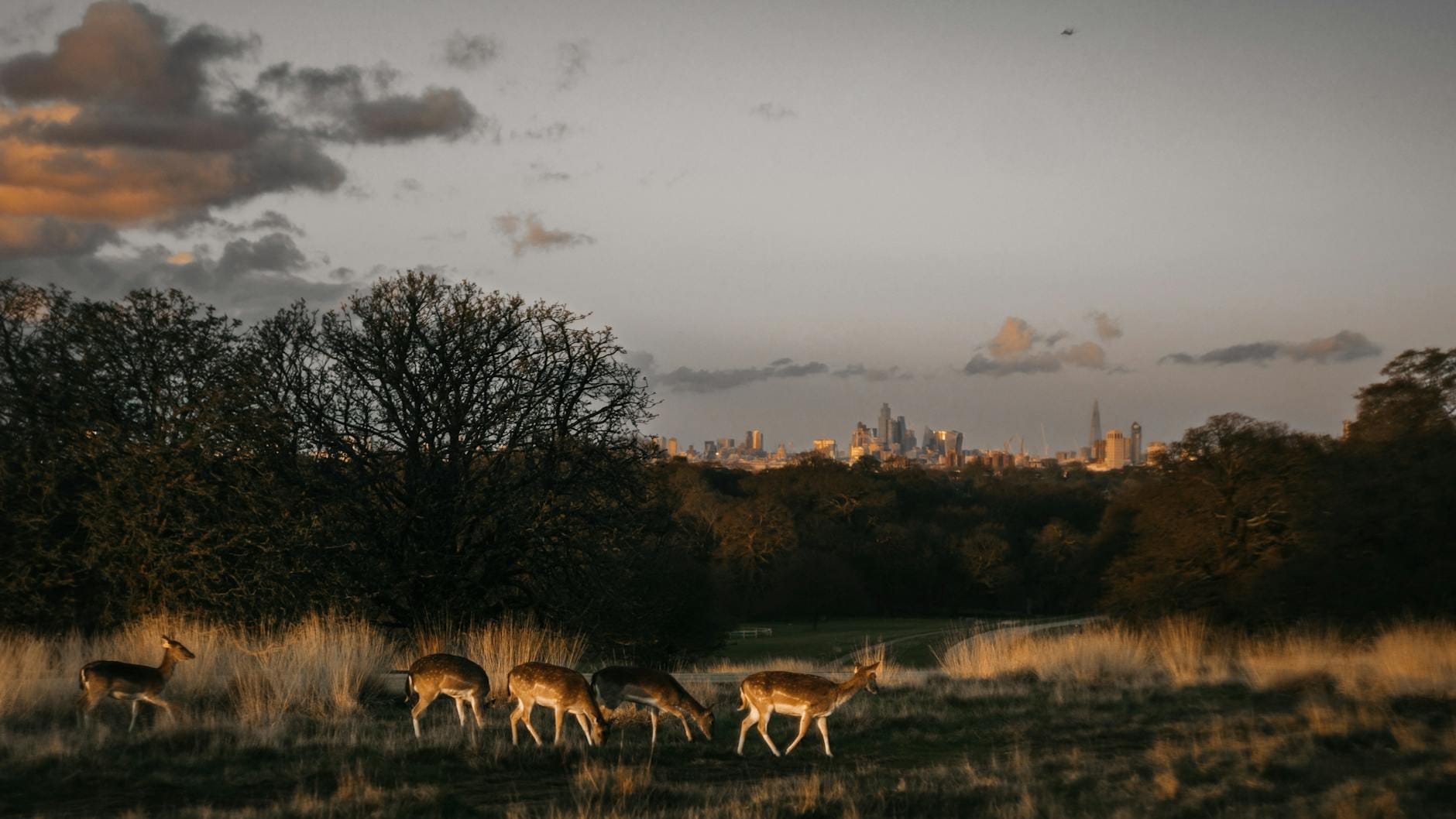
Richmond Park is the largest of London's Royal Parks, covering 2,500 acres of open grassland, ancient woodland, and wetland ponds in southwest London. Home to around 630 free-roaming red and fallow deer, it holds National Nature Reserve status and offers one of the most wild experiences within the city limits — all completely free to enter.
Quick Facts
- Location
- London Borough of Richmond upon Thames, southwest London
- Getting There
- Richmond station (District line + National Rail); buses to multiple park gates
- Time Needed
- 2–5 hours depending on route; a full day is easily spent
- Cost
- Free entry to the park; charges apply for golf, bike hire, and horse riding
- Best for
- Nature walkers, dog owners, cyclists, photographers, families with kids
- Official website
- www.royalparks.org.uk/visit/parks/richmond-park
What Richmond Park Actually Is
Richmond Park is a Royal Park and National Nature Reserve covering approximately 2,500 acres in southwest London — making it the largest of the eight Royal Parks, and one of the largest urban parks in Europe. It sits within the London Borough of Richmond upon Thames, roughly bordered by Richmond to the north, Roehampton to the east, Kingston upon Thames to the south, and Twickenham to the west. Arriving here for the first time produces a particular kind of surprise: within 30 minutes of central London, you step through a gate and the city simply disappears.
The park holds three significant conservation designations: it is a National Nature Reserve, a Site of Special Scientific Interest, and a European Special Area of Conservation. These are not honorary titles. The ancient oak trees in certain enclosures are among the oldest living organisms in the greater London area, and the park supports hundreds of invertebrate species that depend on those veteran trees. For wildlife, this is serious habitat. For visitors, it means the landscape rewards slow, attentive walking rather than a quick loop.
ℹ️ Good to know
Entry to Richmond Park is free. Vehicle gates open at 07:00 (British Summer Time) or 07:30 (winter) and close at dusk. Pedestrian gates are normally open 24/7.
The Deer: What to Expect Up Close
Around 630 red and fallow deer roam freely across Richmond Park, and watching them is the central spectacle. Red deer are the larger of the two species — the males carry impressive antlers and can stand over a metre at the shoulder. Fallow deer are smaller, more dappled in summer coat, and tend to gather in larger mixed groups. Both herds move through the open grassland and bracken in loose, unhurried patterns, and on a clear morning you will often find them grazing in full view of the main paths.
The most dramatic period is the red deer rut, which runs through October and into early November. Males bellow across the park, clashing antlers in territorial contests that can be heard from a considerable distance. This is when Richmond Park draws its most dedicated wildlife photographers, some arriving before dawn to catch stags silhouetted in low autumn mist. If you visit during the rut, keep a minimum distance of 50 metres from the deer — the males are unpredictable and much faster than they appear.
⚠️ What to skip
Never approach the deer at any time of year. Dogs must be kept on leads near deer from 1 March to 31 July (calving and fawning season) and from 1 August to 31 October (approaching rut). The park posts updated leash-rule notices at gates throughout the year.
Outside the rut, deer sightings are still reliable but more casual. Early morning visitors — before 08:30 — tend to find the herds moving and grazing without the midday distraction of cyclists, dogs, and large family groups. Late afternoon light in spring and summer turns the grassland golden and the deer are often particularly active as temperatures drop. By midday on a summer weekend, the deer have often retreated into the bracken and wooded enclosures and become much harder to spot.
Tickets & tours
Hand-picked options from our booking partner. Prices are indicative; availability and final rates are confirmed when you complete your booking.
Soho Instagram a self-guided walking tour to top photo spots
From 6 €Instant confirmationFree cancellationTootbus London by Night: Bus tour
From 32 €Instant confirmationFree cancellationIFS Cloud Cable Car Ride and Uber Boat Hop-on Hop-off 1 Day Ticket
From 38 €Instant confirmationFree cancellationThe Making of Harry Potter Guided Tour of London Warner Bros. Studio
From 201 €Instant confirmationFree cancellation
King Henry's Mound and the Protected View
Near the Richmond Gate entrance, King Henry's Mound is a prehistoric earthwork and one of the most underappreciated viewpoints in the whole of London. On a clear day, standing at the designated sightline, you can see St Paul's Cathedral roughly 10 miles away across the city. This is not accidental: the view corridor from King Henry's Mound to St Paul's is legally protected under the London View Management Framework, meaning no building can be constructed to obscure it.
The mound itself also offers sweeping views across the park toward the Thames and into Surrey. It rewards visiting in both directions — telescope north toward the dome of St Paul's, then turn south and you are looking at open green countryside with no urban architecture in sight. For a broader survey of Richmond Park, London's best viewpoints, this one earns its place among the top tier, especially because it involves no entrance fee and very few crowds.
How the Park Changes Through the Day and Seasons
Richmond Park is a different experience depending on when you visit, and understanding that rhythm saves disappointment. On summer weekday mornings before 09:00, the park is almost uncannily quiet: mist sits low in the hollows between the bracken, the only sounds are birdsong and the occasional distant call of a parakeet. Ring-necked parakeets — an introduced species now well established in southwest London — are audible before they are visible, their sharp green wings catching the light as they move between the oak trees.
By 10:30 on a summer weekend, cyclists are out in numbers on the perimeter road (a popular 7-mile loop), families have spread across the grassland near Pembroke Lodge, and dog walkers occupy most of the paths. This is still perfectly enjoyable, but it is no longer a solitary experience. Midday in July or August is the most congested period, particularly around the Isabella Plantation — the park's formal woodland garden — and the car parks near Robin Hood Gate.
Autumn is arguably the finest season: bracken turns amber and bronze, the rutting stags create genuine drama, and the low-angled light between October and early November is exceptional for photography. Winter brings frost on the grass and a stripped-back quality to the woodland that reveals the architecture of the veteran oaks. Spring is reliably good for birdlife, and the Isabella Plantation peaks in late April and May when its azaleas and rhododendrons flower in mass colour.
The Isabella Plantation
The Isabella Plantation is a 40-acre woodland garden enclosed within the park, fed by naturally flowing streams and ponds. It was developed from the 1950s onward and is now one of the finest collections of azaleas, rhododendrons, camellias, and moisture-loving plants in Greater London. Entry is free and the garden is open year-round, though it is at its most spectacular in late April and the first two weeks of May when the evergreen azaleas are in full bloom.
In spring, the plantation draws significant crowds — weekend mornings in late April can see queues forming at the entrance paths. The best approach is to arrive before 09:30 or visit on a weekday. The contrast between the structured, colourful garden and the rough open parkland immediately outside it is striking. If you are exploring Kew Gardens on the same trip, note that the two are stylistically very different: Kew is a formal world-class botanic garden; the Isabella Plantation is wilder, more intimate, and embedded within a working deer park.
Getting There and Moving Around
Richmond station is served by both the District line and National Rail services, and sits roughly a 30-minute walk from King Henry's Mound near the Richmond Gate. Multiple bus routes serve the park gates, including services to Roehampton Gate and Kingston Gate from different directions. Cycling to the park is feasible from Richmond station, and the 7-mile tarmac road loop around the park's perimeter is one of the best traffic-free cycling routes in London — vehicles are present on this road but speeds are limited.
Driving is possible and there are several car parks, but these fill rapidly on sunny weekends from late morning. If you plan to drive, arrival before 09:30 is strongly advised. For visitors combining Richmond Park with other southwest London destinations, it pairs naturally with a visit to Kew Gardens (a 20-minute drive or a longer scenic walk along the Thames). The broader guide to London's best parks gives useful context for comparing Richmond Park with alternatives like Hampstead Heath or Hyde Park, which have very different characters.
Within the park, paths vary considerably in surface. The main perimeter tarmac road and several internal roads are fully accessible for wheelchairs and pushchairs. The grassland and woodland paths are uneven and can become muddy after rain — waterproof footwear is strongly recommended from October through March, and useful any time of year. The AccessAble website provides detailed step-free access notes for specific routes and facilities.
Pembroke Lodge and Food Options
Pembroke Lodge is a Georgian mansion near the Richmond Gate that operates as a tearoom and events venue. It has a large terrace garden with views across the Thames valley and is a comfortable place to stop for tea, sandwiches, or a light lunch. The food is straightforward cafe fare rather than anything destination-worthy, but the setting earns it a visit. Note that it gets very busy on sunny weekend afternoons and service can slow considerably. It is open daily, though hours vary by season — check directly before visiting.
There is no other substantial food provision within the park, so if you are planning a longer visit, bringing your own food is sensible. Picnicking is common and entirely permitted across the grassland areas. The nearby town of Richmond has a good range of cafes and restaurants along George Street and by the riverside, which makes it worth building extra time into a visit. Richmond sits within easy reach of the River Thames towpath, and a walk from the park down to the riverbank via Richmond Hill is a classic southwest London afternoon route.
Photography and Practical Notes
Richmond Park is one of the best wildlife photography locations accessible from central London. The deer are approachable enough — within safe distance — to fill a frame with a standard telephoto lens (200mm is useful, 400mm gives more flexibility during the rut). Early morning in any season offers the best light quality and the fewest distractions in frame. The ancient oaks in Sidmouth Wood and Spankers Hill Wood provide strong compositional subjects in their own right, particularly in winter when the canopy is bare.
If photography is a primary goal, the October rut mornings are the standout opportunity. Arrive at or before sunrise through either Richmond Gate or Robin Hood Gate. The guide to London's most photogenic locationsincludes Richmond Park among its recommendations precisely because the imagery achievable here — deer in morning mist, ancient oaks, the protected St Paul's view — is distinctive rather than the standard London skyline.
Insider Tips
- During the October rut, Sidmouth Wood and the open ground near Pen Ponds offer the most reliable stag sightings at dawn. Park at Robin Hood Gate car park (it opens earliest) and walk northwest — you will often hear the bellowing before you see anything.
- The protected sightline to St Paul's from King Henry's Mound is framed by a specially maintained gap in the tree canopy. Stand at the marked viewpoint rather than slightly to the side — the gap is narrow and a metre off-centre loses the cathedral entirely.
- The Isabella Plantation has several entry points; the southern entrance via the path from Robin Hood Gate tends to be quieter than the more direct routes from the main car parks. This matters most during peak bloom in late April.
- Pen Ponds — two large lakes in the centre of the park — are excellent for birdwatching, with herons, kingfishers, and visiting winter wildfowl. The area around the ponds is one of the few places where deer, open water, and good light reliably converge in a single frame.
- On weekdays during school term time, the park is strikingly empty compared to weekends. If your schedule is flexible, a Tuesday or Wednesday morning visit between October and April gives a completely different experience from any summer weekend.
Who Is Richmond Park For?
- Nature lovers and wildlife watchers, especially during the October deer rut
- Cyclists looking for a safe, scenic loop away from London traffic
- Families with young children who want open space and reliable wildlife encounters
- Photographers seeking genuine wildlife and landscape subjects within the city
- Visitors wanting a half-day or full-day escape from central London without leaving on a train
Nearby Attractions
Combine your visit with:
- Abbey Road
The Abbey Road zebra crossing in St John's Wood is one of the most photographed stretches of tarmac in the world, immortalised by the Beatles on the cover of their 1969 album. Entry is free, it's accessible around the clock, and the Grade II listed studios next door still operate as a working recording facility. Here's everything you need to know before you visit.
- Alexandra Palace
Perched on one of north London's highest ridges, Alexandra Palace is a Grade II-listed Victorian landmark that combines a 196-acre park, a restored theatre, a year-round ice rink, and a live music venue. Entry to the park is free, and the views across the city stretch further than almost anywhere else at ground level.
- Dulwich Picture Gallery
Opened in 1817, Dulwich Picture Gallery is Britain's first purpose-built public art gallery, designed by Sir John Soane and housing over 600 European masterpieces. Set in the quiet streets of Dulwich Village, it offers a rare combination of architectural beauty, world-class paintings, and a unhurried atmosphere that larger central London galleries rarely manage.
- Hampton Court Palace
Hampton Court Palace stands on the banks of the River Thames in East Molesey, Surrey, roughly 30 minutes by train from central London. With Tudor kitchens, baroque state apartments, a famous hedge maze, and 60 acres of formal gardens, it offers more depth than almost any other royal site in England. This guide covers everything you need to plan a visit well.