Royal Botanic Gardens, Kew: What to Expect Before You Visit
A UNESCO World Heritage Site covering 121 hectares in southwest London, Kew Gardens holds one of the world's most significant living plant collections. Whether you have two hours or a full day, understanding the layout and seasonal rhythms makes the difference between a rewarding visit and a frustrating one.
Quick Facts
- Location
- Royal Botanic Gardens, Kew, Richmond, London TW9 3AE — southwest London, about 30 minutes from central London
- Getting There
- Kew Gardens Station (District line / London Overground), a 5-minute walk to Victoria Gate. Multiple bus routes serve the area; river services also stop nearby
- Time Needed
- Minimum 2.5 hours for highlights; 4-5 hours to explore properly; a full day if you plan to sit, eat, and take in seasonal events
- Cost
- Paid admission; prices vary by age and ticket type; check kew.org for current tickets. Check kew.org for current tickets — online booking is strongly recommended
- Best for
- Families, plant enthusiasts, photographers, architecture lovers, anyone needing a slow day away from central London crowds
- Official website
- www.kew.org
What Kew Gardens Actually Is
The Royal Botanic Gardens, Kew is not a park in the conventional London sense. It is a working scientific institution that has been curating, studying, and conserving plant life since 1759. The gardens spread across 121 hectares of southwest London and hold a living collection of over 50,000 living plants, supported by a herbarium containing over 8.5 million preserved plant and fungal specimens. It is inscribed as a UNESCO World Heritage Site and listed Grade I on the Register of Historic Parks and Gardens.
That scientific pedigree matters to visitors because it shapes everything: the quality and variety of what you see, the labelling throughout the gardens, the architectural ambition of the glasshouses, and the sense that this place is cared for rather than simply maintained. For a traveller weighing up how to spend a day in London, Kew is one of the few attractions in the city that rewards time rather than just rewarding presence.
💡 Local tip
Book tickets online before you arrive. Kew often sells out on warm weekends and during school holidays. On-the-day tickets may be limited, so booking ahead is recommended. Arriving without a booking in summer is a gamble not worth taking.
The Experience Across Different Times of Day
Kew opens at 10:00 daily, and the first hour is different from mid-afternoon. The light is cooler, the paths quieter, and the glasshouses feel less like tourist attractions and more like the greenhouses they are. The smell when you first enter the Princess of Wales Conservatory on a morning in spring is botanical and slightly humid, a mix of damp soil and exotic bloom that is hard to describe except to say it is not the air of anywhere else in London.
By noon, particularly on weekends between April and September, the gardens fill significantly. The café near the Palm House gets crowded, the main central path from the Victoria Gate towards the Palm House sees steady foot traffic, and the lawns attract picnickers. This is not a reason to avoid Kew — the site is large enough to absorb visitor numbers — but it does mean that arriving before 11:00 on a weekend gives you the better part of the experience.
Late afternoon in summer, especially on weekdays, brings a second window of calm. Daily, 10:00 to 19:00 (last entry 18:00), with weekends and Bank Holidays, 10:00 to 20:00 (last entry 19:00). The evening light across the Syon Vista or reflecting off the Palm House glasswork is worth staying for if your schedule allows. Hours vary seasonally, so always check the current schedule at kew.org before planning around a specific closing time.
Tickets & tours
Hand-picked options from our booking partner. Prices are indicative; availability and final rates are confirmed when you complete your booking.
Westminster Walking Tour with Visit to Kew Gardens
From 81 €Instant confirmationFree cancellationKensington Gardens guided tour and high tea
From 114 €Instant confirmationGuided walking tour of three royal palaces with high tea
From 114 €Instant confirmationHampton Court Palace tickets with gardens and maze
From 31 €Instant confirmationFree cancellation
The Key Structures: What to Prioritise
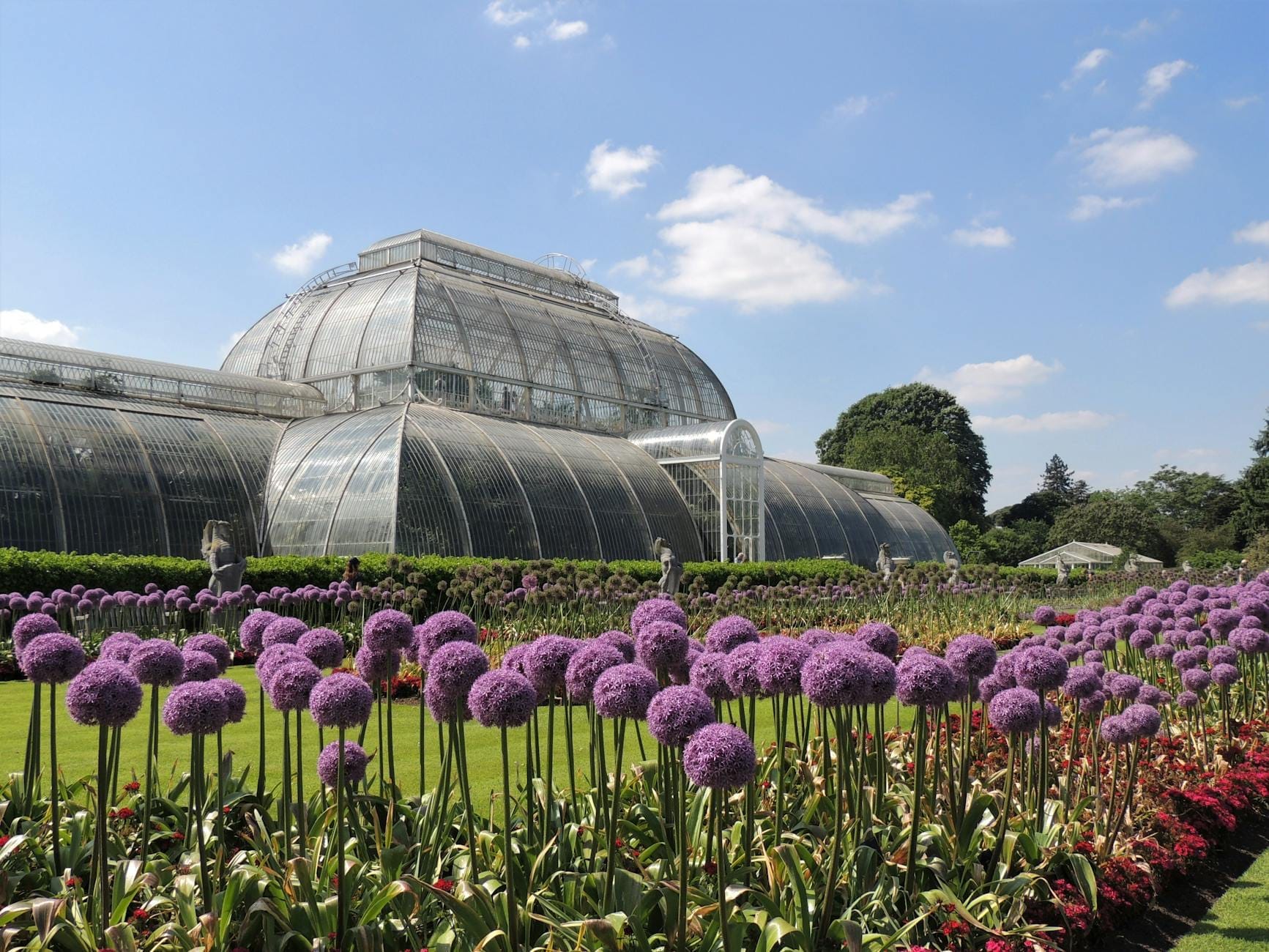
The Palm House is the architectural centrepiece of Kew: a curvilinear glasshouse completed in 1848, designed by Decimus Burton and Richard Turner. From outside, the ribbed ironwork and glass dome read as Victorian ambition at its most elegant. Inside, the humidity is immediate and tropical plants reach toward the upper galleries. The Marine Display in the basement is easy to overlook and is interesting if you have time.
The Temperate House is larger, reopened after a major restoration in 2018, and less visited than the Palm House despite holding the world's largest collection of plants under glass. The collection includes the Chilean Wine Palm, believed to be the world's largest indoor plant. It is a more serious, less theatrical space than the Palm House, and that is precisely why plant enthusiasts tend to prefer it.
The Princess of Wales Conservatory divides its climate zones into several distinct environments, from arid to humid tropical. The contrast between zones is noticeable as you move through — temperature, humidity, and the character of the plants shift within a few steps. The giant Amazon water lily, Victoria amazonica, is displayed here seasonally and draws considerable attention when in bloom.
The Treetop Walkway, an 18-metre-high elevated steel structure running through the forest canopy, offers a perspective most visitors do not expect. The views are not dramatic in the conventional sense — you are looking through a tree canopy, not over a cityscape — but the scale of mature oaks and chestnuts seen from this height is quietly impressive. It is also a useful escape from ground-level crowds.
ℹ️ Good to know
The Pagoda, designed by William Chambers and completed in 1761, is one of Kew's most recognised structures. It has been undergoing phased restoration work in recent years; access to the interior has been intermittent, so check current status at kew.org if viewing the interior is important to your visit.
Seasonal Character and When to Go
Kew changes dramatically by season, more so than almost any other attraction in London. Spring, roughly March to May, is the period most visitors associate with Kew's best form: the bluebells in the Woodland Garden, crocuses across the lawns, and flowering cherry trees along the paths. If you are visiting London in spring, Kew deserves a place on your itinerary. For a broader look at how London's parks perform across different months, the best parks in London guide offers useful seasonal comparison.
Summer brings full canopy coverage and the kitchen gardens in peak production. The downside is visitor volume: July and August on a warm weekend can feel significantly busier than the site's size suggests it should. The grounds are still peaceful in their outer reaches — the Conservation Area near the river boundary and the Arboretum's eastern sections see a fraction of the foot traffic on the central paths.
Autumn at Kew is underrated. The Arboretum contains around 14,000 trees, and the colour change from late September through November is sustained rather than brief. Visitor numbers drop considerably after schools return in September, and the quality of light in the early hours is excellent for photography.
Winter gardens open around late November for the annual Kew Gardens Christmas event, which operates on a separate ticket from daytime admission. It transforms sections of the gardens with light installations and is popular with London residents as well as visitors — advance booking is essential. Outside of that event, the winter daytime gardens are quiet and have their own particular appeal: the glasshouses feel more purposeful, and the skeletal forms of deciduous trees show off the Arboretum's structure.
Getting There and Navigating the Site
The most straightforward route from central London is the District line to Kew Gardens station, from where the Victoria Gate entrance is a five-minute walk. The Overground also serves Kew Gardens station. From zones 1-2, the journey is typically around 30 minutes. If you are travelling from further afield or using a multi-day pass, the getting around London guide covers Oyster card and contactless payment options in detail.
Kew has four gates: Victoria Gate (the main entrance from the station), Elizabeth Gate (on Kew Green, closer to buses), Lion Gate (on Kew Road, southern end), and Brentford Gate (on Ferry Lane, accessible from Kew Bridge station via National Rail or by river). Parking at Kew is limited. The riverside approach via Brentford Gate is an underused and pleasant option if you are already in the area.
Inside, the gardens are largely flat, which makes them accessible for pushchairs and wheelchairs. The main paths between key glasshouses are paved. Some sections, particularly the woodland areas, are on uneven grass paths that can become muddy after rain. Wearing flat, water-resistant shoes is a practical decision in any season, not just winter.
⚠️ What to skip
The site is 121 hectares. This sounds abstract until you are 45 minutes in and realise the Pagoda is still 20 minutes away and your feet already ache. Pick your priorities before arriving, download the map from the Kew website, and build in rest time. There is no quick way through the gardens if you are trying to see everything.
Food, Photography, and Practical Details
Kew has several cafés and a restaurant within the grounds, concentrated near the Palm House and the Orangery. Food is reasonably priced by London attraction standards. Bringing your own picnic is permitted and commonly done — the lawns near the Palm House and along the Syon Vista are popular spots. There are bins, seating areas, and enough space that picnicking does not feel crowded except on peak summer weekends.
Photography inside the glasshouses requires patience with glass reflections and condensation on lenses. The exterior of the Palm House photographs best in morning or late-afternoon light. For anyone interested in London's most photogenic outdoor spaces, the most Instagrammable places in London guide lists several spots across the city that pair well with a Kew visit.
Kew does not allow commercial drone photography without prior permission. For personal photography, there are no meaningful restrictions in the gardens or glasshouses, but tripods on main paths during busy hours will block other visitors. Early morning weekday visits are the practical solution for anyone who wants unobstructed shots of the major glasshouses.
Kew is located in southwest London, in the Richmond and Kew area, which also borders Richmond Park — home to around 600 free-roaming red and fallow deer. Combining the two in a day is feasible if you want a full immersion in southwest London's green spaces. A visit to Richmond Park pairs naturally with Kew, though both deserve several hours individually.
Who Should Reconsider Visiting
Kew is not for visitors looking for a quick tick-box experience. If you are on a two-day London itinerary prioritising landmarks like the Tower of London, Westminster Abbey, and Buckingham Palace, the 30-minute journey and half-day time commitment here may not be the right trade-off. It is also not the right choice on a heavy-rain day without good waterproofs: while the glasshouses provide shelter, the walk between them is exposed, and the grass paths in the outer gardens become muddy.
Visitors with very young children should know that the distances inside are substantial and pushchair-friendly paths, while present on main routes, do not cover all areas. Kew is, however, good for older children with curiosity — the carnivorous plant section, the Treetop Walkway, and the sheer scale of the Palm House tend to hold attention. For a broader view of what works well in London with children, theLondon with kids guide covers age-appropriate options across the city.
Insider Tips
- Kew's outer perimeter paths along the Thames-facing boundary are almost always quiet, even on summer weekends. If crowds around the Palm House bother you, cut toward the river boundary and walk back through the Conservation Area — the transition in vegetation and atmosphere is striking.
- The Waterlily House, the smallest glasshouse at Kew, is easy to walk past without noticing. It is the hottest and most humid structure in the gardens and holds tropical species distinct from those in the Princess of Wales Conservatory. Worth five minutes even if you are not a plant specialist.
- Kew's Members programme grants unlimited entry throughout the year. If you are staying in London for a week or more, or plan to return, the membership cost can work out cheaper than two individual visits — and members can enter before the general public on some occasions.
- The Marianne North Gallery, a Victorian building at the southern end of the gardens, displays the work of a nineteenth-century botanical painter who travelled the world to document plants in their habitats. The paintings cover every wall from floor to ceiling. It is rarely busy and takes about 20 minutes — unlike anything else in London.
- If you visit in late spring, the Azalea Garden near the lake is at its most intense around late April and early May. The colour is concentrated enough that it reads less like a garden and more like a landscape painting. It is about a 15-minute walk from the Palm House and worth building into a route.
Who Is Royal Botanic Gardens, Kew For?
- Plant enthusiasts and gardeners who want access to a world-class living collection with serious scientific depth
- Families with older children looking for a full-day outdoor experience with genuine points of fascination
- Photographers seeking botanical architecture and seasonal colour away from central London crowds
- Visitors on longer London trips who want a half-day escape from the intensity of the main tourist circuit
- Anyone visiting in autumn or spring when the gardens are at their most visually distinctive and visitor numbers are manageable
Nearby Attractions
Combine your visit with:
- Abbey Road
The Abbey Road zebra crossing in St John's Wood is one of the most photographed stretches of tarmac in the world, immortalised by the Beatles on the cover of their 1969 album. Entry is free, it's accessible around the clock, and the Grade II listed studios next door still operate as a working recording facility. Here's everything you need to know before you visit.
- Alexandra Palace
Perched on one of north London's highest ridges, Alexandra Palace is a Grade II-listed Victorian landmark that combines a 196-acre park, a restored theatre, a year-round ice rink, and a live music venue. Entry to the park is free, and the views across the city stretch further than almost anywhere else at ground level.
- Dulwich Picture Gallery
Opened in 1817, Dulwich Picture Gallery is Britain's first purpose-built public art gallery, designed by Sir John Soane and housing over 600 European masterpieces. Set in the quiet streets of Dulwich Village, it offers a rare combination of architectural beauty, world-class paintings, and a unhurried atmosphere that larger central London galleries rarely manage.
- Hampton Court Palace
Hampton Court Palace stands on the banks of the River Thames in East Molesey, Surrey, roughly 30 minutes by train from central London. With Tudor kitchens, baroque state apartments, a famous hedge maze, and 60 acres of formal gardens, it offers more depth than almost any other royal site in England. This guide covers everything you need to plan a visit well.