Gendarmenmarkt: Berlin's Most Elegant Square
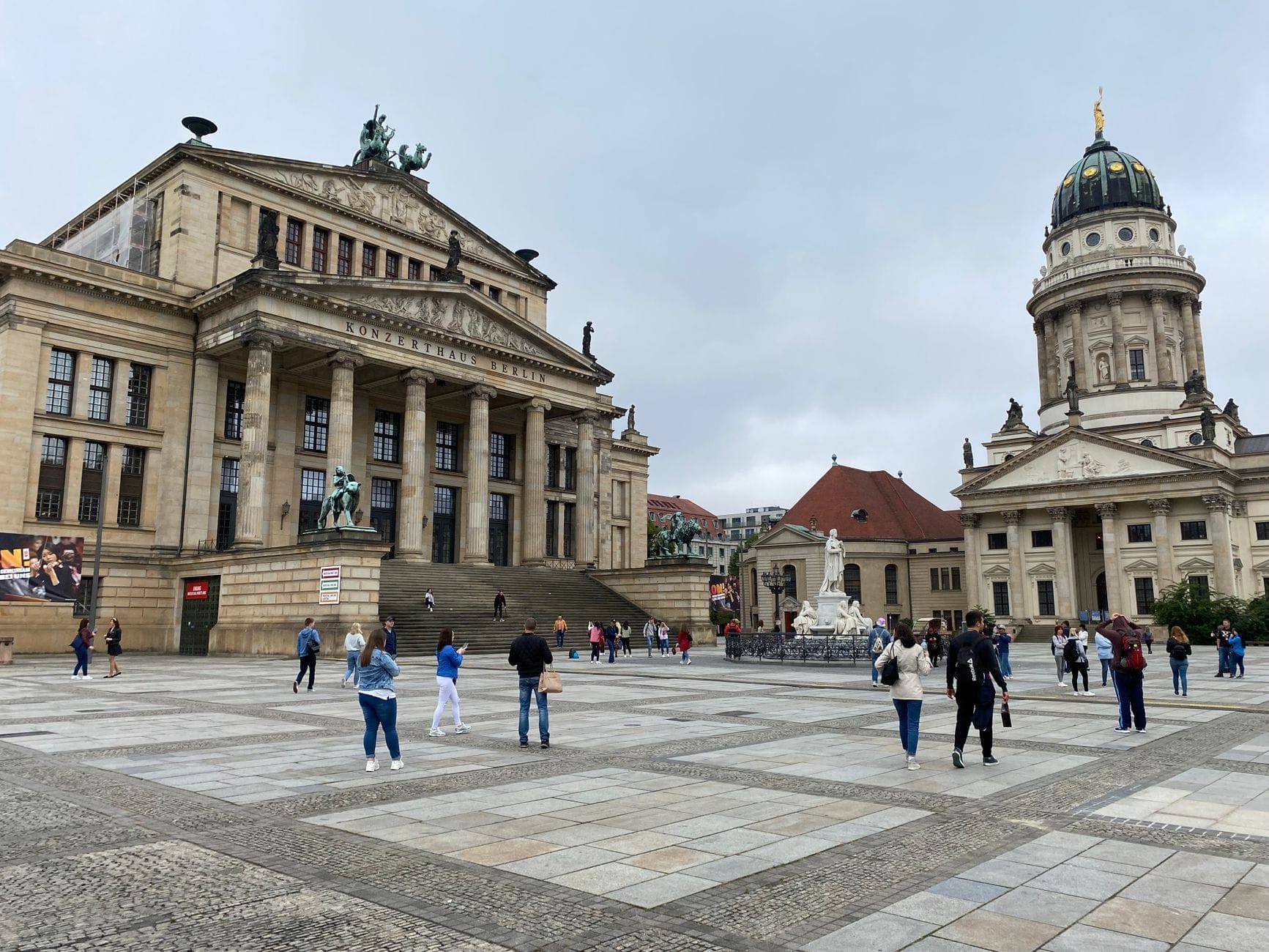
Flanked by two near-identical cathedral domes and the grand Konzerthaus Berlin, Gendarmenmarkt is the most architecturally coherent square in the city. The square is free to enter at any hour, making it equally rewarding at midday or after dark.
Quick Facts
- Location
- Gendarmenmarkt 1, 10117 Berlin-Mitte
- Getting There
- U2 Hausvogteiplatz or U2/U6 Stadtmitte
- Time Needed
- 30–90 minutes for the square; half a day if entering buildings
- Cost
- Free (square); ticketed events/exhibitions inside Konzerthaus and cathedrals
- Best for
- Architecture lovers, history buffs, evening strolls, winter markets
- Official website
- www.visitberlin.de/en/gendarmenmarkt
What Makes Gendarmenmarkt Worth Your Time
Berlin has many squares, but Gendarmenmarkt is the only one where the ensemble feels deliberately composed. Three neoclassical monuments occupy the space in near-perfect symmetry: the Französischer Dom to the north, the Deutscher Dom to the south, and the Konzerthaus Berlin in the centre. The effect is unusual for a German city, and unusually photogenic for one that suffered the level of wartime destruction Berlin did. Almost everything you see here is a reconstruction, yet the square does not feel like a replica. It feels like a city that refused to abandon its own idea of beauty.
The square sits in the heart of Mitte, a short walk south of Unter den Linden and west of Museum Island. Its compactness is part of its appeal: you can take in the full spatial logic of the square in under ten minutes on foot, yet the architectural detail rewards much longer attention.
💡 Local tip
The square is a public plaza, open 24 hours a day with no admission charge. You do not need to enter any building to appreciate Gendarmenmarkt's architecture.
A Square With a Long, Complicated History
The space was first laid out at the end of the 17th century by Johann Arnold Nering and initially called the Linden-Markt. It was later redesigned under plans by Georg Christian Unger, substantially completed between 1773 and 1777. The name Gendarmenmarkt dates from 1799, a reference to the Gens d'armes cuirassier regiment that once stabled horses on this ground. Naming a square after a cavalry garrison gives it an odd martial undertone that the current architecture entirely disguises.
The Französischer Dom (French Cathedral) was built between 1701 and 1705 for Berlin's Huguenot community, Protestant refugees who had fled France following the revocation of the Edict of Nantes in 1685. The Deutscher Dom followed in 1708. Both churches were designed as intentional mirror images to frame the central space. The Konzerthaus, originally built as the Schauspielhaus (theatre) between 1818 and 1821 by Karl Friedrich Schinkel, is one of the finest examples of Prussian neoclassicism in existence.
World War II gutted all three buildings. The square was renamed Platz der Akademie in 1950 by the East German government. The Konzerthaus was reconstructed and reopened as a concert hall in 1984; the Deutscher Dom was reopened as a museum in 1996. The square reclaimed its original name in 1991, following German reunification. Standing at the centre now, with a monumental bronze statue of Friedrich Schiller looking toward the Konzerthaus, the square reads as a statement about cultural continuity across political rupture.
Tickets & tours
Hand-picked options from our booking partner. Prices are indicative; availability and final rates are confirmed when you complete your booking.
Skip-the-line ticket for Gemaldegalerie Berlin
From 14 €Instant confirmationPanoramapunkt Berlin ticket with skip-the-line option
From 9 €Instant confirmation1-Hour Berlin Spree River Cruise with On-Board Guide
From 21 €Instant confirmationFree cancellationSamurai Experience Berlin skip-the-line ticket
From 15 €Instant confirmation
The Three Buildings Up Close
The Konzerthaus Berlin is the most architecturally detailed of the three. Schinkel's facade is a study in Ionic columns and precise horizontal banding, and the building's interior, now home to classical concerts, maintains that same measured grandeur. Concert tickets are required to enter the hall itself, but the exterior and the grand staircase approach can be appreciated from the square at no cost.
The Französischer Dom houses a Huguenot museum on its lower levels and a viewing platform at the top of its dome tower. The climb to the platform offers close-up views across the square's rooftops and toward the surrounding streets of Mitte. Admission is ticketed; check opening hours directly with the Huguenot Museum before visiting, as they vary by season.
The Deutscher Dom on the south side functions today not as an active church but as a museum dedicated to German parliamentary and democratic history, operated by the Bundestag. Entry is free. The permanent exhibition, titled 'Milestones, Setbacks, Sidetracks,' traces Germany's political development from the early 19th century to reunification. It is detailed, well-curated, and largely overlooked by tourists who focus on the square's exterior.
ℹ️ Good to know
The Deutscher Dom's permanent parliamentary history exhibition is free to enter and rarely crowded. It makes a worthwhile addition to any visit focused on German political history.
How the Square Changes Through the Day
Early mornings, before 9am, the square belongs almost entirely to local workers cutting through on foot and cyclists crossing the cobblestones at speed. The light at that hour, particularly in spring and autumn, hits the Konzerthaus columns at a low angle that throws strong shadows across the facade. Photographers who want clean architectural shots without tourists in frame should aim for 7am to 8:30am.
By midday the square fills steadily, especially in summer. Lunch crowds from nearby offices occupy the benches near the Schiller statue. The surrounding cafes and restaurants, primarily on the square's perimeter and along Charlottenstraße to the west, fill quickly between noon and 2pm. The square itself can feel exposed on hot summer days as it is largely open and unshaded.
The most rewarding time to visit is evening, from around 6pm onward. The buildings are illuminated from below, the dome of the Französischer Dom turns warm amber, and the volume of foot traffic drops significantly compared to midday. On concert nights at the Konzerthaus, there is a particular atmosphere as formally dressed concertgoers cross the cobblestones toward the entrance. The square takes on a different quality entirely: quieter, more European in feel, closer to the atmosphere of a Viennese or Parisian plaza than most of Berlin manages.
Getting There and Getting Around
The easiest approach by public transport is the U2 to Hausvogteiplatz, a four-minute walk east along Jägerstraße. Alternatively, U2/U6 Stadtmitte places you slightly south-west of the square. Neither station is a major interchange, so the walk from Stadtmitte station (U2/U6) takes about seven minutes and passes through the quiet grid streets of central Mitte.
On foot, Gendarmenmarkt connects naturally into a longer walking route through central Berlin. The Holocaust Memorial and Brandenburg Gate are roughly 15 minutes west on foot. Checkpoint Charlie is a similar distance south, via Friedrichstraße.
The square's cobblestone surface is largely flat, which makes it manageable for wheelchair users and pushchairs, though the uneven stone requires some care. The indoor venues each have their own accessibility provisions; confirm with each institution directly before visiting if this is a priority.
The Christmas Market
Gendarmenmarkt hosts one of Berlin's most popular winter markets, typically running from late November through to the end of December. Unlike some of Berlin's larger markets, the Gendarmenmarkt Christmas market charges a small entrance fee (usually a few euros), which keeps crowds at a manageable level. The combination of illuminated baroque facades and market stalls makes the atmosphere unusually theatrical. For a fuller picture of how this compares to other seasonal markets across the city, the Berlin Christmas markets guide covers the main options in detail.
Arrive after 6pm if you want the full atmospheric effect of the illuminated buildings. Arrive before noon on a weekday if you want to browse without being pushed through the stalls. Weekend evenings in December are genuinely crowded and can test your patience if you have no specific tolerance for dense market crowds.
⚠️ What to skip
The Gendarmenmarkt Christmas market charges an entrance fee (typically a few euros). It is one of the few ticketed outdoor Christmas markets in Berlin. Check current pricing before visiting.
Is Gendarmenmarkt Worth a Visit?
Gendarmenmarkt is frequently cited as Berlin's most beautiful square, and that claim holds up architecturally. The symmetry of the ensemble is genuine and the quality of the restoration work is high. However, visitors expecting a living neighbourhood square may be surprised by how formal and deliberately staged it feels. There are no market stalls on ordinary days, no street food, and relatively little local foot traffic compared to squares like Kollwitzplatz in Prenzlauer Berg. This is a civic space built to be admired, not a space that generates spontaneous street life.
Travelers focused on Berlin's post-war, counterculture, or contemporary identity will likely find more resonance elsewhere. If your primary interest is urban history, the Topography of Terror nearby gives a more direct account of the 20th century than anything Gendarmenmarkt offers. But for anyone interested in Prussian urban planning, neoclassical architecture, or simply a quiet, handsome square in central Berlin, it is worth the detour.
Insider Tips
- The best unobstructed photograph of all three buildings together requires standing at the northern edge of the square, near the Französischer Dom steps, and shooting south. This angle places both cathedral domes and the Konzerthaus in a single frame.
- The Deutscher Dom's parliamentary history museum is operated by the Bundestag and free to enter, yet sees a fraction of the visitors who queue for the Reichstag building. The content is substantive and well-translated into English.
- On concert evenings at Konzerthaus Berlin, the square is noticeably more atmospheric in the hour before and after the performance. Check the Konzerthaus programme in advance if you want this particular version of the square.
- If you are visiting in summer, the terrace tables of the cafes on the eastern side of the square fill by noon. Arrive before 11:30am to secure outdoor seating with a direct view of the buildings.
- The cobblestones on the square's central section can be slippery after rain, particularly in autumn and winter. Flat-soled shoes with grip are more practical than they might seem necessary for a short city walk.
Who Is Gendarmenmarkt For?
- Architecture and urban history enthusiasts who want to understand Prussian neoclassical design in context
- Photographers seeking symmetrical, well-lit architectural subjects, especially at dawn or dusk
- Visitors combining a walking route through central Mitte with nearby sites like Checkpoint Charlie and Unter den Linden
- Travelers visiting Berlin in December who want a Christmas market with a more contained, atmospheric setting
- Classical music audiences attending a concert at Konzerthaus Berlin
Nearby Attractions
Other things to see while in Mitte:
- Alexanderplatz
Alexanderplatz sits at the geographical and historical heart of former East Berlin, a vast open square with roots going back to the 13th century. Today it's a free, always-open crossroads of transit, Cold War monuments, and everyday Berlin life — chaotic, fascinating, and impossible to avoid.
- Berlin Cathedral (Berliner Dom)
The Berlin Cathedral, or Berliner Dom, is Germany's largest Protestant church and one of the most architecturally striking buildings in the city. Built between 1894 and 1905, it anchors Museum Island with a dome you can climb, a royal crypt below ground, and a nave that rewards slow, unhurried attention.
- Berlin TV Tower (Fernsehturm)
Standing 368 metres above central Berlin, the Berliner Fernsehturm is the tallest structure in Germany and the tallest publicly accessible building in Europe. Its observation deck at 203 metres delivers an unobstructed 360-degree panorama of the city. This guide covers what you actually see up there, when crowds are worst, and whether the ticket price is justified.
- Berlin Victory Column (Siegessäule)
Rising from the centre of the Großer Stern roundabout in Tiergarten, the Siegessäule is one of Berlin's most recognisable monuments. At around 67 metres tall, it offers a sweeping panorama over the city's forest-park heart — but you earn the view with 285 steps and no lift.