Galleria Borbonica (Bourbon Tunnel): Naples' Most Dramatic Underground Journey
Commissioned by King Ferdinand II in 1853 as a royal escape route, the project was never fully completed, the Galleria Borbonica became a WWII air-raid shelter and is now one of the most compelling underground experiences in southern Italy. Guided tours descend roughly 30 meters below street level into a world of carved tufa rock, abandoned vehicles, wartime debris, and flooded cisterns.
Quick Facts
- Location
- Vico del Grottone 4, behind Piazza del Plebiscito, Naples
- Getting There
- Metro Line 1 – Municipio; tram/bus to Piazza Vittoria for the Morelli entrance
- Time Needed
- 1 to 2 hours depending on tour type
- Cost
- Standard tour from €15 (adults); €10 for ages 11–13 and 75+; 20% off with Campania Artecard
- Best for
- History enthusiasts, WWII buffs, urban explorers, and travelers curious about Naples beneath the surface
- Official website
- www.galleriaborbonica.com
What Is the Galleria Borbonica?
The Galleria Borbonica is an underground tunnel complex running beneath the Chiaia and Plebiscito area of Naples, combining a 19th-century royal passageway, ancient tufa quarry caves, a Greco-Roman aqueduct cistern, and one of the city's most poignant World War II relics. Construction was ordered by King Ferdinand II of Bourbon by royal decree on February 19, 1853, and the work was assigned to architect Errico Alvino. The original plan was ambitious: a 12-meter-wide, 12-meter-high corridor linking the Royal Palace at Piazza del Plebiscito directly to Piazza Vittoria and the barracks beyond, providing the Bourbon monarchy with a secure military escape route should the city rise in revolt.
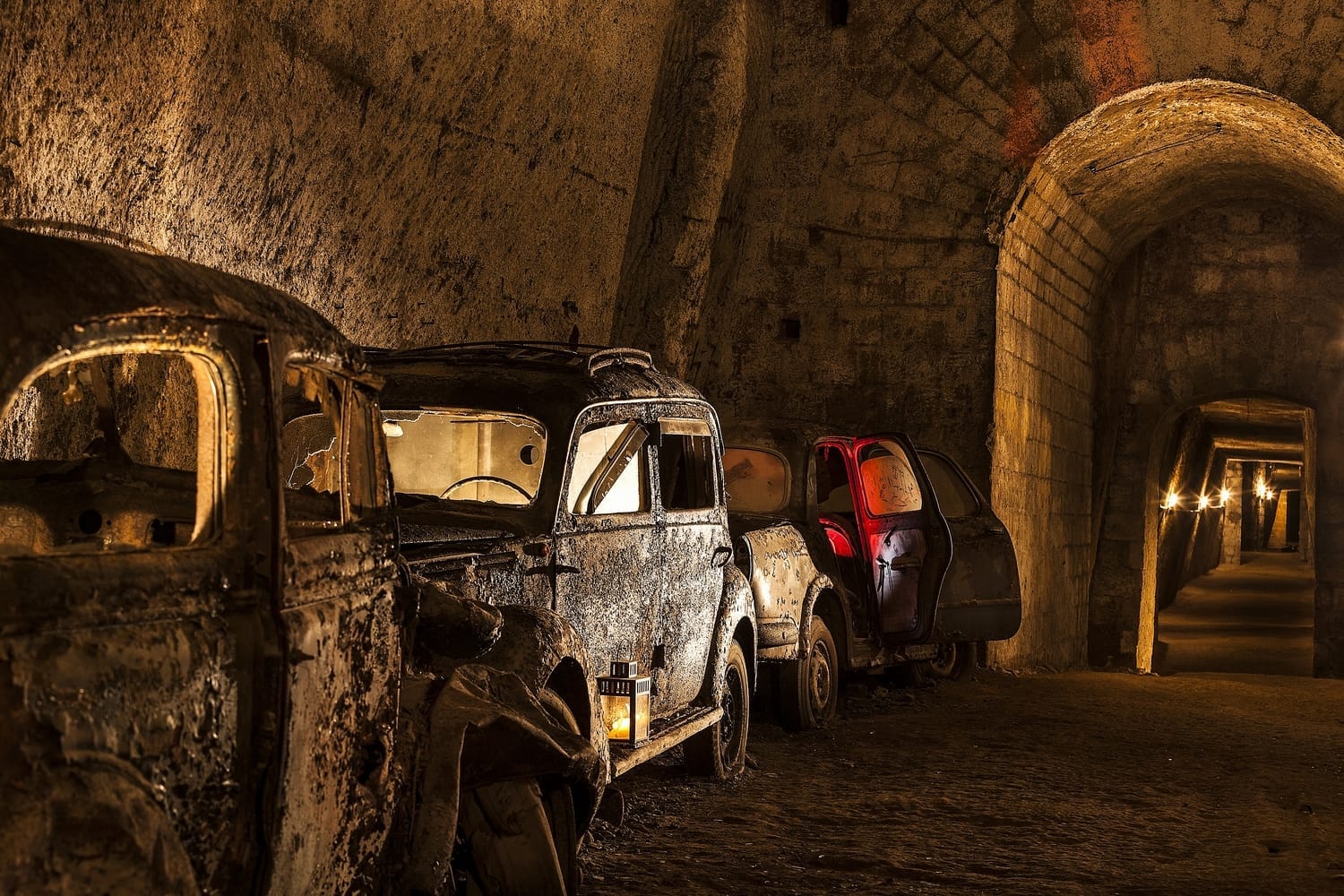
The project was never finished. The project was never completed, with construction ultimately halting due to funding constraints. The incomplete passageway sat largely forgotten until the Second World War, when the city of Naples repurposed it as an air-raid shelter and field hospital. Up to 10,000 Neapolitans sheltered here during Allied bombing campaigns between 1939 and 1945. After the war, the tunnels became a dumping ground, accumulating hundreds of confiscated vehicles, police motorcycles, Fiat 500s, postwar scooters, and bureaucratic detritus. That layer of 20th-century abandonment is part of what makes the tunnel so atmospheric today.
ℹ️ Good to know
Visits are by guided tour only. Tours run multiple times daily but booking ahead is strongly recommended, particularly on weekends and during peak season (April to October). Check the official site at galleriaborbonica.com for current schedules.
The Entrance and Descent
The main entrance at Vico del Grottone 4 is easy to miss: a modest doorway tucked into a side street just steps from the grand colonnades of Piazza del Plebiscito. There is no dramatic facade, no queue barriers or gift shop visible from outside. You ring a bell, a guide appears, and within minutes you are descending a steep staircase into the rock. The air temperature drops noticeably, settling around 17–18°C year-round regardless of the season above. In summer, this transition is one of the first sensory rewards of the visit.
The tunnel is approximately 30 meters below street level at its deepest point. The walls are hewn from yellow Neapolitan tufa, the soft volcanic stone that underlies virtually all of historic Naples. You can see tool marks in the rock and, in sections incorporating the older Carafa Caves, vaulted cistern chambers where water once pooled in the Greco-Roman aqueduct network. The smell is damp and mineral, faintly sulphurous in places, and the acoustics shift from echoing to close depending on the width of the passage.
Tickets & tours
Live prices and dates from our booking partner. If you book, we may earn a commission at no extra cost to you.
Pompeii and Mount Vesuvius tour with transportation
From 110 €Instant confirmationFree cancellationOrigins and legends of Naples walking tour
From 28 €Instant confirmationFree cancellationGuided walking tour of Naples city and Naples underground
From 45 €Instant confirmationFree cancellationMount Vesuvius and Herculaneum tour with transportation
From 100 €Instant confirmationFree cancellation
The WWII Shelter: The Tunnel's Most Haunting Layer
The section that most visitors find the most affecting is the air-raid shelter that occupied the tunnel during World War II. The physical evidence is still here: wooden bunk frames, graffiti scratched into the tufa walls by people who sheltered night after night from Allied bombing raids, fragments of medical equipment from the makeshift field hospital, and a stillness that carries genuine weight. Guides are typically detailed on this period, drawing on local testimony and documented history to explain how the tunnel functioned as a community of last resort.
The WWII context connects the Galleria Borbonica to a broader underground Naples that most visitors barely glimpse. For those wanting to explore further, the Napoli Sotterranea in the historic center offers a different angle on the same subterranean city, focusing on the Greek-era cisterns beneath Spaccanapoli. The two experiences complement each other well and are worth doing on the same trip if underground history is your focus.
The Abandoned Vehicles: An Unexpected Time Capsule
Perhaps the single most visually striking element of the standard tour is a chamber filled with vehicles seized or confiscated by Neapolitan authorities and stored underground during the postwar decades. Dozens of cars and motorcycles sit in the half-dark, their chrome dulled, tires flat, coated in the fine mineral dust that settles in sealed rock chambers. There are Fiat 500s from the 1960s, police motorcycles, Vespas, even ambulance bodies. Nothing was removed or curated; the vehicles simply accumulated until the space filled up. The effect is closer to an accidental installation than a display, which makes it more striking than anything deliberately arranged could be.
Photographers should bring a wide-angle lens if possible. The chamber is low-ceilinged and the vehicles are tightly packed, which rewards close compositional work rather than wide establishing shots. Flash photography tends to flatten the texture that makes the space so compelling; guides often carry lights, but a fast lens set at ISO 800 or higher will give you far more natural-looking results in the ambient light.
💡 Local tip
Wear closed-toe shoes with grip. The tunnel floors are uneven, often damp, and include carved stone steps, gravel sections, and narrow passages. Heeled shoes are genuinely impractical, not just inadvisable.
Tour Options and How to Choose
The Galleria Borbonica offers several distinct tour formats. The Standard Route (from €15) covers the main tunnel, the WWII shelter, the cistern chambers, and the vehicle graveyard, and takes roughly 50 minutes to one hour. This is the right choice for most visitors and gives a thorough overview of all the major elements.
Adventure tours are also available for those who want to go further into less-accessible sections, including areas where you wade through shallow water in rubber boots or crawl through narrow passages. These tours are longer, more physically demanding, and considerably more expensive, but they access parts of the aqueduct network and cistern system that the standard tour does not reach. Check the official website for the current adventure tour formats, as the offerings and scheduling have varied over time.
If you are planning a broader underground Naples itinerary, the Naples underground guide covers all the main subterranean sites and helps you decide which to prioritize based on your interests and physical comfort level.
Getting There and Practical Logistics
The Galleria Borbonica has three separate entrances. The primary entrance on Vico del Grottone 4 sits behind Piazza del Plebiscito and is the easiest to reach on foot from the city center. From Piazza Municipio (Metro Line 1), follow Via Trieste e Trento west past the Piazza del Plebiscito colonnade and look for the sign on the left. Walk time from Municipio station is around 10 minutes. A second entrance is located near Via Domenico Morelli in the Morelli area, nearer to Piazza Vittoria and the Chiaia neighborhood. A third entrance at Via Monte di Dio 14, inside the Palazzo Serra di Cassano courtyard, is used for certain tour formats.
The tunnel sits a short walk from Piazza del Plebiscito and the Palazzo Reale, which means it fits naturally into a half-day itinerary covering the royal and civic heart of Naples. After the tour, the waterfront at Castel dell'Ovo is a 15-minute walk south along the seafront.
The temperature underground is consistent at around 17–18°C regardless of conditions outside, so a light layer is always worth carrying, particularly in summer when the contrast with street-level heat is sharp. Groups are kept to a manageable size and tours depart at set intervals, but booking in advance via the official website prevents the disappointment of arriving to find the next available slot hours away.
⚠️ What to skip
The Galleria Borbonica is not accessible for visitors with limited mobility. The descent involves stairs and uneven terrain throughout. There are no lifts or ramps. If accessibility is a concern, contact the attraction directly before booking.
Is It Worth Your Time? An Honest Assessment
Yes, with one caveat: if you are primarily interested in ancient history and Greek or Roman ruins, the Galleria Borbonica may feel slightly outside your priorities. Its strongest appeal is to visitors who are drawn to 19th-century political history, WWII civilian experience, and the accidental archaeology of a city that never quite cleaned up after itself. The quality of the guides varies, and on a busy weekend tour, the group can feel large enough to dilute the atmosphere in the narrower sections.
For travelers with a strong interest in Neapolitan history more broadly, the experience pairs well with a visit to the Naples National Archaeological Museum earlier in the day: the museum provides the ancient layer, the tunnel provides the modern one, and between them you get a strong sense of how deeply stratified this city's past really is.
Those who find confined spaces genuinely distressing should think carefully before booking. Parts of the tunnel are narrow, low-ceilinged, and dimly lit, and while guides are professional about managing group pace, there is no easy way to exit mid-tour. Most people who are mildly claustrophobic report that the experience is manageable because the main chambers are spacious, but it is worth being honest with yourself before you descend.
Insider Tips
- Book the first tour slot of the day. The tunnel ventilates overnight and the air feels fresher in the morning; later tours on busy days can feel warmer and more crowded in the enclosed sections.
- The Morelli car park entrance at Via Domenico Morelli 61 is less well-known than the Vico del Grottone door. If you are coming from the Chiaia side, this is the more convenient option and often has a slightly shorter gathering queue.
- Bring a small torch or use your phone flashlight. Guides provide lighting for the group, but having your own lets you examine wall textures, tool marks, and inscriptions at your own pace without disrupting the group.
- The 20% Campania Artecard discount is genuine and worth using if you are visiting multiple Naples museums and monuments during your trip. It also works at the archaeological museum and several major churches.
- If you are visiting in summer, schedule the tunnel tour for midday: it is the one time when descending underground is a relief rather than a sacrifice, and you will appreciate the natural 17°C air conditioning more than at any other time of year.
Who Is Galleria Borbonica (Bourbon Tunnel) For?
- History and WWII enthusiasts who want civilian rather than military perspectives on the war in southern Italy
- Architecture and urban history travelers interested in Bourbon-era Naples and 19th-century infrastructure projects
- Photographers looking for genuinely unusual interiors: rusted vehicles, carved tufa walls, and mid-century debris compose unlike any conventional heritage site
- Travelers who have already done the main-street sights and want an experience that feels less curated and more raw
- Anyone visiting Naples in summer who wants an hour of genuine cool air in a city that can be relentlessly hot
Nearby Attractions
Other things to see while in Waterfront & Lungomare:
- Castel dell'Ovo
Perched on a small rocky peninsula jutting into the Gulf of Naples, Castel dell'Ovo is the oldest castle in the city and one of its most immediately recognizable landmarks. Entry is free, the views stretch toward Vesuvius and the islands, and the history runs deeper than the walls suggest.
- Castel Nuovo (Maschio Angioino)
Rising above the Naples waterfront on five round towers, Castel Nuovo has anchored the city's harbor since 1284. Part royal palace, part civic museum, part medieval spectacle, it rewards visitors who look beyond the postcard exterior.
- Galleria Umberto I
Built between 1887 and 1890 as part of Naples' sweeping urban renewal, Galleria Umberto I is a soaring cross-shaped arcade crowned by a 56-metre glass-and-iron dome. Entry is free and the gallery never closes, making it one of the most accessible architectural landmarks in the city.
- Palazzo Reale (Royal Palace)
The Palazzo Reale di Napoli sits at the heart of the city's grandest square, offering throne rooms, a monumental marble staircase, a hanging garden with Gulf views, and one of Italy's largest libraries. Built from 1600 under Spanish viceroys and restored after a 19th-century fire, it rewards visitors who look beyond the obvious tourist circuit.
Planning a trip? Discover personalized activities with the Nomado app.