Naples Underground (Napoli Sotterranea): What to Expect Before You Descend
Beneath the streets of the historic center, Napoli Sotterranea takes you through 40 meters of tunnels carved over 2,400 years. From Greek-era cisterns to WWII air raid shelters, this guided tour offers one of the most compelling perspectives on Naples that most visitors never see.
Quick Facts
- Location
- Piazza San Gaetano 68, Centro Storico, Naples
- Getting There
- Metro Line 1: Dante metro station (10-min walk); several bus lines along Via dei Tribunali
- Time Needed
- about 1 hour for the standard guided tour
- Cost
- Guided tours required; check official site for current pricing (prices vary by tour type)
- Best for
- History enthusiasts, curious travelers, those seeking escape from summer heat
- Official website
- www.napolisotterranea.org/en
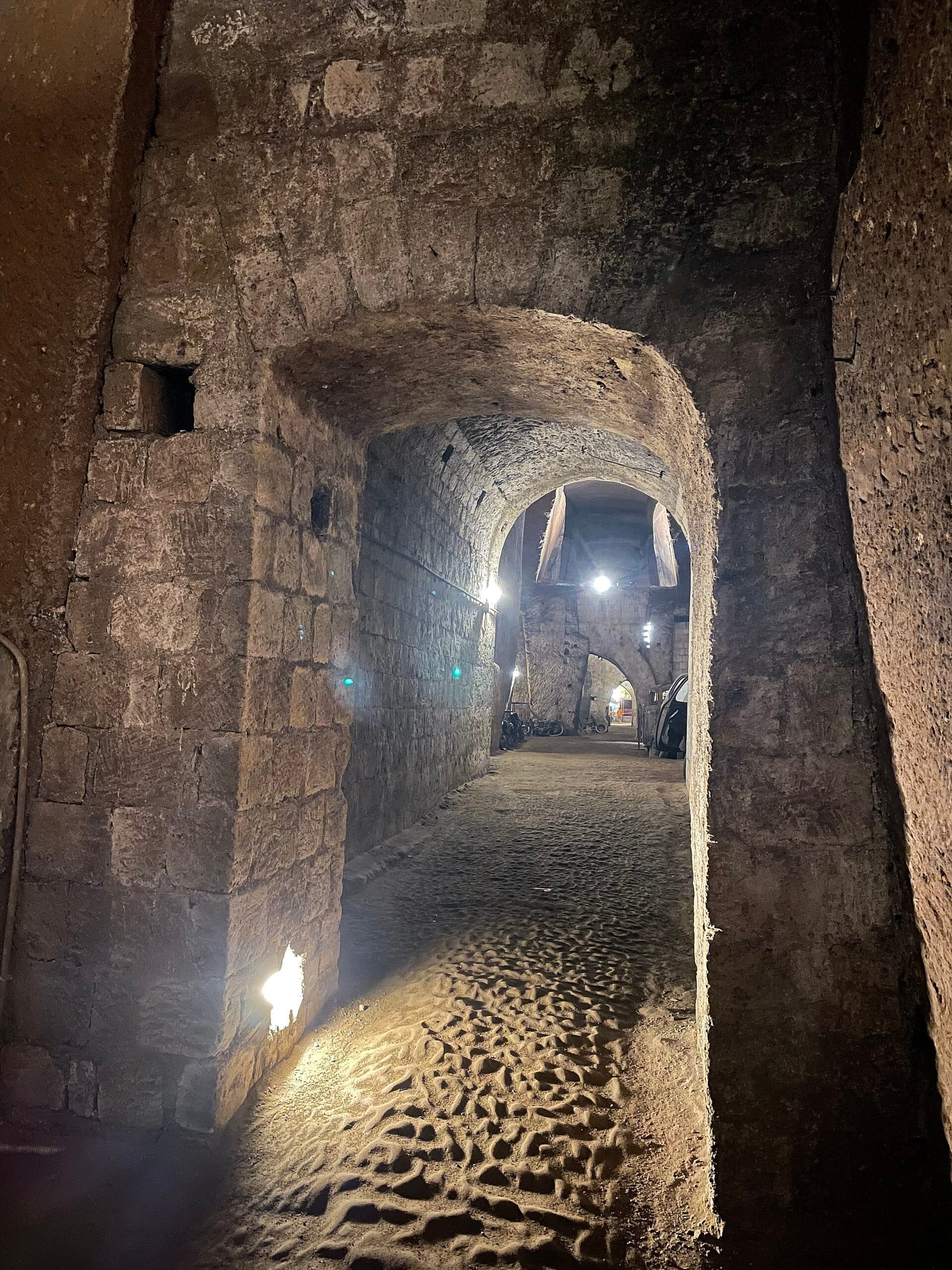
What Naples Underground Actually Is
Napoli Sotterranea is not a single tunnel. It is a layered labyrinth: Greek quarrying operations from the 4th century BCE, Roman aqueduct channels fed by the Serino spring 70 kilometers away, medieval expansions, Bourbon-era modifications, and finally the WWII civilian shelters that hundreds of Neapolitan families retreated to during Allied bombardments. Each layer belongs to a different Naples, and the tour moves through them in roughly chronological sequence.
The entrance is at Piazza San Gaetano 68, just off Via dei Tribunali in the historic center. You descend 136 steps to reach a depth of approximately 40 meters below street level. The air temperature underground stays around 15 degrees Celsius year-round, a stark shift from the surface regardless of season.
💡 Local tip
Bring a light layer even in summer. The 15°C underground temperature feels genuinely cold after a hot day above ground, and the tour lasts long enough that you will feel it.
The History Beneath the Streets
The oldest sections date to the 4th century BCE, when Greek settlers quarried the soft yellow tuff rock to build the city of Neapolis above. What they left behind was an accidental infrastructure: a network of cavities and channels that later civilizations found too useful to ignore. The Romans recognized the value immediately. During the Augustan period, they engineered an aqueduct system that ran water from the Serino springs in the Apennines, 70 kilometers to the east, through the existing cavities and into the city above. Naples depended on this system for its water supply until the cholera epidemic of 1884 prompted a complete overhaul of the city's sanitation.
After the aqueduct was decommissioned in the late 19th century, the tunnels were largely forgotten. They filled partially with debris and became, in the words of locals who remembered them at all, simply the dark space beneath everything. Then came World War II. When Allied bombing campaigns intensified in 1943, the tunnels were excavated and fitted out as civilian shelters. Entire families lived underground for weeks at a time. The WWII section of the tour is the most emotionally resonant: you can still see the remains of small living spaces, graffiti scratched into tuff walls, and the hand-dug alcoves where people tried to create some privacy.
For context on what was happening above ground during this same period, the Galleria Borbonica also served as a WWII shelter and offers a different but complementary underground experience in the Chiaia district.
Tickets & tours
Live prices and dates from our booking partner. If you book, we may earn a commission at no extra cost to you.
The Tour Experience: What You Actually See
Tours run at multiple fixed daily slots, typically at 10am, 12pm, 2pm, and 4:30pm, though schedules vary by season and day of week. All visits are guided and conducted in multiple languages. The standard English-language tour lasts around 90 minutes. Independent exploration is not permitted.
The descent itself is immediate and physical. The staircase is steep but manageable, and the transition from street noise to near-silence happens within the first 20 steps. By the time you reach the main tunnel level, the air is cool and slightly damp, carrying a faint mineral smell from the tuff rock. The tunnels are lit but not brightly. Guides carry candles for sections where lighting is deliberately minimal to replicate conditions experienced by wartime residents.
One of the most memorable sections involves navigating a passage that narrows to roughly 50 centimeters. This is not a gimmick. The original Greek quarry cuts simply never anticipated modern visitors. You turn sideways and move through slowly. Larger visitors should be aware this exists; guides are accustomed to accommodating different body types but the passage is genuinely tight.
The Roman cistern chamber is the architectural highlight. The vaulted tuff ceilings rise several meters, and the scale becomes comprehensible when you consider that this single cavity held enough water to supply an ancient city. The surfaces are still marked with the tool cuts made by Greek quarry workers over two millennia ago. The WWII rooms that follow create a jarring contrast, small and human-scaled, with the remnants of everyday wartime life preserved under museum conditions.
Practical Walkthrough: Getting There and Getting In
The entrance at Piazza San Gaetano sits in the heart of the Centro Storico, Naples's UNESCO-listed historic center. The nearest metro stop is Dante on Line 1, roughly a 10-minute walk east along Via dei Tribunali. The street itself is one of the most concentrated corridors of Neapolitan street life, lined with pizzerias, small churches, and market stalls.
Booking in advance is strongly recommended, particularly from April through October and during Italian school holidays. Walk-up spaces exist but the tour groups fill quickly during peak hours, and the midday slots sell out fastest. The official website at napolisotterranea.org/en handles reservations directly. Check pricing there before visiting, as fees are not published in fixed form across third-party sources.
⚠️ What to skip
Napoli Sotterranea is not wheelchair accessible. The route involves 136 steps, a 40-meter descent, narrow corridor passages, and uneven tuff flooring. Visitors with mobility limitations or severe claustrophobia should consider whether this experience is appropriate for them.
Wear flat, closed shoes with grip. The tuff floor can be slippery in the damp sections, and sandals create a genuine hazard. Photography is permitted throughout the tour without flash, though low light means a phone camera will struggle in several areas. A camera with good high-ISO performance will serve you better.
When to Visit and How It Changes
The underground itself does not change with the seasons. The temperature stays constant, the lighting is fixed, and the history does not rearrange itself. What changes is the crowd density and, consequently, how much space you have to absorb what you are seeing. Summer months, particularly July and August, pack the morning tours quickly. The 4:30pm slot on weekdays tends to be the least crowded in high season. Winter visits offer noticeably quieter tours and a guide with more time for questions.
If you are timing a broader Naples trip, the best months to visit Naples for a balance of good weather and manageable crowds are April through early June and September through October. These same windows apply underground, if only because you will have an easier time booking your preferred time slot.
One practical advantage: on a brutally hot August afternoon when the surface temperature hits 35 degrees and the narrow streets of the centro storico trap heat between buildings, descending into 15-degree tunnels is genuinely welcome. Several visitors treat the underground as a midday refuge as much as a cultural site. That is not the worst reason to go.
How This Fits Into a Broader Naples Itinerary
Napoli Sotterranea pairs naturally with the street-level archaeology on Via dei Tribunali and the surrounding Centro Storico. After the tour, Piazza San Gaetano itself sits above the ancient Greek agora of Neapolis, meaning you return to the surface directly above the city's original civic center. The Naples National Archaeological Museum is a 15-minute walk northwest and provides essential context for the Greek and Roman layers you have just walked through, particularly its collection of Roman frescoes and mosaics from Pompeii.
The area also sits close to the Cappella Sansevero, one of the most extraordinary small baroque chapels in Europe, less than five minutes on foot. Combining both in a half-day is a reasonable and rewarding plan. For those drawn specifically to underground Naples, the Naples Catacombs of San Gennaro in the Sanità district offer a different type of subterranean experience, focused on early Christian burial rather than civic infrastructure.
If your interest in Naples extends to the full scope of its underground history, the dedicated guide to Naples underground sites covers multiple competing access points and operators alongside Napoli Sotterranea.
Is It Worth It, and Who Might Disagree
The honest answer is yes, for most visitors with genuine curiosity about how cities accumulate history. The tour is well-organized, the guides are typically knowledgeable and engaging, and the material itself is genuinely unusual. There is no equivalent surface-level experience that gives you the same layered sense of Naples across 24 centuries.
That said, the experience has limits. If you have no patience for guided group tours and prefer to explore independently at your own pace, this format will frustrate you. The narrow passages require patience and a tolerance for close quarters with strangers. Anyone with significant claustrophobia should be honest with themselves before booking: while the main chambers are spacious, the tight corridor section is unavoidable and non-negotiable. Families with very young children can do the tour, but keeping a four-year-old engaged for 90 minutes in dark tunnels is a genuine parenting challenge.
Insider Tips
- The 4:30pm weekday slot consistently has smaller groups than morning tours during peak season. If you have flexibility, this is the time to book.
- The tour includes a candle-lit section meant to simulate wartime conditions. This is not just atmospheric: it is genuinely dark. Do not rely on your phone screen for light during this segment; the guides provide candles and prefer you use them.
- Piazza San Gaetano sits directly above the ancient Greek agora of Neapolis. Spend a few minutes on the square before descending to appreciate that you are standing on 2,400 years of continuous occupation.
- The narrow corridor passage is unavoidable. If you know you are wider-shouldered, wear fitted rather than loose clothing. Bulky backpacks must be removed and carried in front during this section.
- Combine the underground visit with the Naples National Archaeological Museum the same day. The museum's Roman artifacts provide direct visual context for the aqueduct infrastructure you will have just walked through, and both attractions are within easy walking distance of each other.
Who Is Naples Underground (Napoli Sotterranea) For?
- History travelers who want to understand how cities are built in layers, not just maintained
- Visitors looking for a cool, shaded midday activity during the summer heat
- Anyone interested in WWII civilian history and the lived experience of wartime Naples
- Archaeology enthusiasts drawn to Greek and Roman urban infrastructure
- Travelers who find the surface-level tourist circuit of churches and piazzas insufficient and want depth, literally
Nearby Attractions
Other things to see while in Centro Storico:
- Cappella Sansevero
Cappella Sansevero is a small baroque chapel in Naples' historic centre that contains one of the most technically staggering sculptures in the world: the Veiled Christ, a life-sized marble figure so realistically carved it appears draped in real fabric. The chapel is compact, deeply atmospheric, and almost certainly unlike anything else you will see in Italy.
- Naples Cathedral (Duomo di Napoli)
The Cattedrale di Santa Maria Assunta, known to locals simply as the Duomo, is Naples' most historically layered religious site. Built over Greek temples, Roman structures, and early Christian basilicas, it has been the spiritual center of the city for seven centuries. It is also where the famous liquefaction of San Gennaro's blood draws thousands of pilgrims three times a year.
- Naples Botanical Garden (Orto Botanico)
The Orto Botanico di Napoli is one of southern Italy's most significant botanical institutions, covering 12 hectares in the heart of Naples with around 9,000 plant species. Free to enter and largely overlooked by tourists, it offers a genuinely quiet counterpoint to the city's sensory intensity.
- Catacombs of San Gennaro
Carved into the volcanic tuff beneath Rione Sanità, the Catacombs of San Gennaro form one of Southern Italy's most significant early Christian sites. Spanning roughly 5,600 square metres across two levels, they preserve underground basilicas, bishop tombs, and some of the oldest Christian frescoes in the Mediterranean world.
Planning a trip? Discover personalized activities with the Nomado app.