Cappella Sansevero: Naples' Most Astonishing Chapel
Cappella Sansevero is a small baroque chapel in Naples' historic centre that contains one of the most technically staggering sculptures in the world: the Veiled Christ, a life-sized marble figure so realistically carved it appears draped in real fabric. The chapel is compact, deeply atmospheric, and almost certainly unlike anything else you will see in Italy.
Quick Facts
- Location
- Via Francesco de Sanctis 19/21, off Piazza San Domenico Maggiore, Centro Storico, Naples
- Getting There
- Metro Line 1 to Dante station (10-min walk); bus routes along Spaccanapoli
- Time Needed
- 45–75 minutes is sufficient; allow longer if you want to study each sculpture
- Cost
- Paid entry; reduced for ages 10–26 and disabled visitors; children under 10 free. Check official site for current prices.
- Best for
- Art lovers, history enthusiasts, anyone interested in 18th-century baroque craftsmanship
- Official website
- www.museosansevero.it/en
What Is Cappella Sansevero?
Cappella Sansevero, formally the Sansevero Chapel Museum, is a private baroque funerary chapel tucked into a narrow lane just off Piazza San Domenico Maggiore in Naples' UNESCO-listed historic centre. It is not a working church. It functions as a museum, and that distinction matters: there are no masses, no casual drop-ins, and no free entry. What you get instead is a carefully controlled, intimate encounter with one of the most concentrated collections of 18th-century sculptural genius anywhere in Europe.
The chapel's origins date to the late 1500s, when it was built as a private oratory dedicated to Santa Maria della Pietà by the di Sangro family. It remained a modest aristocratic chapel until the mid-18th century, when Raimondo di Sangro, the 7th Prince of Sansevero, undertook a radical transformation. Di Sangro was a figure difficult to categorize: inventor, Freemason, alchemist, military officer, and patron of extraordinary ambition. Between roughly 1749 and 1766, he commissioned a series of marble sculptures that redefined what was technically possible in stone.
💡 Local tip
Book tickets in advance through the official website at museosansevero.it. The chapel sells out on popular days, particularly in spring and autumn. Walk-up entry is sometimes available early in the morning or on weekdays, but it is not guaranteed.
The Veiled Christ: The Sculpture That Stops People Cold
The Veiled Christ, carved in 1753 by Neapolitan sculptor Giuseppe Sanmartino, occupies the centre of the chapel floor on a low marble plinth. It depicts the body of Christ lying on a cushion after the Crucifixion, covered by a thin burial shroud. The shroud is marble. Every fold, every shadow, every suggestion of the face pressing upward against the fabric is carved from a single block of stone. People stop walking when they see it. Some actually hold their breath.
The sculpture measures roughly life-size, which adds to the confrontational quality of the experience. You do not look at it from a distance across a cathedral nave. You stand within a few feet of it. The detail at close range — the toes visible through the cloth, the ribcage implied beneath it, the expression of exhausted peace on the half-obscured face — is not something photographs prepare you for. This is one of the rare cases where the actual object substantially exceeds its reputation.
For years, a popular legend claimed that di Sangro had achieved the translucent veil effect through a secret alchemical process applied to real fabric. Scientific analysis has confirmed the work is entirely carved marble. That the legend persisted for centuries speaks to how genuinely impossible the sculpture appears even to educated eyes.
Tickets & tours
Live prices and dates from our booking partner. If you book, we may earn a commission at no extra cost to you.
Guided tour of Sansevero Chapel and Naples city audio guide
From 30 €Instant confirmationFree cancellationSmall Group Tour and Entrance Ticket for Sansevero Chapel
From 28 €Instant confirmationFree cancellationNaples old town and Veiled Christ tour
From 45 €Instant confirmationFree cancellationPompeii and Mount Vesuvius tour with transportation
From 110 €Instant confirmationFree cancellation
The Rest of the Chapel: Do Not Rush Past It
Most visitors come for the Veiled Christ and spend the rest of their time distracted. That is a mistake. The chapel is small, roughly the size of a large living room extended into a nave, and every surface rewards attention.
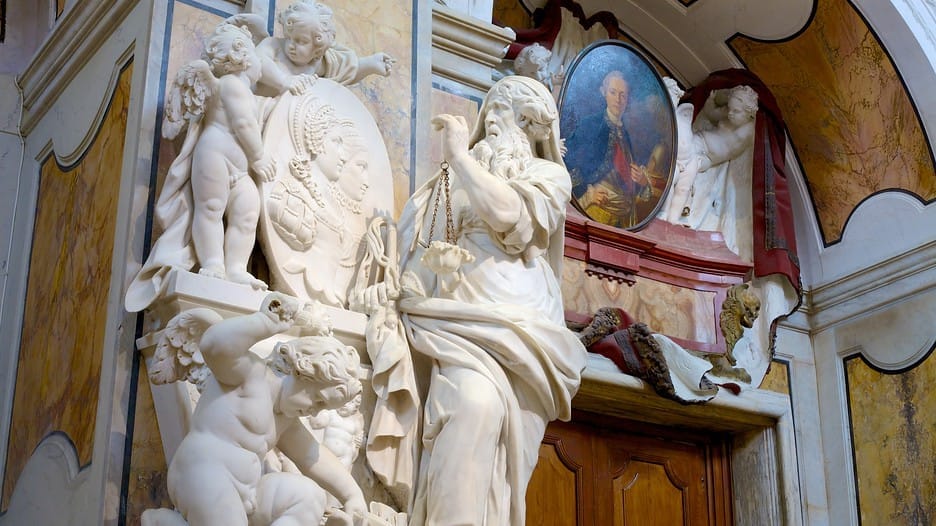
Along the walls, niches hold a series of allegorical sculptures, each representing a virtue. Two of the most technically remarkable are Modesty (La Pudicizia) by Antonio Corradini, which depicts a female figure veiled in a manner nearly as astonishing as the Veiled Christ, and Disillusionment (Il Disinganno) by Francesco Queirolo, which shows a man freed from a net — the net itself carved in marble so fine that individual links appear to have independent tension. Art historians regard Queirolo's net as one of the most technically demanding pieces of 18th-century marble carving in existence.
The ceiling fresco, painted by Francesco Maria Russo in the 1740s, depicts the Glory of Paradise and covers the entire vault. It is rich, warm, and slightly overwhelming in the best baroque tradition. Look up slowly and let your eyes adjust to the depth of the perspective.
In the basement, reached by a staircase, are the Anatomical Machines: two 18th-century skeletons with their arterial and venous systems preserved in extraordinary detail using a technique that has never been fully replicated. Di Sangro claimed responsibility for the process. Whether that is literally true remains debated. Either way, they are deeply unsettling and genuinely fascinating. If you are visiting with children, be aware that the anatomical displays may disturb younger visitors. For more on the strange, layered underworld of Naples' historic centre, the Naples Underground sits just a short walk away and offers a different but equally compelling subterranean experience.
How the Experience Changes by Time of Day
The chapel opens at 9:00 AM and last entry is at 6:30 PM, with closure at 7:00 PM. It is closed every Tuesday and on several public holidays including January 1st, Easter, May 1st, August 15th, and December 25th.
The first entry slot of the day, around 9:00 AM, is generally the quietest. The space itself is small, and even a moderate crowd of 30 people makes it feel congested. In peak season, that threshold is reached by mid-morning. Mid-afternoon, between 2:00 PM and 4:00 PM, tends to be the most crowded window, particularly on weekends and during the spring and autumn travel seasons.
The lighting inside is artificial and consistent regardless of hour, which actually works in the chapel's favour. The sculptures are lit to emphasize texture and depth. Natural light does not play a significant role here, so there is no particular advantage to visiting at golden hour. The advantage of the final entry window is that staff begin gently moving visitors toward the exit, which occasionally creates a quieter last 20 minutes.
⚠️ What to skip
Photography without flash is generally permitted, but the chapel is small and tripods are not allowed. Selfie sticks create genuine problems for other visitors in tight spaces. Phone cameras are adequate for general shots, but replicating the Veiled Christ in a photograph is essentially impossible — the three-dimensional quality is the entire point.
Getting There and the Surrounding Neighbourhood
The chapel sits on Via Francesco de Sanctis, a short lane connecting to Piazza San Domenico Maggiore. The piazza itself is one of the more atmospheric squares in Naples' historic centre, ringed by the exterior of the Gothic church of San Domenico Maggiore and several palazzi. The entrance to Cappella Sansevero is easy to miss: look for the queue rather than the signage.
The nearest Metro stop is Dante on Line 1, approximately a 10-minute walk through the dense grid of the old city. From Piazza Garibaldi (Naples Central Station), the walk takes around 20–25 minutes and passes through Spaccanapoli, the long straight street that bisects the historic centre. It is worth taking slowly rather than rushing.
The immediate area around the chapel contains several of Naples' most significant other stops, which makes clustering your itinerary here logical. The Gesù Nuovo church and Santa Chiara are both within a 5-minute walk, and the San Gregorio Armeno street of nativity craftspeople is nearby. If you are building a full day in the historic centre, the chapel integrates naturally into a half-day loop rather than requiring a dedicated trip.
Practical Notes Before You Go
The chapel is not large. Visitors with significant mobility limitations should be aware that the approach involves cobblestone streets and the basement anatomical display requires staircase access. The main chapel floor is level and accessible, and disabled visitors accompanied by a helper are admitted on a single ticket.
There is no dress code for entry, unlike Naples' active churches, though respectful attire is appropriate given the funerary and religious context. The interior temperature stays reasonably cool year-round, which is a minor blessing during Naples' hot summers. There is no café or shop inside the chapel itself; both exist in the immediate neighbourhood.
For anyone building a Naples itinerary around cultural sites, the Cappella Sansevero pairs naturally with the Naples National Archaeological Museum, which is the other institution in the city that tends to produce genuine moments of stopped-in-your-tracks awe. The two are different in scale and character, but both demonstrate the city's deep relationship with physical craftsmanship and cultural accumulation. A three-day Naples itinerary that includes both, along with Spaccanapoli and the waterfront, covers the essential city without feeling rushed.
Who Should Skip This, and Why
Travellers who find small, crowded interiors claustrophobic may struggle in peak hours. The chapel is genuinely compact, and when it is full the experience is closer to shuffling than contemplating. If you cannot visit early in the morning or during low season, consider whether the conditions will allow the experience to land as intended.
Very young children are often bored by the sculpture-heavy context and may be disturbed by the anatomical displays in the basement. Families with children under 8 or 9 should think carefully about whether this is the best use of limited attention. The admission cost for adults is not negligible, and an impatient child makes the experience harder for everyone in the small space.
People who have already seen extensive baroque sculpture in Rome or Florence may find the chapel's non-Veiled-Christ contents familiar in style. The Veiled Christ itself remains extraordinary regardless of prior exposure, but if the primary draw is the broader baroque program, manage expectations accordingly.
Insider Tips
- Book the very first entry slot of the day, usually around 9:00 AM, if available. You may have the Veiled Christ almost entirely to yourself for the first few minutes, which is the closest the chapel gets to quiet.
- Spend at least 5 minutes circling the Veiled Christ at different angles rather than taking a quick look and moving on. The sculpture changes substantially when viewed from the feet versus the head versus the side. The translucency of the veil reads differently depending on the angle of viewing.
- The chapel is closed every Tuesday without exception. Several travellers arrive on Tuesdays to find a locked door. Check this before building your day around it.
- If you are particularly interested in di Sangro as a historical figure, the chapel's official website carries detailed English-language notes on his biography and the individual commissions. Reading these before visiting adds significant depth to what you see.
- The queue outside the chapel on Saturdays in April and October can stretch past the adjacent piazza. Arrive before the 9:00 AM opening and you will usually be among the first group admitted.
Who Is Cappella Sansevero For?
- Art and sculpture enthusiasts who want direct, close contact with a canonical masterpiece
- Visitors with a specific interest in 18th-century baroque craftsmanship and Neapolitan cultural history
- Travellers who prefer intense, compact experiences over large sprawling museums
- Anyone interested in the history of alchemy, Freemasonry, and Enlightenment-era aristocratic patronage
- Photographers seeking technically challenging and visually extraordinary subjects
Nearby Attractions
Other things to see while in Centro Storico:
- Naples Cathedral (Duomo di Napoli)
The Cattedrale di Santa Maria Assunta, known to locals simply as the Duomo, is Naples' most historically layered religious site. Built over Greek temples, Roman structures, and early Christian basilicas, it has been the spiritual center of the city for seven centuries. It is also where the famous liquefaction of San Gennaro's blood draws thousands of pilgrims three times a year.
- Naples Botanical Garden (Orto Botanico)
The Orto Botanico di Napoli is one of southern Italy's most significant botanical institutions, covering 12 hectares in the heart of Naples with around 9,000 plant species. Free to enter and largely overlooked by tourists, it offers a genuinely quiet counterpoint to the city's sensory intensity.
- Catacombs of San Gennaro
Carved into the volcanic tuff beneath Rione Sanità, the Catacombs of San Gennaro form one of Southern Italy's most significant early Christian sites. Spanning roughly 5,600 square metres across two levels, they preserve underground basilicas, bishop tombs, and some of the oldest Christian frescoes in the Mediterranean world.
- Naples National Archaeological Museum (MANN)
The Museo Archeologico Nazionale di Napoli (MANN) holds one of the most important collections of ancient art on earth, drawing together the treasures of Pompeii, Herculaneum, and the Farnese dynasty. This is not a museum you browse lightly — plan at least two hours and come with a sense of purpose.
Planning a trip? Discover personalized activities with the Nomado app.