Chiesa del Gesù Nuovo: Naples' Most Surprising Baroque Church
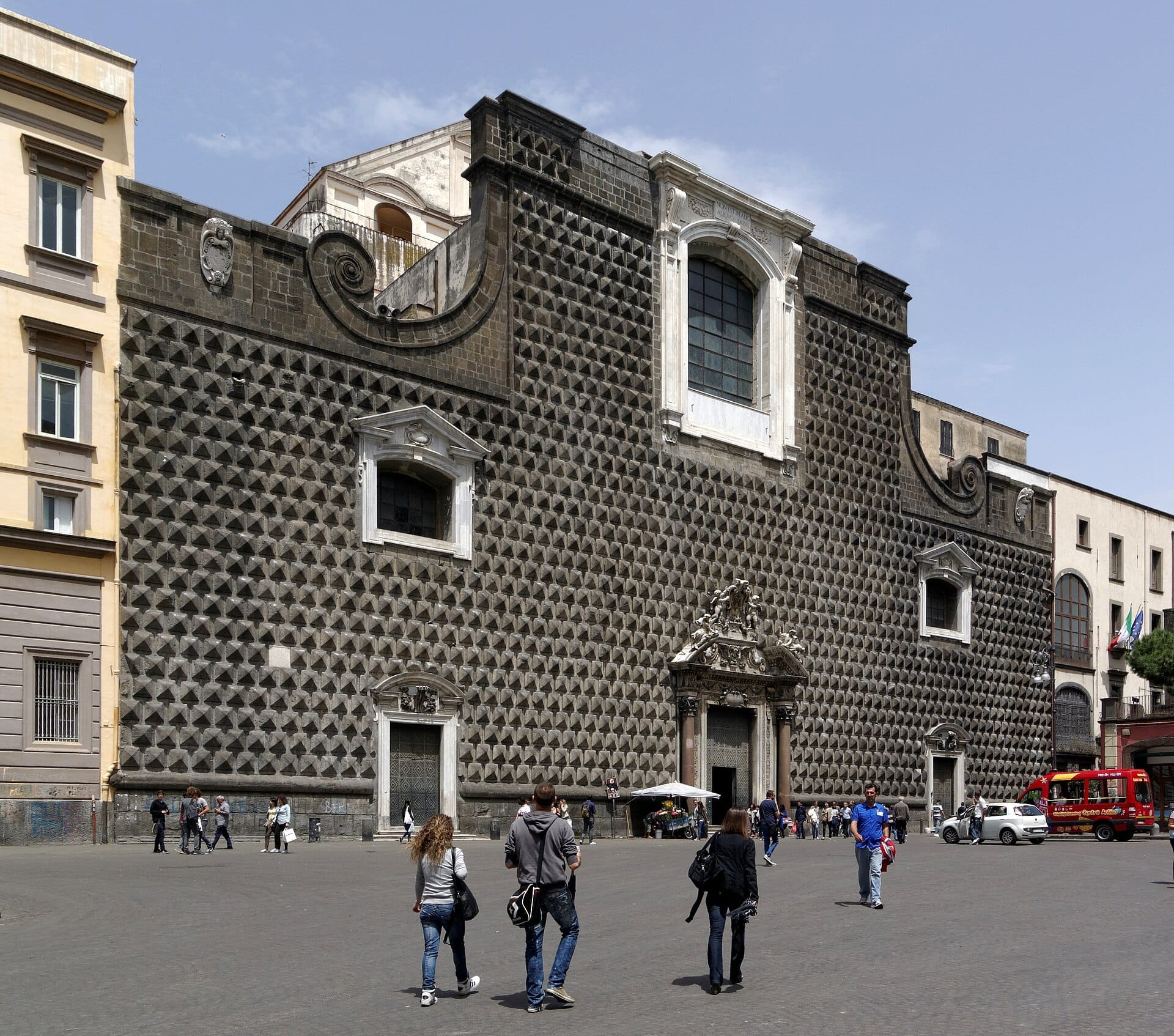
The Chiesa del Gesù Nuovo stands at the heart of Spaccanapoli with one of the most deceptive facades in Italian architecture: a rough diamond-point stone exterior that gives no hint of the gilded Baroque spectacle waiting inside. Free to enter and rarely overcrowded, it rewards visitors who look beyond the more-visited Santa Chiara next door.
Quick Facts
- Location
- Piazza del Gesù Nuovo 2, Spaccanapoli, Naples
- Getting There
- Metro Line 1, Dante station (approx. 200m walk)
- Time Needed
- 45–90 minutes
- Cost
- Free entry
- Best for
- Architecture lovers, history enthusiasts, visitors seeking a quiet spiritual space
- Official website
- http://www.gesunuovo.it/
What Is the Chiesa del Gesù Nuovo?
The Chiesa del Gesù Nuovo is a large Jesuit church on Piazza del Gesù Nuovo, one of the most recognizable squares in the historic centre of Naples. Built between 1584 and 1601 on the shell of a 15th-century aristocratic palace, it is simultaneously a major Baroque monument, an active place of Catholic worship, and a pilgrimage site devoted to Dr. Giuseppe Moscati, a physician canonized in 1987 whose memory the Neapolitans have not let go.
The building is categorised as a Jesuit church of the Counter-Reformation, sharing DNA with the Gesù in Rome but distinguished by its radically unusual exterior. Entry is free, the church is open every day, and because most visitors walk straight past it toward Santa Chiara, the interior is quieter than its importance deserves.
💡 Local tip
Hours can vary slightly by day and season. The most reliable mid-morning window is 9:00 AM to 12:30 PM on weekdays. Arrive before 10:00 AM if you want the nave mostly to yourself and good light in the chapels.
The Facade: An Architectural Puzzle
The first thing anyone notices about the Gesù Nuovo is the exterior wall: a dense grid of protruding diamond-point stone blocks that covers the entire facade. This technique, called bugnato a punta di diamante in Italian, was already in place when the Jesuits acquired the property in the 1580s. It belonged to the original 1470 palace built for Roberto Sanseverino, Prince of Salerno, and the order simply kept it, adding only a Baroque portal and upper pediment.
The result is visually disorienting. The faceted stonework catches light at sharp angles throughout the day, creating a texture closer to a Renaissance fortress than a church. In the early morning, when low sun hits the facade from the east, each stone protrusion casts a small shadow and the whole surface comes alive with geometric depth. By midday the effect flattens. Photographers get the best results before 10:00 AM or on overcast days when the texture reads cleanly without blown highlights.
Research published in 2010 by musicologist Vincenzo De Lutiis proposed that the stone blocks carry a coded musical inscription, their arrangement corresponding to notes in a Baroque composition. The theory has not achieved scholarly consensus, but the church prominently displays related information inside, and it adds another layer of intrigue to a facade that already demands attention.
Tickets & tours
Hand-picked options from our booking partner. Prices are indicative; availability and final rates are confirmed when you complete your booking.
Pompeii and Mount Vesuvius tour with transportation
From 110 €Instant confirmationFree cancellationOrigins and legends of Naples walking tour
From 28 €Instant confirmationFree cancellationGuided walking tour of Naples city and Naples underground
From 45 €Instant confirmationFree cancellationMount Vesuvius and Herculaneum tour with transportation
From 100 €Instant confirmationFree cancellation
Step Inside: The Baroque Interior
Nothing about the exterior prepares you for what is inside. The nave of the Gesù Nuovo is a full-scale Baroque theatre: gilded stucco, frescoed vaults, polychrome marble floors, and a series of chapels lined with works by Francesco Solimena, Luca Giordano, and other major figures of the Neapolitan school. The Greek cross plan, designed by architect Giuseppe Valeriano, channels attention toward the high altar while giving equal visual weight to each of the eleven lateral chapels.
The afternoon light, entering from the upper windows between roughly 4:30 PM and 6:30 PM, rakes across the gilded surfaces at an angle that intensifies the gold tones and makes the frescoes appear to glow. Visiting during this window, especially on a clear day in spring or autumn, produces a genuinely different experience from a morning visit. The church is busiest during the late-afternoon reopening when locals stop in after work, so if contemplation is the goal, aim for the first half-hour of the morning session.
The dome above the crossing was rebuilt twice, after collapses in 1688 and 1786, giving the current structure a relatively late-Baroque character compared to the chapels below. For a more detailed look at Neapolitan religious architecture and how it compares across the city's many churches, the guide to the best churches in Naples provides useful context.
The Moscati Shrine: A Living Pilgrimage Site
The left transept of the church is dedicated to Giuseppe Moscati, a Neapolitan doctor who died in 1927. Moscati worked at the Ospedale degli Incurabili treating patients who could not afford fees, and became known across the city for combining medical precision with a refusal to send anyone away unhelped. He was beatified in 1975 and canonized by Pope John Paul II in 1987.
The chapel built around his memory is unlike the grand Baroque spaces elsewhere in the church. It is intimate and intensely local. The walls are lined floor to ceiling with small metal ex-votos, those small plaques, anatomical models, and handwritten notes left by people who believe Moscati interceded on their behalf. Crutches, medical instruments, and photographs are mixed in among them. The accumulation is dense and oddly moving regardless of religious belief: it is a documented archive of suffering and gratitude that no official museum could manufacture.
A reconstruction of Moscati's study occupies one side of the chapel, with his original furniture and medical equipment. Pilgrims come specifically for this space, and at most hours of the day at least a few people are seated here in prayer. Keep voices low and avoid flash photography in the chapel.
Practical Walkthrough: How to Visit
The church sits on Piazza del Gesù Nuovo, a wide square with a Guglia dell'Immacolata (an 18th-century Baroque obelisk) at its centre. The piazza is a natural gathering point in Spaccanapoli and is often filled with students from the nearby university and people eating lunch on the steps. The square itself is worth a few minutes before or after entering.
Dress code applies: shoulders and knees must be covered. The church provides no loan scarves or shawls, so come prepared. Bags are not checked at the door but photography of the chapels is permitted without flash. The interior is entirely free to walk. There are no timed entry requirements, no queuing system, and no audio guide rental on site, though guidebooks and informational panels in English are available near the entrance.
The Gesù Nuovo sits directly on the Spaccanapoli axis, the long straight street that cuts across the historic centre. Spaccanapoli makes an excellent walking route to pair with the church, connecting it to dozens of other monuments within a few hundred metres in each direction.
ℹ️ Good to know
Opening hours: Monday to Saturday 9:00 am - 12:30 pm and 5:00 pm - 7:15 pm; Sunday 8:30 am - 1:30 pm and 4:30 pm - 7:30 pm. These hours are verified but can shift for religious feast days, so check the official website before planning a tight itinerary.
How It Fits Into Your Time in Naples
The Gesù Nuovo rarely needs more than an hour, but it pairs naturally with the buildings immediately around it. Santa Chiara, the Gothic monastery complex directly across the square, has a famous majolica-tiled cloister that takes another 45 minutes. The two together form one of the strongest single-hour culture stops in the entire city without costing a euro.
The Cappella Sansevero, home to the Veiled Christ sculpture, is a five-minute walk east along Spaccanapoli and is the natural third stop on a morning circuit. Note that Sansevero charges admission and has limited capacity, so book ahead if visiting on a weekend.
Those building a full day around the historic centre should also consider the Naples National Archaeological Museum, reachable in about fifteen minutes on foot from the piazza, for a complete picture of the city's layered history from Greek and Roman antiquity through to the Counter-Reformation.
Travelers with very limited time in Naples should know that the Gesù Nuovo is not essential if the priority is art rather than architecture and atmosphere. The Cappella Sansevero and the archaeological museum have higher concentrations of individually unmissable objects. The Gesù Nuovo rewards the curious and the unhurried; it is not the right choice for someone with only two hours and a fixed list.
Weather, Seasons, and When to Go
Because the church is indoors, weather affects the visit mainly in two ways: the quality of natural light inside and the crowd level outside on the piazza. April through June and September through October bring the most balanced conditions: moderate temperatures, long daylight hours for afternoon visits, and fewer tour groups than July and August. Summer visits are perfectly viable but the piazza and streets around it become significantly more crowded from late morning onward, and the interior can feel stuffy during heatwaves despite its stone construction.
Winter visits have their own character. The piazza empties between afternoon sessions, the city's Christmas atmosphere seeps into the surrounding streets, and the church's gold interior feels particularly warm against the grey December light. Rain doesn't affect the visit at all once you're inside, making this an excellent option for a wet afternoon.
For a broader sense of when Naples rewards visitors most, the best time to visit Naples guide covers seasonal trade-offs in detail.
Insider Tips
- The diamond-point facade is best photographed in the first hour after sunrise or on a lightly overcast day. Harsh midday sun flattens the texture completely.
- Attend a Sunday morning Mass if you want to hear the church's acoustic properties: the Greek cross plan and marble surfaces create a resonance that is impossible to appreciate in silence during tourist hours.
- The reconstruction of Moscati's study in the left transept includes original medical instruments and personal items. Read the panel beside it slowly; the details of his working life are specific and human in a way guidebook summaries never capture.
- The Guglia dell'Immacolata in the square outside is a Baroque obelisk erected in 1750 and worth a close look before you enter. The sculpted figures at its base are frequently ignored by visitors heading straight for the church door.
- If the church is closed when you arrive (mid-afternoon before the 5:00 PM reopening), use the time to walk the Santa Chiara complex across the square, which has different hours and fills the gap perfectly.
Who Is Gesù Nuovo Church For?
- Architecture and design enthusiasts interested in the Counter-Reformation Jesuit aesthetic
- Travelers curious about local religious culture and living pilgrimage traditions
- Photography focused visitors who want a geometrically striking exterior alongside rich interior shots
- Visitors combining a full Spaccanapoli walking route through the historic centre
- Anyone seeking a free, unhurried cultural stop that most tourists underestimate
Nearby Attractions
Other things to see while in Spaccanapoli:
- Complesso Monumentale di Santa Chiara
Built by Angevin royalty in the 14th century, the Complesso Monumentale di Santa Chiara is one of the largest religious complexes in Naples. Its Gothic basilica, majolica-tiled cloister, and attached museum make it a genuinely rewarding stop in the heart of Spaccanapoli.