Naples National Archaeological Museum (MANN): What to See, Know, and Expect
The Museo Archeologico Nazionale di Napoli (MANN) holds one of the most important collections of ancient art on earth, drawing together the treasures of Pompeii, Herculaneum, and the Farnese dynasty. This is not a museum you browse lightly — plan at least two hours and come with a sense of purpose.
Quick Facts
- Location
- Piazza Museo, 19, Centro Storico, Naples
- Getting There
- Metro Line 1 (Museo stop) or Line 2 (Cavour stop)
- Time Needed
- 1.5 to 3 hours depending on depth of interest
- Cost
- Full €18 / Reduced €2 / Ages 18-24 €8 / Under 18 free. Included in Naples City Card.
- Best for
- History lovers, Pompeii visitors, classical art enthusiasts, families with older children
- Official website
- mann-napoli.it
Why the MANN Deserves More Than an Afternoon
The Museo Archeologico Nazionale di Napoli, universally shortened to MANN, is not just the best museum in Naples. It is one of the world's most important repositories of Greco-Roman antiquities, especially for the Bay of Naples region. No other single institution concentrates this much of ancient daily life, monumental sculpture, and fine decorative art from Pompeii, Herculaneum, and the surrounding area. If you are visiting Pompeii or Herculaneum, coming here first will reframe everything you see in the excavations.
The museum sits at the northern end of the historic centre, a few minutes' walk from the chaotic street energy of Centro Storico. Its neoclassical facade on Piazza Museo gives little away — inside, the scale is staggering, with over 150,000 items in its permanent holdings spread across multiple floors and wings.
💡 Local tip
Visit on a weekday morning — Wednesday through Friday between 9 and 11 AM sees the fewest visitors. The Secret Cabinet (Gabinetto Segreto), which houses erotic art from Pompeii, requires a separate timed admission request at the ticket desk; ask when you buy your ticket.
The Building Itself: Four Centuries of Reinvention
The structure has had more identities than most Italian institutions. Originally built as cavalry barracks in the late 16th century, it was repurposed in 1616 to house the University of Naples, a function it served for over 150 years. In 1777, King Ferdinand IV transformed it into a royal collection, and by 1816 it had been formalized as the Royal Bourbon Museum — one of the first purpose-organized public museums in Europe. It acquired its current name after Italian unification in 1861.
The architecture reflects this layered history. Ground-floor galleries feature massive vaulted ceilings that belonged to the original barracks. The upper floors shift toward lighter, more academic spaces that accumulated over centuries of renovation. The building is not particularly beautiful, but its weight and solidity feel appropriate for what it contains — objects pulled from two cities that the earth swallowed whole.
Tickets & tours
Live prices and dates from our booking partner. If you book, we may earn a commission at no extra cost to you.
What to See: The Essential Collections
The Farnese Collection
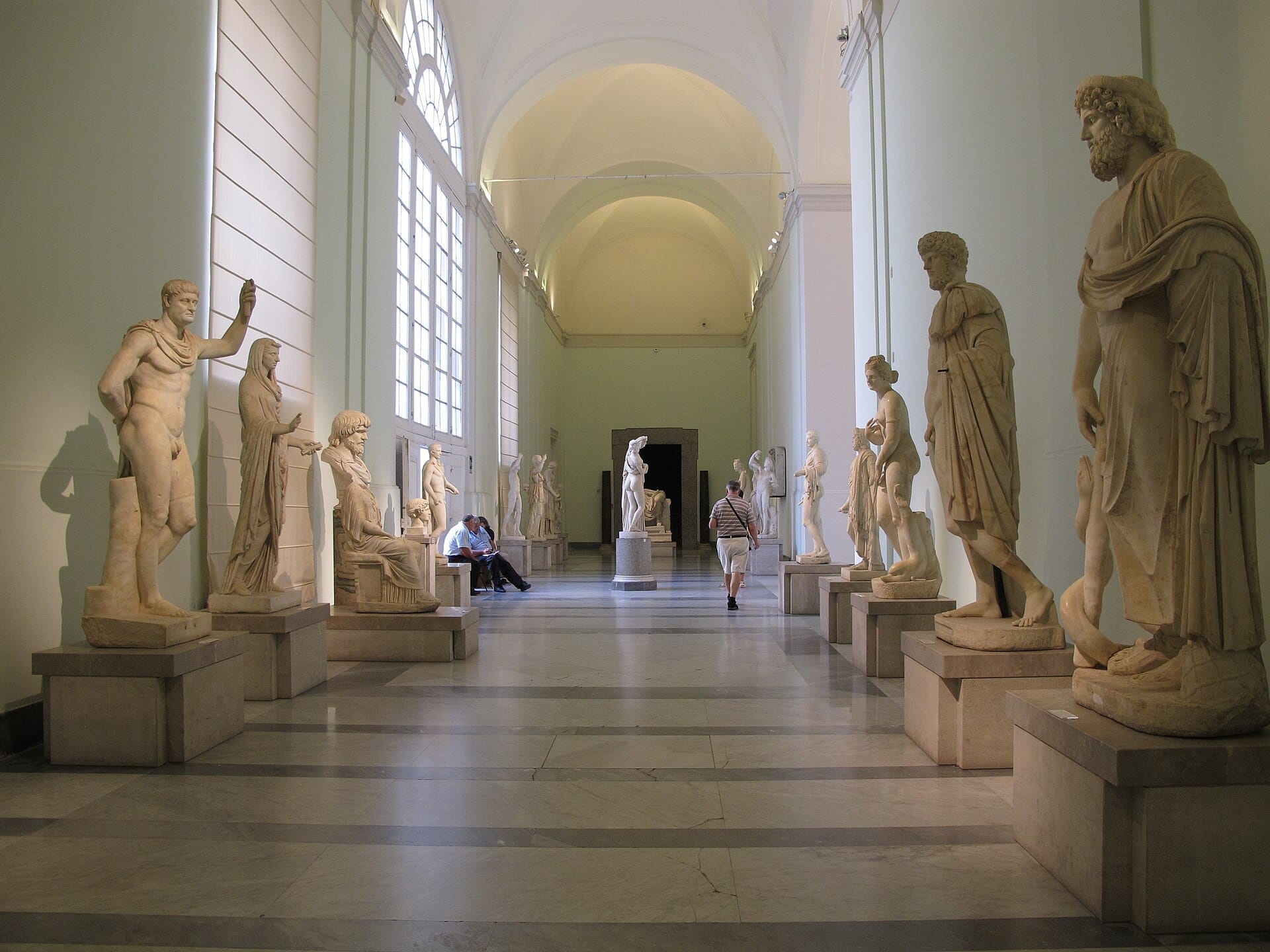
The ground floor is dominated by the Farnese Collection, assembled by Pope Paul III in the 16th century and eventually inherited by the Bourbons. The sculptures here are not merely large — they are overwhelming in person. The Farnese Bull, carved from a single block of marble and standing nearly four metres tall, depicts the punishment of Dirce and remains the largest surviving ancient sculpture group in the world. The Farnese Hercules, a massive Roman copy of a Greek original by Lysippos, shows the hero leaning on his club in exhaustion after completing the Twelve Labours — the weariness in the posture is visible from across the hall.
Also in this section: the Farnese Cup, a first-century BC cameo carved from a single piece of sardonyx agate, roughly 20 centimetres in diameter. It is displayed in a small vitrine and easy to walk past — do not. The layered carving using the natural banding of the stone to create depth and shadow is the kind of technical achievement that makes you stop calculating centuries and just stare.
Pompeii and Herculaneum: Mosaics, Frescoes, and Everyday Objects
The first-floor galleries contain the objects removed from Pompeii and Herculaneum during excavations spanning the 18th and 19th centuries. Many of the finest pieces were immediately transferred here, which is why the archaeological sites themselves — though extraordinary — feel stripped of their most delicate treasures.
The mosaic of the Battle of Issus, measuring roughly five by three metres and composed of an estimated 1.5 million tesserae, is one of the most significant surviving works from antiquity. It depicts the moment Alexander the Great defeated Darius III of Persia, and the detail in the faces — especially the terror in Darius's expression — is extraordinary. Found in the House of the Faun in Pompeii, it required an entire room to be designed around it at the museum.
The frescoes from Pompeii and Herculaneum fill several galleries with rich reds, cobalt blues, and the garden scenes that would have decorated wealthy dining rooms. The colour survives because the volcanic ash that buried these cities also sealed the pigment. Seeing these panels after visiting the excavation sites adds a layer of understanding that neither experience provides alone.
The Secret Cabinet (Gabinetto Segreto)
This collection of erotic art from Pompeii and Herculaneum was so disturbing to 18th-century sensibilities that it was locked away for over a century, accessible only to scholars with written permission from the king. It was finally opened to the general public in 2000. The objects range from explicit frescoes and bronze figurines to decorated oil lamps and fertility amulets — items that would have been ordinary household objects in ancient Roman culture. The collection is not salacious so much as genuinely illuminating about Roman attitudes toward sexuality, prosperity, and the body.
The Gem Collection and Papyri
The gem collection exceeds 2,000 pieces and includes cameos and intaglios of extraordinary delicacy. Less visited but equally remarkable: the carbonized papyri from the Villa dei Papiri at Herculaneum, a private library that was sealed by volcanic material in 79 AD. These are some of the only surviving manuscript texts from the ancient world. Ongoing attempts to read the blackened rolls using multispectral imaging and, more recently, AI-assisted decipherment have made international headlines — the museum holds objects that are still yielding new knowledge.
How the Experience Changes by Time of Day
In the first hour after opening, the Farnese galleries are nearly silent. Natural light enters from high windows and catches the surface of the marble differently than later in the day when tour groups arrive and the overhead lighting dominates the perception of the space. The mosaic room fills quickly after 11 AM and can become difficult to approach closely on weekends — if the Battle of Issus is a priority, be there early.
Midday is the most crowded period, particularly between 12 and 2 PM when cruise passengers on day tours move through in organized groups. The upper floors — particularly the gem collection and the Magna Graecia galleries — stay quieter throughout the day and reward visitors who venture past the first-floor highlights. Late afternoon, after 4 PM, brings a second quieter window before the museum closes at 7:30 PM.
ℹ️ Good to know
The museum is generally open daily, 9:00 AM to 7:30 PM, and closed on Tuesdays plus major holidays such as January 1st, May 1st, and December 25th. Pass inclusions change, so check the current official card or ticket terms before assuming Pompeii, Naples Underground, or other major sites are covered.
Getting There and Practical Details
The MANN is one of the easiest major attractions in the city to reach by public transport. Metro Line 1 stops directly at Museo station; Line 2 stops at Cavour, a three-minute walk. Both metro lines are accessible from the central transport hub at Piazza Garibaldi, making this a logical first stop if you arrive at Naples Centrale by train.
The museum entrance is on Piazza Museo. There is a bag storage area near the entrance — large backpacks and rolling luggage must be checked. Photography is permitted in most galleries without flash; tripods are not allowed. The building is largely wheelchair accessible via lift, though some smaller gallery spaces have thresholds that can be awkward.
Online booking is available and costs slightly more than the door price but skips the ticket queue, which on weekend mornings can run 20 to 30 minutes. If you hold a Naples City Card, you still need to exchange it for a museum ticket at the desk — factor in this step.
⚠️ What to skip
Some galleries are periodically closed for restoration without advance notice. The Egyptian collection and parts of the prehistoric section have been intermittently unavailable in recent years. Check the museum's website before visiting if a specific collection is your priority.
Honest Assessment: Who This Museum Is For
The MANN is one of the few institutions that genuinely justifies the phrase 'world-class'. The density of significant objects per square metre is hard to match anywhere. That said, if your interest in ancient history is passing rather than sustained, the experience can feel overwhelming rather than enriching. There are no interactive displays or digital interpretation tools that rival what you find in northern European museums. The labelling is in Italian and English, but the English translations are sometimes sparse, particularly in the gem and numismatic galleries.
Visitors with young children will find the museum challenging. The scale of the building works against short attention spans, and there is no dedicated family activity area. Older children and teenagers with an interest in history, or those who have studied the Roman world at school, respond very differently. If you are planning a trip to Pompeii after the museum, consider pairing those visits — the MANN provides context that transforms what you see at the excavations. For more on making that connection, the guide to getting from Naples to Pompeii covers logistics in detail.
Art lovers who focus primarily on Renaissance or Baroque painting will find the highlights here rewarding but may prefer to spend equivalent time at the Museo e Real Bosco di Capodimonte, which holds the stronger collection for those periods. The MANN belongs to ancient history — it does that one thing at a level nothing else in the city approaches.
Insider Tips
- Ask specifically at the ticket desk to access the Secret Cabinet (Gabinetto Segreto) — it is not always prominently signposted and staff do not always mention it unprompted.
- The museum has a café on the ground floor, but it is average and expensive. The streets immediately around Piazza Museo have several decent coffee bars where you can take a break mid-visit and return — your ticket is valid for re-entry on the same day.
- If you plan to visit Pompeii and Herculaneum on the same trip, visit the MANN first, not after. The mosaics and objects here are the finest pieces removed from both sites — seeing them before the excavations gives the ruins context that dramatically improves the experience.
- The numismatic collection on the upper floors is rarely visited and almost always quiet. If you hit the main galleries at peak hours, retreat upstairs — the coin collection is genuinely impressive and you will often have entire rooms to yourself.
- The museum's restoration workshop is a recognized centre of excellence — occasionally visible through glass panels near the main galleries. If you spot activity, it is worth pausing: watching conservators work on ancient objects is its own kind of education.
Who Is Naples National Archaeological Museum (MANN) For?
- Travelers visiting Pompeii or Herculaneum who want the full archaeological picture
- Classical history and ancient art enthusiasts who want depth over breadth
- Dedicated museum-goers who can spend two or more hours in a single collection
- Caravaggio fans — the Pio Monte della Misericordia is nearby and the two visits pair well for a full art morning
- Travelers on a Naples City Card looking to maximize the value of their pass
Nearby Attractions
Other things to see while in Centro Storico:
- Cappella Sansevero
Cappella Sansevero is a small baroque chapel in Naples' historic centre that contains one of the most technically staggering sculptures in the world: the Veiled Christ, a life-sized marble figure so realistically carved it appears draped in real fabric. The chapel is compact, deeply atmospheric, and almost certainly unlike anything else you will see in Italy.
- Naples Cathedral (Duomo di Napoli)
The Cattedrale di Santa Maria Assunta, known to locals simply as the Duomo, is Naples' most historically layered religious site. Built over Greek temples, Roman structures, and early Christian basilicas, it has been the spiritual center of the city for seven centuries. It is also where the famous liquefaction of San Gennaro's blood draws thousands of pilgrims three times a year.
- Naples Botanical Garden (Orto Botanico)
The Orto Botanico di Napoli is one of southern Italy's most significant botanical institutions, covering 12 hectares in the heart of Naples with around 9,000 plant species. Free to enter and largely overlooked by tourists, it offers a genuinely quiet counterpoint to the city's sensory intensity.
- Catacombs of San Gennaro
Carved into the volcanic tuff beneath Rione Sanità, the Catacombs of San Gennaro form one of Southern Italy's most significant early Christian sites. Spanning roughly 5,600 square metres across two levels, they preserve underground basilicas, bishop tombs, and some of the oldest Christian frescoes in the Mediterranean world.
Planning a trip? Discover personalized activities with the Nomado app.