Naples Cathedral (Duomo di Napoli): What to Know Before You Visit
The Cattedrale di Santa Maria Assunta, known to locals simply as the Duomo, is Naples' most historically layered religious site. Built over Greek temples, Roman structures, and early Christian basilicas, it has been the spiritual center of the city for seven centuries. It is also where the famous liquefaction of San Gennaro's blood draws thousands of pilgrims three times a year.
Quick Facts
- Location
- Via Duomo 147, Centro Storico, Naples
- Getting There
- Metro Line 1 – Duomo stop (approx. 300m); Metro Line 2 – Piazza Cavour (approx. 400m)
- Time Needed
- 1–2 hours for cathedral + chapel; up to 3 hours with museum
- Cost
- Free entry to main cathedral; Chapel of San Gennaro + Tesoro museum require a separate paid ticket
- Best for
- History lovers, architecture enthusiasts, pilgrims, and anyone curious about Neapolitan culture
- Official website
- duomonapoli.it/en
What the Duomo di Napoli Actually Is
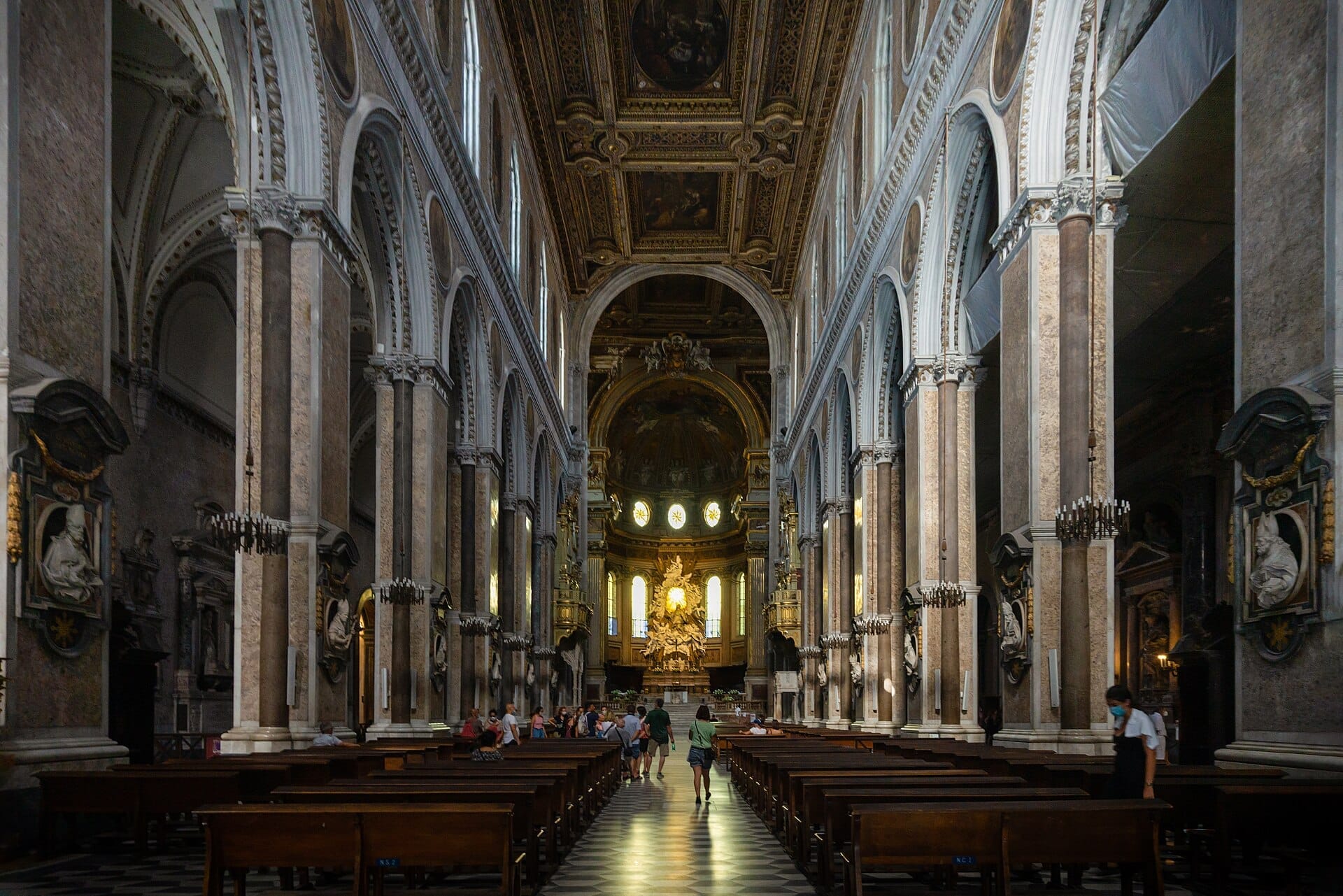
The Naples Cathedral, officially named the Cattedrale di Santa Maria Assunta, is commonly known as the Duomo di Napoli. It sits on Via Duomo in the heart of the historic center, a street that cuts straight through one of the oldest continuously inhabited urban grids in the Western world. The building you walk into today was begun in 1294 under Charles I of Anjou and continued under Charles II and Robert of Anjou, reaching completion in the early 14th century. But the story underneath goes back far further.
Below the cathedral's foundations lie the remnants of Greek and Roman temples, two paleo-Christian basilicas from the 4th and 5th centuries, and layers of archaeological material that span roughly 2,000 years. Naples is a city where history accumulates rather than replaces itself, and nowhere is that more literal than here. The main nave stretches approximately 100 meters in length and rises to around 35 meters at its highest point, with the full three-nave structure reaching over 48 meters at its vault. The scale is significant without being overwhelming, and the interior manages to feel intimate in places despite its size.
💡 Local tip
Entry to the main cathedral is free, but access to the Chapel of San Gennaro and the Tesoro di San Gennaro museum requires a separate paid ticket. Budget time for both. The underground archaeological area is often overlooked and worth seeking out.
The Architecture: Gothic Bones, Baroque Flesh
The facade you approach on Via Duomo is a 19th-century Neo-Gothic reconstruction, completed in 1905 following earthquake damage. It is detailed and vertical, with pointed arches and stone tracery that read as medieval from a distance but feel somewhat theatrical up close. First-time visitors expecting original Gothic stonework may be mildly surprised: this is a restoration that matches the spirit of the original rather than preserving its fabric.
Step through the main portal and the interior tells a different story. The Angevin Gothic structure is still intact in its essential bones: tall pointed arches, a rhythmic procession of columns down the central nave, and a quality of light that shifts from cool grey in the morning to gold in the afternoon as sun moves through the clerestory windows. Over the centuries, successive chapels, altarpieces, and decorative programs were added, so the walls read as a compressed history of Neapolitan art from the medieval period through the Baroque. Look up at the coffered ceiling to see 16th-century painted panels depicting saints and biblical scenes, a feature that softens what would otherwise be a severe Gothic ceiling.
Along the right nave, visitors pass through into the Cappella Minutolo. For a more theatrical sacred-art experience elsewhere in the historic centre, Cappella Sansevero is the obvious comparison. The Cathedral's Cappella Minutolo, though, is particularly notable for its preserved medieval frescoes, among the best surviving examples of 14th-century painting in southern Italy. Most visitors walk past without stopping. Do not.
Tickets & tours
Live prices and dates from our booking partner. If you book, we may earn a commission at no extra cost to you.
Origins and legends of Naples walking tour
From 28 €Instant confirmationFree cancellationGuided walking tour of Naples city and Naples underground
From 45 €Instant confirmationFree cancellationCaserta Royal Palace day-trip from Naples
From 100 €Instant confirmationFree cancellationSafe and Convenient 24-7 Luggage Storage in Naples
From 6 €Instant confirmationFree cancellation
The Chapel of San Gennaro: The Emotional Heart of Naples
If you visit only one part of the cathedral beyond the main nave, make it the Cappella del Tesoro di San Gennaro. Built between 1527 and 1646, this side chapel is one of the most extraordinary Baroque interiors in Italy, and locals hold it in a reverence that has no parallel in other Italian cities. The chapel was built following a vow made by the city during the 1527 plague epidemic, on the condition that San Gennaro, Naples' patron saint, would protect the city. He is credited with doing exactly that.
The interior is saturated with frescoes by Domenichino and Giovanni Lanfranco, competing works painted during an acrimonious artistic rivalry that is well documented in Neapolitan art history. The ceiling fresco by Lanfranco depicting the Glory of Paradise is particularly striking: figures seem to dissolve into light as your eye moves upward. The silver bust reliquary of San Gennaro, encrusted with gemstones donated by the city over four centuries, sits behind an elaborate iron gate along with two vials said to contain the saint's blood.
The liquefaction of San Gennaro's blood is one of the most charged public rituals in European religious life. Three times a year, on the Saturday before the first Sunday in May, on September 19th (the feast day), and on December 16th, the Cardinal holds up the vials before a crowd of Neapolitans who watch in near-silence to see whether the dried, dark substance inside will liquefy. If it does, the city considers itself protected for another year. If it does not, the atmosphere in the cathedral becomes genuinely tense. This is not a ceremony for tourists, but visitors are welcome to attend. Arriving very early is essential.
The Underground: What Lies Beneath
Below the main floor, an archaeological excavation area is accessible through the sacristy. This descends through strata of the city's pre-medieval past: Greek walls, Roman-era mosaics, and the structural remains of the paleo-Christian Basilica of Santa Restituta, which includes the Baptistery of San Giovanni in Fonte, the latter containing what is believed to be the oldest baptistery in the Western world, with 5th-century mosaic decoration still partially intact.
This underground layer is less well known than the famous Napoli Sotterranea tunnels nearby, but for visitors interested in the deep chronology of the city, it is arguably more revealing. The basilica of Santa Restituta, incorporated into the left aisle of the cathedral itself, dates to the 4th century and contains a chapel with a Luca Giordano ceiling fresco from the 1680s, a neat compression of 1,300 years in a single room.
How the Experience Changes by Time of Day
Morning visits before 10am offer the quietest experience. The cathedral's stone interior holds the cool of the night until mid-morning, and the quality of light through the upper windows is flattering for photography without the harsh midday flattening. The nave smells faintly of stone dust and incense, more stone than perfume, which anchors the experience in something genuinely old rather than ceremonial.
By late morning, school groups and tour parties arrive and the nave becomes considerably louder. Whispered Italian commentary echoes off the vaulted ceiling in a way that can feel intrusive if you came for contemplation. Midday in summer pushes temperatures outside past 30°C, making the interior a practical refuge, but also its most crowded window. Late afternoon, roughly from 4pm onward, brings a second quieter period as most organized groups have departed, and the light through the western-facing windows takes on a warmer tone.
Sunday mornings mean active services, which restricts tourist access to parts of the cathedral. If attending Mass is not your intention, aim for a weekday morning or a weekday afternoon. Via Duomo itself is a working commercial street, narrow and trafficked by motorcycles and delivery vehicles, so arriving on foot from the metro is easier than by car.
⚠️ What to skip
Dress code is strictly enforced: covered shoulders and knees are required for all visitors. Scarves or wraps are sometimes available at the entrance but bringing your own is more reliable. Backpacks may need to be removed in the chapel area.
Getting There and Practical Logistics
The cathedral is straightforward to reach from the Centro Storico. Metro Line 1 has a stop named Duomo, approximately 300 meters from the entrance, while Line 2's Piazza Cavour stop is around 400 meters away. Both are walkable in under five minutes through streets that are narrow, atmospheric, and occasionally chaotic. The walk from Piazza Cavour takes you past market stalls and small workshops that give a clearer picture of daily Neapolitan life than many tourist routes.
If you are combining the cathedral with other sites in the area, San Gregorio Armeno is only a few minutes' walk west, and the Naples National Archaeological Museum is reachable in under 15 minutes on foot. A focused morning can reasonably cover all three without feeling rushed.
Tickets for the Chapel of San Gennaro and the Tesoro museum are available online through the official site at duomonapoli.it, which is worth doing in advance during peak months (April through October) to avoid queuing. The museum holds one of the most important collections of sacred treasures in Italy, including jeweled reliquaries, Baroque silver ex-votos, and paintings donated to the saint's cult over four centuries. It is more engaging than most cathedral treasury museums.
ℹ️ Good to know
The Naples Museum Card and some combination tickets include access to the chapel and museum. Check current availability at duomonapoli.it before purchasing separately. Combined tickets with the Museo Filangieri have been available from €15, but pricing should be verified before your visit.
Is It Worth Your Time?
For most visitors to Naples, yes. The cathedral is not the city's most spectacular single interior, and visitors coming directly from Rome's churches or Venice's San Marco may find the exterior underwhelming. But the Duomo di Napoli rewards context. It is the place where the city's relationship with its own past, its devotion to San Gennaro, its layered archaeological identity, and its Baroque artistic ambition all converge in one address. Spending an hour here makes the rest of the historic center more legible.
Visitors who find religious sites dull regardless of their historical depth, or who are primarily focused on Naples' food, street life, or coastal scenery, will not find much here to hold their attention. The main nave without the chapel and museum is visually rich but can be covered in 20 minutes. Spending the entry fee on the chapel and museum elevates the visit considerably.
Insider Tips
- The Cappella Minutolo in the right transept contains some of the finest surviving 14th-century frescoes in southern Italy. There are rarely more than a handful of visitors near it at any time. Slow down here.
- For the San Gennaro liquefaction ceremony on September 19th, arrive at least two hours before the service begins if you want to be inside the chapel. The surrounding streets fill quickly and access becomes restricted.
- The archaeological area beneath the cathedral, including the ancient baptistery of San Giovanni in Fonte, is easy to miss because the entrance is through the sacristy. Ask staff for access rather than assuming it is closed.
- Photography without flash is generally permitted in the main cathedral but may be restricted in the chapel and museum areas. Ask before raising your camera rather than assuming.
- Via Duomo has several good pastry shops and a handful of serious espresso bars. Stop for coffee before entering rather than after: the morning calm on the street before 9am is brief but genuinely pleasant.
Who Is Naples Cathedral (Duomo di Napoli) For?
- Travelers with an interest in medieval and Baroque architecture who want context beyond Rome
- Anyone curious about Neapolitan religious and civic culture, particularly around the cult of San Gennaro
- History-oriented visitors who want to trace the city's Greek, Roman, and early Christian layers in one site
- Photographers working in available light, particularly in the early morning or late afternoon
- Visitors building a full Centro Storico walking itinerary combining churches, markets, and street life
Nearby Attractions
Other things to see while in Centro Storico:
- Cappella Sansevero
Cappella Sansevero is a small baroque chapel in Naples' historic centre that contains one of the most technically staggering sculptures in the world: the Veiled Christ, a life-sized marble figure so realistically carved it appears draped in real fabric. The chapel is compact, deeply atmospheric, and almost certainly unlike anything else you will see in Italy.
- Naples Botanical Garden (Orto Botanico)
The Orto Botanico di Napoli is one of southern Italy's most significant botanical institutions, covering 12 hectares in the heart of Naples with around 9,000 plant species. Free to enter and largely overlooked by tourists, it offers a genuinely quiet counterpoint to the city's sensory intensity.
- Catacombs of San Gennaro
Carved into the volcanic tuff beneath Rione Sanità, the Catacombs of San Gennaro form one of Southern Italy's most significant early Christian sites. Spanning roughly 5,600 square metres across two levels, they preserve underground basilicas, bishop tombs, and some of the oldest Christian frescoes in the Mediterranean world.
- Naples National Archaeological Museum (MANN)
The Museo Archeologico Nazionale di Napoli (MANN) holds one of the most important collections of ancient art on earth, drawing together the treasures of Pompeii, Herculaneum, and the Farnese dynasty. This is not a museum you browse lightly — plan at least two hours and come with a sense of purpose.
Planning a trip? Discover personalized activities with the Nomado app.