Via San Gregorio Armeno: Inside Naples' Famous Christmas Alley
Via San Gregorio Armeno is one of the most distinctive streets in the Naples historic centre, famous worldwide for its year-round artisan workshops producing handcrafted nativity figurines. Free to walk, rich in history, and genuinely unlike anywhere else in Italy.
Quick Facts
- Location
- Via San Gregorio Armeno, Historic Centre, Naples 80138
- Getting There
- Walk from Piazza Dante (Metro Line 1) or Piazza Cavour; about 10-15 min on foot
- Time Needed
- 30-60 min for the street; add 1-2 hours for monastery and San Lorenzo Maggiore
- Cost
- Free entry to the street; San Gregorio Armeno Monastery €5; San Lorenzo Maggiore Complex €10 adults, €7 ages 6-18
- Best for
- Cultural curiosity, artisan shopping, photography, families, Christmas travellers
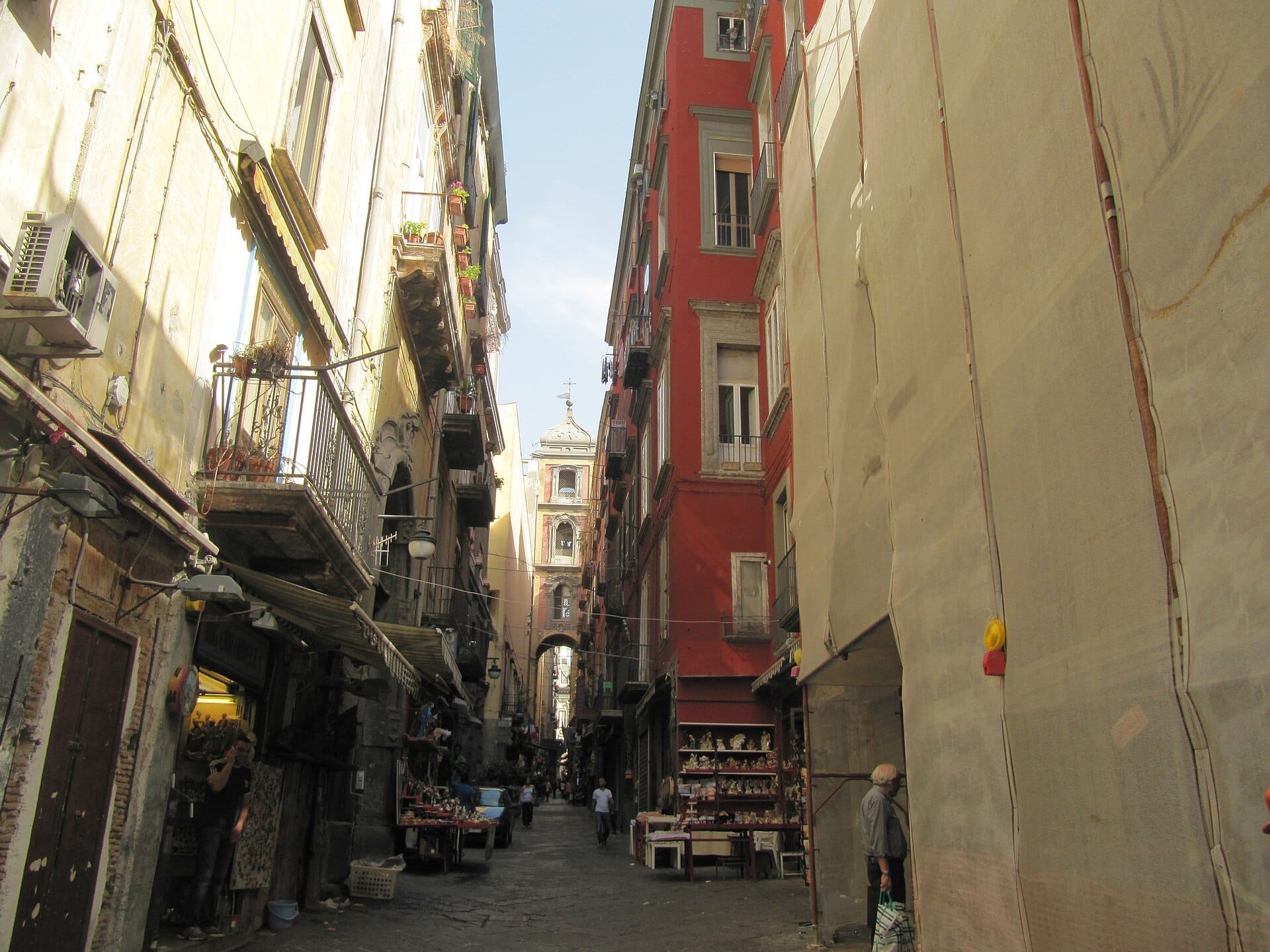
What Is Via San Gregorio Armeno?
Via San Gregorio Armeno is a narrow cobbled lane cutting through the heart of Naples' historic centre, running between Via dei Tribunali to the north and Via San Biagio dei Librai (part of Spaccanapoli) to the south. Known in English as Nativity Street or Christmas Alley, it has been the city's dedicated artisan quarter for nativity craftsmanship since at least the late 18th century, though the street's origins are far older.
The street is short, perhaps 200 metres end to end, but it rewards slow walking. Both sides are lined almost without interruption by workshop-boutiques, many family-run for multiple generations, where artisans produce handmade terracotta figurines ranging from traditional biblical characters to satirical portraits of footballers, politicians, and celebrities. The smell of sawdust, paint, and clay mingles with coffee drifting from a nearby bar. Overhead, strings of lights and suspended nativity scenes create a low ceiling of colour even on grey winter days.
💡 Local tip
The street is free to walk any time. Artisan shops are generally open Monday to Saturday, with some closing for a few hours at midday. Many also open on Sundays during the Christmas season. Arrive before 10:30am to browse without being shoulder-to-shoulder with other visitors.
History: From Roman Temple to Nativity Tradition
The site has been significant for far longer than its Christmas association suggests. Archaeological evidence indicates a Roman temple dedicated to Ceres stood on this ground in antiquity, placing the street within one of the oldest continuously occupied urban zones in Western Europe. When Naples' historic centre was inscribed as a UNESCO World Heritage Site in 1995, Via San Gregorio Armeno was recognised as part of that irreplaceable layer cake of civilisation.
The Benedictine monastery of San Gregorio Armeno, which dominates the upper part of the street, was founded in the 9th century, though the current baroque complex dates largely from the 16th and 17th centuries. The nativity scene tradition, locally called the presepio, became deeply embedded in Neapolitan culture during the 18th century, when noble families competed to commission ever more elaborate tableaux. The artisans who supplied them settled along this street and never left. Today that craft is still very much alive, not ossified into souvenir production but actively evolving.
Tickets & tours
Live prices and dates from our booking partner. If you book, we may earn a commission at no extra cost to you.
Pompeii and Mount Vesuvius tour with transportation
From 110 €Instant confirmationFree cancellationOrigins and legends of Naples walking tour
From 28 €Instant confirmationFree cancellationGuided walking tour of Naples city and Naples underground
From 45 €Instant confirmationFree cancellationMount Vesuvius and Herculaneum tour with transportation
From 100 €Instant confirmationFree cancellation
What You Actually See Walking the Street
The workshops are the main draw, and they divide roughly into two types. The first are traditional studios where figurines are crafted in terracotta and then dressed in hand-sewn fabric, following techniques unchanged for centuries. Shepherds, the Three Kings, angels, and the Holy Family are rendered with remarkable anatomical precision, some standing just a few centimetres tall, others life-size showpieces. Prices range from a few euros for a small unpainted figure to several hundred for a fully dressed, hand-painted centrepiece.
The second type of shop leans into satire and pop culture. This is a distinctly Neapolitan contribution to the tradition. You will find Diego Maradona as a shepherd, Pope Francis mid-blessing, local politicians caught in unflattering poses, and annually updated figures of whoever dominated the news cycle. These are not cheap novelties. Many are finely crafted and reflect the city's longstanding habit of processing current events through irreverent humour. If you want to understand Neapolitan character in one object, a satirical presepio figurine will tell you more than a textbook.
Maradona's presence on the street feels especially charged. The Maradona murals scattered around the city are a form of civic devotion; on Via San Gregorio Armeno, that devotion gets crystallised into terracotta. You will find Diego in at least a dozen incarnations in most shops.
How the Street Changes by Time of Day and Season
Morning visits, particularly between 9am and 10:30am, offer the most comfortable experience. Shop owners are setting out their displays, the light angling down from the south end is clean and photographic, and the lane is navigable. By midday in summer, tour groups flood in and the narrow street becomes a slow shuffle. In the heat of July and August, the experience tips from charming into genuinely uncomfortable.
September through November is widely regarded as the sweet spot. The heat has softened, shops are fully stocked for the pre-Christmas season, artisans are actively working, and visitor numbers are manageable. From mid-November through early January, the street operates at full intensity: additional stalls appear outside the permanent shops, the lighting increases, and the atmosphere becomes genuinely festive. It is also, during this period, the most crowded the street gets all year. Weekend afternoons in December can see foot traffic so dense that forward movement slows to a crawl.
⚠️ What to skip
December weekends between noon and 4pm are extremely crowded. If you visit during this window, be prepared for very slow movement and bring patience. Weekday mornings in December are significantly calmer and the shops are just as well-stocked.
The Monastery of San Gregorio Armeno
Partway up the street, the entrance to the Benedictine monastery of San Gregorio Armeno opens onto a cloistered courtyard that most visitors walk straight past. It is worth the modest admission. The cloister is one of the finest baroque spaces in the city: a well-tended garden with citrus trees, a central fountain topped with an 18th-century sculpture, and surrounding loggia decorated with frescoes and majolica tiles. The contrast with the commercial intensity of the street outside is immediate.
The attached church, which faces Via San Gregorio Armeno itself, is freely accessible and contains a gilded ceiling, a significant collection of 17th-century paintings, and a notable organ. Services are still held here. If you enter during a quiet hour, the sound of the organ being tested or the faint echo of chanting from the still-active community of nuns can be a surprisingly moving experience in a street otherwise defined by commercial energy.
What Else Is Nearby
The northern end of the street meets Via dei Tribunali, one of the historic centre's main arteries and home to some of the best pizza in the city. The Naples Underground (Napoli Sotterranea) entrance is a short walk along Via dei Tribunali, offering access to the Greek-Roman tunnels and cisterns beneath the city.
At the southern end, Via San Biagio dei Librai leads quickly to the Cappella Sansevero, one of Naples' genuinely unmissable interiors, where Sammartino's Veiled Christ sculpture draws visitors from around the world. Plan 20-30 minutes to walk there and book tickets in advance, as the chapel has strict entry limits.
Immediately adjacent is the San Lorenzo Maggiore Complex, open daily from 9:30am to 5:30pm (adult €10, children 6-18 €7, under 6 free), which combines a Gothic basilica with an underground archaeological site where layers of Greek and Roman Naples are visible beneath street level. This pairing, Via San Gregorio Armeno plus San Lorenzo Maggiore, makes for one of the most historically layered morning itineraries in the city.
Practical Notes for Visiting
The street is a public road and accessible at all hours. Artisan shops typically open from around 9am to 7pm, Monday to Saturday, with some variation by season. Many shops close for an hour or two in the early afternoon outside peak season. During November and December, most operate seven days a week with extended hours.
Getting there on foot is straightforward. From Piazza Dante (Metro Line 1), walk east along Via dei Tribunali for about 10 minutes until you see the street sign and the first cluster of nativity displays. From Piazza Cavour (also Metro Line 1), approach from the north via Via Duomo, then turn onto Via dei Tribunali heading west. The street is not accessible by car, and the surrounding historic centre is largely pedestrian.
If this is part of a broader day in the historic centre, see the Naples walking tour guide for a sensible routing that avoids doubling back. The historic centre repays a full day, and Via San Gregorio Armeno sits naturally in the middle of most routes.
The street is narrow and uneven underfoot: cobblestones with gaps, slight inclines, and no dedicated pedestrian infrastructure beyond the lane itself. Wheelchair access is possible but challenging, particularly during busy periods when the pavement is fully occupied by display racks extending from shop fronts. Pushchairs are manageable in quiet hours.
ℹ️ Good to know
Photography: The street is very photogenic at both ends. Shooting from Via dei Tribunali looking south captures the full corridor of hanging decorations. From the Spaccanapoli end, morning light from the east creates a softer effect. Shops generally permit photography of their displays without purchase, but ask first in the working studios.
Who Should Skip This
If you have no interest in crafts, nativity traditions, or artisan culture, and you are visiting in peak summer or December, the crowd-to-payoff ratio may not be worth it. The street is short, and a disengaged visitor can exhaust it in ten minutes. Similarly, travellers with serious mobility limitations may find the cobblestones and narrow crowded conditions frustrating, particularly at peak times.
Insider Tips
- Prices in the shops are often negotiable, particularly if you are buying multiple items or going to a less prominent shop away from the main foot traffic at either end. Haggling is not expected but a polite counter-offer is generally accepted.
- The best figurine quality tends to come from workshops where you can see artisans actively working rather than shops that are purely display-and-sell. Look for the small open studios where pieces are being painted or assembled at a workbench inside.
- If you want the satirical contemporary figures (the celebrities and politicians), browse the shops in the northern third of the street near Via dei Tribunali. The southern end tends toward more traditional religious figures.
- The Monastery of San Gregorio Armeno cloister is one of the most peaceful spaces in the entire historic centre. If the street feels overwhelming, the small entry fee is worth it purely as an escape, quite apart from the artistic interest.
- Combine the visit with a stop on Spaccanapoli immediately after. The southern end of Via San Gregorio Armeno deposits you almost directly onto one of Naples' most atmospheric corridors, making it easy to continue exploring without retracing your steps.
Who Is Via San Gregorio Armeno For?
- Travellers interested in artisan craft and traditional religious folk art
- Families with children who engage easily with the spectacle of miniature figures and workshop activity
- Photography enthusiasts looking for textured, colourful street scenes in the historic centre
- Anyone visiting Naples in the pre-Christmas period who wants to experience a genuinely local seasonal tradition
- Curious visitors who want to understand Neapolitan humour and pop culture through the satirical figurine tradition
Nearby Attractions
Other things to see while in Centro Storico:
- Cappella Sansevero
Cappella Sansevero is a small baroque chapel in Naples' historic centre that contains one of the most technically staggering sculptures in the world: the Veiled Christ, a life-sized marble figure so realistically carved it appears draped in real fabric. The chapel is compact, deeply atmospheric, and almost certainly unlike anything else you will see in Italy.
- Naples Cathedral (Duomo di Napoli)
The Cattedrale di Santa Maria Assunta, known to locals simply as the Duomo, is Naples' most historically layered religious site. Built over Greek temples, Roman structures, and early Christian basilicas, it has been the spiritual center of the city for seven centuries. It is also where the famous liquefaction of San Gennaro's blood draws thousands of pilgrims three times a year.
- Naples Botanical Garden (Orto Botanico)
The Orto Botanico di Napoli is one of southern Italy's most significant botanical institutions, covering 12 hectares in the heart of Naples with around 9,000 plant species. Free to enter and largely overlooked by tourists, it offers a genuinely quiet counterpoint to the city's sensory intensity.
- Catacombs of San Gennaro
Carved into the volcanic tuff beneath Rione Sanità, the Catacombs of San Gennaro form one of Southern Italy's most significant early Christian sites. Spanning roughly 5,600 square metres across two levels, they preserve underground basilicas, bishop tombs, and some of the oldest Christian frescoes in the Mediterranean world.
Planning a trip? Discover personalized activities with the Nomado app.