Maradona Murals & Shrine: Naples' Most Emotional Street Landmark
Painted in 1990 by local artist Mario Filardi to mark Napoli's second Scudetto, the three-story Maradona mural in the Quartieri Spagnoli has grown into a living shrine covered in photos, scarves, candles, and handwritten notes. It is free, open around the clock, and tells you more about Naples than any museum.
Quick Facts
- Location
- Via Emanuele de Deo 60, Quartieri Spagnoli, Naples
- Getting There
- 10-minute walk from Piazza del Plebiscito; Toledo metro station (Line 1) approx. 12 minutes on foot
- Time Needed
- 20–40 minutes to absorb the murals and shrine; longer if the neighborhood draws you in
- Cost
- Free — public street art, open 24/7
- Best for
- Football fans, street art seekers, anyone wanting to understand Neapolitan identity
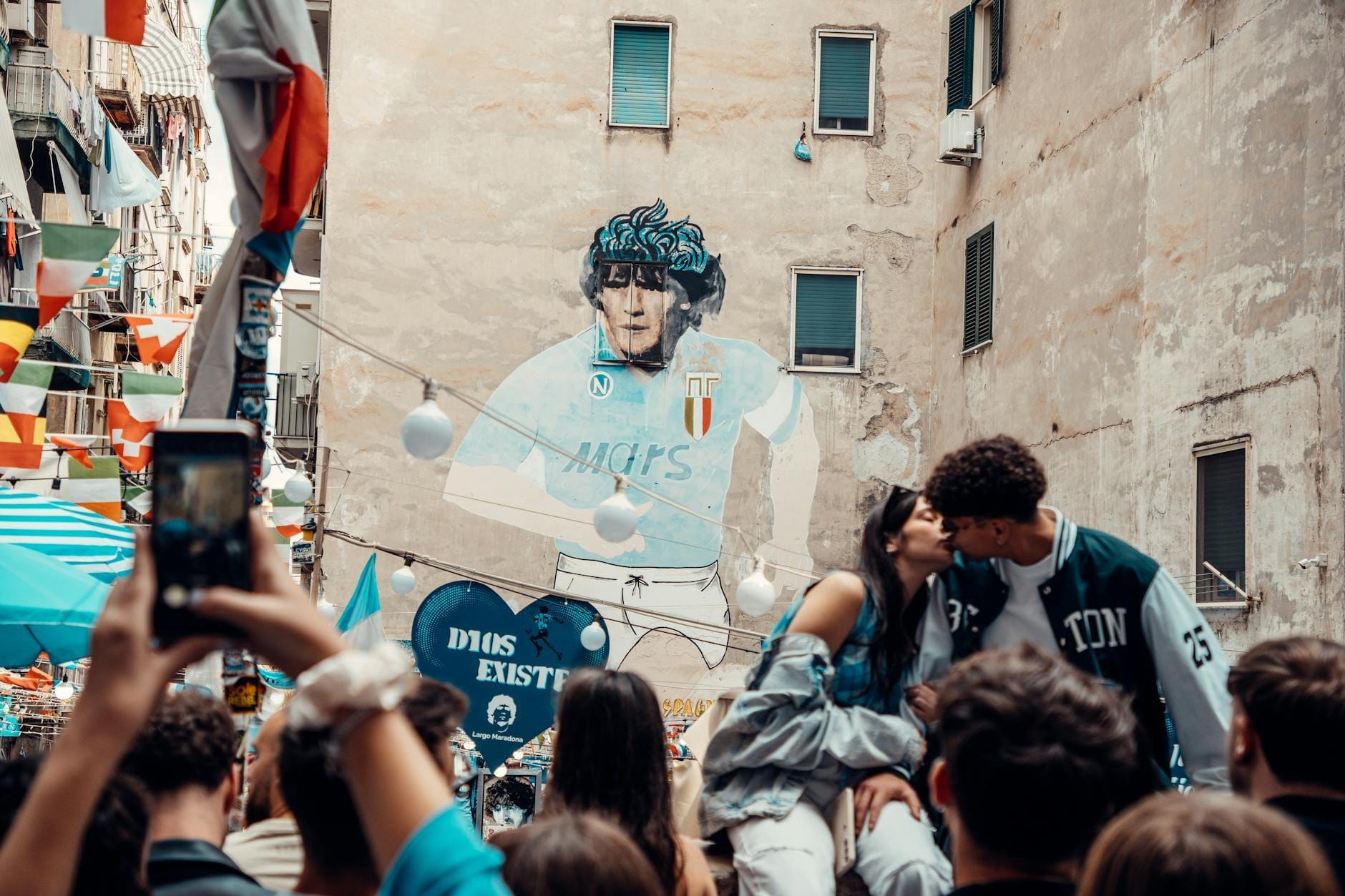
What You're Actually Looking At
The Maradona Murals & Shrine occupies a narrow corner of the Quartieri Spagnoli — specifically a small widening of Via Emanuele de Deo that locals call Largo Maradona. The centerpiece is a three-story-tall mural of Diego Armando Maradona in full stride, painted in 1990 by Neapolitan artist Mario Filardi to celebrate S.S.C. Napoli's second Scudetto (Italian league championship). The mural itself is vivid and unapologetically large: Maradona's face dominates the upper section, painted in the flat, graphic style common to political and sporting murals of that era, while the lower portion gives way to decades of graffiti, additions, and tributes layered on top of each other like geological strata.
Below and around the mural, the shrine proper takes shape. Glass cases, improvised shelves, and ledges hold an accumulation of objects: framed photographs, replica shirts, football scarves from clubs around the world, candles — some still lit — and handwritten notes in Italian, Spanish, and English. After Maradona's death in November 2020, the shrine expanded dramatically. Fresh flowers and new dedications still appear regularly, even years later. This is not a static installation. It changes week to week.
ℹ️ Good to know
The shrine sits on a public street with no barrier or admission fee. There is no official attendant. Visitors are expected to be respectful — this is a place of genuine grief and pride for many locals, not simply a photo backdrop.
The History Behind the Paint
To understand why this mural matters, you need some context about what Maradona's time at Napoli meant to the city. He arrived in 1984, when the club was a mid-table southern side routinely mocked by wealthier northern clubs. By 1987, Napoli had won their first Serie A title — the first major trophy in the club's history. A second Scudetto followed in 1990. For Naples, a city historically sidelined within Italian economic and political life, these wins carried a weight that went far beyond sport. Maradona was not just a footballer here. He was the agent of a long-overdue reversal.
Mario Filardi's mural was painted at the height of that second championship fever. The Quartieri Spagnoli, a dense working-class neighborhood built on a grid by Spanish viceroy Pedro de Toledo in the 16th century, was the kind of place where football allegiance ran deepest. The mural landed on the wall of a building that locals passed every day, and it immediately became a reference point. Over the following three decades, it absorbed the neighborhood's emotions — celebrations, defeats, Maradona's complicated later years, and finally his death.
The Quartieri Spagnoli itself is worth understanding as a place, not just a backdrop. Explore the full neighborhood through our guide to the Quartieri Spagnoli — one of Naples' most architecturally coherent and socially distinct districts.
Tickets & tours
Live prices and dates from our booking partner. If you book, we may earn a commission at no extra cost to you.
Private tour to discover Maradona in Naples
From 280 €Instant confirmationFree cancellationDiego Maradona tour with football, culture and pizza in Naples
From 160 €Instant confirmationFree cancellationTour of Naples and Maradona
From 31 €Instant confirmationFree cancellationOrigins and legends of Naples walking tour
From 28 €Instant confirmationFree cancellation
How the Experience Changes by Time of Day
Morning visits — before 10am — offer the clearest photographs and the most contemplative atmosphere. The narrow alley is cool and shaded at that hour, the candles from the previous evening still visible, and foot traffic is mostly locals heading to work or school. You can stand in front of the mural without competing for space.
Midday brings tour groups, which is when the site can feel genuinely crowded given how small the space is. The alley is perhaps five to six meters wide at its broadest near the shrine. Groups of twelve or more fill it completely. If you visit between noon and 3pm in high season (June through August), expect to wait for a clear sightline.
Evening is arguably the most atmospheric window. Candles are lit by residents, the warm light catches the colors of the mural differently than midday sun, and the surrounding bars and trattorias create a low hum of neighborhood life that gives the shrine its proper context. On match days — particularly when Napoli play at home at the Stadio Diego Armando Maradona in Fuorigrotta — the area around the shrine becomes genuinely electric. Scarves appear, songs drift through the alleys, and the distinction between religious devotion and football passion blurs almost completely.
💡 Local tip
Check Napoli's fixture calendar before your trip. Visiting the shrine on a home match day, even if you're not attending the game, gives the site a different energy entirely.
Navigating the Quartieri Spagnoli to Find It
The mural is at Via Emanuele de Deo 60, roughly a ten-minute walk from Piazza del Plebiscito heading northwest into the grid of the Spanish Quarter. The streets are narrow and the signage minimal, so use a mapping app rather than relying on printed directions. The neighborhood's 16th-century grid means most streets run in straight lines, which actually makes navigation easier than the older historic centre.
A natural route pairs this visit with a walk along Via Toledo, Naples' main pedestrian shopping artery, which runs along the eastern edge of the Quartieri Spagnoli. From Via Toledo you simply turn west into any of the cross streets and head uphill slightly until you reach Via Emanuele de Deo.
The terrain is uneven in places — cobbled streets, occasional steps up from cross-alleys — and the mural itself is on a public street with no dedicated access route. Standard walking shoes are sufficient. Wheelchairs and pushchairs face real difficulty here, both from the surfaces and from the crowd density near the shrine on busy days.
Photography: What Works and What Doesn't
The mural is three stories tall and the alley is narrow, which creates an immediate composition problem: you cannot get far enough back to frame the whole painting from street level without a very wide lens. A 16mm equivalent or wider will capture the full height. Standard smartphone cameras shooting at their widest setting will cut off either the top or the bottom of the mural at close range.
The shrine itself — the lower accumulation of candles, photographs, and offerings — rewards close attention and close-range photography. The textures are rich: melted wax over glass, faded photographs in plastic sleeves, hand-stitched club badges. This level of detail is more compelling in photographs than the full mural elevation, and it is the part most visitors rush past to get the 'big shot'.
Lighting is tricky at midday when direct sun creates harsh contrast on the painted surface. Overcast mornings or the golden hour before sunset produce the most even results. Flash is unnecessary and looks disrespectful near the candle-lit section.
What This Place Tells You About Naples
Traveling to the Maradona shrine and treating it purely as a photo opportunity misses the point almost entirely. What makes the site significant is the depth of feeling it reflects. Naples has a tradition of street devotion — the kind you also see at the religious shrines tucked into alcoves throughout the city — and Maradona simply entered that tradition on secular terms. Locally made figurines of Maradona placed beside the Virgin Mary appear in shops throughout the city. The parallel is intentional, and it is not entirely ironic.
This cult of personality also connects to Naples' broader relationship with its own identity, something you can explore further at the Naples National Archaeological Museum, where the city's 2,500-year-old sense of civic pride is on literal display, or through the religious art of the Cappella Sansevero a few streets east in the historic centre.
Visitors who expect a tidy, curated landmark will find the shrine a little chaotic and weathered. That is precisely the point. Nobody manages this place. Locals maintain it organically. Offerings accumulate and are periodically cleared to make room for new ones. If you approach it with that understanding, the experience is genuinely moving.
People who will NOT enjoy this site: those who need comfort and organization in their sightseeing, or who have no interest in football culture. The mural is a powerful document of a city's emotions, but if neither the sport nor street art speaks to you, thirty minutes here may feel like a detour rather than a destination. It also requires navigating one of Naples' denser residential neighborhoods on foot, which rewards curiosity rather than impatience.
Combining This Visit with the Surrounding Area
The Quartieri Spagnoli pairs well with a broader walking itinerary that includes Piazza del Plebiscito to the south, which is ten minutes on foot and represents the formal, monumental face of Naples in contrast to the neighborhood's domestic scale. After the shrine, walk back toward Via Toledo for coffee or street food — the area has no shortage of either.
If you want to extend your understanding of Naples' street culture and independent creative energy, the nearby San Gregorio Armeno — the street of nativity craftspeople in the historic centre — offers a very different but complementary example of how Neapolitan popular culture turns devotion into tangible, handmade form.
Insider Tips
- The small bars immediately adjacent to the shrine sometimes display their own Maradona memorabilia inside. Step in for an espresso and look around — you will often find jerseys, programs, and photographs that do not appear on any tourist map.
- On the anniversary of Maradona's death (November 25), the shrine fills with candles and flowers brought by locals. If your visit coincides with this date, arrive in the evening for the most significant atmosphere.
- Multiple other Maradona murals exist across Naples beyond this one — on building walls in Forcella, Ponticelli, and elsewhere. The Via Emanuele de Deo mural is the oldest and most elaborated, but the others offer a less crowded, more spontaneous encounter.
- The neighborhood's laundry-strung alleys and crumbling baroque facades are the backdrop most photographers really want. Walk two or three blocks in any direction from the shrine and you will find compelling street scenes with almost no other tourists.
- Street food vendors near Via Toledo offer fried pizza and cuoppo (paper cones of mixed fried snacks) that make a practical and affordable lunch before or after the visit. Eat standing at the counter like locals do.
Who Is Maradona Murals & Shrine (Quartieri Spagnoli) For?
- Football fans making a pilgrimage to one of the sport's most emotionally charged sites
- Street art and urban culture enthusiasts interested in how public art evolves organically over decades
- Travelers wanting to understand Neapolitan identity beyond museums and monuments
- Photographers looking for layered, textural subjects rather than polished landmarks
- Anyone with a half-day in central Naples who wants to combine a walk through a historic neighborhood with a genuinely affecting stop
Planning a trip? Discover personalized activities with the Nomado app.