Piazza del Plebiscito: Naples' Grand Civic Heart
At 25,000 square metres, Piazza del Plebiscito is the largest square in Naples and one of the most architecturally commanding open spaces in Italy. Framed by the Royal Palace on one side and the neoclassical Basilica of San Francesco di Paola on the other, it costs nothing to enter and changes personality completely depending on the hour you arrive.
Quick Facts
- Location
- Piazza del Plebiscito, 80132 Napoli NA — waterfront Naples, at the foot of Via Toledo
- Getting There
- Metro Line 1, Municipio stop (5-min walk); bus lines R2, 151, 151, 140 stop at Piazza Trieste e Trento
- Time Needed
- 30–60 minutes for the square itself; 2–3 hours if combining with Palazzo Reale
- Cost
- Free (the square is a public space, open 24/7)
- Best for
- Architecture lovers, early-morning walkers, photographers, history enthusiasts
First Impressions: Scale That Stops You in Your Tracks
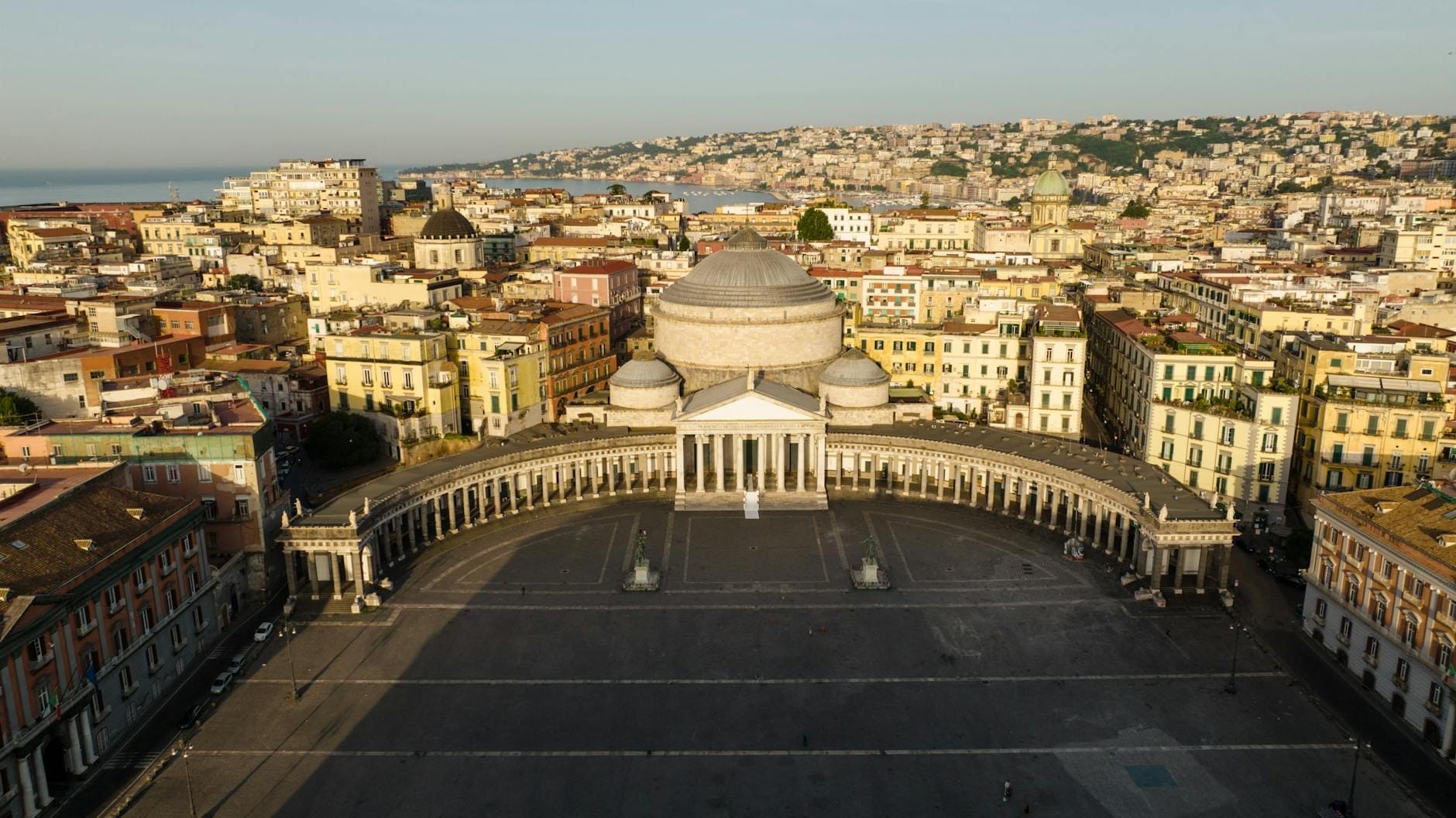
You round the corner from Via Toledo and the city suddenly exhales. Piazza del Plebiscito opens in front of you without warning, and the scale is genuinely disorienting after the compressed lanes of central Naples. At 25,000 square metres, it is the largest public square in the city and one of the most spacious in the entire country. The ground beneath your feet is dark volcanic basalt quarried from the slopes of Vesuvius, worn smooth by generations of feet and rain, still faintly gritty underfoot after a dry spell.
The square is essentially a curved arc of space held between two monumental structures: the Palazzo Reale di Napoli along the eastern edge and the neoclassical Basilica of San Francesco di Paola completing a grand semicircular colonnade to the west. Equestrian statues of Charles III of Spain and Ferdinand I of the Two Sicilies anchor the centre, casting long shadows across the stone on bright mornings. There are no market stalls, no souvenir sellers, no outdoor terraces cluttering the view. This is deliberately, almost austerely, civic space.
💡 Local tip
Arrive before 8:30 am to experience the square with almost no other visitors. The low morning light rakes across the basalt paving and illuminates the colonnade's columns from the side, creating a photographic effect that disappears once the sun climbs higher.
The Architecture: Two Buildings Defining the Whole Space
The Basilica of San Francesco di Paola, completed in 1816 under Bourbon King Ferdinand I, was modelled closely on the Pantheon in Rome, with a domed rotunda flanked by curving colonnades that wrap around to define the square's western boundary. The proportions are precise and intentional: the colonnade frames the visitor's eye toward the Royal Palace opposite, creating a theatrical dialogue between church and state that was very much the political point. Step inside the basilica if it is open; the interior is cool, marble-floored, and surprisingly intimate given the external scale.
The Palazzo Reale di Napoli occupies the entire eastern flank of the square. Its facade runs for roughly 170 metres and features a long arcade of arched niches containing statues of Naples' rulers across the centuries, from Roger the Norman to Vittorio Emanuele II. The building is still a working cultural institution, housing the National Library on its upper floors and the Royal Apartments museum. You can visit the interior on a separate ticket, which is worth budgeting time for if Italian baroque interiors interest you.
Between the two buildings, the open paving stretches wide enough that conversations across it are impossible. On windy days, particularly in autumn and winter, the square acts as a funnel for gusts rolling off the Bay of Naples, and the temperature drops noticeably compared to the sheltered streets just a hundred metres away. Bring a layer if visiting outside summer.
Tickets & tours
Live prices and dates from our booking partner. If you book, we may earn a commission at no extra cost to you.
Tickets for Citta della Scienza in Naples
From 10 €Instant confirmationPompeii and Mount Vesuvius tour with transportation
From 110 €Instant confirmationFree cancellationOrigins and legends of Naples walking tour
From 28 €Instant confirmationFree cancellationGuided walking tour of Naples city and Naples underground
From 45 €Instant confirmationFree cancellation
Historical Weight: What the Name Actually Means
The square takes its name from the plebiscite of October 21, 1860, when the population of the Kingdom of the Two Sicilies voted overwhelmingly to unify with the nascent Kingdom of Italy under Vittorio Emanuele II. It was a decisive moment in the Risorgimento, and naming this space after the vote was a deliberate act of political memory. Before 1860, it was called Largo di Palazzo, a functional name reflecting its role as the forecourt of royal power.
The history embedded in the square goes back further. The area's layout and most of its architectural fabric was established during the Napoleonic period, when Joseph Bonaparte and later Joachim Murat controlled Naples as French client kings and undertook ambitious urban redesign projects. The colonnade you see today was begun under Murat and completed after the Bourbon restoration. Few public spaces in Europe carry such a compressed record of regime change in their stonework.
How the Square Changes by Time of Day
Early mornings belong to joggers and dog walkers from the Chiaia and waterfront neighbourhoods. The square's flat, pedestrianised surface makes it the natural circuit for anyone wanting open space in a city that otherwise offers very little of it. By mid-morning, tour groups begin arriving from coaches parked along the Lungomare, and the central area fills with the familiar choreography of guides holding umbrellas aloft and guests photographing the colonnade. By noon in summer, the unshaded basalt absorbs heat aggressively, and the square empties somewhat as visitors retreat to cafes.
Late afternoons are genuinely excellent. The western sun strikes the colonnade columns directly, the stone glows a warm ochre, and the Royal Palace facade picks up golden light. Neapolitan families begin drifting through from around 5pm, children running across the open paving while adults linger near the equestrian statues. By early evening in summer, the square hosts an informal passeggiata and, occasionally, open-air concerts or cultural events organised by the city.
Night is worth considering if you are in the area after dinner. The square is lit, the colonnade is atmospheric, and the crowds thin considerably. The Lungomare waterfront promenade is a five-minute walk south, making an evening combination of the two very manageable.
ℹ️ Good to know
The square was used as a car park until 1994, when it was pedestrianised as part of a broader effort to reclaim Naples' historic public spaces. The decision transformed it from a traffic roundabout into the civic gathering point it was originally intended to be.
Getting There and Moving On
The most logical approach on foot is from Via Toledo, Naples' main pedestrian shopping street, which terminates near Piazza Trieste e Trento adjacent to the square. The walk from the Municipio metro station (Line 1) takes around five minutes along flat ground. If you are coming from the historic centre, the approach through Spaccanapoli and then southwest adds around fifteen minutes but passes through architecturally rich streets.
From the square, the Castel dell'Ovo on its promontory is visible to the south along the waterfront. The walk takes around fifteen minutes along the Lungomare Caracciolo, one of the more pleasant stretches of pavement in the city. Heading north from the square along Via Toledo toward the Galleria Umberto I takes about three minutes; the 19th-century iron-and-glass arcade is directly opposite the Royal Palace and worth a look.
Accessibility is reasonable. The square's paving is flat and firm, with no steps or barriers at its main entrances. The basalt surface can be slippery when wet, and the wide joints between stones may require some care for wheelchair users, but overall the space is navigable without significant obstacles.
Photography and Practical Considerations
The colonnade's semicircular geometry creates natural compositional symmetry that is straightforward to use but difficult to make distinctive. The most interesting frames come from the outer edges of the colonnade looking inward, or from low angles on the basalt surface using the equestrian statues as foreground elements against the dome of the basilica. A wide-angle lens handles the space well; anything tighter struggles to convey the actual scale.
For video, the morning and golden hour are the practical windows. Midday light is flat and harsh on the pale stone of the colonnade. Overcast days actually work well for even, shadow-free architecture shots, and Naples in November or February delivers plenty of those.
⚠️ What to skip
The square is fully exposed with no shade. In July and August, midday visits without sun protection are uncomfortable rather than enjoyable. The nearest bar with outdoor seating is on Piazza Trieste e Trento, a two-minute walk toward Via Toledo — expect higher prices for the location.
Who Will Enjoy This, and Who Might Not
Travellers who appreciate civic architecture, urban scale, and the kind of space that communicates political intention through stone will find Piazza del Plebiscito genuinely rewarding. It pairs naturally with a visit to the Teatro San Carlo, Italy's oldest opera house, which sits immediately adjacent to the Royal Palace on the square's northern side.
Travellers looking primarily for activity, colour, or street-level neighbourhood character may find the square too formal and too empty. It does not have the layered human energy of the historic centre or the visual drama of the port. If your priority is food markets, street art, or the compressed social texture of old Naples, the square is worth a ten-minute stop rather than a dedicated visit. Children with energy to burn actually enjoy the open space for running, which is harder to find elsewhere in central Naples, so families should not dismiss it.
For those piecing together a full day in the city, the square fits naturally into a Naples walking tour that starts at the historic centre and ends at the waterfront. It marks a clear transition between the two halves of central Naples.
Insider Tips
- Stand at the very centre of the square and look back toward the Palazzo Reale facade: the equestrian statues frame the Royal Palace arcade almost perfectly, and this midpoint gives you the full sweep of the colonnade's curve that photographs from any single edge cannot capture.
- The local tradition of walking blindfolded between the two equestrian statues as a test of orientation is well-known to Neapolitans but rarely mentioned in guidebooks. It is harder than it sounds, and watching people attempt it on weekend evenings is genuinely entertaining.
- If the Palazzo Reale is open, buy the museum ticket and exit through the back gardens facing the sea: the view from the rear terrace toward Vesuvius and the Bay of Naples is one of the better unmediated views in the city centre.
- Piazza Trieste e Trento, the smaller adjacent square connecting to Via Toledo, has the historic Gran Caffè Gambrinus on its corner. Prices are tourist-level, but the interior is a Neapolitan institution dating to 1860 and worth seeing once.
- Major public events including New Year's Eve concerts and summer festivals regularly use the square as their main venue. Check the city's official event listings before visiting in December or during summer weekends, as the square can be partially closed or heavily managed for large gatherings.
Who Is Piazza del Plebiscito For?
- Architecture and urban design enthusiasts wanting to understand how power shaped Neapolitan space
- Photographers seeking early-morning light on neoclassical stonework without crowds
- First-time visitors to Naples who want a spatial orientation point before diving into the historic centre
- Evening walkers combining the square with a Lungomare waterfront stroll
- Families with young children who need open, flat, traffic-free space in a city that offers very little of it
Nearby Attractions
Other things to see while in Waterfront & Lungomare:
- Castel dell'Ovo
Perched on a small rocky peninsula jutting into the Gulf of Naples, Castel dell'Ovo is the oldest castle in the city and one of its most immediately recognizable landmarks. Entry is free, the views stretch toward Vesuvius and the islands, and the history runs deeper than the walls suggest.
- Castel Nuovo (Maschio Angioino)
Rising above the Naples waterfront on five round towers, Castel Nuovo has anchored the city's harbor since 1284. Part royal palace, part civic museum, part medieval spectacle, it rewards visitors who look beyond the postcard exterior.
- Galleria Borbonica (Bourbon Tunnel)
Commissioned by King Ferdinand II in 1853 as a royal escape route, the project was never fully completed, the Galleria Borbonica became a WWII air-raid shelter and is now one of the most compelling underground experiences in southern Italy. Guided tours descend roughly 30 meters below street level into a world of carved tufa rock, abandoned vehicles, wartime debris, and flooded cisterns.
- Galleria Umberto I
Built between 1887 and 1890 as part of Naples' sweeping urban renewal, Galleria Umberto I is a soaring cross-shaped arcade crowned by a 56-metre glass-and-iron dome. Entry is free and the gallery never closes, making it one of the most accessible architectural landmarks in the city.
Planning a trip? Discover personalized activities with the Nomado app.