Castel Nuovo (Maschio Angioino): Naples' Waterfront Fortress, Explained
Rising above the Naples waterfront on five round towers, Castel Nuovo has anchored the city's harbor since 1284. Part royal palace, part civic museum, part medieval spectacle, it rewards visitors who look beyond the postcard exterior.
Quick Facts
- Location
- Via Vittorio Emanuele III, 80133 Napoli — waterfront, near the main port
- Getting There
- Metro Line 1, Municipio station (2-min walk); bus stop at Piazza Municipio
- Time Needed
- 1.5 to 2.5 hours for exterior, courtyard, chapel, and museum floors
- Cost
- Admission fee applies; verify current pricing at the ticket office before visiting
- Best for
- History enthusiasts, architecture lovers, anyone connecting ferry routes with sightseeing
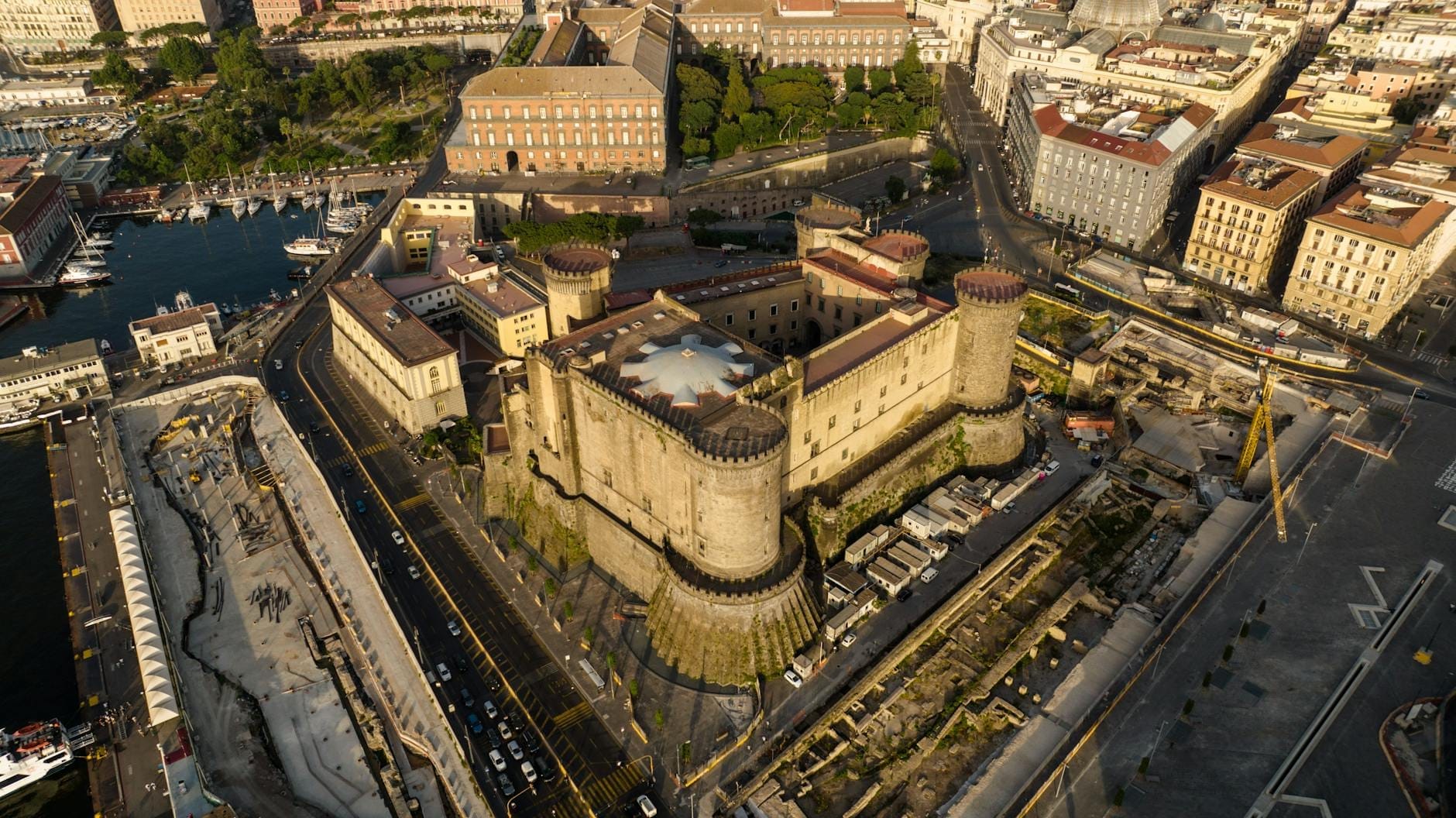
What Castel Nuovo Actually Is
Castel Nuovo, more commonly known to Neapolitans as Maschio Angioino (the Angevin Keep), is a massive 13th-century fortress that sits at the edge of the Naples harbor, facing the ferry terminals and the bay. Construction began in 1279 under Charles I of Anjou and was completed in 1282. For the next three centuries it served as the royal residence of the Kings of Naples, receiving rulers from the House of Anjou through the Aragonese and into the Spanish viceregal period. Today it houses the Civic Museum of Castel Nuovo, a library, and is still used for municipal functions.
The castle is not a ruin. It is not a reconstruction. The five dark basalt towers, connected by thick stone curtain walls, are largely original medieval fabric, which makes the experience of walking through it feel genuinely substantial. What you see is what was there. That solidity is something you notice immediately when you approach from Piazza Municipio: the towers are enormous, squat, and slightly ominous, and the white marble triumphal arch wedged between two of them looks almost impossibly delicate by contrast.
💡 Local tip
The Municipio metro station (Line 1) opened after a decade of archaeological excavation that uncovered Greek, Roman, and medieval remains beneath the square. The station itself is worth a look before or after your castle visit.
The Triumphal Arch: The Detail That Stops Everyone
The Arch of Alfonso I, built between 1443 and 1471, is one of the most important examples of early Renaissance sculpture in southern Italy. Alfonso V of Aragon commissioned it to commemorate his entry into Naples in 1443, and it was carved in white marble to sit between two of the castle's grey towers, creating a deliberate visual tension between military severity and humanist celebration. The arch rises across two levels: the lower registers depict Alfonso's triumphal procession with carved figures in high relief, while the upper section includes allegorical figures, classical motifs, and portrait medallions.
Photography-wise, the arch catches direct sunlight in the late morning, which picks out the sculptural depth in the reliefs particularly well. By early afternoon in summer it moves into partial shade, which can actually help reduce glare if you are shooting with a phone. The proportional contrast between the dark towers and pale marble means you need some exposure adjustment to capture both in the same frame.
Tickets & tours
Live prices and dates from our booking partner. If you book, we may earn a commission at no extra cost to you.
Castel Sant'Elmo and Certosa di San Martino Tour
From 25 €Instant confirmationFree cancellationCastel Sant'Elmo self-guided audio tour in Naples
From 4 €Instant confirmationCastel Sant'Elmo Entry Ticket with Audio Guide in Naples
From 14 €Instant confirmationFree cancellationPompeii and Mount Vesuvius tour with transportation
From 110 €Instant confirmationFree cancellation
Inside the Castle: What Each Space Offers
The Courtyard and Palatine Chapel
Once through the arch, the internal courtyard opens up in a way that surprises most visitors. It is large, quiet, and relatively plain compared to the elaborate entrance, with a double-loggia arcade on two sides. The Palatine Chapel (Cappella Palatina) sits in the south wing and is one of the primary reasons art historians make the trip. The chapel contains fragmentary frescoes attributed to Giotto, who worked in Naples at the court of Robert of Anjou around 1328 to 1333. Most of Giotto's cycle was lost during a gunpowder explosion in 1456, and what remains is partial, but even the surviving fragments carry enough authority to make this a significant stop for anyone tracking the painter's work across Italy.
The chapel interior is compact. Natural light enters from narrow Gothic windows and the space has a cool, slightly damp atmosphere that you notice immediately after the heat of the courtyard. Plan to spend at least 15 minutes here with the details.
The Hall of the Barons
The Sala dei Baroni is the castle's most architecturally distinctive interior. The hall takes its name from an infamous event in 1487, when Ferdinand I of Aragon invited rebellious barons to a wedding feast and arrested them all. The ceiling is the reason to stand in the center of the room: an octagonal ribbed vault spans the entire space without interior columns, a feat of 15th-century engineering attributed to Guillem Sagrera, the Mallorcan architect who worked here after completing the Lonja de Palma. The geometry of the vault is mathematically exact, and the ribs create a star pattern that draws the eye repeatedly upward. The hall is now used for Naples city council meetings, which means access is occasionally restricted.
The Hall of the Armory and Roman Remains
The Sala dell'Armeria contains one of the more unexpected features in any Italian castle: a glass floor panel set into the ground revealing Roman-era ruins excavated beneath the medieval construction. You are looking at remains from a period predating the castle by over a thousand years, visible from above at an angle that makes the layers of history feel very immediate. The archaeological context is not extensively labeled, so arrive with some background reading or you may move through quickly without understanding what you are seeing.
The Civic Museum Floors
The upper floors of the castle house the Civic Museum of Castel Nuovo, with a collection spanning the 15th through 20th centuries. Works by Battistello Caracciolo and Luca Giordano are among the notable names represented. The collection is uneven in density and the hanging is not always illuminated ideally, but for visitors already engaged with Neapolitan painting, the permanent collection adds useful context. The museum also gives access to the tower interiors, where narrow spiral staircases and slit windows give you a genuine sense of the castle's defensive function.
The art on display here complements what you will find at the Naples National Archaeological Museum and the Museo e Real Bosco di Capodimonte, both of which hold deeper collections but different periods and media.
How the Experience Changes by Time of Day
Arriving at opening (verify current hours; typically 9:00 AM Monday to Saturday) gives you the courtyard almost to yourself. Tour groups tend to arrive from 10:00 AM onward, and by late morning the narrow staircase to the towers can feel congested. The exterior is approached across Piazza Municipio, which is a working transit and pedestrian square: in the early morning it is relatively quiet, with ferry passengers crossing toward the port. By midday the square is loud with traffic, street vendors, and pedestrians connecting the port to the city center.
Late afternoon (after 4:00 PM) sees the square calm again and the western light beginning to warm the stone of the towers. The castle's ticket office closes one hour before the castle itself, so if you plan to enter the museum floors, arrive no later than 6:00 PM on a weekday. On Sundays, confirm if opening is limited to 2:00 PM onwards for select spaces; full museum access may vary.
⚠️ What to skip
Verify Sunday access limitations and Monday-Saturday closing times on official sources. If full museum access is needed, prioritize weekdays.
Getting Here and Practical Notes
The castle sits directly on Piazza Municipio at Via Vittorio Emanuele III, 80133 Napoli. The Municipio station on Metro Line 1 deposits you at street level approximately two minutes from the main entrance. Multiple bus routes also stop on the square. If you are arriving from the ferry port, the castle is visible on foot within five minutes of the main terminal exit, making it a logical first stop after arriving by sea from Capri, Procida, or Ischia.
Castel Nuovo sits on the Naples waterfront, and a short walk west along the seafront connects you to Piazza del Plebiscito and the Palazzo Reale — making a natural half-day sequence along the civic waterfront.
Wear comfortable shoes with grip. The internal tower staircases are steep stone spiral steps with uneven risers, and some of the museum floors are worn marble. Accessibility for visitors with mobility limitations is limited by the medieval construction: the towers and upper floors are not wheelchair accessible, though the courtyard-level spaces including the chapel can be reached without climbing.
Who Should Temper Their Expectations
If your primary interest is Italian art and you are comparing museum experiences, the Civic Museum collection inside Castel Nuovo is secondary in quality and curation to the city's major museums. The Giotto fragments in the Palatine Chapel are fragmentary precisely because they are fragments: scholars and dedicated art historians will find them compelling, but casual visitors expecting an intact fresco cycle may feel underwhelmed.
The castle exterior is photographed from every angle and appears on every Naples travel image. The inside can feel slightly anticlimactic to visitors who arrive with high expectations for immersive medieval atmosphere. The municipal use of the Sala dei Baroni and the administrative presence in parts of the building gives some areas a bureaucratic rather than historical feel. That said, for anyone with genuine interest in Angevin and Aragonese history in southern Italy, this is one of the few surviving royal fortresses of that period in working condition.
For a different kind of subterranean historical experience in Naples, the Naples Underground (Napoli Sotterranea) offers an entirely different register of the city's layered past.
Insider Tips
- The best exterior photographs of the triumphal arch are taken in late morning light, around 10:00 to 11:30 AM, when the sun hits the marble reliefs at an angle that reveals the sculptural depth. Overcast days actually work well for even illumination.
- If you are visiting on a weekday morning, ask at the ticket desk whether the Sala dei Baroni is currently open. Council meetings occasionally restrict access without advance notice.
- The glass floor panel in the Armory Room is easy to walk past without realizing what it is. Stop, look down, and give yourself a moment to understand the depth and context of the Roman remains beneath you.
- Combining this visit with the nearby Toledo metro station (a short walk away) adds almost no time but gives you access to one of the most architecturally remarkable metro stations in Europe.
- Ferry travelers connecting to Capri, Procida, or Ischia have their terminals within five minutes of the castle. A visit structured around your boat departure is entirely practical, especially for an early-afternoon sailing.
Who Is Castel Nuovo (Maschio Angioino) For?
- History and medieval architecture enthusiasts who want a castle with genuine surviving fabric rather than a restored shell
- Art historians tracking Giotto's work across Italy, particularly the fragmentary frescoes in the Palatine Chapel
- Travelers connecting ferry routes through Naples port who want to use transit time productively
- Visitors building a waterfront itinerary that links the castle, Piazza del Plebiscito, and the Royal Palace in one half-day walk
- Anyone interested in the Aragonese period in southern Italian history
Nearby Attractions
Other things to see while in Waterfront & Lungomare:
- Castel dell'Ovo
Perched on a small rocky peninsula jutting into the Gulf of Naples, Castel dell'Ovo is the oldest castle in the city and one of its most immediately recognizable landmarks. Entry is free, the views stretch toward Vesuvius and the islands, and the history runs deeper than the walls suggest.
- Galleria Borbonica (Bourbon Tunnel)
Commissioned by King Ferdinand II in 1853 as a royal escape route, the project was never fully completed, the Galleria Borbonica became a WWII air-raid shelter and is now one of the most compelling underground experiences in southern Italy. Guided tours descend roughly 30 meters below street level into a world of carved tufa rock, abandoned vehicles, wartime debris, and flooded cisterns.
- Galleria Umberto I
Built between 1887 and 1890 as part of Naples' sweeping urban renewal, Galleria Umberto I is a soaring cross-shaped arcade crowned by a 56-metre glass-and-iron dome. Entry is free and the gallery never closes, making it one of the most accessible architectural landmarks in the city.
- Palazzo Reale (Royal Palace)
The Palazzo Reale di Napoli sits at the heart of the city's grandest square, offering throne rooms, a monumental marble staircase, a hanging garden with Gulf views, and one of Italy's largest libraries. Built from 1600 under Spanish viceroys and restored after a 19th-century fire, it rewards visitors who look beyond the obvious tourist circuit.
Planning a trip? Discover personalized activities with the Nomado app.