Castel dell'Ovo: Naples' Ancient Egg Castle Above the Sea
Perched on a small rocky peninsula jutting into the Gulf of Naples, Castel dell'Ovo is the oldest castle in the city and one of its most immediately recognizable landmarks. Entry is free, the views stretch toward Vesuvius and the islands, and the history runs deeper than the walls suggest.
Quick Facts
- Location
- Borgo Marinaro, waterfront Naples (Via Partenope)
- Getting There
- Metro Line 1 to Municipio, then approx. 800m walk along the waterfront
- Time Needed
- 45 minutes to 1.5 hours depending on whether exhibitions are on
- Cost
- Free entry
- Best for
- History, views, photography, and waterfront walks
What Is Castel dell'Ovo?
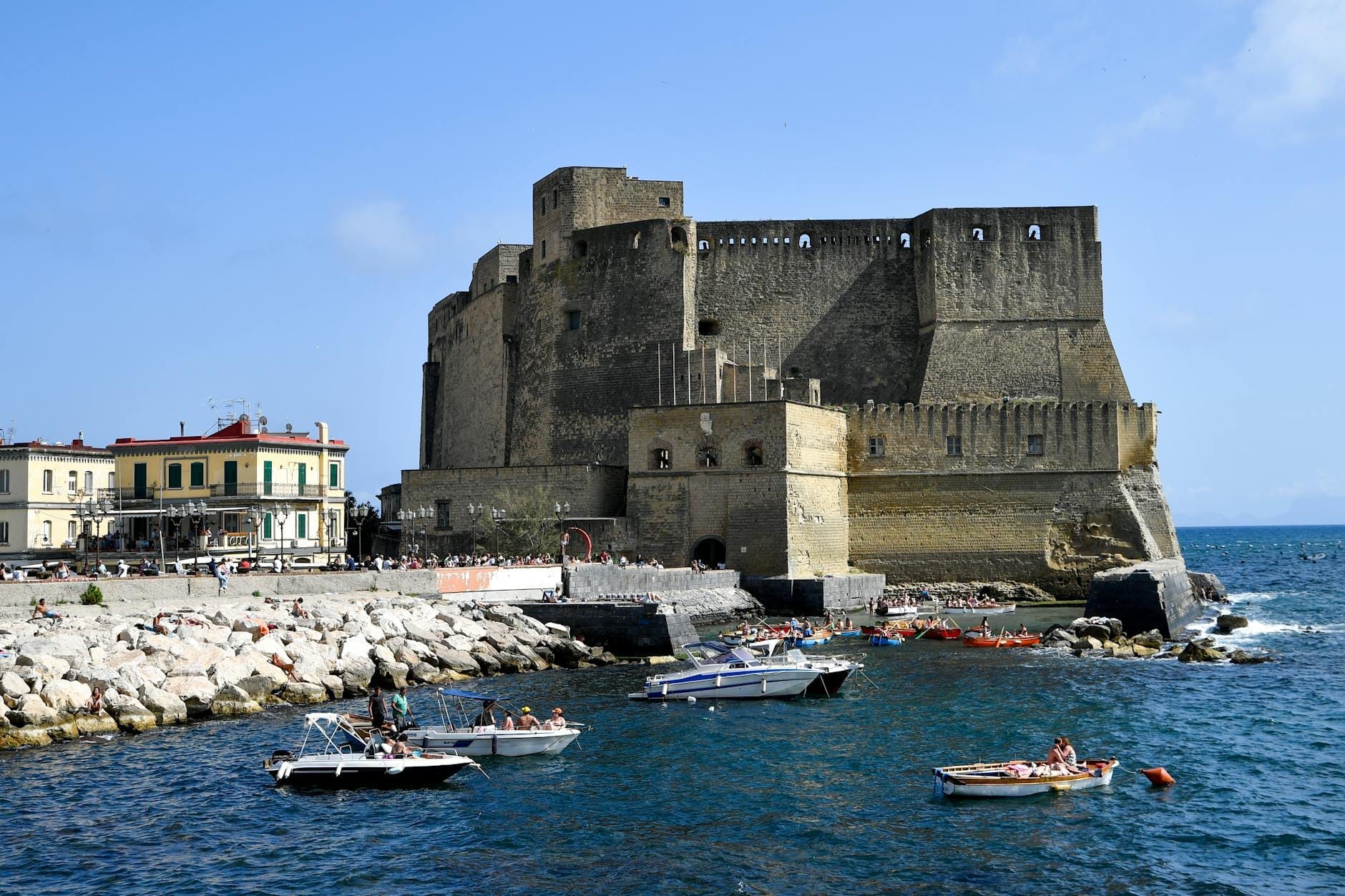
Castel dell'Ovo, which translates literally as the Egg Castle, is the oldest surviving castle in Naples, sitting on the Borgo Marinaro islet connected to the mainland by a short causeway along Via Partenope. From a distance it looks like a fortress rising directly out of the sea, its towers and ramparts catching the morning light off the Gulf of Naples. Up close, it is more layered and stranger than it first appears.
The site's history begins long before the Normans built the current structure in 1128. In the 1st century BC, the Roman general and gourmet Lucius Licinius Lucullus chose this rocky outcrop for a private villa, recognizing the defensible position and the extraordinary views toward Ischia, Procida, and the cone of Vesuvius. After the fall of the Western Roman Empire, Romulus Augustulus, the last Roman emperor, was held here in exile. Few castles in Italy carry that kind of biographical weight in their foundations.
ℹ️ Good to know
The name 'Egg Castle' comes from a medieval legend: the poet Virgil supposedly placed a magic egg inside the castle's foundations. If the egg breaks, the castle falls and Naples with it. The legend has no historical basis, but Neapolitans have always known how to make geography feel mythological.
The Approach and the Borgo Marinaro
You reach the castle by walking out along the causeway from Via Partenope, passing through the Borgo Marinaro, a small cluster of seafood restaurants and fishing boats pressed up against the castle's base. In the morning, the smell of salt water and coffee drifts over from the cafe tables. By noon, the restaurants have filled with locals and tourists eating grilled fish with a direct view of the castle walls above their heads.
The walk from the Metro Line 1 Municipio stop takes about 10 to 15 minutes along the waterfront promenade. This stretch of coast is one of the more pleasant walks in central Naples: the road curves gently, Vesuvius sits in the background across the bay, and the castle grows larger as you approach. Early morning, before 9 AM, is when this promenade is at its calmest, with joggers and dog walkers, and the castle glowing amber before the tour groups arrive.
The waterfront neighborhood belongs to the broader Naples waterfront district, which runs from the port west through Chiaia to Mergellina. If you are pairing this visit with other sights, Piazza del Plebiscito and the Royal Palace are a 15-minute walk inland and worth combining in the same half-day.
Tickets & tours
Live prices and dates from our booking partner. If you book, we may earn a commission at no extra cost to you.
Castel Sant'Elmo and Certosa di San Martino Tour
From 25 €Instant confirmationFree cancellationCastel Sant'Elmo self-guided audio tour in Naples
From 4 €Instant confirmationTickets for Citta della Scienza in Naples
From 10 €Instant confirmationCastel Sant'Elmo Entry Ticket with Audio Guide in Naples
From 14 €Instant confirmationFree cancellation
Inside the Castle: What You Actually See
The castle is open to visitors free of charge, and you pass through a gate and up a ramp to explore the courtyards, terraces, and interior rooms. What you encounter inside is a patchwork: Norman stonework sits alongside Aragonese additions, and rooms that once held garrisons now house temporary art exhibitions or sit empty between events. The castle currently serves as an institutional venue for Campania's Regional Directorate for Cultural Heritage, which means some internal spaces are administrative offices not open to the public.
The highlights are the two towers, including the Torre Normanna and Torre Maestra. From the upper terraces, the panorama takes in the full sweep of the Bay of Naples. On a clear day, which is most days between April and October, you can see Capri to the south, Ischia and Procida to the west, and the full profile of Vesuvius to the east. This is genuinely one of the better elevated viewpoints in the city, and unlike the hilltop views from Vomero, here you are at sea level looking out across open water.
Interior rooms accessible on a visit typically include Gothic vaulted chambers and spaces with frescoed ceilings, though availability varies depending on whether exhibitions or events are scheduled. An information desk operates during visiting hours. It is worth noting that the castle's interior is not a conventional museum with permanent collections, so visitors who arrive expecting labeled exhibits may find it sparse between exhibitions.
💡 Local tip
Check the castle's current exhibition schedule before visiting. When a cultural event is running, more rooms are accessible and the experience is considerably richer. If no event is scheduled, focus on the outdoor terraces and towers, which are the real draw anyway.
When to Visit and How the Light Changes Everything
The castle looks different at every hour. At dawn, the stone walls shift between deep ochre and pale gold as the sun rises over the hills behind the city. By mid-morning the light flattens and the crowds arrive. Midday in summer is genuinely hot, and the ramparts offer little shade. Late afternoon, from about 4 PM onward, the light softens and the Borgo Marinaro restaurants begin to fill, creating the particular atmosphere of a Neapolitan evening where the sea, the food, and the medieval stonework exist in easy proximity.
Sunset from the western terraces of the castle is among the better viewpoints in Naples, looking out over the open bay as the sky turns red above the islands. For the best sunset views, arrive at least 30 minutes before sunset and position yourself on the seaward ramparts.
If planning your visit around the best light and weather, the best months to visit Naples are April through June and September through October. July and August are the most crowded and hottest months, though the castle itself manages to feel less overwhelmed than the historic centre.
Opening Hours and Practical Details
In summer, the castle is open weekdays from 9 AM to 7:30 PM, with last entry at 7 PM. On Sundays and public holidays, hours are shorter: 9 AM to 2 PM, with last entry at 1:30 PM. Winter hours are reduced and worth confirming before you go, as they can change with little notice depending on institutional events. Admission is free.
The castle is not well suited for visitors with significant mobility limitations. The ramps, uneven stone floors, and tower staircases require steady footing. An information desk is available during opening hours for guidance on accessibility within the venue.
⚠️ What to skip
Sunday hours are significantly shorter (closes at 2 PM). If you plan a Sunday visit, arrive by 11 AM at the latest to allow adequate time to explore. The castle can also close for private events without much public notice, so a quick check of current conditions is always advisable.
Photography, Context, and Who Should Manage Expectations
Castel dell'Ovo photographs well from the outside at any time of day, and the views from its terraces justify a wide-angle lens. The most dramatic exterior shots come from across the bay at the Borgo Marinaro level, with fishing boats in the foreground and the castle rising above. For the bay panorama from the towers, a medium focal length works better than ultra-wide, helping compress the view and bring Vesuvius and the islands into the frame together.
A realistic note for travelers: the castle's interior, in the absence of a running exhibition, can feel underwhelming if you have spent time in Naples' major cultural institutions. The Naples National Archaeological Museum or the Certosa di San Martino offer far richer indoor experiences. What Castel dell'Ovo does that no other site in central Naples replicates is place you physically on a peninsula surrounded by sea, with a 360-degree perspective of the bay. That spatial experience is the attraction. The medieval architecture and history are context.
Travelers particularly interested in Neapolitan fortifications may also want to visit Castel Nuovo near the port, which has a permanent museum inside and the famous marble Triumphal Arch at its entrance, and Castel Sant'Elmo on the Vomero hill, which commands the broadest views over the entire city.
Before and After: Building a Half-Day Around Castel dell'Ovo
The castle pairs naturally with a walk along the waterfront toward Chiaia or Mergellina, both reachable on foot in under 20 minutes heading west. The Borgo Marinaro restaurants at the castle base are reliable for a seafood lunch, though not exceptional value compared to spots a few streets inland. For coffee before your visit, the cafes along Via Partenope open early and face the water.
If you have the afternoon free after the castle, consider heading north into the historic centre to visit the Cappella Sansevero or walking the length of Spaccanapoli. The contrast between the open sea views at the castle and the dense medieval streets inland is one of the more rewarding sequences a day in Naples can offer.
Insider Tips
- Visit on a weekday morning between 9 AM and 10 AM to have the terraces largely to yourself. By 11 AM, tour groups from cruise ships begin arriving in numbers.
- The Borgo Marinaro restaurants at the castle base are known for atmosphere rather than exceptional cooking. For better quality seafood at comparable prices, walk 10 minutes west toward Chiaia.
- If you want to access the frescoed interior rooms and Gothic vaulted spaces, visit when a cultural exhibition is running. The event calendar is posted on the Campania cultural heritage regional website.
- For the best external photograph of the castle, walk to the far end of Via Partenope in the direction of the Santa Lucia waterfront and shoot back toward the castle with the morning light behind you.
- The causeway leading to the castle is a popular evening promenade for Neapolitans, particularly in summer. Visiting at dusk gives you both a golden-hour view and the chance to experience a genuinely local ritual rather than a tourist site.
Who Is Castel dell'Ovo For?
- First-time visitors wanting a free, uncrowded introduction to Neapolitan history and geography
- Photographers and travelers prioritizing sea views and landscape photography
- Couples looking for a waterfront walk with evening atmosphere at the Borgo Marinaro
- History travelers interested in the layered Roman and Norman legacy of the Bay of Naples
- Families with children who can handle uneven stone surfaces and enjoy open outdoor spaces
Nearby Attractions
Other things to see while in Waterfront & Lungomare:
- Castel Nuovo (Maschio Angioino)
Rising above the Naples waterfront on five round towers, Castel Nuovo has anchored the city's harbor since 1284. Part royal palace, part civic museum, part medieval spectacle, it rewards visitors who look beyond the postcard exterior.
- Galleria Borbonica (Bourbon Tunnel)
Commissioned by King Ferdinand II in 1853 as a royal escape route, the project was never fully completed, the Galleria Borbonica became a WWII air-raid shelter and is now one of the most compelling underground experiences in southern Italy. Guided tours descend roughly 30 meters below street level into a world of carved tufa rock, abandoned vehicles, wartime debris, and flooded cisterns.
- Galleria Umberto I
Built between 1887 and 1890 as part of Naples' sweeping urban renewal, Galleria Umberto I is a soaring cross-shaped arcade crowned by a 56-metre glass-and-iron dome. Entry is free and the gallery never closes, making it one of the most accessible architectural landmarks in the city.
- Palazzo Reale (Royal Palace)
The Palazzo Reale di Napoli sits at the heart of the city's grandest square, offering throne rooms, a monumental marble staircase, a hanging garden with Gulf views, and one of Italy's largest libraries. Built from 1600 under Spanish viceroys and restored after a 19th-century fire, it rewards visitors who look beyond the obvious tourist circuit.
Planning a trip? Discover personalized activities with the Nomado app.