Palazzo Reale di Napoli: Inside the Royal Palace of Naples
The Palazzo Reale di Napoli sits at the heart of the city's grandest square, offering throne rooms, a monumental marble staircase, a hanging garden with Gulf views, and one of Italy's largest libraries. Built from 1600 under Spanish viceroys and restored after a 19th-century fire, it rewards visitors who look beyond the obvious tourist circuit.
Quick Facts
- Location
- Piazza del Plebiscito 1, Waterfront Naples (80132)
- Getting There
- Metro Line 1 (Municipio); buses along Via Toledo or Lungomare
- Time Needed
- 1.5 to 2.5 hours for the state apartments and garden; longer if visiting the National Library
- Cost
- Full €10 / Reduced €2 / Under 18 free / Hanging Garden free
- Best for
- History lovers, architecture enthusiasts, and anyone curious about Bourbon-era Naples
- Official website
- www.coopculture.it/en/poi/royal-palace-of-naples
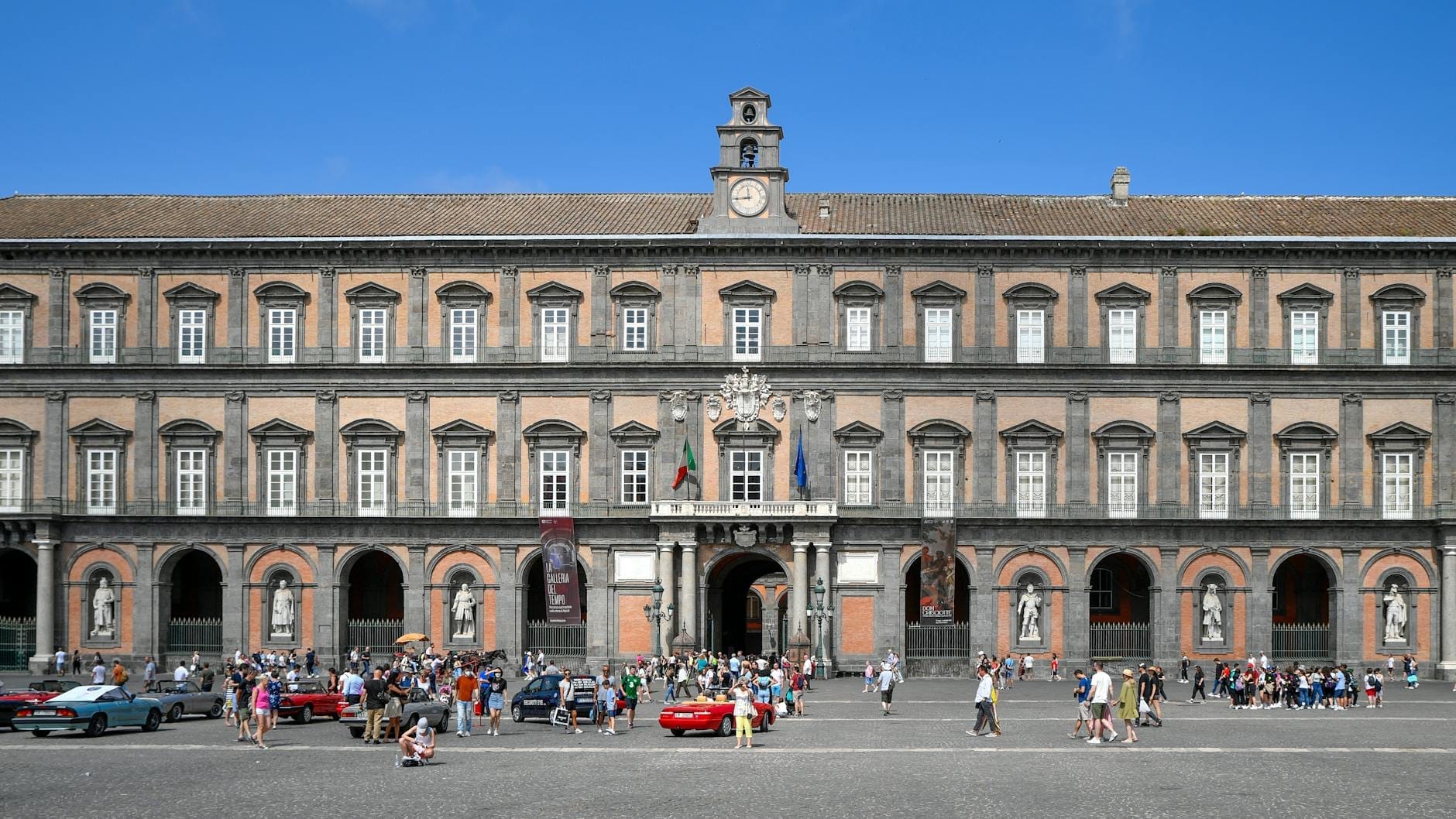
What Is the Palazzo Reale di Napoli?
The Palazzo Reale di Napoli — the Royal Palace of Naples — is a former seat of royal power that now functions as a national museum open to the public. It occupies the entire southern flank of Piazza del Plebiscito, one of the largest and most architecturally coherent squares in Italy. From the outside, the palace presents a long neoclassical facade punctuated by eight niches containing statues of the dynasties that ruled Naples: Norman, Swabian, Angevin, Aragonese, Habsburg, Bourbon, Bonapartist, and Savoy.
Construction began in 1600 under Spanish Viceroy Fernando Ruiz de Castro, with architect Domenico Fontana overseeing the original design. The palace was expanded and reshaped across the following two centuries as successive rulers left their mark. A severe fire in 1837 caused significant damage, and the subsequent restoration by architect Gaetano Genovese produced the elegant hanging garden that still exists today. The palace opened to the public in 1919 and gained independent national museum status in 2019.
This is not a reconstructed royal residence filled with replica furniture. Much of what you see in the state apartments is original: Bourbon-era tapestries, gilded ceilings, period paintings, and furniture that was actually used by the royal households. That authenticity is what separates a visit here from more sanitized palace experiences elsewhere in Europe.
💡 Local tip
Admission to the Hanging Garden is free and separate from the paid museum entrance. If you are short on time, you can at least access the garden for the Gulf of Naples view without buying a ticket.
The State Apartments: What You Will Actually See
The main museum route takes you through the royal state apartments on the piano nobile — the principal floor — via the Staircase of Honour, a monumental white marble staircase that sets the tone immediately. The scale is deliberate: visiting dignitaries were meant to feel the weight of Bourbon authority before reaching the reception rooms.
The Throne Room is the most immediately impressive space: a long rectangular hall with red walls, gilded detailing, and a canopied throne at one end. Even with other visitors present, the room retains a formal stillness. The Hall of Hercules and the Royal Chapel are close behind in terms of visual impact. The chapel in particular is worth slowing down for: its marble detailing and proportions reflect the meticulous craftsmanship that 18th-century Bourbon patronage could commission.
The Court Theatre, a private opera house within the palace itself, is a smaller but surprisingly complete space. It predates the more famous Teatro San Carlo nearby, and its intimate scale gives a clearer sense of how royal entertainment functioned as a display of cultural authority rather than simply leisure.
Tickets & tours
Live prices and dates from our booking partner. If you book, we may earn a commission at no extra cost to you.
The Hanging Garden and the View
Gaetano Genovese designed the hanging garden as part of the post-1837 restoration, and it sits elevated above the palace's internal courtyard, accessible from the upper floors. The garden itself is modest in size — more of a landscaped terrace than a full park — but the views it offers are not modest at all. On a clear day you can see across the Gulf of Naples toward Vesuvius on the right and the coastline curving southwest toward Posillipo on the left.
Because garden entry is free, this terrace occasionally attracts people who have no particular interest in the palace interior. In the late afternoon, when the light falls at a lower angle, the view takes on a particular quality that makes it worth timing your visit accordingly. Morning visits to the garden tend to be quieter and the light is cleaner for photography.
ℹ️ Good to know
The National Library of Naples occupies the eastern wing of the palace and holds over two million volumes, including rare manuscripts and papyri recovered from Herculaneum. The library operates under separate access arrangements — check directly with the institution if you want to visit the reading rooms or special collections.
How the Experience Changes by Time of Day
Piazza del Plebiscito changes character throughout the day, and that context shapes how you experience arriving at the palace. In the morning, the square is calm and the light hits the palace facade directly from the east, making it the best time for exterior photography. By midday, tour groups from cruise ships and coach tours arrive in volume, and the entrance hall can feel congested.
The state apartments themselves are cool and dim regardless of the hour, which is welcome in summer. The contrast between the shadowed interior and the brightness of the hanging garden terrace is most pronounced in the early afternoon. If you arrive around opening time or in the final 90 minutes before closing, the ratio of visitors per room drops noticeably. The palace is not so overwhelmingly popular that crowds become unbearable, but the difference is real.
For those exploring the broader waterfront area, the palace pairs naturally with a walk along the Lungomare toward Castel dell'Ovo or a coffee at one of the cafes on the piazza itself. The waterfront promenade is about a ten-minute walk south of the palace entrance.
Historical and Cultural Context
Naples was one of the largest and wealthiest cities in Europe for much of the early modern period, and the Palazzo Reale was designed to reflect that status. Spanish viceroys, then Bourbon kings, then briefly the Bonapartes under Joachim Murat and Carolina Bonaparte (who oversaw expansions between 1743 and 1748), and finally the Savoys all used this building as a working palace. Each phase left physical traces that a careful visitor can identify in the shifting decorative registers across different rooms.
The palace sits within a broader concentration of institutional power along the waterfront. The Castel Nuovo — the older Angevin fortress — is a short walk north toward the port, and the two buildings together give a compressed sense of how royal and military authority were physically organized in the city. Between them, Galleria Umberto I offers a 19th-century counterpoint.
The palace also connects to a broader Naples cultural circuit that includes the Naples National Archaeological Museum to the north, which holds the most important collection of ancient Roman artifacts in the world, much of it recovered from Pompeii and Herculaneum. If you are allocating a full day to cultural Naples, these two institutions make a logical pairing, with the archaeological museum demanding the longer block of time.
Practical Walkthrough: Getting There and What to Bring
The palace is at Piazza del Plebiscito 1. The nearest metro station is Municipio on Line 1, about a five-minute walk. Several bus routes along Via Toledo also deposit you within easy walking distance. If you are coming from the historic center, the walk down Via Toledo takes roughly 15 minutes and passes through some of the most commercially active streets in the city.
Tickets are purchased at the palace entrance. At €10 full price, this is among the more affordable major palace museums in southern Italy. For context, the nearby Certosa di San Martino up on the Vomero hill charges a similar rate and offers a very different but equally rewarding experience.
The palace interiors are largely accessible on foot across level floors, though the Staircase of Honour involves steps. Contact the venue directly at +39-081-580-8255 for specific accessibility information, as details are not consistently published online. Comfortable walking shoes are advisable — the marble floors are hard and the route through the state apartments covers significant ground.
⚠️ What to skip
Opening hours are subject to seasonal variation and occasional closures for official state functions. Verify current hours directly with the palace or through the official Italian culture ministry website before your visit, especially if traveling outside peak season.
Honest Assessment: Is It Worth Your Time?
For visitors with a genuine interest in European royal history, Baroque and neoclassical interior decoration, or the specific history of the Kingdom of Naples, the Palazzo Reale delivers a great deal at a low price. The rooms are well-preserved, the scale is genuinely grand, and the building is not so over-touristed that the experience feels processed.
For visitors primarily interested in ancient history or contemporary Naples culture, this may feel like a secondary priority. The palace does not tell the story of Greek or Roman Naples, and it lacks the raw energy of the city's street-level neighborhoods. Someone on a short trip with limited time might reasonably choose the archaeological museum or a walk through the historic center over the royal palace — and that would be a defensible decision.
The hanging garden, being free, is worth five minutes of anyone's time if they are already on the piazza. The interior is best treated as a deliberate half-day choice rather than a casual add-on.
Insider Tips
- The statues in the eight facade niches were added by the Savoy dynasty in the late 19th century. Each represents a ruling dynasty in chronological order — reading them left to right gives you a compressed timeline of who controlled Naples from the Normans onward.
- The National Library in the eastern wing occasionally hosts temporary exhibitions that do not appear in standard listings. Check directly with the library if you are interested in the Herculaneum papyri or the rare manuscript collections.
- Cruise ship groups typically arrive between 10am and 1pm. Arriving at opening time or after 3pm measurably reduces the density in the throne room and main reception halls.
- The palace cafe and bookshop near the entrance is a reasonable place to pick up illustrated volumes on Bourbon Naples that are hard to find elsewhere in the city.
- Piazza del Plebiscito itself is worth revisiting after dark — the square is lit and largely pedestrianized in the evening, giving you a completely different perspective on the palace facade without paying for entry.
Who Is Palazzo Reale (Royal Palace) For?
- Travelers interested in Bourbon and Spanish viceregal history in southern Italy
- Architecture enthusiasts focused on neoclassical and Baroque interior decoration
- Visitors who want a major cultural experience at a modest ticket price
- Anyone already visiting Piazza del Plebiscito who wants to move beyond the square's exterior
- Researchers or bibliophiles interested in the National Library of Naples and its rare collections
Nearby Attractions
Other things to see while in Waterfront & Lungomare:
- Castel dell'Ovo
Perched on a small rocky peninsula jutting into the Gulf of Naples, Castel dell'Ovo is the oldest castle in the city and one of its most immediately recognizable landmarks. Entry is free, the views stretch toward Vesuvius and the islands, and the history runs deeper than the walls suggest.
- Castel Nuovo (Maschio Angioino)
Rising above the Naples waterfront on five round towers, Castel Nuovo has anchored the city's harbor since 1284. Part royal palace, part civic museum, part medieval spectacle, it rewards visitors who look beyond the postcard exterior.
- Galleria Borbonica (Bourbon Tunnel)
Commissioned by King Ferdinand II in 1853 as a royal escape route, the project was never fully completed, the Galleria Borbonica became a WWII air-raid shelter and is now one of the most compelling underground experiences in southern Italy. Guided tours descend roughly 30 meters below street level into a world of carved tufa rock, abandoned vehicles, wartime debris, and flooded cisterns.
- Galleria Umberto I
Built between 1887 and 1890 as part of Naples' sweeping urban renewal, Galleria Umberto I is a soaring cross-shaped arcade crowned by a 56-metre glass-and-iron dome. Entry is free and the gallery never closes, making it one of the most accessible architectural landmarks in the city.
Planning a trip? Discover personalized activities with the Nomado app.