Teatro San Carlo: Inside the World's Oldest Active Opera House
Opened in 1737, the Real Teatro di San Carlo predates both La Scala and La Fenice, making it the oldest continuously active opera house on the planet. Whether you attend a performance or join a guided tour through its gilded auditorium and royal stage, a visit here is one of the most historically charged experiences Naples has to offer.
Quick Facts
- Location
- Via San Carlo 98/F, next to Piazza del Plebiscito, Waterfront Naples
- Getting There
- Metro Line 1, Municipio station; also served by multiple ANM bus lines along the waterfront
- Time Needed
- 1–1.5 hours for a guided daytime tour; 2.5–3.5 hours for a full evening performance
- Cost
- Tour prices vary; check the official website or call +39 081 797 2331 for current rates. Performance tickets range widely by seat and production.
- Best for
- Opera and ballet lovers, architecture enthusiasts, history-focused travelers, couples seeking a grand evening out
- Official website
- www.teatrosancarlo.it
What Makes This Place Worth Your Time
The Real Teatro di San Carlo is not merely a beautiful old building. It is the oldest continuously active opera house in the world, opened on March 4, 1737, under the commission of King Charles VII of Bourbon, who wanted Naples to have a royal theater worthy of his court. La Scala in Milan opened in 1778. La Fenice in Venice opened in 1792. San Carlo was already 55 years old by the time either of those legendary stages saw their first curtain rise.
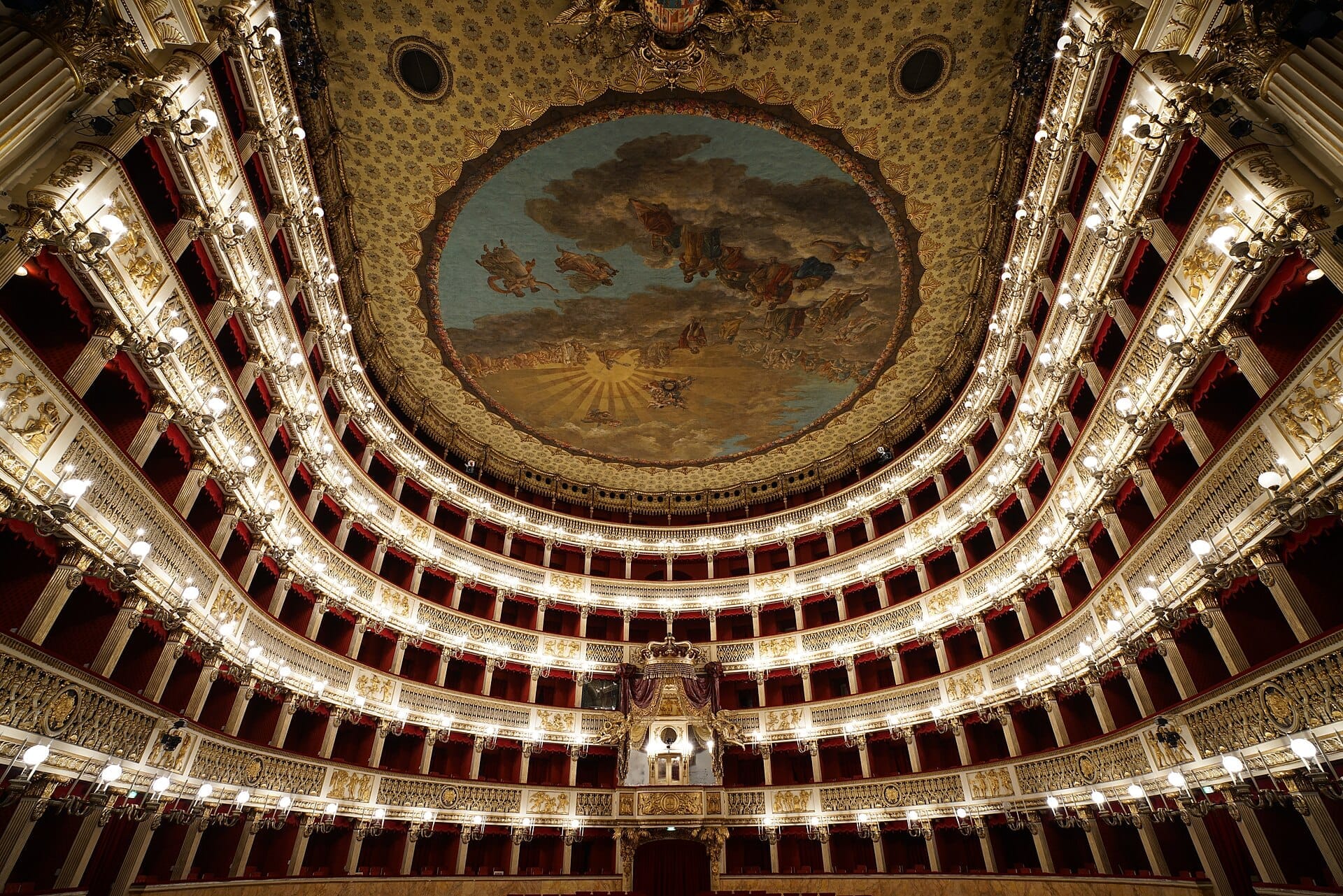
Sitting inside this theater during a performance produces a sensation that is difficult to replicate anywhere else in Europe. The horseshoe-shaped auditorium holds 1,386 seats across six tiers of boxes, each dressed in crimson velvet with gilded railings. The ceiling fresco, the chandelier suspended at the center of it all, and the acoustic design that has been praised by composers for nearly three centuries combine into something genuinely overwhelming. For a traveler who has visited many famous opera houses, San Carlo tends to be the one that stays with you.
💡 Local tip
If a live performance isn't possible during your visit, the daily guided tour still grants access to the Historic Auditorium, Royal Foyer, and Royal Stage, and MeMUS, the theater's museum and historical archive. It's the most intimate way to absorb the space without sharing it with 1,386 other people.
A Short History That Changes How You See the Room
Charles VII of Bourbon ordered the construction of San Carlo in 1737 to replace the older, smaller Teatro San Bartolomeo. The speed of construction was remarkable by any era's standards: the theater was built in just eight months. From its opening night, San Carlo set the tone for operatic culture across Europe. Composers including Donizetti, Rossini, and Verdi either premiered or staged major works here. Rossini himself served as the theater's artistic director in the early 19th century.
The theater was devastated by fire in February 1816 and rebuilt within a year, a reconstruction effort that speaks to how central San Carlo was to Neapolitan identity. The rebuilt hall, which is what visitors see today, preserved the horseshoe layout but introduced refinements that improved both acoustics and sightlines. The experience of standing on the Royal Stage and looking out at those stacked tiers of empty boxes gives a visceral sense of what it must have felt like to premiere a new Rossini opera before a Neapolitan crowd.
For those interested in tracing Naples's artistic heritage more broadly, the Naples National Archaeological Museum and the Museo e Real Bosco di Capodimonte together form a cultural triangle that reflects centuries of Bourbon patronage across painting, antiquity, and performing arts.
Tickets & tours
Live prices and dates from our booking partner. If you book, we may earn a commission at no extra cost to you.
Pompeii and Mount Vesuvius tour with transportation
From 110 €Instant confirmationFree cancellationOrigins and legends of Naples walking tour
From 28 €Instant confirmationFree cancellationGuided walking tour of Naples city and Naples underground
From 45 €Instant confirmationFree cancellationMount Vesuvius and Herculaneum tour with transportation
From 100 €Instant confirmationFree cancellation
The Daytime Tour: What You Actually See
Guided tours run daily except when performances or rehearsals are scheduled, typically from 10:00 a.m. to 5:30 p.m. Tours may be cancelled at short notice due to rehearsals or technical requirements, so confirming by phone before you arrive is a good habit. The theater puts its own programming first, as it should.
The tour typically moves through the historic Foyer, where the atmosphere shifts from street-level Naples into something formal and hushed, then into the auditorium itself. The auditorium is best experienced from the stalls level first, where the full vertical sweep of the boxes becomes apparent. From there, the scale is almost disorienting. Guides will usually bring groups onto the Royal Stage, which offers the reverse perspective: looking out from the stage into the empty tiers, the acoustic shell of the space surrounding you. It is the kind of moment that travelers photograph but often struggle to capture in a way that conveys the actual feeling.
MeMUS, the theater's museum and historical archive, rounds out the tour. It houses costumes, set designs, historic programs, and documents spanning nearly three centuries of productions. For someone without a deep background in opera history, it provides useful context. For genuine opera scholars, it is exceptional.
⚠️ What to skip
Tours can be cancelled without advance public notice when rehearsals or technical requirements take priority. Always call +39 081 797 2331 or check the official website the morning of your visit to confirm the tour is running.
Attending a Performance: The Real Reason to Come
The opera season at San Carlo runs from late November through July. The ballet season runs from December into early June. Attending a performance here is simply not the same experience as visiting during a guided tour. The theater transforms completely when the audience fills those 1,386 seats. The collective warmth of a sold-out house, the orchestra tuning in the pit, the way sound behaves in this particular room, all of it changes your relationship to the architecture.
Dress code tends to be smart to formal, particularly for opening nights or high-profile premieres. Standard performances attract a mixed crowd, from local regulars in dressed-up casual attire to international visitors in suits or cocktail dresses. Erring on the side of smarter clothing is never wrong here. Standing or gallery seats, when available, can offer significantly lower price points while still placing you inside one of the world's great acoustical environments.
If you're planning the logistics of an evening at San Carlo as part of a broader Naples stay, the nearby Piazza del Plebiscito is an ideal place to begin the evening, and the restaurants along the waterfront between Plebiscito and Castel dell'Ovo make for good pre-performance dining. The Galleria Umberto I, which sits directly adjacent to the theater, is a natural stop for a coffee before or after.
Location, Access, and Practical Logistics
Teatro San Carlo sits at the geographic heart of monumental Naples, flanked by Piazza del Plebiscito to one side, the Palazzo Reale to another, and the Galleria Umberto I to the north. From the Municipio metro station on Line 1, the walk takes roughly five to eight minutes. Multiple ANM bus lines serve the area along Via San Carlo and the waterfront. The theater is also reachable on foot from most central hotels in 10 to 20 minutes.
The immediate neighborhood is one of Naples's most polished and pedestrian-friendly zones. During daytime hours, the area fills with tourists visiting the Royal Palace and the piazza, creating a lively but generally calm atmosphere. In the evenings before performances, well-dressed theater-goers create a noticeably different energy along the surrounding streets. Taxis and private car services can drop off directly in front of the theater on Via San Carlo.
Travelers who want to combine a visit to San Carlo with a full day in the area should also consider the Palazzo Reale di Napoli, which occupies the same royal complex. Together with San Carlo, it offers a complete picture of Bourbon Naples at the peak of its ambition.
ℹ️ Good to know
Accessibility information for visitors with mobility needs is not published in detail online. Contact the theater directly at +39 081 797 2331 well in advance of your visit to discuss specific requirements.
Photography and What to Expect Inside
During guided daytime tours, photography is generally permitted in the auditorium and foyer. The main visual challenge is the contrast between the warm golden glow of the interior and the darker upper tiers. A phone camera on auto settings will tend to overexpose the chandelier and lose detail in the boxes. Shooting from the stalls looking upward, or from the stage looking outward, produces the most dramatic compositions. Use the horizontal format to capture the full horseshoe sweep of the tiers.
Photography during live performances is not permitted, as in virtually all professional opera houses. Flash photography inside the historic spaces should be avoided out of courtesy to the building's surfaces and to other visitors, regardless of whether it is formally restricted on a given day.
Who Will Love This, and Who Might Not
Travelers who are drawn to grand European history, to architecture as lived experience rather than backdrop, and to the performing arts will find this one of the most rewarding stops in Naples. It is also, genuinely, one of the few places in the city where the physical space alone carries enough historical weight to justify a visit even without a performance.
Travelers who are not interested in classical music or theater, and who are visiting purely for a cultural checkbox, may find a 75-minute guided tour through a darkened auditorium underwhelming compared to the outdoor spectacle of Pompeii or the direct sensory pleasure of the city's street food scene. Young children are likely to lose interest quickly during tours, though an evening performance, depending on the production, can be a memorable introduction to opera for older children. If a live performance holds no appeal and architecture is not a priority, your time in Naples is probably better spent elsewhere.
For a fuller sense of what Naples has to offer across its cultural institutions, the guide to the best museums in Naples covers the broader landscape and helps put San Carlo in context alongside the city's other major collections.
Insider Tips
- Booking performance tickets directly through the official website often gives you access to seats that third-party platforms have already marked as unavailable. The theater releases returned and unclaimed tickets closer to performance dates.
- The guided tour schedule is genuinely subject to last-minute cancellation. Call the theater on the morning of your visit. This is not a formality: rehearsals for a major production can shut down public access with no online announcement.
- If you visit during the daytime, the Foyer on its own is worth pausing in before the formal tour begins. The proportions and the quality of the decorative detail are easy to rush through but reward slow attention.
- Standing places, when available for certain productions, are among the best-value cultural experiences in Europe. You are inside one of the world's great opera houses, hearing world-class singers, for a fraction of the cost of a box seat.
- The Galleria Umberto I directly adjacent to the theater is a useful practical base: its cafes are good spots to collect yourself before a tour or kill time if your tour slot is delayed. Avoid the more tourist-facing bars on the main concourse and look for the smaller counters inside.
Who Is Teatro San Carlo For?
- Opera and classical music lovers who want to hear a world-class company in an acoustically exceptional historic hall
- Architecture and decorative arts enthusiasts drawn to Bourbon-era grandeur and 18th-century theater design
- Couples looking for a genuinely memorable evening that goes beyond restaurants and viewpoints
- History-focused travelers interested in how Naples functioned as a major European cultural capital
- Travelers on a multi-day Naples itinerary who want to balance outdoor sights with an interior experience of real depth
Nearby Attractions
Other things to see while in Waterfront & Lungomare:
- Castel dell'Ovo
Perched on a small rocky peninsula jutting into the Gulf of Naples, Castel dell'Ovo is the oldest castle in the city and one of its most immediately recognizable landmarks. Entry is free, the views stretch toward Vesuvius and the islands, and the history runs deeper than the walls suggest.
- Castel Nuovo (Maschio Angioino)
Rising above the Naples waterfront on five round towers, Castel Nuovo has anchored the city's harbor since 1284. Part royal palace, part civic museum, part medieval spectacle, it rewards visitors who look beyond the postcard exterior.
- Galleria Borbonica (Bourbon Tunnel)
Commissioned by King Ferdinand II in 1853 as a royal escape route, the project was never fully completed, the Galleria Borbonica became a WWII air-raid shelter and is now one of the most compelling underground experiences in southern Italy. Guided tours descend roughly 30 meters below street level into a world of carved tufa rock, abandoned vehicles, wartime debris, and flooded cisterns.
- Galleria Umberto I
Built between 1887 and 1890 as part of Naples' sweeping urban renewal, Galleria Umberto I is a soaring cross-shaped arcade crowned by a 56-metre glass-and-iron dome. Entry is free and the gallery never closes, making it one of the most accessible architectural landmarks in the city.
Planning a trip? Discover personalized activities with the Nomado app.