Galleria Umberto I: Naples' Grand 19th-Century Glass Gallery
Built between 1887 and 1890 as part of Naples' sweeping urban renewal, Galleria Umberto I is a soaring cross-shaped arcade crowned by a 56-metre glass-and-iron dome. Entry is free and the gallery never closes, making it one of the most accessible architectural landmarks in the city.
Quick Facts
- Location
- Via Toledo, San Ferdinando, Naples (near Piazza del Plebiscito)
- Getting There
- Metro Line 1, Toledo station (5-min walk)
- Time Needed
- 20–45 minutes
- Cost
- Free entry, open 24/7
- Best for
- Architecture lovers, photographers, rainy-day shelter, casual strollers
What Is Galleria Umberto I?
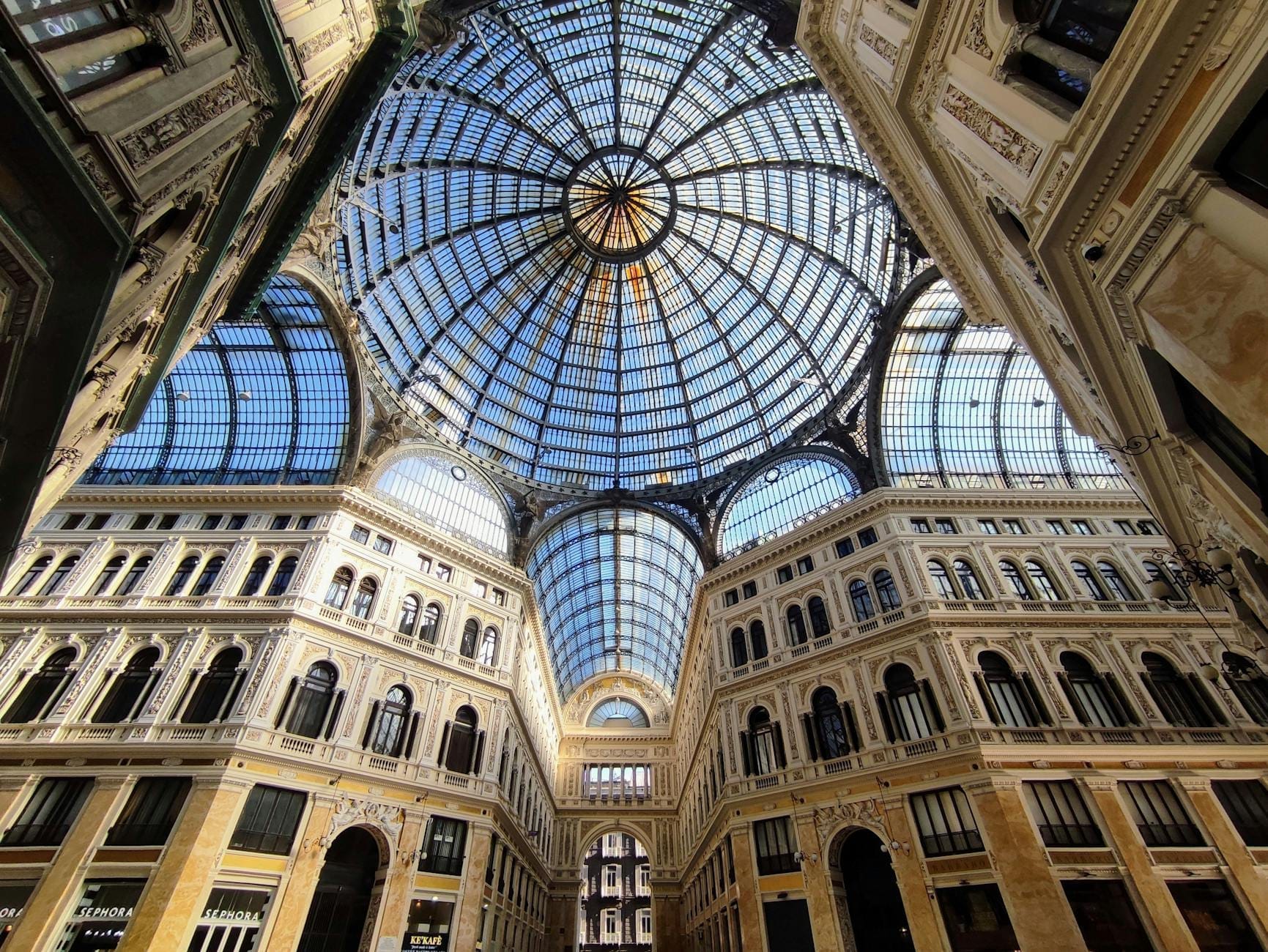
Galleria Umberto I is a monumental public shopping arcade in the heart of Naples, completed in 1890 and named after King Umberto I of Italy. Its floor plan forms a Latin cross, with four glazed arms meeting beneath a central dome that rises 56 metres — roughly 18 storeys — above a geometric mosaic floor. Sixteen iron ribs support the dome's glass panels, flooding the interior with natural light on clear days and turning the space into a luminous lantern effect after dark.
The gallery sits directly across Via San Carlo from the Teatro San Carlo opera house, and stands barely two minutes on foot from Piazza del Plebiscito. This geographic trifecta — opera house, royal square, grand arcade — gives the surrounding block a density of civic architecture rarely matched anywhere in southern Italy.
ℹ️ Good to know
Galleria Umberto I is part of the UNESCO Historic Centre of Naples World Heritage Site. Entry is always free and the gallery has no official closing time, though the atmosphere and safety at 3am differ noticeably from daytime.
Architecture and Historical Context
The gallery was designed by architect Emanuele Rocco and built between 1887 and 1890, during Naples' risanamento period — a massive state-directed urban clearance and reconstruction project triggered by a catastrophic cholera epidemic in 1884. The epidemic killed thousands in the city's overcrowded lower quarters, and the Italian government responded by demolishing dense residential slums near the port and replacing them with wider streets, new sewers, and prestige public buildings. Galleria Umberto I was one of the most visible products of that effort: a symbol of a modernising city, built to rival Milan's Galleria Vittorio Emanuele II, which had opened in 1877.
The style is Stile Umbertino, the Italian equivalent of Beaux-Arts — heavy classical detailing, arched entrance portals, rusticated stonework on the lower facades, and ornate ironwork at the higher levels. Up close, the stonework shows its age: staining, patched repairs, and peeling plaster are visible in places, giving the gallery an honest sense of time passed rather than the scrubbed perfection of a museum exhibit. That imperfection is part of its character.
The gallery predates the nearby Teatro San Carlo by nearly a century, but the two buildings were consciously linked — the main entrance on Via San Carlo faces the opera house directly, reinforcing the idea that the arcade was meant to serve the theatre's well-heeled audience as a place to promenade before and after performances.
Tickets & tours
Live prices and dates from our booking partner. If you book, we may earn a commission at no extra cost to you.
Pompeii and Mount Vesuvius tour with transportation
From 110 €Instant confirmationFree cancellationOrigins and legends of Naples walking tour
From 28 €Instant confirmationFree cancellationGuided walking tour of Naples city and Naples underground
From 45 €Instant confirmationFree cancellationMount Vesuvius and Herculaneum tour with transportation
From 100 €Instant confirmationFree cancellation
What the Visit Actually Feels Like
Walking in through the main Via San Carlo entrance, the scale hits you before the details do. The barrel-vaulted glass ceiling curves overhead, and the central crossing opens up suddenly into the full height of the dome. The mosaic floor beneath the dome is a twelve-pointed star pattern in cream, terracotta, and grey, worn smooth by well over a century of foot traffic. Stand at the centre and tilt your head back: the ironwork ribs converge at a central oculus, and on a sunny morning the light comes down in sharp diagonal shafts.
The ground-floor units along the four arms are a mix of cafes, souvenir shops, a few fashion outlets, and pharmacies. It is not a luxury retail destination by any measure. Some units have been vacant for years. But that absence of commercial pressure makes the gallery feel more like a public square than a mall, which suits it well. People cut through on their way somewhere else, stop for an espresso at the bar near the southern arm, or simply pause to look up.
Acoustically, the space is remarkable in a way guidebooks rarely mention. Footsteps echo sharply on the marble, and conversations carry further than expected. A street musician performing near the central crossing can fill the entire gallery without amplification. The resonance gives the space a theatricality that is entirely appropriate given its neighbour.
How the Experience Changes by Time of Day
Morning
Between 8am and 10am, the gallery is quiet and the light is at its best. The low morning sun enters through the southeastern arm and catches the dome's glass at a low angle, producing a warm, diffuse glow that is unlike any other time of day. Photographers working with natural light should aim for this window. A handful of locals stop at the cafe bar for a standing espresso. The marble floor is slightly cooler than the outside air, and the smell is faintly of old stone and coffee — not unpleasant.
Midday and Afternoon
By noon the gallery fills with tourists, school groups, and people sheltering from summer heat. The dome provides shade and the thick stone walls keep the interior noticeably cooler than the streets in July and August, which makes a brief visit a genuinely practical relief. Crowds peak between 11am and 2pm. On weekends the central crossing can feel congested.
Evening and Night
After 8pm, the shops close and the gallery's character shifts. The artificial lighting illuminates the ironwork from below, casting upward shadows that make the dome's structure appear more dramatic. The cafe near the Via Santa Brigida exit usually stays open later. The gallery is technically accessible through the night, but foot traffic thins considerably after 10pm and common-sense caution applies, as it would anywhere in a major Italian city at that hour.
💡 Local tip
For photography, arrive before 9am on a weekday. The combination of low-angle light, an empty floor, and the full vertical scale of the dome is difficult to achieve at any other time.
Getting There and Practical Logistics
The most convenient transit option is Metro Line 1 to Toledo station, a five-minute walk along Via Toledo toward the waterfront. Toledo station is itself worth a brief stop: its platforms are lined with deep-blue mosaic artwork by artist Robert Wilson. From the station, walk south on Via Toledo and the Galleria's northern entrance appears on your left just before the intersection with Via San Carlo.
The gallery has four entrances: Via San Carlo (main, faces the opera house), Via Santa Brigida, Via Giuseppe Verdi, and Via Toledo. All are open and all lead to the central crossing. There is no ticket desk, no bag check, and no queue.
The marble floors are smooth and generally even, though the gallery has not been comprehensively modernised. Visitors with mobility considerations should note that the floor is wheelchair-accessible at street level through all four entrances, but the gallery's upper gallery levels — where historic walkways once ran — are not accessible to the public.
⚠️ What to skip
Watch your belongings in the central crossing area during busy midday hours. The open, cathedral-like space can attract opportunistic pickpockets in high season, particularly when tour groups pass through.
Combining Galleria Umberto I with the Surrounding Area
The gallery makes most sense as part of a broader walk through this district. Directly across Via San Carlo is the Teatro San Carlo, Italy's oldest continuously active opera house, where guided daytime tours are available if you are not attending a performance. Two minutes south, Piazza del Plebiscito is one of the largest squares in Italy, framed by the Royal Palace and the neoclassical colonnade of the Basilica of San Francesco di Paola. The combination of gallery, opera house, and royal square can be walked in under an hour at a slow pace.
If you are building a longer route, the Palazzo Reale is immediately adjacent to Piazza del Plebiscito and houses a significant collection of Neapolitan art and royal apartments. For those interested in the broader context of Naples' architectural legacy, the best museums in Naples guide covers the major institutions within walking distance of this neighborhood.
The gallery is also the logical starting or ending point if you are walking Via Toledo from north to south. The street connects the historic centre with the waterfront in a straight line, and the gallery stands at its southern terminus, serving as both a physical and symbolic gateway between the commercial spine of the city and its royal civic core.
Who Should Skip This Attraction
Visitors expecting a high-end shopping experience will be underwhelmed. Galleria Umberto I is not the Galleria Vittorio Emanuele II in Milan. Its retail offering is modest and patchy, and several units have been empty for years. If shopping is your goal, the streets around Via Chiaia and Via Calabritto offer considerably better options.
Travellers on very short itineraries who have already seen Milan's Galleria or Paris's Galeries Lafayette may find the space familiar enough to skip in favour of something more distinctly Neapolitan. The gallery is architecturally significant, but it is not the most urgent thing to see in Naples if your time is genuinely limited.
Insider Tips
- Stand at the precise centre of the crossing under the dome and look straight up: the twelve-point mosaic star on the floor is designed to align with the dome's central oculus, and the vertical axis is most visible from that single spot.
- The cafe inside the southern arm of the gallery serves espresso at standard Neapolitan bar prices, which are lower than the tourist cafes on Piazza del Plebiscito a few metres away. Same coffee, different postcode.
- If you are visiting in December, the gallery is decorated for Christmas and the acoustics make any live music or choral performance taking place inside sound extraordinary. Check local event listings for seasonal concerts.
- The Via San Carlo entrance is the most photographed facade, but the Via Toledo entrance gives you the longest uninterrupted view down one of the gallery's four arms, which shows the barrel vault's proportions most clearly.
- The gallery connects Via San Carlo with Via Santa Brigida and Via Toledo, making it a genuinely useful pedestrian shortcut through a block that has no other direct crossing point. Use it as navigation, not just as a sight.
Who Is Galleria Umberto I For?
- Architecture enthusiasts interested in 19th-century iron-and-glass construction
- Photographers working in natural light, particularly in early morning
- Travellers building a walking route between Via Toledo, Piazza del Plebiscito, and the Teatro San Carlo
- Anyone seeking cool shade and a coffee break during hot summer afternoons
- Visitors on a free itinerary looking for significant architecture without admission costs
Nearby Attractions
Other things to see while in Waterfront & Lungomare:
- Castel dell'Ovo
Perched on a small rocky peninsula jutting into the Gulf of Naples, Castel dell'Ovo is the oldest castle in the city and one of its most immediately recognizable landmarks. Entry is free, the views stretch toward Vesuvius and the islands, and the history runs deeper than the walls suggest.
- Castel Nuovo (Maschio Angioino)
Rising above the Naples waterfront on five round towers, Castel Nuovo has anchored the city's harbor since 1284. Part royal palace, part civic museum, part medieval spectacle, it rewards visitors who look beyond the postcard exterior.
- Galleria Borbonica (Bourbon Tunnel)
Commissioned by King Ferdinand II in 1853 as a royal escape route, the project was never fully completed, the Galleria Borbonica became a WWII air-raid shelter and is now one of the most compelling underground experiences in southern Italy. Guided tours descend roughly 30 meters below street level into a world of carved tufa rock, abandoned vehicles, wartime debris, and flooded cisterns.
- Palazzo Reale (Royal Palace)
The Palazzo Reale di Napoli sits at the heart of the city's grandest square, offering throne rooms, a monumental marble staircase, a hanging garden with Gulf views, and one of Italy's largest libraries. Built from 1600 under Spanish viceroys and restored after a 19th-century fire, it rewards visitors who look beyond the obvious tourist circuit.
Planning a trip? Discover personalized activities with the Nomado app.