Via Toledo: Naples' Grand Pedestrian Corridor
Stretching 1.2 kilometers through the heart of Naples, Via Toledo is the city's main artery for daily life, commerce, and history. Commissioned by Spanish viceroy Pedro de Toledo in 1536, this pedestrian street connects major landmarks, world-class shopping, and some of Italy's finest Baroque architecture — all without an entrance fee.
Quick Facts
- Location
- Centro Storico, Naples — from Piazza Dante (north) to Piazza Trieste e Trento (south), near Piazza del Plebiscito
- Getting There
- Toledo Metro Station (Line 1), opened 2012 — exit directly onto the street
- Time Needed
- 1–3 hours depending on stops; full exploration with side streets takes half a day
- Cost
- Free to walk; individual shops and attractions vary
- Best for
- First-time visitors, shoppers, architecture enthusiasts, evening passeggiata
What Via Toledo Actually Is
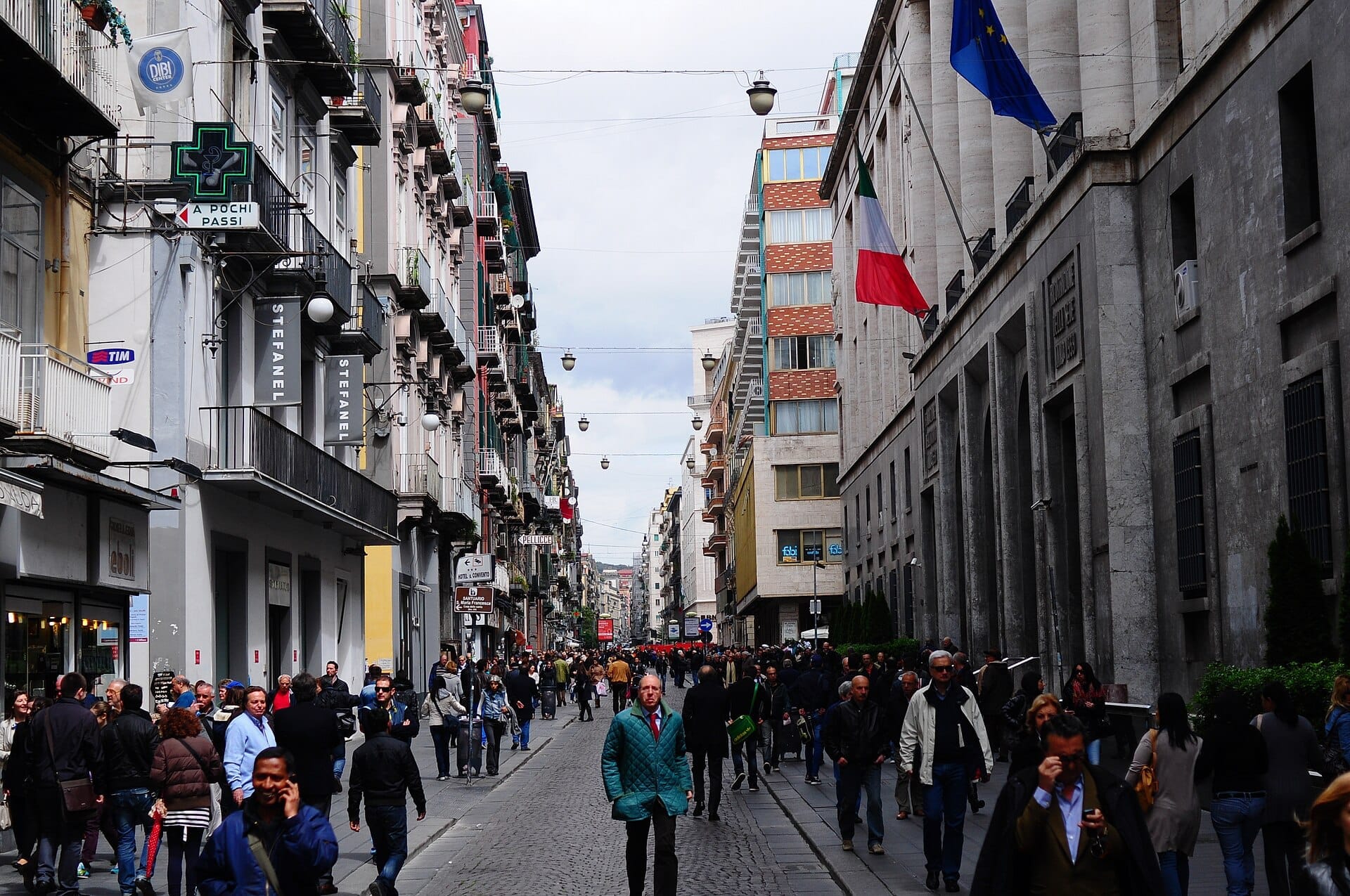
Via Toledo is not a tourist attraction in the conventional sense. There is no ticket booth, no opening time, no queue. It is simply the spine of Naples — a straight, 1.2-kilometer pedestrian street that the city has used as its main artery for nearly five centuries. Walk it once and you understand immediately why: it connects the historic center to the royal quarter, passes the entrance to the city's most celebrated shopping arcade, and places you within a short detour of the Royal Palace, the opera house, and some of the most significant Baroque churches in southern Italy.
The street runs roughly north to south, from Piazza Dante down to Piazza Trieste e Trento, which opens onto Piazza del Plebiscito. The section from Via Armando Diaz to the southern end is fully pedestrianized, giving the lower stretch a completely different energy from the slightly narrower northern end where buses still navigate.
ℹ️ Good to know
Via Toledo is also known historically as Via Roma — a name it carried from 1870 to 1980, when it was renamed in honor of Italian unification. Locals over a certain age still occasionally use both names.
A Street Built by Spanish Power
Via Toledo was created in 1536 on the orders of Pedro Álvarez de Toledo, the Spanish viceroy of Naples, who commissioned architects Ferdinando Manlio and Giovanni Benincasa to lay it out. At the time, it was an act of urban ambition: a wide, straight road cutting through a medieval city of narrow, winding alleys — a statement of Spanish viceregal authority as much as a piece of practical city planning.
The street defined the western edge of the Greek and Roman street grid of the ancient city (what is now the centro storico), and it remained Naples' most important commercial and civic artery through the Bourbon period and well into the 20th century. The Spanish Quarters, the tight grid of streets to the west of Via Toledo, were built in the same era to house the Spanish military garrison. Walking the street, you are tracing a line that Neapolitan history has crossed repeatedly for nearly 500 years.
The street's relationship to the surrounding city is just as interesting as the street itself. To the east lies the dense fabric of the centro storico, the UNESCO-listed historic center with its Greek-Roman street plan. To the west begin the Quartieri Spagnoli, one of Naples' most densely populated and architecturally layered neighborhoods.
Tickets & tours
Live prices and dates from our booking partner. If you book, we may earn a commission at no extra cost to you.
E-bike ride with Vesuvian vineyards and wine tasting
From 74 €Instant confirmationFree cancellationPompeii and Mount Vesuvius tour with transportation
From 110 €Instant confirmationFree cancellationOrigins and legends of Naples walking tour
From 28 €Instant confirmationFree cancellationGuided walking tour of Naples city and Naples underground
From 45 €Instant confirmationFree cancellation
What You See Walking the Street
The walk from Piazza Dante southward begins at one of the city's most atmospheric squares — a curved neoclassical space dominated by a large statue of Dante Alighieri, with cafés under the arcades and second-hand book sellers along the edges. From here, Via Toledo opens up and the rhythm of the city immediately kicks in: shops, bars, street food vendors selling fried pizza and cuoppo (fried seafood cones), and a near-constant stream of pedestrians at any hour past 9am.
The mix of retail ranges from small family-run shoe shops and tabacchi to branches of major Italian fashion chains. Around the midpoint of the street, the entrance to Galleria Umberto I appears on the western side — a late 19th-century iron-and-glass arcade whose scale tends to surprise first-time visitors. The galleria's interior, built between 1887 and 1890, features a soaring cross-shaped nave topped by a 57-meter dome. It is worth entering even if you are not shopping.
Near the southern end, the street opens toward Piazza Trieste e Trento, where you will find the side facade of the Teatro San Carlo, one of the oldest and most prestigious opera houses in Europe, and the entrance to Palazzo Reale di Napoli. The square itself, with its central fountain and surrounding cafés, is a good place to pause and orient before continuing to Piazza del Plebiscito.
Also along Via Toledo's length is the Palazzo Zevallos Stigliano, a 17th-century palazzo that now houses a small but significant art collection including Caravaggio's last known painting, the Martyrdom of Saint Ursula. The entrance is easy to miss — a modest door on the street's east side.
How the Street Changes Through the Day
Early morning, before 9am, Via Toledo has a completely different character. Shopkeepers pull up metal shutters, delivery vans occupy the side streets, and the few people out walk with purpose. The light is flat and the smells are different: roasting coffee from bars, bread from nearby bakeries, the faint trace of the street-cleaning trucks that come through overnight. This is the quietest time and, for photography, often the best.
From late morning through early afternoon, the street reaches peak density. Neapolitans do not graze quietly — they move fast, talk loudly, and use the full width of the pedestrian zone. The air fills with the smell of frying from street food stalls, and the noise of conversation and passing scooters from the adjacent streets bleeds in. For travelers who find sensory overload challenging, midday on a weekday is the hardest time to enjoy a slow walk.
Late afternoon and early evening is where Via Toledo genuinely shines. From around 5pm, the passeggiata — the Italian tradition of the evening stroll — begins in earnest. Families, couples, and groups of teenagers fill the street at a slower pace. The light turns warm and golden from the south. Gelato shops and bars become the main social infrastructure. By 7pm, the street has a festive quality without being chaotic.
💡 Local tip
For the most photogenic light and manageable crowds, aim to walk the street between 7am and 9am, or between 5pm and 7pm. Midday in July and August is genuinely uncomfortable — temperatures on the stone pavement can feel ten degrees hotter than in the shade.
The Toledo Metro Station: Worth Going Underground For
The metro station at Via Toledo deserves specific mention, because it is one of the most visually striking subway stations in Europe. Designed by Spanish architect Oscar Tusquets Blanca and opened in 2012, the station descends around 50 meters below street level through a series of chambers clad in iridescent blue and white mosaic tiles. The deepest level features a wave-like ceiling installation that creates a genuinely disorienting and beautiful effect.
Even if you are not taking the metro, going down to look is worthwhile — there is no admission charge for entering the station. For more on how to use Naples' public transit system, see the guide to getting around Naples.
Practical Notes for Visitors
Via Toledo is fully pedestrianized along its southern section and requires no planning to visit — you simply walk it. Wear comfortable shoes with grip; the flat stones become slippery when wet. In summer, sun exposure on the open southern stretch is significant, so carry water and sunscreen if you are walking midday. There are public water fountains (fontanelle) in the surrounding streets.
Pickpocketing is a genuine concern on densely packed stretches, particularly around the metro entrance and during peak crowd hours. Keep bags on your front and avoid displaying expensive cameras on shoulder straps in tight groups. This is standard city precaution, not unique to this street.
The street connects naturally to a wider walking route through the city center. From Piazza Dante, you can detour east into the historic center toward Cappella Sansevero or continue north toward the Naples National Archaeological Museum. Southward, Piazza del Plebiscito and the waterfront are five minutes on foot.
⚠️ What to skip
Via Toledo itself does not have public restrooms. Your best options are cafés (buy a coffee), the Galleria Umberto I, or the metro station facilities.
Who May Not Enjoy This
Travelers looking for a quiet, contemplative experience will find Via Toledo frustrating during peak hours. The street is genuinely crowded on Saturday afternoons and during holidays, and the noise level is high. If you prefer slower, less commercial streets, the centro storico alleys to the east offer more architectural texture with fewer chain shops. Via Toledo is commercial first, historic second — the history is present but you have to look for it between the storefronts.
Visitors with mobility difficulties should be aware that while the pedestrian zone is flat and wide, the surrounding area involves significant uneven paving and occasional steps. The metro station is accessible via lift, but the lifts are not always operational — confirm in advance if this is essential.
Insider Tips
- Enter Palazzo Zevallos Stigliano for Caravaggio's Martyrdom of Saint Ursula — the building is easy to walk past without noticing, and the collection is small enough to visit in 30 minutes.
- The Toledo metro station is most impressive at the lowest level. Take the escalators all the way down even if you are not catching a train — the mosaic tile work and light installation at depth is genuinely unlike anything else in Naples.
- For the best espresso without paying tourist prices, step into any bar one or two side streets off Via Toledo rather than the ones with outdoor seating directly on the main street. The price difference can be 50%.
- The northern stretch of Via Toledo around Piazza Dante has several good second-hand bookshops that stock Italian editions and occasional vintage maps of Naples — worth checking if you have time.
- Saturday afternoon is the worst time to walk Via Toledo if you want space to move. Sunday morning before noon is surprisingly calm and offers a completely different, almost meditative experience of the same street.
Who Is Via Toledo For?
- First-time visitors to Naples who want to orient themselves quickly and cover multiple landmarks in one walk
- Shoppers wanting a mix of local independent stores and mainstream Italian brands in a compact stretch
- Architecture and history enthusiasts who can layer the street's Spanish viceregal origins onto what they see
- Evening walkers who want to experience the Neapolitan passeggiata in its most authentic setting
- Transit users arriving via metro who want to begin exploring the city immediately on exit
Nearby Attractions
Other things to see while in Centro Storico:
- Cappella Sansevero
Cappella Sansevero is a small baroque chapel in Naples' historic centre that contains one of the most technically staggering sculptures in the world: the Veiled Christ, a life-sized marble figure so realistically carved it appears draped in real fabric. The chapel is compact, deeply atmospheric, and almost certainly unlike anything else you will see in Italy.
- Naples Cathedral (Duomo di Napoli)
The Cattedrale di Santa Maria Assunta, known to locals simply as the Duomo, is Naples' most historically layered religious site. Built over Greek temples, Roman structures, and early Christian basilicas, it has been the spiritual center of the city for seven centuries. It is also where the famous liquefaction of San Gennaro's blood draws thousands of pilgrims three times a year.
- Naples Botanical Garden (Orto Botanico)
The Orto Botanico di Napoli is one of southern Italy's most significant botanical institutions, covering 12 hectares in the heart of Naples with around 9,000 plant species. Free to enter and largely overlooked by tourists, it offers a genuinely quiet counterpoint to the city's sensory intensity.
- Catacombs of San Gennaro
Carved into the volcanic tuff beneath Rione Sanità, the Catacombs of San Gennaro form one of Southern Italy's most significant early Christian sites. Spanning roughly 5,600 square metres across two levels, they preserve underground basilicas, bishop tombs, and some of the oldest Christian frescoes in the Mediterranean world.
Planning a trip? Discover personalized activities with the Nomado app.