Catacombs of San Gennaro: Naples' Underground Sacred City
Carved into the volcanic tuff beneath Rione Sanità, the Catacombs of San Gennaro form one of Southern Italy's most significant early Christian sites. Spanning roughly 5,600 square metres across two levels, they preserve underground basilicas, bishop tombs, and some of the oldest Christian frescoes in the Mediterranean world.
Quick Facts
- Location
- Via Capodimonte 13, Rione Sanità, Naples (Centro Storico)
- Getting There
- Bus to Rione Sanità; check current routes; Metro Line 1 to Museo, then 15-min walk uphill
- Time Needed
- 1.5 to 2 hours (guided tour included)
- Cost
- Check catacombedinapoli.it for current ticket prices; reservations required
- Best for
- History enthusiasts, early Christian art, underground exploration, off-the-standard-circuit Naples
- Official website
- catacombedinapoli.it/en
What the Catacombs of San Gennaro Actually Are
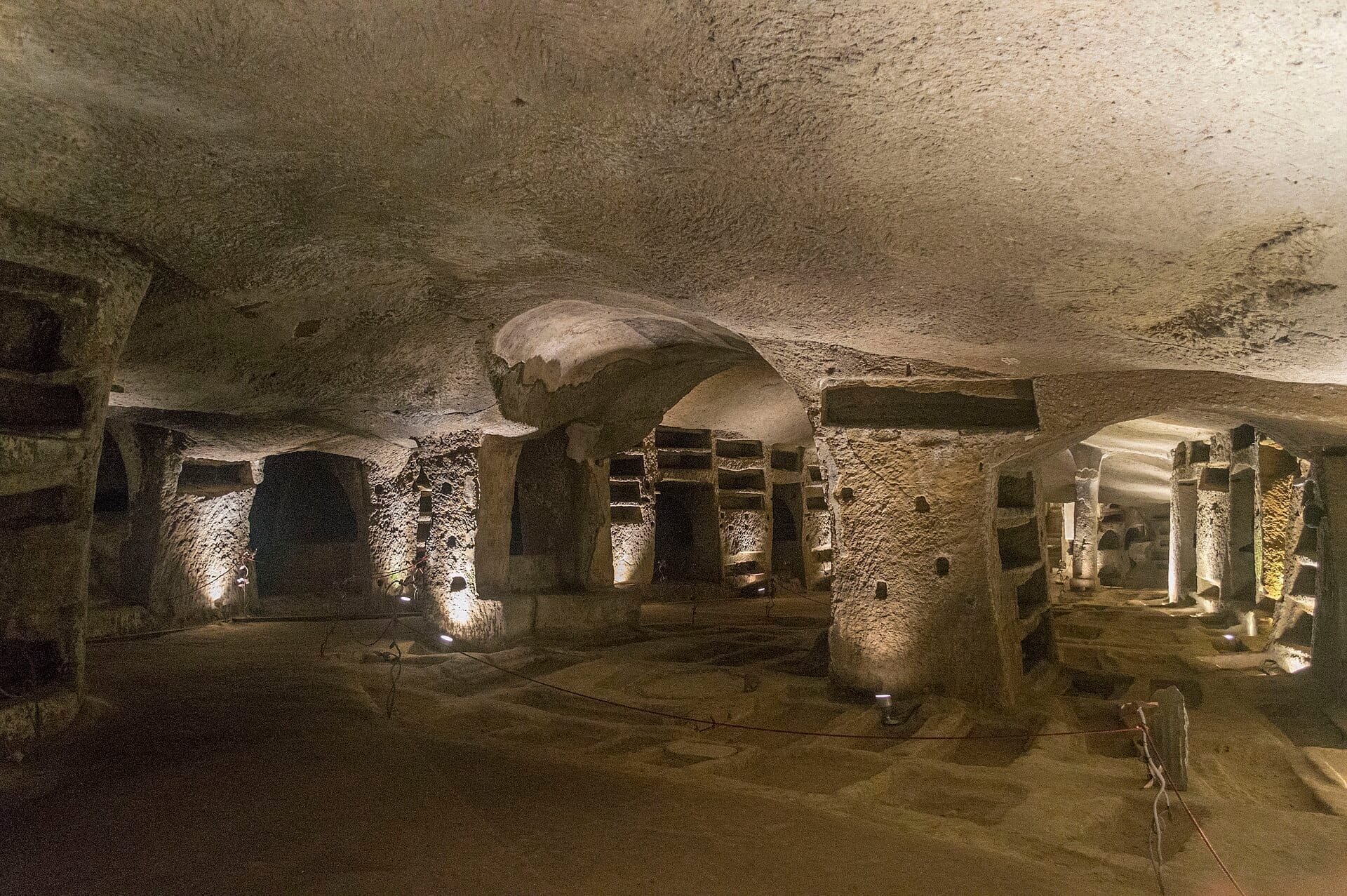
The Catacombe di San Gennaro are not a single tunnel. They are a layered underground city, two distinct levels deep, cut through the soft yellow tuff that underlies much of Naples. The upper level dates to the late 2nd or early 3rd century AD; the lower level was expanded significantly between the 4th and 6th centuries, when the catacombs became one of the most important pilgrimage sites in the Western Christian world. Ceilings in the lower galleries reach up to six metres, giving these spaces the feel of subterranean basilicas rather than narrow burial corridors.
The site covers approximately 5,600 square metres in total, though tours follow a curated route through the most significant chambers. What makes this place exceptional is the density of surviving early Christian art: mosaic portraits, fresco cycles, and decorative schemes that predate most of what survives above ground in Italy. Many visitors arrive expecting gloomy Roman corridors and leave surprised by the scale, the colour still visible on ancient plaster, and the architectural ambition of what was built here underground.
ℹ️ Good to know
Reservations are mandatory. Visits are guided only — you cannot explore independently. English-language tours are available; check official site for current schedule. Book directly through the official website before your trip, especially April through October.
Historical Context: Why This Site Matters
The story of these catacombs is inseparable from Naples' patron saint. San Gennaro (Saint Januarius), the Bishop of Benevento, was martyred around 305 AD during the Diocletianic persecutions. His remains were transferred here in the 5th century, and the site immediately became a destination for Christian pilgrims traveling from across the Mediterranean. The presence of a martyr's tomb transformed what had been a private burial hypogeum into a major ecclesiastical complex.
Over the following centuries, the bishops of Naples chose to be buried here, creating the so-called Crypt of the Bishops, a remarkable sequence of tombs that tracks the leadership of the early Neapolitan church through the 11th century. The Basilica Maior, with its three naves carved from the rock, functioned as an underground church long before Christianity was the dominant architecture above ground. The site fell into disuse during the medieval period and was effectively sealed off until its modern reopening in the late 1960s.
For context on how this fits into Naples' broader Christian heritage, the Cathedral of Naples (Duomo) above ground holds the famous ampules of San Gennaro's blood, making the two sites complementary chapters in the same story. The Duomo is roughly 25 minutes by foot from the catacombs.
Tickets & tours
Live prices and dates from our booking partner. If you book, we may earn a commission at no extra cost to you.
What You See on the Tour
Guided tours begin at the Basilica Madre del Buon Consiglio on Via Capodimonte, where you descend into the upper gallery. The first thing most visitors notice is the temperature: roughly 14 to 16 degrees Celsius year-round, regardless of the season above ground. In July this is a relief. In January, bring a layer.
The upper level contains the oldest sections, including arched loculi (burial niches) stacked in rows along the walls and several family mausolea with traces of fresco decoration. Look for the small mosaic portrait bust near the entrance sequence — it is one of the earliest Christian portraits surviving in Italy, dating to the 4th century, and it retains enough original colour to be genuinely striking rather than merely historically interesting.
Descending to the lower level, the scale shifts dramatically. The Basilica Maior opens up across three rock-cut naves, with columns and carved architectural details that would look at home in an above-ground Roman church. The Crypt of the Bishops lines the walls with episcopal tombs, each marked with inscriptions and varying degrees of decorative painting. Guides will point out individual bishops' dates and the stylistic evolution of the funerary art across six centuries.
Visitors with a particular interest in early Christian art may also want to compare this site with Naples National Archaeological Museum, which houses artefacts from the region's pre-Christian layers. Together they make a strong case for dedicating a full day to Naples' ancient and late-antique heritage.
Getting There and Practical Logistics
The catacombs sit in the Rione Sanità, a neighbourhood that climbs the hillside above the historic centre toward Capodimonte. The address is Via Capodimonte 13, and the entrance is through the Basilica Madre del Buon Consiglio. This is not a part of central Naples that most tourists wander into by accident, and the walk uphill from the Spaccanapoli axis is steeper than it looks on a map.
The most practical approach from the centre is bus C63 or R4 toward Rione Sanità, which gets you close to the entrance without the climb. Alternatively, Metro Line 1 to the Museo stop puts you about 15 minutes on foot, mostly uphill. Taxis and rideshare apps (Uber and Free Now both operate in Naples) are the easiest option if you are arriving with luggage or in summer heat.
💡 Local tip
The neighbourhood of Rione Sanità itself is worth arriving early to explore. The Ponte della Sanità (the 18th-century viaduct), the street market activity in the lower streets, and the Baroque church facades are all worth 30 minutes before your tour begins. This area sees a fraction of the tourist traffic of the centro storico.
Opening hours generally run Monday through Sunday, 10:00 AM to 5:00 PM, with timed tours throughout the day. Confirm current hours and ticket prices at catacombedinapoli.it before visiting, as these details are subject to change.
Photography, Accessibility, and What to Wear
Photography is generally permitted on guided tours, but flash can damage fragile fresco surfaces, so turn it off before you descend. The combination of low artificial lighting and vivid ochre tuff walls actually produces atmospheric results with a smartphone on night mode. The earliest Christian portraits near the entrance, small but remarkably well-preserved, are the most photogenic single details on the circuit.
The site is described as architecturally barrier-free, but the official notes indicate limited access for visitors with significant motor disabilities due to the hydrogeological nature of the site — uneven surfaces and narrow sections exist in parts of the lower level. Contact the site directly if this is a concern before booking.
Wear closed-toe shoes with some grip. The tuff floors can be uneven and occasionally damp. A light jacket or layer is advisable at any time of year given the consistent underground temperature of around 14 to 16 degrees.
Who Will Get the Most From This Visit
The catacombs reward visitors who arrive with some curiosity about early Christian history, Roman burial practices, or ancient urban archaeology. The guided format ensures you understand what you are looking at — without it, many of the most significant details (specific bishop tombs, iconographic programmes in the frescoes) would be easy to walk past without registering their importance.
Families with children who have an interest in history often find this more engaging than a standard museum visit: the underground setting, the scale of the spaces, and the guides' storytelling approach hold attention well. That said, very young children who struggle with enclosed spaces or darkness may find the experience stressful rather than exciting.
Visitors interested in Naples' full underground layer should consider pairing this with Napoli Sotterranea in the historic centre, which explores the Greek-Roman aqueduct tunnels beneath Spaccanapoli. The two sites are complementary rather than redundant: Napoli Sotterranea is geological and civic; the Catacombs of San Gennaro are ecclesiastical and art-historical.
Those who want only the visual highlights of Naples in a single day and are primarily interested in views, food, and atmosphere may find this a poor use of limited time. The experience is slow, guided, and context-dependent. It does not deliver quick gratification. For the right traveler, that is precisely its value.
If you are building an itinerary around Naples' underground and historic Christian sites, the guide to Naples' best churches and the Cappella Sansevero make natural companions for the same day or days adjacent.
Insider Tips
- Book the Saturday 9:30 AM English-language tour directly through catacombedinapoli.it well in advance. Spots fill quickly from spring through early autumn, and the English tours run only once a week.
- Arrive 15 to 20 minutes early and walk through the Rione Sanità neighbourhood below the basilica. The street life here, including the covered market and the view back toward the historic centre, gives you useful context for understanding the layered nature of this city.
- The early Christian mosaic portrait near the upper-level entrance is easy to rush past if you are following the group at pace. Tell your guide you want a moment to study it — most will accommodate the request.
- The underground temperature hovers around 14 to 16 degrees Celsius regardless of season. In August, this is genuinely refreshing. In December or January, bring an extra layer or you will spend the second half of the tour focused on being cold rather than on the frescoes.
- The site is managed by the Cooperativa La Paranza, a local social enterprise from Rione Sanità. Purchasing a ticket here directly supports neighbourhood regeneration in one of Naples' most historically overlooked districts.
Who Is Catacombs of San Gennaro For?
- Travellers with a serious interest in early Christian history and late-antique art
- Visitors who want to see Naples beyond the standard Spaccanapoli and waterfront circuit
- Architecture enthusiasts interested in rock-cut sacred spaces and underground basilicas
- Families with older children who engage well with guided storytelling and historical context
- Anyone visiting both the Duomo and wanting to understand the full San Gennaro story from its origin
Nearby Attractions
Other things to see while in Centro Storico:
- Cappella Sansevero
Cappella Sansevero is a small baroque chapel in Naples' historic centre that contains one of the most technically staggering sculptures in the world: the Veiled Christ, a life-sized marble figure so realistically carved it appears draped in real fabric. The chapel is compact, deeply atmospheric, and almost certainly unlike anything else you will see in Italy.
- Naples Cathedral (Duomo di Napoli)
The Cattedrale di Santa Maria Assunta, known to locals simply as the Duomo, is Naples' most historically layered religious site. Built over Greek temples, Roman structures, and early Christian basilicas, it has been the spiritual center of the city for seven centuries. It is also where the famous liquefaction of San Gennaro's blood draws thousands of pilgrims three times a year.
- Naples Botanical Garden (Orto Botanico)
The Orto Botanico di Napoli is one of southern Italy's most significant botanical institutions, covering 12 hectares in the heart of Naples with around 9,000 plant species. Free to enter and largely overlooked by tourists, it offers a genuinely quiet counterpoint to the city's sensory intensity.
- Naples National Archaeological Museum (MANN)
The Museo Archeologico Nazionale di Napoli (MANN) holds one of the most important collections of ancient art on earth, drawing together the treasures of Pompeii, Herculaneum, and the Farnese dynasty. This is not a museum you browse lightly — plan at least two hours and come with a sense of purpose.
Planning a trip? Discover personalized activities with the Nomado app.