Certosa di San Martino: Naples' Baroque Monastery Above the Bay
Perched on the Vomero hill above Naples, the Certosa di San Martino is a 14th-century Carthusian monastery transformed into one of southern Italy's most rewarding museums. Between its gilded church, serene cloisters, and a terrace view that sweeps from Vesuvius to Capri, it earns far more attention than most visitors give it.
Quick Facts
- Location
- Largo San Martino 5, Vomero hill, Naples
- Getting There
- Metro Line 1 to Vanvitelli, or funicular from Montesanto or Centrale/Chiaia; then a short walk uphill
- Time Needed
- 2 to 3 hours for a thorough visit; 1 hour minimum for church, main cloister, and terrace
- Cost
- €12 standard admission; €2 reduced. Closed Wednesdays, Dec 25, Jan 1. Open Thu–Tue 8:30 AM–7:30 PM (verify hours before visiting)
- Best for
- Art lovers, history enthusiasts, anyone wanting the finest panoramic view in Naples with cultural depth to match
What the Certosa di San Martino Actually Is
The Certosa di San Martino is a former Carthusian monastery that stands on the western edge of the Vomero hill, sharing its rocky promontory with Castel Sant'Elmo. Its full institutional name today is the Certosa e Museo Nazionale di San Martino, and it functions as a major state museum managed by Italy's Ministry of Culture. From street level in the city below, the complex is barely visible; you see only the sheer tufa cliff face. From the terrace inside, the entire Bay of Naples opens up beneath you.
Founded in 1325 by Carlo di Calabria, son of King Robert of Anjou, the monastery was initially a Gothic structure. Over the following two centuries it expanded steadily, and by the early 17th century it was undergoing a near-total transformation under architect and sculptor Cosimo Fanzago, who gave the complex its defining Baroque character beginning in 1623. The result is a church interior of almost theatrical richness: inlaid marble floors, ceiling frescoes, altars loaded with sculpture, and a sacristy that functions as a minor gallery in its own right.
When the Carthusian order was suppressed in 1866 following Italian unification, the state converted the complex into a national museum. Today the museum spreads across roughly 100 rooms and three distinct cloisters, covering the history of the Kingdom of Naples through painting, sculpture, decorative arts, maps, naval models, and the finest presepe (Nativity scene) collection in the world.
The Church: Where the Baroque Is at Its Most Intense
The church of San Martino is the centrepiece and it hits differently than a typical Neapolitan baroque church. Space here was not a constraint: the Carthusians had money, land, and time. The nave is wide, the chapels deep, and every surface carries deliberate decoration. The marble inlay work on the floor and lower walls is so precisely cut and coloured that it looks almost painted. Look upward and you find ceiling frescoes by Giovanni Lanfranco and Battistello Caracciolo, artists who shaped Neapolitan painting in the first half of the 17th century.
The sacristy contains one of the most extraordinary marquetry cycles in Italy: wooden cabinets with inlaid landscapes, architectural scenes, and botanical details that took craftsmen decades to complete. This is the kind of work that photographs poorly and rewards slow looking in person. Bring reading glasses if detail matters to you.
💡 Local tip
The church is inside the ticketed museum area. Unlike many Neapolitan churches, you cannot enter for free. Budget time specifically for the sacristy — most visitors rush through it.
The Certosa holds one painting that demands mention on its own: a large Caravaggio-influenced work that reflects the seismic effect the artist had on Neapolitan painters after his two visits to the city in the early 1600s. For the broader story of Caravaggio's impact on Naples, the Naples Caravaggio guide covers the key works across multiple venues.
Tickets & tours
Live prices and dates from our booking partner. If you book, we may earn a commission at no extra cost to you.
The Cloisters: Three Worlds Inside One Complex
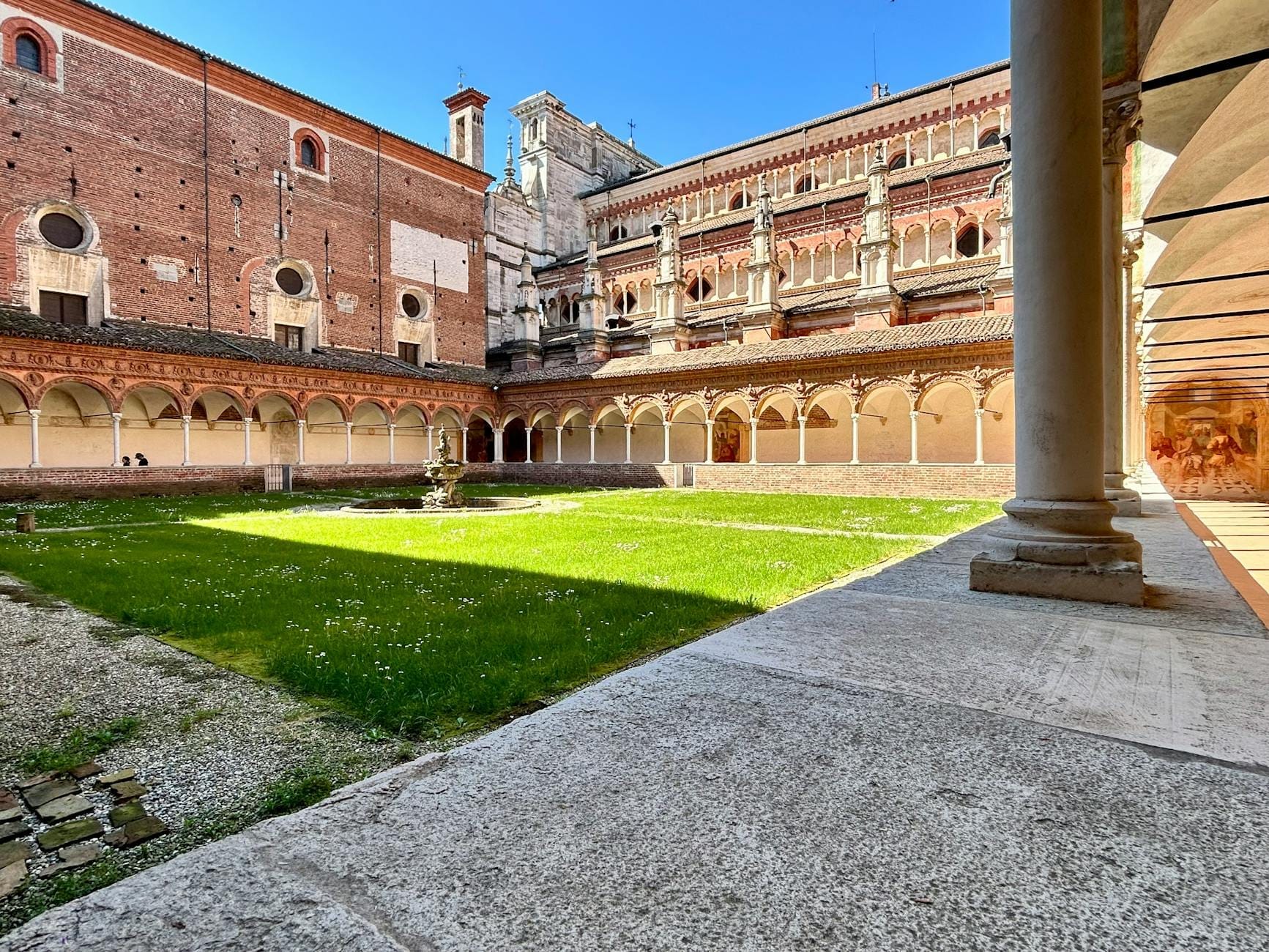
The monastery has three cloisters at different scales and purposes. The Chiostro Grande, the Great Cloister, is the one that stays with you. Designed by Fanzago, it is surrounded by 64 arches and bordered by a balustrade of skulls and monks' heads carved in marble — a memento mori that the Carthusians found entirely appropriate for a life devoted to contemplation. The lawn inside is immaculate, the proportions generous, and the sound from the city barely penetrates. On a warm morning, the light falls across the arcade in long diagonal strips.
The Chiostro dei Procuratori is smaller and older in character, while the Chiostro del Priore opens onto the famous south-facing terrace. Each feels distinct. The progression from one to the next gives a sense of how the monastery functioned as a self-contained world, with spaces for prayer, administration, hospitality, and private retreat.
Gardens attached to the priory cloister descend in terraced levels toward the cliff edge. They are not always fully accessible and the terrain is uneven: worn stone steps, low curbs, and narrow paths make certain sections difficult for those with limited mobility. Contact the museum directly at +39 081 229 4503 before visiting if accessibility is a concern.
The Museum Collections: More Than a Backdrop
The Museo Nazionale di San Martino holds collections that would justify a separate institution. The most famous single exhibit is the Cuciniello presepe, an 18th-century Neapolitan Nativity scene assembled across a sculpted landscape roughly the size of a dining table, populated with hundreds of individually crafted terracotta figures. Neapolitan presepi are a serious art form, not a folk curiosity, and this example shows why. The figures' faces are individually modelled; the food in the market stalls is botanically accurate; the landscape includes a distant volcano unmistakably modelled on Vesuvius.
Beyond the presepe, the museum's painting galleries document five centuries of Neapolitan art from the Angevin period through the 19th century. There are rooms dedicated to the history of the Bourbon kingdom, sections covering theatrical costume and opera history tied to the Teatro San Carlo, and a collection of historical maps and prints showing how Naples looked before the 19th-century demolitions reshaped the city centre. These maps alone are worth 20 minutes of attention.
One section documents the history of the Neapolitan navy with ship models, charts, and navigational instruments. It is niche but well presented, and it connects the museum's holdings to the broader maritime identity of the city in ways that the paintings alone cannot.
The View: What You Actually See from the Terrace
The south-facing terrace off the Chiostro del Priore provides what many visitors come specifically to see. The view takes in the entire arc of the Bay of Naples: directly below is the Castel dell'Ovo on its small island, then the waterfront promenade, Mergellina in the middle distance, and the Posillipo peninsula curving to the west. On clear days, Capri sits on the horizon like a dark ridge above the sea. To the east, Vesuvius rises above the port and the low suburbs. The city itself spreads out below in layers of ochre, terracotta, and grey.
💡 Local tip
Morning light (8:30–10:30 AM) falls on the bay from the east and is the cleanest for photography. By midday in summer the haze off the water can flatten the view considerably. Late afternoon in autumn and winter often produces the sharpest visibility and the most dramatic colour.
This is one of the finest elevated viewpoints in the city, comparable to the view from Castel Sant'Elmo next door, though the Certosa terrace places you within a garden setting rather than on raw fortification walls. For a wider comparison of where to find elevated views across Naples, the best views in Naples guide covers the main options.
The terrace can feel genuinely peaceful in the first hour after opening, before group tours arrive. By late morning on weekends, it fills quickly. If you want to photograph without strangers in frame, arrive at opening or come on a weekday afternoon when the light is still workable.
Getting There and Practical Logistics
The Certosa sits on the Vomero hill and requires some upward travel regardless of how you approach. The most straightforward route is the funicular: either the Funicolare di Montesanto from Montesanto station in the Quartieri Spagnoli area, or the Funicolare Centrale from near Via Toledo, both reaching Vomero in a few minutes. From the Vomero funicular stations, it is a walk of roughly 10 to 15 minutes through residential streets to reach the Certosa. Signs are present but not always prominent; use the address Largo San Martino 5 on a mapping app.
Metro Line 1 stops at Vanvitelli, which is also in Vomero and roughly the same walking distance. The Naples funicular is the more scenic and efficient option for most visitors coming from the historic centre or the waterfront.
Admission is €12 standard, €2 reduced as of the most recently verified pricing (circa 2023–2024). The museum is open Thursday through Tuesday from 8:30 AM to 7:30 PM, with last entry before closing. It is closed on Wednesdays, December 25, and January 1. Opening hours at Italian state museums can shift seasonally or for special events: confirm on the official Cultura.gov.it listing before you go. The phone number for direct enquiries is +39 081 229 4503.
⚠️ What to skip
Hours listed in various third-party sources for the Certosa di San Martino vary significantly. Some list a 4:00 PM or 5:00 PM close; the official record shows 7:30 PM. Always confirm directly or through Cultura.gov.it before your visit.
Wear comfortable shoes with grip. The interior mixes flat museum rooms with stone cloisters, tiled church floors (sometimes polished to a shine), and terraced garden paths on sloped ground. The site is not ideal for pushchairs or wheelchairs in the garden sections, though the main museum rooms are generally accessible.
Who This Attraction Suits and Who Might Reconsider
The Certosa rewards visitors who move slowly and look carefully. If your interest is primarily in a single knockout panorama with minimal effort, Castel Sant'Elmo next door delivers the view more quickly and with a simpler layout. The Certosa is for people who want the view plus several hours of serious cultural content: Baroque architecture, painting, decorative arts, and historical collections that genuinely illuminate Neapolitan history.
Visitors who arrive having already spent time at the Naples National Archaeological Museum will find the Certosa a strong complement: one focuses on the ancient world, the other on the Bourbon and Viceregal periods. Together they bracket the long history of the city.
Children under around 10 will likely find the pace and content difficult to sustain across a full visit. The presepe room tends to capture their attention; the painting galleries and decorative arts rooms less so. If you are visiting Naples with young children, plan to spend an hour here rather than two or three, or save this site for when the children are occupied elsewhere.
Insider Tips
- Arrive within 30 minutes of opening on a weekday to have the Great Cloister almost entirely to yourself. The quality of the silence there in the early morning is something most visitors never experience.
- The presepe collection is displayed in relatively low light to protect the materials. Let your eyes adjust before moving through the room, and take your time with the Cuciniello presepe specifically — the detail in individual figures repays close inspection.
- Castel Sant'Elmo shares the same hilltop and has a separate ticket. Combining both in one visit is efficient and the contrast between the monastery's ornate interiors and the fortress's stark military architecture is genuinely interesting. Buy tickets separately at each entrance.
- The museum gift shop stocks a better than average selection of art history publications, including titles on Neapolitan painting not easily found elsewhere. If this period of Italian art interests you, leave time at the end to browse.
- On overcast days in autumn and winter, the terrace view can actually be more dramatic than on bright summer days: low cloud breaks over Vesuvius, the sea turns dark grey, and the city's colour becomes more saturated. Do not dismiss the Certosa in winter conditions.
Who Is Certosa di San Martino For?
- Art and architecture enthusiasts wanting to understand the Baroque period in Naples
- Travellers looking for a panoramic viewpoint that offers genuine cultural depth beyond the view itself
- Anyone interested in Neapolitan history from the medieval period through the 19th century
- Visitors who want a calmer, less crowded alternative to the city's busiest sites
- Photography-focused travellers seeking the best morning light view over the Bay of Naples
Nearby Attractions
Other things to see while in Vomero:
- Castel Sant'Elmo
Perched on Vomero Hill above the city, Castel Sant'Elmo is a star-shaped medieval fortress carved from volcanic tuff, offering some of the most complete panoramas in Naples. For a fraction of what most attractions charge, you get ancient ramparts, a contemporary art museum, and an unobstructed view of Vesuvius rising over the bay.
- Naples Funiculars
Naples operates four historic funiculars as part of its everyday public transport network, linking the seafront and historic centre to the hilltop neighbourhood of Vomero. Riding them costs the same as a bus ticket and delivers views that most visitors completely overlook.
- Villa Floridiana & Duca di Martina Museum
Perched on the Vomero hill above Naples, Villa Floridiana combines a free neoclassical park with a world-class ceramics museum housing over 6,000 pieces. It's one of the few attractions in the city where you can sit on a bench overlooking the Bay of Naples without fighting a crowd.
Planning a trip? Discover personalized activities with the Nomado app.