Naples Funiculars: The Four Lines That Climb the City
Naples operates four historic funiculars as part of its everyday public transport network, linking the seafront and historic centre to the hilltop neighbourhood of Vomero. Riding them costs the same as a bus ticket and delivers views that most visitors completely overlook.
Quick Facts
- Location
- Multiple lower stations; upper terminus in Vomero, Naples
- Getting There
- Vanvitelli (Line 1 Metro) for Central & Montesanto upper stations; Piazza Fuga for Central lower
- Time Needed
- 10–20 min per ride; 1–2 hours to explore all four lines
- Cost
- Covered by standard ANM transit tickets; verify the current fare before travel
- Best for
- City orientation, photographers, travellers heading to Vomero or Certosa di San Martino
- Official website
- www.anm.it
What the Naples Funiculars Actually Are
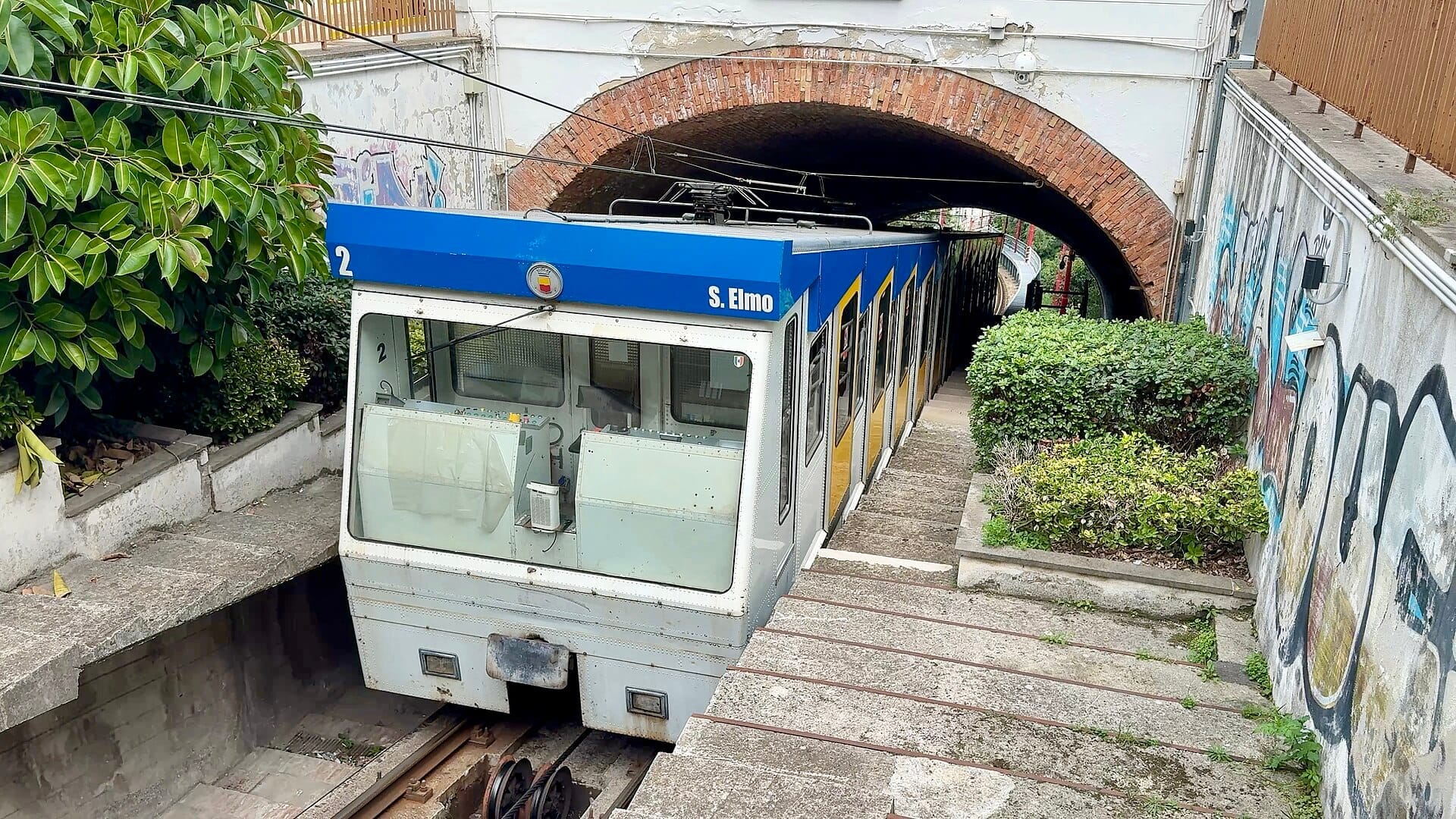
The Naples funiculars are not tourist rides. They are a functioning part of the city's ANM public transport network, used daily by Neapolitans commuting from the steep Vomero hill down to the centro storico, Chiaia, and the seafront at Mergellina. There are four lines in total: the Funicolare Centrale, the Funicolare di Chiaia, the Funicolare di Montesanto, and the Funicolare di Mergellina. Between them, they have been solving the city's fundamental geography problem since 1889, when Chiaia first opened.
Naples is not a flat city. The Vomero plateau sits roughly 170 metres above the lower districts, separated by slopes too steep for conventional roads. The funiculars climb those slopes on cable-hauled tracks, with each car counterbalancing the other on the same incline. The Central line, the most used, covers a 1,270-metre track at a 13% gradient and runs at an average speed of 7 metres per second. The ride takes just a few minutes, but the altitude change is dramatic enough that the view from the upper windows transforms completely on the way up.
💡 Local tip
A standard ANM single ticket (valid 90 minutes) covers the funiculars, metro, and buses. Buy tickets at tobacconists, newsstands, or ANM machines before boarding. Validators are inside the carriage.
The Four Lines: What Each One Connects
Funicolare Centrale
The busiest of the four, the Central Funicular runs from Augusteo (near Via Toledo) up through Corso Vittorio Emanuele and Petraio to Piazza Fuga in Vomero. It opened in 1928 and was significantly modernised in 2017. This is the line most travellers should use first: the lower station sits a short walk from Piazza del Plebiscito and the Via Toledo shopping street, and the upper station drops you almost directly at the entrance to the Certosa di San Martino. Frequency is every 10 minutes.
The Central line runs Monday–Tuesday 7:00–22:30; Wednesday, Thursday, and Sunday 7:00–00:30; Friday–Saturday 7:00–00:30. That late-night service matters if you plan an evening at one of Vomero's restaurants and want to avoid the taxi queue. For context on what's near the upper station, see the full guide to Certosa di San Martino and the fortress at Castel Sant'Elmo.
Funicolare di Chiaia
The oldest operating line, opened in 1889, Chiaia connects the upscale Via Chiaia neighbourhood to Vomero via four stations including Corso Vittorio Emanuele and Palazzolo. It carries roughly half a million passengers per year, making it the quietest of the four lines, and the ride feels noticeably more local. The lower station is close to the Chiaia waterfront and the Villa Comunale public gardens, which makes it useful if you are spending an afternoon along the seafront before heading uphill for sunset views.
Funicolare di Montesanto
Opened in 1891, Montesanto connects the Quartieri Spagnoli (Spanish Quarter) near the Montesanto metro and rail station to Morghen in Vomero, via three stops. With over 2.5 million passengers annually, it is the second busiest line. The lower station is a short walk from the Quartieri Spagnoli, making this the natural choice if you are starting your Vomero excursion from the historic centre side. Morghen station in Vomero emerges onto a quiet residential piazza with cafes, notably less tourist-facing than the Piazza Fuga end.
Funicolare di Mergellina
The southernmost line, opened in 1931, runs from the Posillipo Alto neighbourhood down to the Mergellina waterfront via five stations. This is the least used by short-stay visitors but arguably the most scenic, climbing through residential Posillipo on its way to a hilltop that overlooks the Bay of Naples. If you are combining it with a walk along the Mergellina seafront or planning to catch a ferry to the islands, this line gives you a useful altitude shortcut back up to Posillipo Alto.
Tickets & tours
Live prices and dates from our booking partner. If you book, we may earn a commission at no extra cost to you.
Origins and legends of Naples walking tour
From 28 €Instant confirmationFree cancellationGuided walking tour of Naples city and Naples underground
From 45 €Instant confirmationFree cancellationCaserta Royal Palace day-trip from Naples
From 100 €Instant confirmationFree cancellationSafe and Convenient 24-7 Luggage Storage in Naples
From 6 €Instant confirmationFree cancellation
What the Ride Actually Feels Like
Boarding any of the funiculars during the morning commute (roughly 8:00 to 9:30) is a fully Neapolitan experience: school bags, shopping carts, the smell of espresso on someone's breath, and a surprising amount of cheerful noise in a very small car. The cars themselves are functional rather than romantic, with bench seating along the sides and standing room in the centre. Windows run the length of each car and, on the Central and Chiaia lines especially, frame a progressively widening panorama of the city and bay as you ascend.
Midday is when the funiculars empty slightly and you get more room to stand at the windows. Late afternoon, from around 17:00, they fill again with people heading home. The golden hour before sunset, roughly 45 to 75 minutes before dark depending on season, is when the light catches the rooftops of the lower city most dramatically through the carriage windows. At that point, even a three-minute ride becomes worth pausing for.
ℹ️ Good to know
The Central Funicular was significantly upgraded in 2017. Its cars are the most modern of the four. The Chiaia and Mergellina lines feel slightly older in character, with a bit more mechanical hum on the climb.
Historical and Cultural Context
The construction of the funiculars in the late 19th and early 20th centuries was directly tied to the urbanisation of Vomero. Before the funiculars, the hill was difficult to access and sparsely populated. Once the lines opened, developers began building the orderly residential streets and Belle Époque villas that still define the neighbourhood. The funiculars did not just serve the city, they shaped it. The fact that you can still ride lines opened in 1889 and 1891 as ordinary transit, rather than heritage attractions, says something distinctive about Naples.
The song 'Funiculì, Funiculà', composed by Luigi Denza in 1880, was written to celebrate the original rack railway up Mount Vesuvius, not these city funiculars. But the song became so associated with Naples broadly that the conflation stuck. If you want to understand the city's relationship with its own mythology, that small confusion is quite instructive. For more on the city's layered character, the guide to whether Naples is worth visiting addresses the question directly.
Getting There and Practical Logistics
All four lower stations are reachable on foot from central Naples, though the distances vary. The Central Funicular's Augusteo station is the easiest to find: it is on the corner of Via Toledo and Piazza Duca d'Aosta, marked by a standard ANM entrance. The Montesanto lower station is inside the Montesanto metro and railway hub, which also connects to the Circumflegrea and Cumana suburban lines. Chiaia's lower station is on Via Cimarosa near the waterfront, and Mergellina's base station is at the Mergellina seafront near the ferry terminal.
If you are travelling on the metro, Line 1's Vanvitelli stop deposits you directly at the Vomero upper plateau, near both the Central Funicular's Piazza Fuga exit and the Montesanto Funicular's Morghen exit. This means you can ride the metro up and one of the funiculars down, which is the logical way to experience both without retracing your steps. For a full overview of how to navigate the city, the getting around Naples guide covers ANM tickets, the metro network, and what to watch out for on buses.
⚠️ What to skip
Ticket prices and operating hours change periodically. Always check the ANM website (anm.it) or ask at a tobacco shop before travel, especially if visiting outside standard hours.
Photography, Views, and What to Combine Your Visit With
For photography, the most interesting shots from the funiculars are through the windows on the way up: rooftop terraces, laundry strung between buildings, and the slow reveal of Vesuvius on the eastern horizon. A wide-angle lens or a smartphone in landscape mode works better than a telephoto inside the narrow car. The Central Funicular's passage through the Petraio station, which is essentially a cut through a residential hillside, is visually arresting enough to warrant a photo if you are near the window.
Once at the top, the Vomero plateau gives you access to some of the city's best elevated viewpoints. The terrace at Castel Sant'Elmo is the highest point accessible to visitors, while the Certosa di San Martino's external loggia has arguably the most composed view over the bay. Both are a short walk from Piazza Fuga. If you want broader advice on where to find elevated perspectives across the city, the guide to the best views in Naples covers all the key vantage points.
Travellers who should probably skip the funiculars entirely: anyone with no interest in Vomero or the hilltop attractions, and anyone expecting a scenic heritage railway experience. These are transit vehicles. They are interesting as urban infrastructure and genuinely useful for getting up the hill efficiently, but if your entire Naples visit is focused on Pompeii, street food in the historic centre, and the Cappella Sansevero, you may simply never need to go to Vomero at all.
Insider Tips
- Ride the Central Funicular down, not just up. The descent gives you a full-frontal view of the lower city opening up below you, which feels more dramatic than the ascent.
- The Montesanto upper station at Morghen is surrounded by quieter Vomero cafes with no tourist markup. Order a coffee here after the Certosa di San Martino rather than at the more visited Piazza Vanvitelli.
- If you plan to ride multiple lines in one afternoon, a 90-minute ANM ticket covers the transfer, provided you validate correctly at each entry. Time your loop accordingly.
- The Chiaia Funicular's intermediate station at Corso Vittorio Emanuele has an exit that leads to a quiet residential terrace with an unobstructed bay view that almost nobody stops at.
- Avoid the Central Funicular between 8:00 and 9:30 on weekdays if you have luggage or a pushchair. The cars fill completely and there is no room to manoeuvre.
Who Is Naples Funiculars For?
- First-time visitors wanting a fast, cheap way to reach Vomero and its hilltop museums
- Photographers looking for city roofscape and bay views without a long hike
- Travellers interested in urban infrastructure and how a city solves its own geography
- Anyone combining a morning in the historic centre with an afternoon at Certosa di San Martino or Castel Sant'Elmo
- Visitors who want to experience Naples as a working city, not just a postcard
Nearby Attractions
Other things to see while in Vomero:
- Castel Sant'Elmo
Perched on Vomero Hill above the city, Castel Sant'Elmo is a star-shaped medieval fortress carved from volcanic tuff, offering some of the most complete panoramas in Naples. For a fraction of what most attractions charge, you get ancient ramparts, a contemporary art museum, and an unobstructed view of Vesuvius rising over the bay.
- Certosa di San Martino
Perched on the Vomero hill above Naples, the Certosa di San Martino is a 14th-century Carthusian monastery transformed into one of southern Italy's most rewarding museums. Between its gilded church, serene cloisters, and a terrace view that sweeps from Vesuvius to Capri, it earns far more attention than most visitors give it.
- Villa Floridiana & Duca di Martina Museum
Perched on the Vomero hill above Naples, Villa Floridiana combines a free neoclassical park with a world-class ceramics museum housing over 6,000 pieces. It's one of the few attractions in the city where you can sit on a bench overlooking the Bay of Naples without fighting a crowd.
Planning a trip? Discover personalized activities with the Nomado app.