Pompeii Archaeological Park: The Complete Visitor Guide
Buried by Mount Vesuvius in 79 AD and frozen in extraordinary detail, the Archaeological Park of Pompeii is one of the most significant ancient sites on Earth. Covering 66 hectares near Naples, it rewards careful planning far more than a casual stroll. Here is what you actually need to know before you go.
Quick Facts
- Location
- Via Villa dei Misteri, 2, 80045 Pompei NA, Italy
- Getting There
- Circumvesuviana train from Naples to Pompei Scavi-Villa dei Misteri station (approx. 35–40 min)
- Time Needed
- 3–5 hours minimum; full-day recommended
- Cost
- Verify current ticket prices at pompeiisites.org before visiting; book in advance to avoid queues
- Best for
- History lovers, archaeology enthusiasts, photography, families with curious older children
- Official website
- pompeiisites.org/en
What Pompeii Actually Is (and Why Scale Matters)
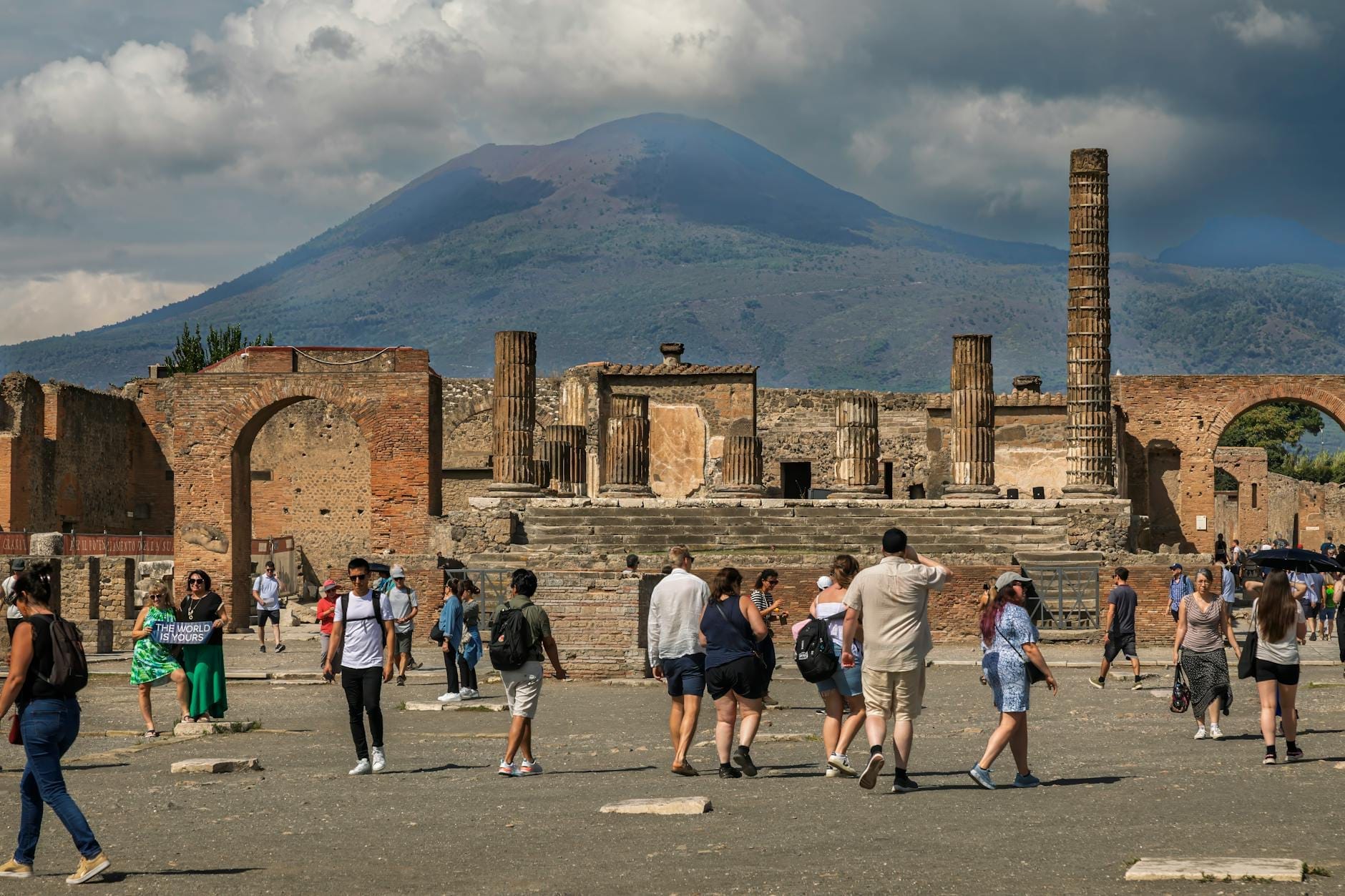
The Archaeological Park of Pompeii, known in Italian as the Parco Archeologico di Pompei, is not a ruin in the conventional sense. It is an entire Roman city, covering 66 hectares, with roughly 50 hectares already excavated including its suburbs. When Vesuvius erupted on August 24, 79 AD, a torrent of volcanic ash and pumice buried Pompeii so rapidly and completely that it preserved streets, buildings, frescoes, food in ovens, and the shapes of human bodies in near-perfect condition. What you walk through today is not a reconstruction: it is the real city, exposed.
That scale is the first thing most visitors underestimate. Guidebook descriptions and social media photos give the impression of a compact open-air museum. In reality, Pompeii is closer to a small town, with intersecting grid streets, distinct residential neighborhoods, commercial districts, bath complexes, temples, an amphitheater, and two theaters. You will not see it all in a morning. Planning is not optional here, it is essential.
💡 Local tip
Book tickets online at pompeiisites.org before your visit. Ticket queues at the gate can be substantial, especially from late spring through early autumn. Arriving without a booking wastes the best hours of the day.
Getting There from Naples
The most reliable and affordable route from Naples is the Circumvesuviana commuter rail line, which departs from Napoli Porta Nolana station (accessible via Napoli Centrale-Garibaldi underground passage). Take the Sorrento-direction train and disembark at Pompei Scavi–Villa dei Misteri. The journey takes approximately 35 to 40 minutes. The station exit deposits you almost directly at the main park entrance on Via Villa dei Misteri, so there is no confusing walk. For full details on navigating the city's transport network, the getting around Naples guide covers train options, fares, and timing clearly.
Taxis and private transfers from Naples are available and considerably faster, particularly if you are traveling with a group or have mobility concerns. Driving yourself is possible, but parking around the site can be chaotic during high season. If you are combining Pompeii with a day that starts or ends in central Naples, the train remains the most practical choice.
⚠️ What to skip
The Circumvesuviana is a regional commuter line, not a metro. Trains can be crowded and air conditioning is inconsistent. Keep bags secure and be at the platform a few minutes early, especially on summer weekends.
Tickets & tours
Live prices and dates from our booking partner. If you book, we may earn a commission at no extra cost to you.
What to See First: A Practical Walkthrough
Enter through the Porta Marina gate, the main entrance closest to the rail station, and you emerge directly onto the Via dell'Abbondanza, Pompeii's main commercial artery. The street is wide by Roman standards, paved with large basalt slabs worn smooth by centuries of cart wheels, and lined with the remains of shops, taverns, and bakeries. You can still see the deep grooves carved by wagon wheels into the stone at intersections. The stepping stones crossing the road, raised to keep feet dry in the frequent floods, give the whole street a strange, functional intimacy.
Prioritize the Forum first, before crowds concentrate there mid-morning. This was the administrative and religious heart of the city, and the spatial logic of the whole site becomes clearer once you understand the Forum's relationship to the surrounding streets. From there, the Temple of Apollo, the Basilica (the main law court), and the Macellum (covered food market) form a logical cluster that can be covered in under an hour.
The House of the Vettii and the House of the Faun are the two domestic properties that receive the most attention, and for good reason. The House of the Faun contains the original location of the famous Alexander Mosaic (now in the Naples Archaeological Museum), while the House of the Vettii still holds some of the finest surviving frescoes in the ancient world. Check at the entrance whether both are open on the day of your visit, as individual houses rotate closures for conservation work.
The plaster casts of the victims, located in several spots around the site including the Garden of the Fugitives and the Forum Granary, are among the most affecting things you will see anywhere in Italy. Pompeii's excavators discovered that the ash had hardened around the decayed organic matter of bodies, leaving perfect cavities. By injecting plaster into these voids, archaeologists preserved the exact postures of people in their final moments. The quality of the National Archaeological Museum's companion collection in Naples is extraordinary, and the Naples National Archaeological Museum houses many of the finest Pompeian objects, including the Alexander Mosaic, and makes for a natural pairing with this visit.
How the Experience Changes by Time of Day
Pompeii opens at 9:00 AM. Arriving at opening time is not just a practical tip, it is a genuinely different experience. The site in the first hour has a quality that disappears by mid-morning: quiet streets, low-angle light cutting across the ancient basalt, and the faint smell of damp stone and vegetation that characterizes the site before the heat sets in. Bird calls carry across empty streets. The scale feels comprehensible.
By 10:30 to 11:00 AM, tour groups are moving through the main arteries in large numbers. The Forum and the major streets become congested. Photography requiring clear sightlines requires patience. The site does not become unpleasant, but the contemplative quality of early morning is gone. If your schedule allows any flexibility, use it to arrive at or shortly after opening.
The last entry is well before the official closing time, so verify the current cutoff on the official website before planning a late afternoon visit. Afternoon light is excellent for photography along the eastern streets of the site, where the sun angles low across the ruins and Vesuvius sits in the background. However, the combination of crowds and heat in summer months makes afternoons physically taxing.
⚠️ What to skip
Summer heat at Pompeii is serious. Most of the site is fully exposed, with minimal shade. Bring at least 1.5 liters of water per person, wear a hat and sunscreen, and plan breaks in the covered areas around the Forum Granary or the theater complex.
Historical Context: Why This Place Matters
Pompeii was a prosperous Roman town of 10,000 to 20,000 residents before the eruption. It was not Rome: it was a commercially active port city with trade connections across the Mediterranean, a class of wealthy merchants who funded elaborate homes and public buildings, and a working-class population that left its own record in the graffiti scratched onto walls throughout the city. Political slogans, insults, declarations of love, and business advertisements cover surfaces that have been preserved under volcanic material for nearly two millennia.
Systematic excavation began in 1748 under the Bourbon King Charles III of Naples and has continued, with interruptions, ever since. The site was designated a UNESCO World Heritage Site in 1997, jointly with Herculaneum, the Oplontis villas, and the Stabiae ruins. Excavation is ongoing: the Great Pompeii Project, launched in 2012, has produced significant new discoveries as recently as 2023, including intact frescoes and skeletal remains that have revised understanding of the eruption's timeline.
Pompeii is frequently paired with its neighbor Herculaneum, a smaller but in many ways better-preserved site located closer to Naples. The two sites offer different experiences: Pompeii has unmatched scale, while Herculaneum has finer organic preservation including wooden furniture and second-floor structures. If you have two days and a serious interest in Roman history, both are worth the time. The comparison guide on Pompeii vs Herculaneum breaks down which site suits which type of visitor.
Photography, Accessibility, and Practical Logistics
Photography is permitted throughout the park for personal use. The two most consistently rewarding shots are the view down Via dell'Abbondanza with Vesuvius framed at the end of the street, and the Forum looking toward the Temple of Jupiter with the mountain behind it. Both require arriving before 10:00 AM for clear sightlines. The afternoon version of the Vesuvius-from-the-Forum shot benefits from softer light but competes with afternoon haze in summer.
Accessibility is limited by the nature of the site. The original Roman streets are paved with large, uneven basalt stones and have raised stepping stones at crossings. These surfaces are challenging for wheelchairs and difficult for anyone with significant mobility limitations. Some areas have been fitted with wooden boardwalks, but coverage is incomplete. Visitors with mobility concerns should check the official park website for current accessibility routes before visiting.
There is a bag storage facility near the main entrance for large luggage. Lockers are available but limited. Restrooms are present at several points around the site. A cafe operates within the park grounds. Food options just outside the gate on Via Villa dei Misteri range from adequate to mediocre: bringing your own lunch is a reasonable alternative for a long visit.
💡 Local tip
Wear comfortable, closed-toe shoes with grip. The basalt street paving is uneven and slippery when wet. Sandals that work perfectly in the city become a genuine problem on Pompeii's roads after an hour.
Who Will Love This and Who Might Not
Pompeii rewards people who come prepared. Visitors who have read even a basic account of the city's history, or watched a documentary beforehand, consistently report a more meaningful experience than those who arrive with no context. The ruins are extraordinary, but without understanding what you are looking at, a bakery is just a room with a stone oven and a bath complex is just connected chambers.
Children under around 10 often find the visit long and physically challenging, though the plaster casts and the scale of the amphitheater tend to hold attention well. Families with younger children may find the Naples with kids guide helpful for balancing Pompeii with more accessible activities.
Visitors who struggle with heat, uneven terrain, or extended walking on hard surfaces should think carefully about timing and duration. A half-day visit covering the Forum, a few key houses, and the amphitheater is genuinely satisfying and more manageable than trying to cover everything. Attempting to see the entire site in one visit without prior planning almost always results in fatigue before you reach the things you most wanted to see.
Anyone expecting a manicured experience with consistent signage and clear interpretation at every point may be frustrated. The park is enormous, maintenance is ongoing, and several areas are closed for restoration at any given time. The best attitude is one of active exploration rather than passive consumption: walk down a side street, look at the graffiti on a wall, peer into a garden, and let the city reveal itself gradually.
Insider Tips
- Pick up a free paper map at the entrance booth rather than relying solely on your phone. GPS signal is inconsistent inside the site, and the map helps you navigate the grid of streets more efficiently than any app.
- The Amphitheater sits at the far eastern end of the site and is often skipped by visitors who run out of time or energy. It is worth the walk: built around 70 BC, it is one of the oldest surviving stone amphitheaters in the Roman world, and by the time you arrive in late morning, it is usually less crowded than the western sections.
- The Garden of the Fugitives, near the Amphitheater, contains the largest single group of plaster casts on public display in the park. Most visitors see the casts in the Forum Granary and stop there. The Garden group is more numerous and more spatially arranged, giving a stronger sense of the final moments.
- If you want to visit the Lupanare (the ancient brothel), go early. It is one of the most visited spots in the park and admission is timed to prevent overcrowding. There is often a short queue from mid-morning onward.
- Combine your Pompeii ticket with a visit to the Naples National Archaeological Museum on the same trip. The museum holds the finest portable objects removed from the site, including erotic art from the brothel, surgical instruments, and the Alexander Mosaic. The two sites genuinely complete each other.
Who Is Pompeii Archaeological Park For?
- History and archaeology enthusiasts who want depth, not highlights
- Photographers seeking ancient Roman streetscapes with Vesuvius as backdrop
- Travelers pairing the site with the Naples National Archaeological Museum for full context
- Families with older children or teenagers who can handle a half-day of walking
- Day-trippers from Naples looking for a substantial cultural experience outside the city
Nearby Attractions
Combine your visit with:
- Amalfi Coast
The Amalfi Coast stretches 40 kilometres along one of Italy's most dramatic shorelines, linking 13 cliff-side towns between Vietri sul Mare and Positano. A UNESCO World Heritage Site since 1997, it rewards visitors with layered history, vertiginous views, and some of the most photographed coastline in the Mediterranean. Getting there from Naples takes planning, but the payoff is considerable.
- Capri
Capri is one of the most recognized islands in the Mediterranean, sitting at the southern edge of the Gulf of Naples. It offers dramatic limestone cliffs, the famous Blue Grotto, elegant piazzas, and views that justify the journey. But it comes with crowds, costs, and logistical quirks that every visitor should understand before boarding the ferry.
- Cimitero delle Fontanelle
Carved into volcanic tuff in the Sanità district, the Cimitero delle Fontanelle holds the remains of roughly 40,000 people, many of them victims of the 1656 plague. Reopened in April 2026 after a five-year closure, it is one of the most historically dense and atmospheric places in all of southern Italy.
- Città della Scienza
Città della Scienza is Naples' premier interactive science museum, set on a former industrial waterfront in the Bagnoli district. With hands-on exhibits spanning the human body, sea life, insects, and space, plus a full planetarium, it delivers a genuinely engaging half-day for families, curious adults, and school groups alike.
Planning a trip? Discover personalized activities with the Nomado app.