Cimitero delle Fontanelle: Inside Naples' Extraordinary Bone Sanctuary
Carved into volcanic tuff in the Sanità district, the Cimitero delle Fontanelle holds the remains of roughly 40,000 people, many of them victims of the 1656 plague. Reopened in April 2026 after a five-year closure, it is one of the most historically dense and atmospheric places in all of southern Italy.
Quick Facts
- Location
- Via Fontanelle 80, Sanità/Materdei district, Naples
- Getting There
- Metro Line 1 to Materdei (approximately 400 meters walking distance)
- Time Needed
- 1 to 1.5 hours
- Cost
- Free; advance reservation required via official website
- Best for
- History lovers, cultural travelers, photography, quiet reflection
- Official website
- cimiterodellefontanelle.it/en
What Is the Cimitero delle Fontanelle?
The Cimitero delle Fontanelle is an ossuary chapel and burial site carved into a natural tuff-rock cavern in the Sanità hillside, roughly a kilometer north of Naples' historic center. The space measures somewhere between 3,000 and 4,000 square meters and holds the skeletal remains of approximately 40,000 people, stacked in rows, arranged in neat pyramids, and organized into three broad nave-like corridors. It is among the largest urban ossuaries in Europe.
The site reopened on April 19, 2026, after a five-year closure for safety and accessibility works, including barrier-free access improvements. Reservations are now required. Entry costs €6 to €8 depending on the booking option, and the cemetery is open daily from 10:00 a.m. to 6:00 p.m. (last admission 5:15 p.m.), closed Wednesdays.
⚠️ What to skip
Reservations are mandatory and must be made in advance via the official website (cimiterodellefontanelle.it). Walk-in entry is not guaranteed. Book before you travel, especially on weekends.
The History Behind the Bones
The site began as a working tuff quarry, likely active from the medieval period, then converted to a burial overflow site in the early 16th century when Naples' churches could no longer contain their dead. The real turning point came in 1656, when a catastrophic plague epidemic killed an estimated 250,000 people across the Kingdom of Naples. The city had nowhere to put them. The cave at Fontanelle became a mass depository, and the scale of the remains reflects that. Subsequent cholera outbreaks in the 19th century added further layers of the dead.
In 1872, a local priest named Don Gaetano Barbati organized the chaotic accumulation into the orderly arrangement visible today: skulls aligned in rows, long bones stacked behind them, the three naves separated and labeled. This reorganization was not just practical but devotional. Barbati saw the remains as deserving dignity, and local Neapolitan culture responded powerfully.
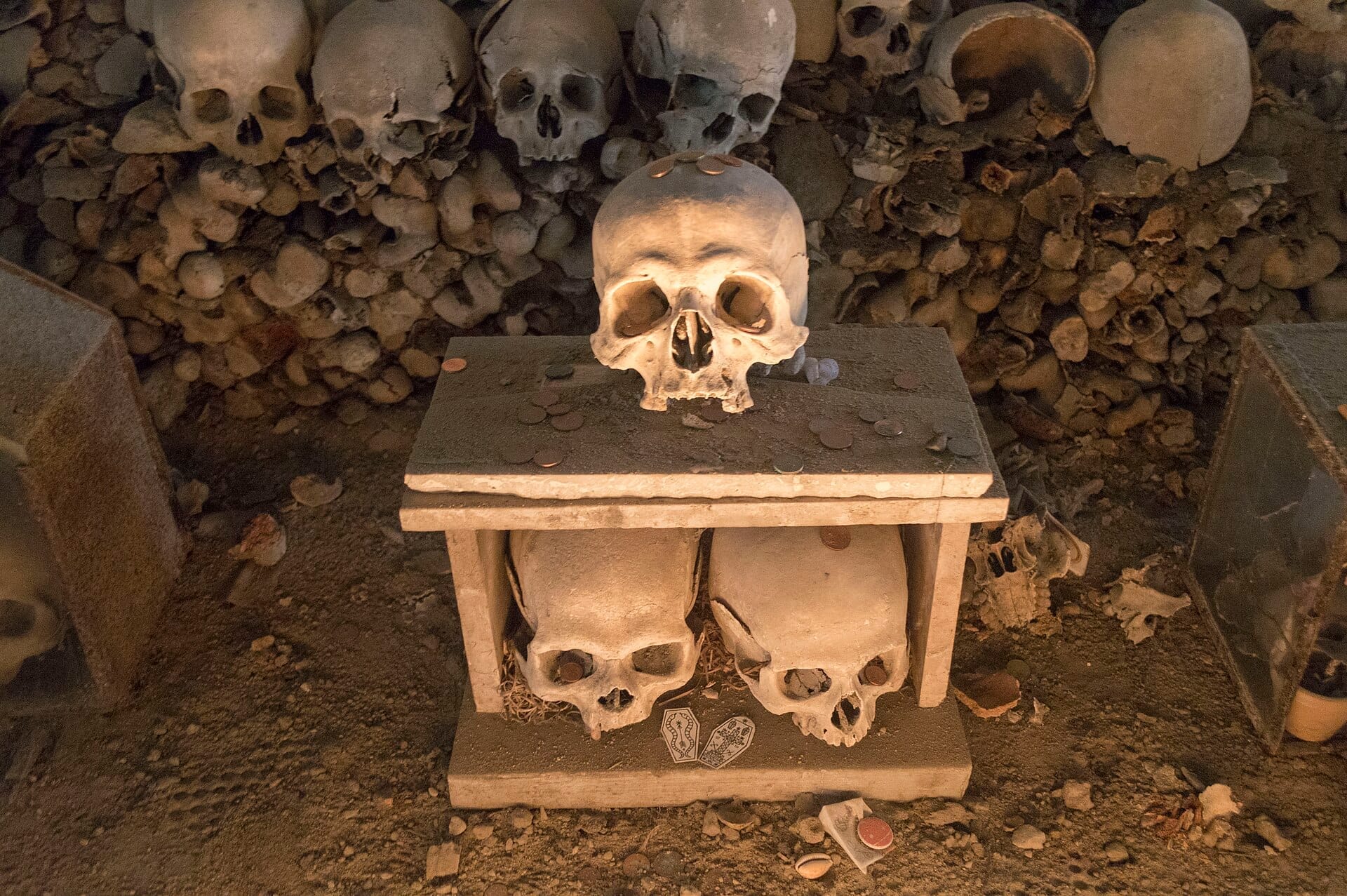
What followed Barbati's reorganization was the cult of the anime pezzentelle, the 'poor souls.' Neapolitan families would adopt individual skulls, clean them, give them names, place them in small wooden boxes, and pray for them in exchange for favors in dreams and visions. The practice was officially banned by the Catholic Church in 1969, but traces of it persist in the small glass shrines and offerings still visible in certain alcoves.
Tickets & tours
Live prices and dates from our booking partner. If you book, we may earn a commission at no extra cost to you.
Tickets for Citta della Scienza in Naples
From 10 €Instant confirmationPompeii and Mount Vesuvius tour with transportation
From 110 €Instant confirmationFree cancellationOrigins and legends of Naples walking tour
From 28 €Instant confirmationFree cancellationGuided walking tour of Naples city and Naples underground
From 45 €Instant confirmationFree cancellation
What You'll See Inside
The entrance from Via Fontanelle leads down a short ramp into the main cavern. The temperature drops immediately. The tuff walls are pale yellow-grey, soft to the eye, and the natural rock ceiling rises irregularly overhead, giving the space the feel of a carved interior more than a constructed one. Light enters from a few directed sources, and the contrast between the lit skull arrangements and the shadowed recesses is stark.
The three naves run lengthwise into the hill. The first nave, nearest the entrance, is the most visited and contains the most organized display: pyramidal stacks of skulls arranged on stone shelving, row upon row, with larger bones stored behind them. Scattered among the anonymous remains are individual compartments where named skulls rest inside small wooden or glass enclosures, some decorated with dried flowers or handwritten notes left by visitors decades ago.
Further into the complex, the light fades and the arrangement becomes denser. There are memorial plaques, fragments of carved stone from older church burials, and sections where the bones are simply too numerous to have been formally organized. A small chapel area near the center of the space contains an altar and a few devotional images. The atmosphere is one of concentrated stillness rather than dread, though visitors with a strong aversion to skeletal remains should know exactly what they are entering.
ℹ️ Good to know
The site is not suitable for very young children. The remains are fully visible and the space is designed for contemplative adult visitors. There is no 'sanitized' version of the display.
How the Visit Changes Through the Day
Morning visits, particularly on weekdays between 10:00 and 11:30 a.m., offer the quietest experience. With timed reservations controlling flow, the interior rarely feels crowded, but early arrivals have the corridors more or less to themselves. The relative silence at that hour amplifies the sensory peculiarity of the place: the faint smell of cool stone and old dust, the slight echo of footsteps on the rock floor, the visual weight of thousands of skulls arranged at eye level.
Midday and early afternoon tend to bring groups, sometimes guided tours which add narration but reduce the solitary atmosphere. If you are visiting primarily for photography, the controlled lighting works well at almost any hour since natural light plays only a minor role inside the cavern. A wide-angle lens and willingness to shoot at higher ISO values will serve you better than flash, which flattens the texture of the tuff walls.
Getting There: Directions and Transit
The most practical route from central Naples is Metro Line 1 to Materdei station. From the station exit, the walk to the cemetery takes approximately nine minutes on relatively flat ground, following signs through the Materdei neighborhood. The area is residential and worth a few minutes of attention on the way: this part of Naples is less traveled by tourists and has an unhurried street life that contrasts sharply with what awaits underground.
Alternatively, Metro Line 2 to Montesanto puts you about 28 minutes on foot from the entrance, passing through the lower Sanità district. If you plan to combine Fontanelle with other Sanità highlights, consider visiting the Catacombs of San Gennaro, which are less than a ten-minute walk away. The two sites complement each other well and together represent a concentrated look at Naples' deep relationship with its dead.
Taxis and ride-hailing services (Free Now, Uber) can drop you directly at the Via Fontanelle entrance. Parking in the Sanità area is possible but the streets are narrow and the neighborhood is better navigated on foot once you arrive.
💡 Local tip
Wear a light layer you can remove easily. The cavern stays cool even in summer, noticeably colder than outside. A jacket or long-sleeved shirt adds comfort, especially on hot days when the contrast with street temperature is severe.
Cultural Context: Naples and Its Dead
Neapolitan culture has always held an unusually intimate relationship with death, shaped by centuries of plague, volcanic risk, poverty, and Catholic tradition. The Fontanelle cemetery is the most concentrated expression of that relationship, but it is not an isolated phenomenon. Naples' underground layers are filled with burial chambers, aqueducts converted to catacombs, and devotional spaces carved into volcanic rock. Fontanelle sits at the center of this tradition, both geographically and symbolically.
The skull-adoption practice, the anime pezzentelle, reflected a specific theology of reciprocity: the living pray for the souls of unknown dead, and in return those souls intercede in the world of the living. It was personal, local, and deeply Neapolitan. Academic interest in the practice has grown significantly since the 1990s, and the site now attracts anthropologists and religious historians alongside general visitors.
For those who want to explore this dimension more deeply, the Cappella Sansevero in the historic center offers a different but related encounter with death, the body, and Neapolitan devotional practice, this time filtered through Baroque aristocratic excess rather than working-class faith.
Honest Assessment: Is It Worth Your Time?
For visitors who engage with history and are comfortable with skeletal remains, this is one of the most singular attractions in Naples. There is nothing quite like it in the city, and very little like it anywhere in Italy. The scale, the preservation, and the cultural layers accumulated over four centuries make it genuinely instructive rather than merely macabre.
That said, travelers looking for conventional sightseeing, those with young children, or anyone expecting polished museum-style interpretation may find the experience disorienting. The post-2026 renovation has improved accessibility and organization, but Fontanelle remains a raw, unmediated space. The bones are real, uncovered, and present in extraordinary quantity. That is precisely its value, but it is also exactly what makes it unsuitable for some visitors.
If you are building a multi-day itinerary and trying to decide what fits, the cemetery pairs logically with a morning in the Sanità neighborhood, a visit to the catacombs, and an afternoon in the historic center. For fuller planning help, the 3-day Naples itinerary covers how to sequence the city's major neighborhoods without over-scheduling.
Insider Tips
- Book the first entry slot of the day (10:00 a.m.) on a weekday. Timed entry controls crowds, but Tuesday and Thursday mornings are consistently the quietest.
- The individual skull shrines with personal names and handwritten notes are concentrated in the first nave, to the right as you enter. Spend time here before moving deeper; the light is better and the personal histories are the most affecting part of the visit.
- Photography without flash is permitted and encouraged. Bring or set your camera to ISO 1600 or higher. The warm tone of the tuff walls responds well to the available lighting, and close-up shots of skull arrangements show remarkable textural detail.
- Combine the visit with the Catacombs of San Gennaro on the same half-day. They are a short walk apart, and the two sites cover complementary periods of Naples' burial history. Both now require advance booking, so plan both before you go.
- The street leading to the cemetery, Via Fontanelle, passes through an ordinary residential area where almost no tourists pass. The small bars and food shops along the route offer a more authentic slice of daily Neapolitan life than you will find near the main tourist sites.
Who Is Cimitero delle Fontanelle For?
- Travelers interested in the history of plague, urban mortality, and southern Italian religious culture
- Photographers seeking low-light, high-contrast subjects with real historical weight
- Anyone already visiting the Sanità catacombs who wants to extend their half-day in the neighborhood
- Cultural travelers who prefer unconventional sites over standard museum circuits
- Visitors interested in Neapolitan folk religion and the archaeology of devotional practice
Nearby Attractions
Combine your visit with:
- Amalfi Coast
The Amalfi Coast stretches 40 kilometres along one of Italy's most dramatic shorelines, linking 13 cliff-side towns between Vietri sul Mare and Positano. A UNESCO World Heritage Site since 1997, it rewards visitors with layered history, vertiginous views, and some of the most photographed coastline in the Mediterranean. Getting there from Naples takes planning, but the payoff is considerable.
- Capri
Capri is one of the most recognized islands in the Mediterranean, sitting at the southern edge of the Gulf of Naples. It offers dramatic limestone cliffs, the famous Blue Grotto, elegant piazzas, and views that justify the journey. But it comes with crowds, costs, and logistical quirks that every visitor should understand before boarding the ferry.
- Città della Scienza
Città della Scienza is Naples' premier interactive science museum, set on a former industrial waterfront in the Bagnoli district. With hands-on exhibits spanning the human body, sea life, insects, and space, plus a full planetarium, it delivers a genuinely engaging half-day for families, curious adults, and school groups alike.
- Herculaneum (Ercolano)
Buried by Vesuvius in 79 AD and only partially excavated, Herculaneum is the most intact Roman city on earth. Smaller than Pompeii, quieter, and significantly better preserved, it rewards visitors who want to feel rather than just see ancient Rome. Located 8 km from Naples, it is reachable in under 30 minutes by Circumvesuviana train.
Planning a trip? Discover personalized activities with the Nomado app.