Capri Island: What to Expect, How to Get There, and Whether It's Worth It
Capri is one of the most recognized islands in the Mediterranean, sitting at the southern edge of the Gulf of Naples. It offers dramatic limestone cliffs, the famous Blue Grotto, elegant piazzas, and views that justify the journey. But it comes with crowds, costs, and logistical quirks that every visitor should understand before boarding the ferry.
Quick Facts
- Location
- Tyrrhenian Sea, Gulf of Naples, Campania, Italy. 45-50 minutes by fast ferry from Naples Molo Beverello.
- Getting There
- Fast ferries (aliscafi) from Naples Molo Beverello or Mergellina; slower car ferries also available. Hydrofoils also run from Sorrento.
- Time Needed
- Full day minimum (8-10 hours). An overnight stay is the only way to experience the island without the day-trip crowds.
- Cost
- Ferry round-trip approx. €40-50 per person depending on operator and season. Blue Grotto €18 (rowboat €15 + entry €3). Budget €100+ for a full day with meals.
- Best for
- Scenic day trips, coastal photography, Roman history, couples, and travelers who want Mediterranean island atmosphere.
The Reality of Capri: Spectacular and Crowded in Equal Measure
Capri is not a secret. It hasn't been one for centuries. Roman emperors built palaces on its cliffs. The European aristocracy made it fashionable in the 19th century. Today, between June and August, the island receives thousands of day-trippers daily, and the narrow lanes around Capri Town's Piazzetta can feel less like a serene Mediterranean retreat and more like a luxury shopping street with a view. That is not a reason to skip it. The landscape is genuinely extraordinary. But it is a reason to plan carefully.
The island splits administratively into two municipalities: Capri town in the east and Anacapri to the west and higher up. They have different characters. Capri town is polished, boutique-filled, and packed with tourists from mid-morning onward. Anacapri is quieter, more residential, and gives better access to the island's interior paths and Monte Solaro. Most day-trippers never make it to Anacapri, which alone makes it worth the bus ride up.
💡 Local tip
Arrive on the first or second ferry of the day from Naples (typically departing around 7:00-8:00 AM). You will have the Piazzetta and most scenic overlooks to yourself for at least an hour before the crowds arrive.
Getting to Capri from Naples
Ferries depart from Naples' Molo Beverello pier, located steps from Castel Nuovo near Piazza Municipio. Fast hydrofoils (aliscafi) take approximately 50 minutes. Slower car ferries take closer to 80 minutes. Multiple operators run the route, including Caremar, SNAV, and Alilauro, with departures spread through the day from early morning. Return ferries run until early evening, though exact last departure times vary by season and operator — check timetables the day before, especially in shoulder seasons.
Ferries also run from Sorrento, which is a faster crossing of about 20 minutes. If you are combining Sorrento with Capri, departing from there makes logistical sense. From Naples, allow time to reach Molo Beverello during morning traffic.
⚠️ What to skip
On windy days or in rough sea conditions, hydrofoil services are frequently suspended. Car ferries are more resilient but not immune. Always check weather before your trip and keep a flexible return plan.
Tickets & tours
Live prices and dates from our booking partner. If you book, we may earn a commission at no extra cost to you.
Marina Grande: Your First Impression of the Island
Every visitor arrives at Marina Grande, Capri's main port. It is a working harbour with colourful stacked houses climbing the hillside, small fishing boats moored alongside tourist craft, and a constant procession of ferries arriving from Naples, Sorrento, Positano, and Amalfi. The port itself smells of salt, diesel, and espresso. The main ticket offices for island transport are here: buses to Capri town and Anacapri, and the funicular that runs up to Capri town's main square.
The funicular is the more scenic option for the first ascent. It's a short ride, but the views over the port as you climb are immediately rewarding. The queue can be long from mid-morning. If you arrive early, this is rarely a problem. If you arrive after 10 AM in peak season, the bus to Capri town (which leaves from just above the port) is often faster despite the winding road.
The Blue Grotto: Worth the Wait, or Overrated?
The Blue Grotto (Grotta Azzurra) is Capri's most famous single attraction and also its most logistically complex. Access is by small rowboat through a low opening in the cliff face. Inside, sunlight entering through an underwater cavity creates an electric-blue luminescence on the water. The effect is real and genuinely striking, especially on a clear morning when the sun angle is optimal.
The limitations are significant. You must lie flat in a small rowboat to enter. The visit itself lasts roughly five minutes inside the grotto. The queue at peak times means waiting 45-90 minutes for those five minutes. The combined cost of the motorboat from Marina Grande (or from the grotto's own small dock) plus the separate grotto entrance fee can reach €15-20 or more depending on operator. And if sea conditions are even slightly rough, the grotto closes without warning or refund for the boat portion.
The honest assessment: if you have never seen it and the conditions are good, it is worth experiencing once. If you are visiting on a limited budget or a tight schedule, the time-to-payoff ratio is poor. Morning visits before 10 AM offer shorter queues. The grotto itself closes early afternoon on most days.
ℹ️ Good to know
The Blue Grotto can also be reached by bus from Anacapri and then by small boat from the landing below. This avoids the longer motorboat trip from Marina Grande and is slightly cheaper.
Capri Town, Anacapri, and the Landscape in Between
Capri Town's Piazzetta (officially Piazza Umberto I) is the social centre of the island and one of the most photographed small squares in Italy. It's surrounded by cafes with eye-watering prices, the clock tower, and the dome of Santo Stefano church. In the early morning it is quiet and genuinely lovely. By 11 AM it is shoulder-to-shoulder. This is a place for a single espresso standing at the bar, not a long lunch.
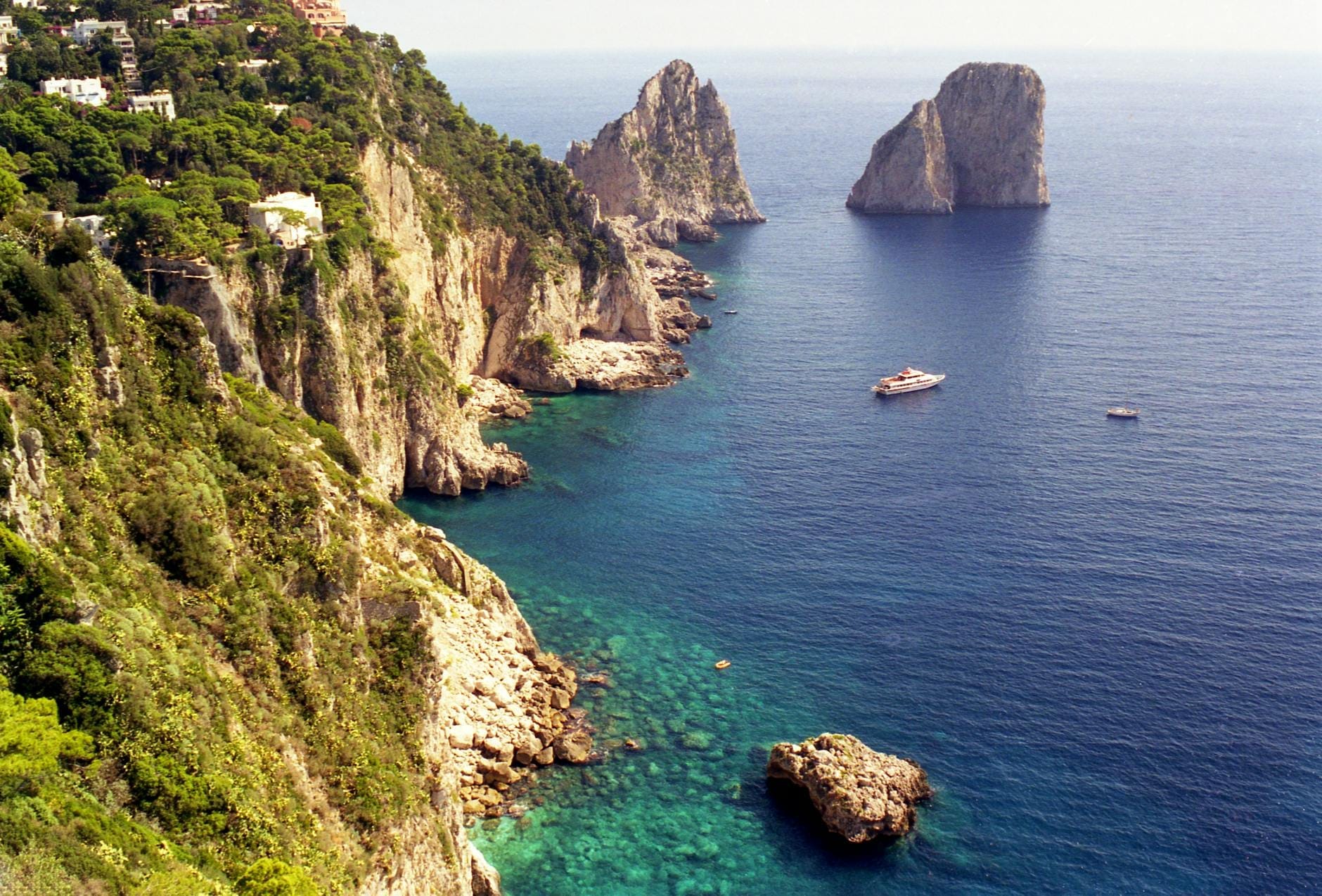
Walk south from the Piazzetta toward the Belvedere of Tragara for one of the best views on the island: a cliff-edge terrace overlooking the Faraglioni, three limestone sea stacks rising from the sea. The walk takes about 20-25 minutes through a residential lane lined with bougainvillea. It is free, uncrowded by comparison, and the light on the Faraglioni in late afternoon turns the stone warm amber.
For a longer walk, the path to Villa Jovis on the island's eastern tip takes roughly 45-50 minutes from Capri town. Villa Jovis was the main palace of Emperor Tiberius, who effectively governed Rome from Capri for the last decade of his reign (AD 27-37). The ruins are substantial and the position on the cliff edge, with views across to the Sorrentine Peninsula and Ischia, is extraordinary. Few day-trippers make the climb, which keeps the site genuinely peaceful.
Anacapri is reached by local bus from Marina Grande or from Capri town. The ride is famous for its nerve-wracking narrowness: a single-lane road with passing places where buses must reverse to allow oncoming traffic through. The views down to the sea as the bus climbs are spectacular. From Anacapri, a chairlift (seggiovia) ascends Monte Solaro, at 589 metres the island's highest point. The open single-seat chairlift takes about 13 minutes and deposits you at a panorama that extends on clear days to the Amalfi Coast, Vesuvius, and in exceptional conditions, the mountains of Calabria.
Photography, Light, and What to Actually Photograph
The Faraglioni catch the best light in late afternoon, especially from the Belvedere di Tragara. For a different angle, boat tours of the island circumnavigate the rocks and allow close-up shots. If panoramic views of the Bay of Naples are your priority, the top of Monte Solaro on a clear day is unmatched. Early morning from the chairlift at Anacapri offers soft light with no other visitors in frame.
The Blue Grotto's interior is extremely difficult to photograph well with a phone. The darkness, motion of the boat, and the brief time inside mean most phone photos are disappointing. A camera with good low-light performance and a fast lens is needed. Video often captures the blue luminescence better than stills.
💡 Local tip
For the classic Faraglioni shot without crowds, arrive at Belvedere di Tragara before 9 AM or after 5 PM. The lane is largely deserted and the sea stacks glow differently at these hours than in the flat midday light.
Who Should Skip Capri (or Adjust Their Expectations)
Capri is poorly suited to travelers on tight budgets. Food, drinks, and services on the island carry a significant premium compared to Naples. A coffee at the Piazzetta can cost three to four times what you pay standing at a bar in Naples. Shopping is mostly luxury goods. The only free major experience on the island is walking its paths, which admittedly are among the best in Campania.
Travelers with significant mobility limitations will find Capri challenging. The terrain is steep, the cobbled lanes uneven, and the funicular and buses have limited accessibility provisions. This is not a flat, easily navigable destination. Those looking for beach swimming will also find Capri less convenient than expected: the island has rocky rather than sandy shores, and access to the sea mostly involves ladders or steps cut into rock. Procida offers a more relaxed, less commercial island experience in the same gulf for a fraction of the cost.
If you are visiting Naples for three days or fewer, Capri requires sacrificing a full day that could cover multiple major city attractions. The island makes most sense for visitors who have already explored central Naples and want a full day of coastal scenery.
Practical Details
Ferry timetables and bookings are available through individual operators and aggregator sites. Book outbound ferries in advance during July and August. Return ferries are usually available without pre-booking outside peak dates, but check last departures carefully. The island uses the same Euro currency as the mainland, and card payments are widely accepted, though smaller establishments (boat tours, market stalls) may be cash-only. For context on how Capri fits into a broader Naples trip, see a structured 3-day Naples itinerary.
Dress practically: comfortable walking shoes are essential on the uneven terrain. Capri's famous 'Capri pants' origin story aside, shorts and light layers work well in summer. In spring and autumn, bring a layer for the wind at Monte Solaro's summit, where temperatures drop noticeably. Sunscreen and water are non-negotiable in summer, when the limestone paths reflect heat intensely.
Insider Tips
- Buy your return ferry ticket before heading inland. Seats on busy summer afternoon sailings fill up, and the last thing you want after a full day of walking is to be stuck waiting for a later boat.
- The path from Capri town down to Marina Piccola (the smaller, southern harbour) passes through the Gardens of Augustus, a terraced garden with views over the Faraglioni and the sea. Entry is cheap and most visitors walk straight past the entrance sign. It takes 20 minutes to walk down from here to Marina Piccola, where the crowds are thinner and the swimming spots less brutal.
- Local buses between Anacapri and Marina Grande are included with a single island ticket. Keep your ticket: inspectors board regularly and the fine for ticketless travel is not small.
- Monte Solaro chairlift can be walked down rather than taken both ways. The descent path through Anacapri takes about 45 minutes and passes through quieter residential streets, giving a completely different impression of the island.
- If you want a restaurant meal that doesn't double your daily budget, walk two streets away from the Piazzetta in any direction. Prices drop noticeably even within 100 metres of the main square.
Who Is Capri For?
- Couples and honeymooners who want classic Mediterranean scenery and can absorb the higher costs
- Photographers targeting coastal landscapes, sea stacks, and clifftop panoramas
- History enthusiasts interested in Roman imperial sites, specifically Villa Jovis and the island's Tiberian connections
- Travelers who have already covered Naples' major attractions and want a scenic day on the water
- Those who plan to stay overnight and want to experience the island after the day-trip crowds leave on the late afternoon ferries
Nearby Attractions
Combine your visit with:
- Amalfi Coast
The Amalfi Coast stretches 40 kilometres along one of Italy's most dramatic shorelines, linking 13 cliff-side towns between Vietri sul Mare and Positano. A UNESCO World Heritage Site since 1997, it rewards visitors with layered history, vertiginous views, and some of the most photographed coastline in the Mediterranean. Getting there from Naples takes planning, but the payoff is considerable.
- Cimitero delle Fontanelle
Carved into volcanic tuff in the Sanità district, the Cimitero delle Fontanelle holds the remains of roughly 40,000 people, many of them victims of the 1656 plague. Reopened in April 2026 after a five-year closure, it is one of the most historically dense and atmospheric places in all of southern Italy.
- Città della Scienza
Città della Scienza is Naples' premier interactive science museum, set on a former industrial waterfront in the Bagnoli district. With hands-on exhibits spanning the human body, sea life, insects, and space, plus a full planetarium, it delivers a genuinely engaging half-day for families, curious adults, and school groups alike.
- Herculaneum (Ercolano)
Buried by Vesuvius in 79 AD and only partially excavated, Herculaneum is the most intact Roman city on earth. Smaller than Pompeii, quieter, and significantly better preserved, it rewards visitors who want to feel rather than just see ancient Rome. Located 8 km from Naples, it is reachable in under 30 minutes by Circumvesuviana train.
Planning a trip? Discover personalized activities with the Nomado app.