Herculaneum (Ercolano): The Roman City Pompeii's Shadow Keeps Hiding
Buried by Vesuvius in 79 AD and only partially excavated, Herculaneum is the most intact Roman city on earth. Smaller than Pompeii, quieter, and significantly better preserved, it rewards visitors who want to feel rather than just see ancient Rome. Located 8 km from Naples, it is reachable in under 30 minutes by Circumvesuviana train.
Quick Facts
- Location
- Ercolano, Campania — approx. 8 km southeast of Naples city centre
- Getting There
- Circumvesuviana train from Naples Porta Nolana or Piazza Garibaldi to 'Ercolano Scavi' station (approx. 20 min); 10-min walk downhill to the site entrance
- Time Needed
- 2 to 3 hours for a thorough visit; half-day including travel from Naples
- Cost
- Check ercolano.cultura.gov.it for current ticket prices; combined tickets with Pompeii are often available
- Best for
- History enthusiasts, architecture lovers, and anyone who found Pompeii overwhelming
- Official website
- ercolano.cultura.gov.it
Why Herculaneum Deserves Its Own Day Trip
Most visitors to the Naples region put Pompeii on the list and treat Herculaneum as an afterthought. That is a significant miscalculation. The Archaeological Park of Herculaneum, known officially as the Parco Archeologico di Ercolano, is in many ways the more rewarding site: smaller in scale, far better preserved at the structural level, and consistently less crowded than its famous neighbour. Where Pompeii gives you breadth, Herculaneum gives you depth.
The city was home to between 4,000 and 5,000 residents when Vesuvius erupted on 24 to 25 August, 79 AD. Rather than being buried gradually under ash like Pompeii, Herculaneum was entombed almost instantly by superheated pyroclastic flows, a surge of gas, rock, and volcanic material that carbonised organic matter before oxygen could cause decay. The result: wooden furniture, food, fabric, even papyrus scrolls survived in forms that Pompeii simply cannot match.
💡 Local tip
Book tickets in advance through the official website or a reputable third-party platform. Walk-up queues can form during peak season (June to August) and the site has daily visitor caps. Arriving at opening time is the single most effective way to get the site to yourself.
The Experience on the Ground
Descending into Herculaneum is genuinely disorienting in the best way. You walk down a long ramp from street level in modern Ercolano, and the excavated city appears below you in a kind of geological bowl, the modern apartment blocks of the town rising above its ancient walls on every side. That visual contrast, ancient Rome framed by 1970s Italian concrete, stays with you.
Once inside the site, the streets are narrow and feel proportional in a way that Pompeii, spread over 66 hectares, does not. You can walk from one end of the excavated area to the other in 20 minutes, which means you are free to move slowly, double back, and spend real time with individual buildings rather than racing between highlights. The stone paving underfoot is original Roman basalt, worn smooth, with wheel ruts still visible where carts once passed.
The smells are earthen and mineral, the air noticeably cooler inside the bowl than on the modern streets above. On busy summer days, the shade provided by the excavation walls becomes a genuine comfort. In winter, the site can feel almost deserted, which allows for an experience that approaches genuine solitude in an ancient city.
Tickets & tours
Live prices and dates from our booking partner. If you book, we may earn a commission at no extra cost to you.
Mount Vesuvius and Herculaneum tour with transportation
From 100 €Instant confirmationFree cancellationCampania ArteCard 365 Lite with 34 Entry Passes and 4 Audio Guides
From 37 €Instant confirmationHerculaneum private walking tour with an archaeologist-guide
From 295 €Instant confirmationFree cancellationHerculaneum 2-hours Group Tour with Skip-the-Line Tickets
From 39 €Instant confirmationFree cancellation
What the Site Actually Contains
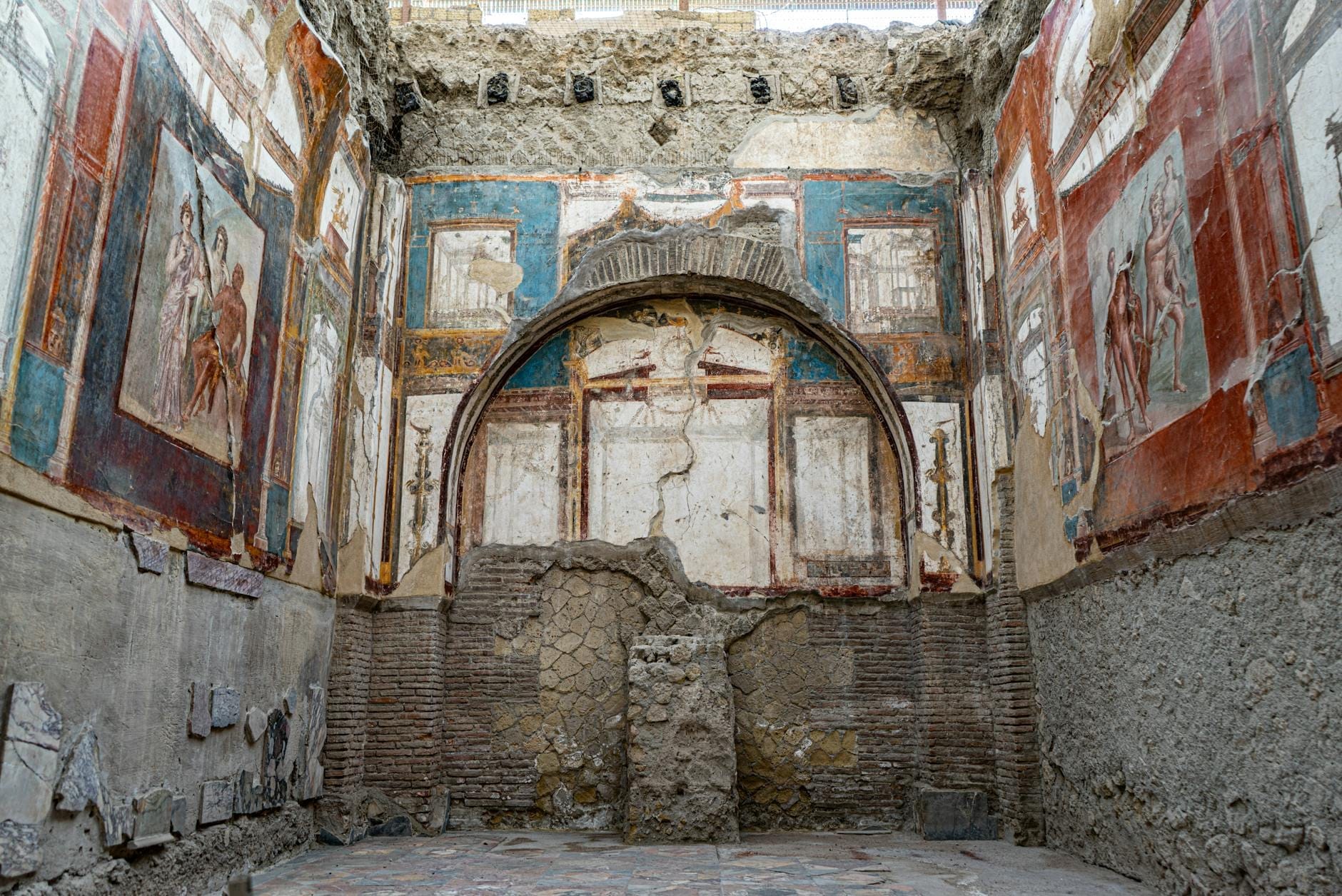
The Suburban Baths (Terme Suburbane) near the seafront are among the most remarkable structures on the site. The vaulted ceilings, mosaic floors, and carved stone details have survived with a completeness that makes restoration drawings unnecessary. You are looking at the actual ancient fabric.
The boat sheds along what was once the beach are among the most sobering spaces in any archaeological site in the world. In the 1980s, excavators found hundreds of skeletons sheltering in these arched vaults, residents who had fled to the shoreline hoping for escape by sea. The skeletons remain in situ, visible to visitors, and the effect is not theatrical but profoundly quiet.
Further into the site, the Sacred Area contains temples dedicated to Venus and a grouping of four gods: Minerva, Vulcan, Mercury, and Neptune. The palaestra, a large sports ground with a portico and a central swimming pool shaped like a cross, gives a sense of civic scale. The House of the Mosaic Atrium and the House of the Deer (Casa dei Cervi) are among the most atmospheric residential structures, with original wall paintings still showing colour in protected interior sections.
One important caveat: over 75% of the ancient city remains buried beneath the modern town of Ercolano above. What you see is the excavated minority, a fact worth keeping in mind. For context on how the site fits into the broader volcanic landscape, the Mount Vesuvius crater hike can be combined into the same day trip, as it is located a short bus ride from the Ercolano Scavi train station.
How the Visit Changes by Time of Day
The first hour after opening is the clearest window for photography and movement. Light enters the excavation bowl at a low angle, casting long shadows across the stone streets and illuminating wall textures without the harsh overhead glare that flattens detail by midday. Tour groups and school visits typically arrive between 9:30 and 11:00, so arriving at or just before opening is the most practical advice for any serious visitor.
By early afternoon, the site population peaks. The open streets offer limited shade in summer, and midday sun between June and August makes the exposed sections uncomfortable. If you are visiting in peak season, consider an early start and plan to leave by noon, or arrive in the late afternoon when the light returns to a more workable angle and visitors begin to thin. The site closes in the early-to-mid afternoon on some days depending on season, so confirming closing times on the official website before you go is essential.
⚠️ What to skip
Summer heat inside the excavation bowl can be intense. Carry at least 1.5 litres of water, wear sun protection, and bring a hat. There is limited shade and the stone surfaces retain heat. This is not an attraction that is well-suited to visiting between noon and 3pm in July or August.
Getting There and Getting In
The most practical approach from Naples is the Circumvesuviana train line, which runs roughly every 30 minutes from Piazza Garibaldi (Naples central station) and the Porta Nolana terminal. The journey to Ercolano Scavi station takes approximately 20 minutes. From the station, a single downhill road leads directly to the archaeological park entrance in about 10 minutes on foot.
Driving is possible, with parking available in the modern town, but navigation in the narrow streets can be frustrating and the train is genuinely faster and less stressful. If you are planning to combine the visit with Pompeii on the same day, note that Ercolano is served by the same Circumvesuviana line. The Naples to Pompeii guide covers the train logistics in more detail, and the same information applies to Herculaneum since both sites sit on the same line.
Ticket prices and combined-entry options change periodically. The official website at ercolano.cultura.gov.it is the only reliable source for current admission costs. At the time of writing, combined tickets covering Herculaneum together with other Vesuvian sites were available, but these arrangements change seasonally. Do not rely on third-party sites for pricing.
Herculaneum vs Pompeii: An Honest Comparison
Both sites share the same UNESCO World Heritage designation, granted in 1997 for the collective ruins of Pompeii, Herculaneum, and Torre Annunziata. But they are not interchangeable experiences. Pompeii is a city; Herculaneum is a neighbourhood. Pompeii requires most of a day and considerable walking. Herculaneum can be done thoroughly in two to three hours. The structural preservation at Herculaneum is consistently superior: upper floors, wooden elements, and painted surfaces survived the pyroclastic burial in ways that Pompeii's slower ash burial did not allow. For a full breakdown of the differences, the guide to Pompeii vs Herculaneum covers the tradeoffs in detail.
If you only have time for one site, the choice depends on what you want. Pompeii gives you scale, variety, and a sense of a complete urban system. Herculaneum gives you intimacy, detail, and significantly better preservation at the level of individual materials. For visitors with particular interest in Roman domestic life, craftsmanship, or architecture, Herculaneum is the stronger choice. For visitors who want the full sweep of a Roman city and are comfortable with crowds, Pompeii is the more comprehensive experience.
Who should skip Herculaneum entirely: visitors with very limited mobility may find the uneven Roman cobblestones and the steep ramp down into the site difficult. The site has some accessible routes but it is not fully wheelchair-friendly. Anyone expecting a conventional museum experience with labelled displays in climate-controlled rooms will also find the open-air archaeological format disorienting, though audio guides are available and significantly improve the visit.
Excavation History and What Was Found
The story of how Herculaneum was rediscovered is as remarkable as the site itself. Systematic excavation began in 1738, commissioned by the Bourbon King of Naples, Charles III. Initial work proceeded through underground tunnels driven into the hardened pyroclastic material, a laborious process that extracted statues, frescoes, and decorative objects for the royal collections but left the site itself largely inaccessible. This early phase produced spectacular artefacts, many of which are now held by the National Archaeological Museum in Naples.
Open-air excavation began seriously only in 1927, under archaeologist Amedeo Maiuri, and continued until 1958. Additional significant discoveries came in the 1980s and 1990s, most notably the boat shed skeletons. The best of the portable finds, including intricate bronze statues, carbonised food, and elaborate mosaics, can be seen at the Naples National Archaeological Museum, which should ideally be visited before or after Herculaneum to give the site's artefacts full context.
The Herculaneum Conservation Project, a long-term international initiative, has been working since the early 2000s to stabilise excavated structures and address decades of weather damage. Parts of the site are periodically closed for restoration work, which means the specific buildings accessible on any given visit can vary. This is not a reason to delay visiting; it is simply worth setting realistic expectations and checking recent visitor reports before arrival.
Insider Tips
- Rent an audio guide or download the official app before entering. The site has minimal on-site signage in English, and without context, many structures look similar. The audio guide transforms specific walls and thresholds into meaningful spaces.
- The boat sheds at the seafront edge of the site are often the last stop for visitors, but they are arguably the most affecting space in all of Campania's archaeological sites. Do not run out of time or energy before reaching them.
- Combine Herculaneum with a Mount Vesuvius crater hike on the same day. From Ercolano Scavi train station, EAV buses run uphill toward Vesuvius. The two experiences complement each other in a way that is hard to replicate: you walk through a city destroyed by a volcano, then stand on the volcano that destroyed it.
- The site shop near the entrance sells a detailed site plan that is more useful for navigation than the free map. At a few euros, it is worth the purchase, especially for anyone interested in identifying specific house names and room functions.
- Visiting on a weekday outside Italian school holiday periods reduces the chance of encountering large school groups, which can make the narrow streets feel congested. Mid-September through October and March through early May tend to offer the most comfortable balance of weather and visitor numbers.
Who Is Herculaneum (Ercolano) For?
- Travellers who visited Pompeii and want a more intimate, less tourist-heavy alternative
- Architecture and design enthusiasts interested in Roman construction techniques and domestic spaces
- History readers who want to see the physical reality behind accounts of the 79 AD eruption
- Anyone planning a combined day trip with Mount Vesuvius on the same ticket and train line
- Photographers seeking Roman urban detail without the crowds and scaffolding that can affect Pompeii
Nearby Attractions
Combine your visit with:
- Amalfi Coast
The Amalfi Coast stretches 40 kilometres along one of Italy's most dramatic shorelines, linking 13 cliff-side towns between Vietri sul Mare and Positano. A UNESCO World Heritage Site since 1997, it rewards visitors with layered history, vertiginous views, and some of the most photographed coastline in the Mediterranean. Getting there from Naples takes planning, but the payoff is considerable.
- Capri
Capri is one of the most recognized islands in the Mediterranean, sitting at the southern edge of the Gulf of Naples. It offers dramatic limestone cliffs, the famous Blue Grotto, elegant piazzas, and views that justify the journey. But it comes with crowds, costs, and logistical quirks that every visitor should understand before boarding the ferry.
- Cimitero delle Fontanelle
Carved into volcanic tuff in the Sanità district, the Cimitero delle Fontanelle holds the remains of roughly 40,000 people, many of them victims of the 1656 plague. Reopened in April 2026 after a five-year closure, it is one of the most historically dense and atmospheric places in all of southern Italy.
- Città della Scienza
Città della Scienza is Naples' premier interactive science museum, set on a former industrial waterfront in the Bagnoli district. With hands-on exhibits spanning the human body, sea life, insects, and space, plus a full planetarium, it delivers a genuinely engaging half-day for families, curious adults, and school groups alike.
Planning a trip? Discover personalized activities with the Nomado app.