Mount Vesuvius: What It's Really Like to Stand on an Active Volcano
Mount Vesuvius rises 1,281 metres above the Bay of Naples, its crater still emitting sulphurous gas over 80 years after its last eruption in 1944. This guide covers the crater trail, the historical context that makes the climb meaningful, and everything you need to plan a visit from Naples.
Quick Facts
- Location
- ~9 km east of Naples city centre, Campania, Italy (40°49′06″N 14°25′36″E)
- Getting There
- Circumvesuviana train to Ercolano Scavi, then shuttle bus or taxi to the crater car park
- Time Needed
- 3–5 hours including travel from Naples, ascent, crater rim walk, and return
- Cost
- Entrance fee required (verify current price at park ticket office); shuttle bus from Ercolano extra
- Best for
- Hikers, history enthusiasts, photographers chasing panoramic Bay of Naples views
- Official website
- www.parconazionaledelvesuvio.it/en
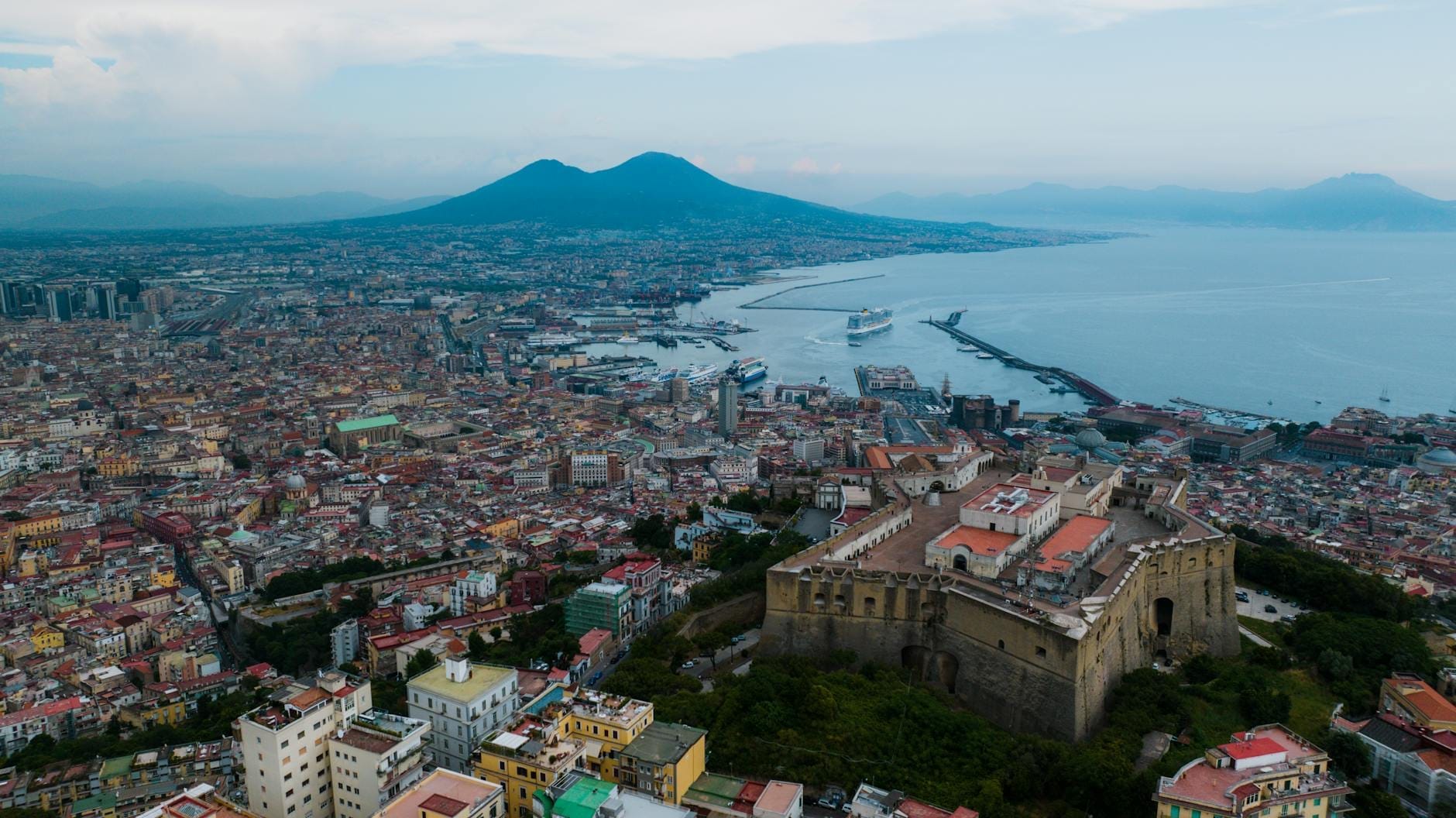
What You're Actually Looking At
Monte Vesuvio is one of Europe's most famous active volcanoes, and it looks the part. The cone rises sharply from the surrounding plain, its summit often shrouded in thin cloud, its slopes a patchwork of dark lava rock, scrubby pine forest, and yellow-flowering broom. From Naples' waterfront the mountain seems to press right up against the city, and that proximity is part of what makes it so striking: roughly 3 million people live within range of a future eruption, and the volcano has been monitored continuously since 1841 from the Vesuvius Observatory, the world's oldest volcanological station.
The numbers that define Vesuvius are worth knowing before you arrive. The summit currently sits at approximately 1,281 metres, though the exact height has shifted with each eruption across history. The crater itself is around 610 metres across and drops roughly 305 metres deep. Gas still seeps from fumaroles along the rim, and on still mornings you can smell the sulphur before you see the vents. This is not a dormant mountain dressed up as an attraction. It is an active geological system, classified at alert level Green (base level) by Italian civil protection authorities, but monitored in real time regardless.
ℹ️ Good to know
Vesuvius falls within the Parco Nazionale del Vesuvio (Vesuvius National Park), established on June 5, 1995. The park protects 8,482 hectares of volcanic landscape and Mediterranean scrub. All crater access is managed through official park trails — do not attempt informal routes.
The AD 79 Eruption: Why the History Matters Here
It is nearly impossible to stand on Vesuvius without thinking about what happened on the 24th of August, AD 79. The eruption that day sent a column of ash and pumice roughly 33 kilometres into the sky. Pompeii, located about 9 kilometres to the southeast, was buried under 4–6 metres of volcanic material. Herculaneum, closer to the western flank, was engulfed by pyroclastic surges of superheated gas and rock moving at speeds that left no chance of escape. The estimated death toll runs into the thousands, though the precise figure remains debated.
What the eruption preserved is why Pompeii and Herculaneum remain two of the most extraordinary archaeological sites in the world. Visiting Vesuvius without combining it with at least one of those sites is, frankly, leaving a major part of the story untold. Both are reachable on the same day. See the guide to Pompeii or consider the comparison at Pompeii vs Herculaneum to decide which suits your interests better.
The last eruption occurred from March to May 1944, during the Allied advance through Italy in World War II. It destroyed several aircraft at a nearby airfield, demolished the towns of San Sebastiano al Vesuvio and Massa di Somma, and killed around 26 people. Allied soldiers reportedly watched the lava flows advance while camped in the area. The 1944 eruption collapsed the twin peaks that had formed after 1631, creating the single cone visitors climb today.
Tickets & tours
Live prices and dates from our booking partner. If you book, we may earn a commission at no extra cost to you.
Pompeii and Mount Vesuvius tour with transportation
From 110 €Instant confirmationFree cancellationMount Vesuvius and Herculaneum tour with transportation
From 100 €Instant confirmationFree cancellationPompeii and Mt. Vesuvius shared tour with optional lunch and tasting
From 130 €Instant confirmationFree cancellationPompeii and Vesuvius semi-private tour by bus from Naples
From 115 €Instant confirmationFree cancellation
The Ascent: What the Trail Is Actually Like
Vehicles can reach a car park and visitor area roughly 200 metres below the summit. From there, the ascent follows a single spiral footpath cut into the volcanic rock and compacted ash. The path is well-maintained but genuinely steep in sections, loose underfoot in places, and exposed to wind. On a busy summer day you will be walking in a slow procession of other visitors. On a weekday in shoulder season you might have stretches of the path nearly to yourself.
The climb takes around 20–30 minutes for a reasonably fit adult moving at a steady pace. The surface underfoot shifts between consolidated lava, fine grey ash, and gravel, so grip matters. Trainers with decent tread are fine; sandals or flat-soled shoes are not. The higher you get, the more the vegetation thins out, and the final section before the crater rim is almost entirely bare rock. The smell of sulphur becomes noticeable in the last 50 metres.
⚠️ What to skip
The trail is not wheelchair accessible and is unsuitable for visitors with limited mobility. Children can manage the climb but should be closely supervised near the crater rim, which has no barriers in all sections. The path can be closed without notice due to weather or volcanic activity — always check conditions before travelling.
At the rim you can walk a partial circuit of the crater, looking down into the bowl of dark rock with its visible fumaroles and looking out over the Bay of Naples in the other direction. On a clear day the view extends across the bay to the islands of Capri and Ischia, with the city of Naples stretched below and the Sorrentine Peninsula to the south. This combination of geological spectacle in one direction and one of Italy's most recognisable coastal panoramas in the other is what the climb is really about.
Time of Day and Seasonal Conditions
Morning visits, particularly on weekdays, offer the clearest skies and the thinnest crowds. By mid-morning in July and August the car park fills quickly and the trail develops a slow-moving queue. Afternoon cloud build-up is common in summer, and arriving after midday risks the crater view being obscured entirely. In winter months, the upper sections can be icy or snow-covered, and access may be restricted. The most reliable visiting window is April through June and September through October, aligning with Naples' broader shoulder season for good reason.
If you're planning your visit as part of a broader Naples trip, the best time to visit Naples guide breaks down weather patterns month by month, which is directly relevant to a summit attempt.
Wind at the summit can be significant even on days that feel calm below. A light layer is worth packing regardless of the forecast at sea level. Temperatures at 1,281 metres drop noticeably compared to Naples city, sometimes by 8–10 degrees Celsius. Sunscreen matters too: the exposed volcanic surface reflects UV effectively, and visitors who dismiss this end up burned.
Getting There from Naples
The most practical independent route is the Circumvesuviana commuter railway, which runs frequently from Naples Porta Nolana or Piazza Garibaldi stations to Ercolano Scavi. The journey takes roughly 20 minutes. From Ercolano station, shuttle buses (operated by tour companies) and taxis run to the park's upper car park, a trip of around 30 minutes up winding mountain roads. Confirm current shuttle availability and pricing at the station or online before relying on this connection, as it is operated by private companies and schedules change seasonally.
Organised day tours from Naples are widely available and combine the volcano with Pompeii or Herculaneum in a single outing. For first-time visitors without a rental car, this is often the most efficient option. Driving independently is straightforward: the road to the car park is signposted and parking is available at the site, but the final mountain road is narrow.
Ercolano station on the Circumvesuviana line is also the access point for Herculaneum, making it realistic to combine both in one long day if you start early.
Photography and What to Bring
The crater itself photographs best in morning light, when the sun is still low and casts angular shadows across the volcanic walls. The view toward Naples and the bay is better in early morning before haze builds over the water. A wide-angle lens captures the full sweep of the panorama; a telephoto is useful for picking out fumarole detail across the crater interior. Tripods are impractical on the narrow rim path.
Bring at minimum: water (at least one litre per person, more in summer), a snack, sunscreen, a windproof layer, and footwear with genuine grip. There are vendors at the lower car park area, but prices are steep and selection limited. Do not count on buying water once you have started the ascent.
Honest Assessment: Is the Climb Worth It?
For travellers with a genuine interest in volcanology, geology, or the history of Pompeii and Herculaneum, Vesuvius is a serious and rewarding experience. Standing at the rim of an active crater is genuinely rare, and the combination of the geological view with the panorama of the Bay of Naples is hard to replicate anywhere else in Europe.
For visitors who are primarily drawn by the name and the Instagram appeal, the reality can be underwhelming. The crater path is crowded in peak season, the ascent involves real physical effort, and on overcast days the view that makes the climb worthwhile simply disappears. If you have only one day and must choose between standing on the volcano and spending time inside the ruins of Pompeii, most travellers find the ruins more compelling. The ideal approach is to do both.
For travellers trying to fit Naples and its surroundings into a short window, the 3-day Naples itinerary offers a practical sequence that can incorporate Vesuvius without sacrificing the city itself.
Insider Tips
- Start at Ercolano, not Pompeii Scavi station. The Ercolano stop puts you closer to the shuttle buses heading up Vesuvius, and the road to the crater car park departs from this side of the mountain. Many first-timers arrive at the wrong station.
- The fumaroles are most visible in the morning, when cooler air causes the volcanic gas to condense into thin white plumes. By early afternoon on warm days they become nearly invisible against the heat haze.
- The narrow crater rim path is one-directional during peak hours to manage crowd flow. If you want to spend time photographing specific sections, position yourself early before the queue from the car park reaches the rim.
- Sulphur fumes vary in intensity depending on wind direction. If you're sensitive to air quality or respiratory conditions, check volcanic activity reports from the Osservatorio Vesuviano before visiting: www.ov.ingv.it/en.
- Combine with Herculaneum rather than Pompeii if time is tight. Herculaneum is smaller, better preserved, and directly at Ercolano station, meaning you can walk the ruins before catching the shuttle up the mountain without retracing your steps.
Who Is Mount Vesuvius For?
- Hikers and outdoor travellers who want a short but genuinely dramatic ascent with panoramic reward
- History enthusiasts visiting Pompeii or Herculaneum who want to understand the eruption from the source
- Photographers seeking the iconic Bay of Naples panorama from altitude, especially at dawn
- Families with older children (10+) who can manage a 20–30 minute steep trail and stay focused near the rim
- Travellers with a specific interest in volcanology or active geological systems
Nearby Attractions
Combine your visit with:
- Amalfi Coast
The Amalfi Coast stretches 40 kilometres along one of Italy's most dramatic shorelines, linking 13 cliff-side towns between Vietri sul Mare and Positano. A UNESCO World Heritage Site since 1997, it rewards visitors with layered history, vertiginous views, and some of the most photographed coastline in the Mediterranean. Getting there from Naples takes planning, but the payoff is considerable.
- Capri
Capri is one of the most recognized islands in the Mediterranean, sitting at the southern edge of the Gulf of Naples. It offers dramatic limestone cliffs, the famous Blue Grotto, elegant piazzas, and views that justify the journey. But it comes with crowds, costs, and logistical quirks that every visitor should understand before boarding the ferry.
- Cimitero delle Fontanelle
Carved into volcanic tuff in the Sanità district, the Cimitero delle Fontanelle holds the remains of roughly 40,000 people, many of them victims of the 1656 plague. Reopened in April 2026 after a five-year closure, it is one of the most historically dense and atmospheric places in all of southern Italy.
- Città della Scienza
Città della Scienza is Naples' premier interactive science museum, set on a former industrial waterfront in the Bagnoli district. With hands-on exhibits spanning the human body, sea life, insects, and space, plus a full planetarium, it delivers a genuinely engaging half-day for families, curious adults, and school groups alike.
Planning a trip? Discover personalized activities with the Nomado app.