Amalfi Coast (Costiera Amalfitana) From Naples: The Complete Trip Guide
The Amalfi Coast stretches 40 kilometres along one of Italy's most dramatic shorelines, linking 13 cliff-side towns between Vietri sul Mare and Positano. A UNESCO World Heritage Site since 1997, it rewards visitors with layered history, vertiginous views, and some of the most photographed coastline in the Mediterranean. Getting there from Naples takes planning, but the payoff is considerable.
Quick Facts
- Location
- Southern Campania, Italy. Stretches from Vietri sul Mare (east) to Positano (west), approx. 55 km from Naples.
- Getting There
- Ferry from Naples Molo Beverello or Mergellina (seasonal); SITA bus from Salerno or Amalfi; car or private transfer via SS163 Amalfi Drive.
- Time Needed
- Minimum 1 full day for highlights; 2-3 days to explore multiple towns properly.
- Cost
- Free public access to the coast and drive. Ferry from Naples: approx. €10-20 one-way (seasonal). Individual site fees apply (e.g., Amalfi Cathedral).
- Best for
- Scenic drives, coastal walking, historic towns, photography, day trips from Naples.
What the Amalfi Coast Actually Is
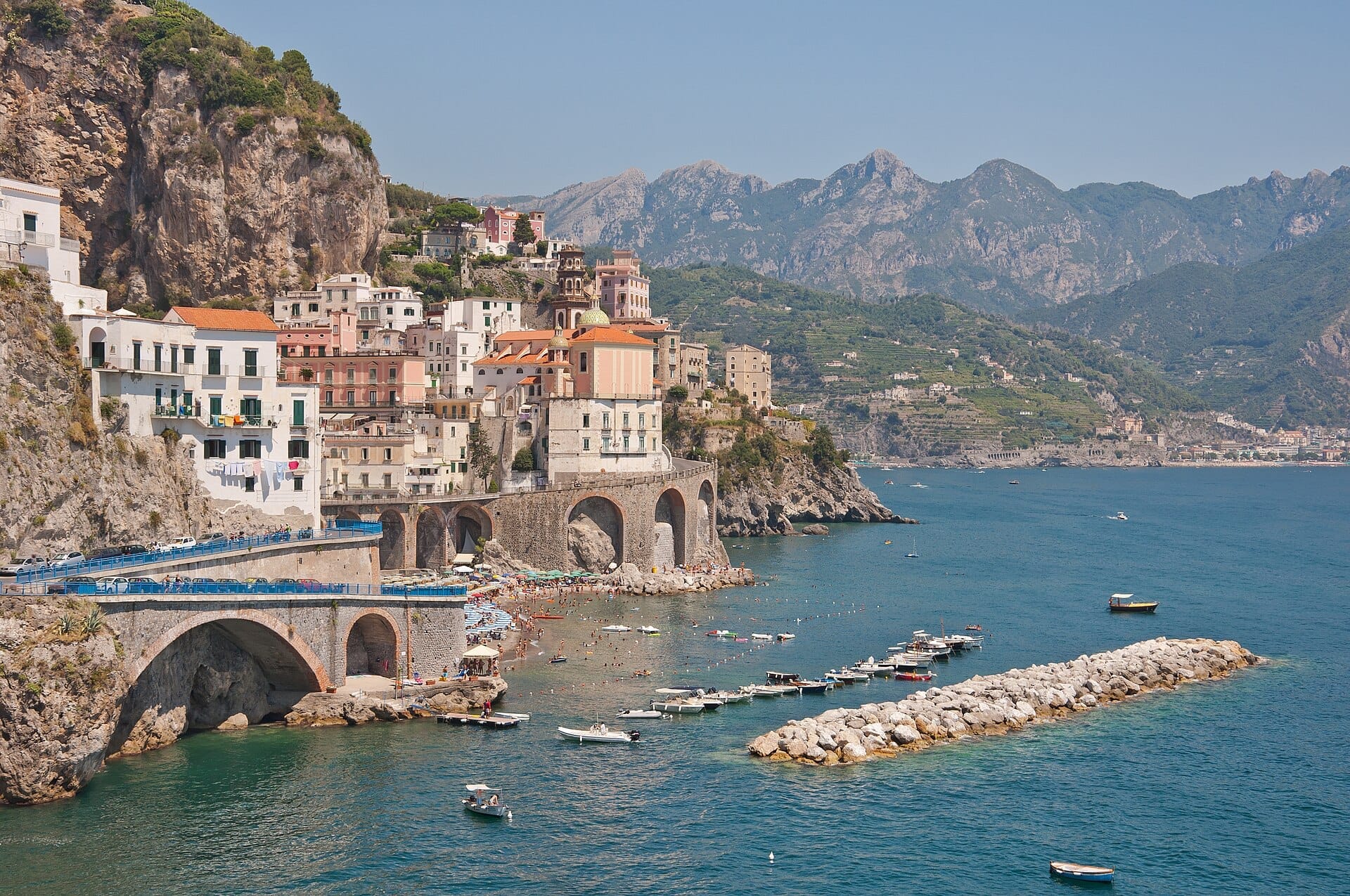
The Costiera Amalfitana is not a single town or a beach resort. It is a 40-kilometre coastal stretch of the Sorrentine Peninsula, where the Lattari Mountains drop almost vertically into the Tyrrhenian Sea. Thirteen municipalities cling to this terrain, each perched on rock shelves, connected by a single two-lane road, SS163, the Amalfi Drive, carved into the cliff face in the 19th century. The scenery is genuinely extraordinary: lemon groves terraced into impossible angles, pastel-coloured houses stacked like tiles on the hillsides, and water that changes colour from pale green in the shallows to deep cobalt offshore.
UNESCO designated the Amalfi Coast a World Heritage Cultural Landscape in 1997, recognising not just the scenery but the long human effort required to inhabit and cultivate it. Amalfi itself was once one of the most powerful maritime republics in the Mediterranean. Its Duchy dominated trade routes in the 10th and 11th centuries, establishing contact with Arab, Byzantine, and Norman cultures before being sacked by Pisa in 1137. The elaborate Cathedral of Sant'Andrea in Amalfi town is a direct architectural legacy of that era, its Arab-Norman facade and striped bell tower unlike anything else in southern Italy.
ℹ️ Good to know
The coast runs west to east from Positano to Vietri sul Mare. Most visitors approach from Naples (western end) or Salerno (eastern end). Both directions offer dramatic road sections, but the approach from Salerno through Vietri is often less congested in summer.
Getting There from Naples: Your Real Options
Naples is the natural base for visiting the Amalfi Coast, sitting roughly 55 kilometres northwest of Positano. The journey is rarely straightforward, which is worth knowing before you commit to a one-day schedule.
The fastest option in season is the hydrofoil or ferry from Naples, departing from Molo Beverello or Mergellina. Services run to Positano, Amalfi, and other coastal towns, taking between 60 and 90 minutes depending on the destination and sea conditions. This is the most pleasant way to arrive: you approach the coast from the water, which gives you the full visual impact before you set foot on land. Ferries are seasonal, typically running from April or May through October, and fill up fast in July and August. Check timetables and book ahead. You can find ferry departure points near the Mergellina waterfront in Naples.
By road, the most common route is to take the motorway south toward Salerno, then pick up SS163 at Vietri sul Mare. Private transfers and rental cars work well, but the Amalfi Drive demands concentration: it is narrow, hairpin-heavy, and shared with SITA buses whose drivers navigate it with alarming confidence. Driving in July and August means accepting significant delays, especially around Positano. If you are not comfortable with tight mountain roads, let someone else drive.
SITA buses connect Salerno, Amalfi, and Positano regularly and are the cheapest land option. The journey from Salerno to Amalfi takes around 75 minutes. For a broader view of logistics from Naples, the Naples to Amalfi Coast transport guide covers ferry times, bus routes, and private transfer costs in detail.
⚠️ What to skip
Peak summer traffic on SS163 can add 90 minutes or more to road journeys. Some municipalities restrict private car access to the Amalfi Drive on summer days. Check local restrictions before driving between June and August.
Tickets & tours
Live prices and dates from our booking partner. If you book, we may earn a commission at no extra cost to you.
Day trip from Naples to Amalfi and Ravello with optional lunch
From 80 €Instant confirmationFree cancellationAmalfi Coast and Pompeii shared guided tour from Naples
From 120 €Instant confirmationFree cancellationTour of Sorrento and the Amalfi Coast
From 105 €Instant confirmationFree cancellationTour of Positano, Amalfi and Ravello
From 100 €Instant confirmationFree cancellation
The Key Towns: Where to Focus Your Time
Positano is the most photographed town on the coast, its dome of the Chiesa di Santa Maria Assunta and cascading coloured buildings familiar from every travel poster. It deserves the attention. The narrow lanes between Via Cristoforo Colombo and the beach fill with people from mid-morning, but arrive before 9am and the light on the buildings is soft, the air still cool, and the lanes largely empty. The town is almost entirely on foot: staircases connect the upper road to the waterfront, and every level has its own rhythm and angle.
Amalfi town is the historical centre of the whole coast and worth more time than most day-trippers give it. Beyond the cathedral, the Valle delle Ferriere walking trail leads into a nature reserve of fern-covered gorges and waterfalls, offering genuine quiet within twenty minutes of the main piazza. The town also produces the region's famous handmade paper, carta di Amalfi, which you can still buy from workshops near the Paper Museum.
Ravello sits 350 metres above sea level, connected to Amalfi by a steep road. It is a different experience entirely: quieter, cooler, and orientated around Villa Cimbrone and Villa Rufolo, both with garden terraces that are among the finest viewpoints on the entire coast. Ravello has attracted writers and composers for over a century, including Wagner, who drew inspiration for Parsifal from Villa Rufolo's gardens. In summer, the Ravello Festival stages classical concerts on the Villa Rufolo terrace, with the sea as backdrop.
Praiano, Furore, and Cetara are smaller towns that most visitors skip. Praiano has quieter swimming spots and fewer crowds than Positano with similar cliff scenery. Cetara, near the eastern end, is known for colatura di alici, an anchovy-based condiment that has been produced there since at least the medieval period. If your interest is food rather than Instagram, it is worth the detour.
What the Experience Is Actually Like: Time of Day and Season
The coast is at its most beautiful in the hours immediately after sunrise and in the late afternoon. By 10am in peak season, the main towns receive tour group arrivals by boat and bus, and the narrow streets in Positano and Amalfi fill quickly. The light in early morning is cooler and cleaner, bouncing off the facades without the flat harshness of midday. The smell at that hour is seawater, lemon blossom if you are near the groves, and coffee from the bars just opening.
By noon in July, the heat on the clifftops is considerable. Stone paths and terraces hold the warmth, and shade is limited on the popular routes. This is when most visitors retreat to the beaches, which are themselves crowded and mostly pebble or coarse sand rather than the soft beaches people sometimes expect. Private beach clubs with sun loungers and umbrellas charge for access; free public sections exist but are narrower.
Late afternoon, roughly 4pm to sunset, is the second best window. The light turns amber against the buildings, the sea goes glassy, and the tourist volumes begin to ease as day-trippers board return ferries and buses. For photographers, the western-facing stretches toward Positano catch the sun setting over the water from October onward. In June and July, the sun sets further north and the coastal light at dusk is softer rather than dramatic.
Shoulder season, April to early June and September to October, is when the coast works best for most visitors. Temperatures are comfortable for walking, accommodation prices are lower, ferry connections are mostly operational, and the towns feel like places people actually live in rather than sets built for tourism. November through March sees many hotels and restaurants close, ferry services suspended, and occasional road closures from landslides. The coast is beautiful in winter if you can accept the limitations, but it requires flexibility.
💡 Local tip
Book ferry tickets in advance for July and August departures, especially the Naples to Positano route. Ticket windows at Molo Beverello often sell out the morning service by mid-morning during peak weeks.
The Drive Itself: SS163 Amalfi Drive
The Amalfi Drive, Strada Statale 163, is described in guidebooks as one of the world's great scenic roads, and by any honest measure it is. The road was carved from the cliff in the 1850s by order of King Ferdinand II of the Two Sicilies, an engineering achievement that required blasting through rock overhangs and constructing dozens of bridges and viaducts. At its narrowest, it allows barely enough room for two vehicles to pass.
If you are driving, keep your attention on the road rather than the scenery. Passenger seats get the views; drivers get the anxiety. The sequence of tunnels, bends, and sudden drops is relentless between Positano and Amalfi. Motorcycles and scooters navigate it more easily and are popular rentals in the region, though that comes with its own risks on a road with almost no shoulder. Buses are driven by professionals who know every centimetre of the route: if you are on a SITA bus, trust the driver and sit on the sea side for views.
Practical Notes for Visiting
Footwear matters more here than almost anywhere in southern Italy. The villages involve constant stair climbing on worn stone steps, often with no handrail. Sandals with grip are the minimum; proper walking shoes are better if you plan to use the coastal trails or go above the main road into the mountains. The Path of the Gods, Sentiero degli Dei, runs along the ridge above the coast from Agerola to Nocelle above Positano, and is one of the best walking routes in southern Italy, but it requires suitable shoes and a reasonable fitness level.
Accessibility for visitors with mobility limitations is genuinely difficult throughout most of the coast. Positano, Amalfi town, and Ravello all involve significant vertical changes managed by stairs or steep slopes. Some waterfront areas in Amalfi town are relatively flat, and the boat journey itself is accessible, but most of the village centres are not wheelchair-friendly. This is not likely to change given the physical terrain.
The Amalfi Coast is expensive relative to the rest of southern Italy. Restaurant prices in Positano and Ravello are high even by Italian coastal standards. If budget is a concern, the towns closer to Salerno such as Vietri sul Mare and Cetara offer similar scenery at considerably lower prices. For a broader look at managing costs around Naples and the surrounding region, the Naples on a budget guide has practical suggestions.
Travellers who have more time in the region should consider combining the coast with a visit to Pompeii, which is accessible from the Naples-Salerno motorway and can be combined with a coastal day in a two-day itinerary. For those based in Naples, a structured 3-day Naples itinerary can help fit the Amalfi Coast into a wider trip without rushing.
Who Should Reconsider This Trip
The Amalfi Coast is overhyped in one specific sense: the gap between its reputation and the experience in high summer is significant. In July and August, Positano in particular can feel more like a theme park than a coastal village. The narrow lanes are shoulder-to-shoulder, the beaches are packed, the ferries are delayed, and prices reflect demand without apology. If your only window is mid-July, the coast is still worth visiting, but calibrate expectations accordingly and prioritise early morning or late afternoon hours.
Visitors who dislike heat, steep terrain, or crowds, and who are travelling in summer, may find Ravello or the quieter eastern towns more rewarding than Positano. Visitors with young children who require pushchairs or strollers will face genuine difficulty in most town centres. And anyone who needs flat, wheelchair-accessible terrain will find the coast largely unsuitable outside of specific waterfront sections.
Insider Tips
- The ferry from Naples arrives at Amalfi's main pier in the town centre. Start your day in Amalfi before the day-tripper boats arrive, then take a local bus up to Ravello in the late morning when the light on the gardens is best and the crowds at Amalfi's cathedral have thinned.
- Ravello's Villa Cimbrone terrace, the Belvedere of Infinity, faces southwest and catches the light from around 4pm onward. If you can only be at one viewpoint at one specific hour, that combination is hard to beat.
- SITA buses between Salerno, Amalfi, and Positano are a fraction of the cost of ferries and pass through every town on the coast. Buy tickets before boarding at tobacconists or bars with the SITA sign, not on the bus.
- Many of the coast's best swimming spots are accessible only by boat or by descending steep steps. Ask locally for fiordi and calette, small sea inlets, rather than heading to the main town beaches, which are crowded and often dominated by paid lounger operators.
- Lemon granita in any bar on the coast is made from sfusato amalfitano lemons, a protected variety grown only in this area. It is not a tourist gimmick but a genuine regional product with a flavour noticeably different from ordinary lemon.
Who Is Amalfi Coast For?
- Travellers who want dramatic coastal scenery combined with substantive history and architecture
- Photographers working in early morning or late afternoon light
- Walkers and hikers interested in mountain-to-sea routes like the Sentiero degli Dei
- Food-focused visitors exploring regional products like colatura di alici, sfusato lemons, and local seafood
- Couples looking for a scenic day trip or overnight stay from a Naples base
Nearby Attractions
Combine your visit with:
- Capri
Capri is one of the most recognized islands in the Mediterranean, sitting at the southern edge of the Gulf of Naples. It offers dramatic limestone cliffs, the famous Blue Grotto, elegant piazzas, and views that justify the journey. But it comes with crowds, costs, and logistical quirks that every visitor should understand before boarding the ferry.
- Cimitero delle Fontanelle
Carved into volcanic tuff in the Sanità district, the Cimitero delle Fontanelle holds the remains of roughly 40,000 people, many of them victims of the 1656 plague. Reopened in April 2026 after a five-year closure, it is one of the most historically dense and atmospheric places in all of southern Italy.
- Città della Scienza
Città della Scienza is Naples' premier interactive science museum, set on a former industrial waterfront in the Bagnoli district. With hands-on exhibits spanning the human body, sea life, insects, and space, plus a full planetarium, it delivers a genuinely engaging half-day for families, curious adults, and school groups alike.
- Herculaneum (Ercolano)
Buried by Vesuvius in 79 AD and only partially excavated, Herculaneum is the most intact Roman city on earth. Smaller than Pompeii, quieter, and significantly better preserved, it rewards visitors who want to feel rather than just see ancient Rome. Located 8 km from Naples, it is reachable in under 30 minutes by Circumvesuviana train.
Planning a trip? Discover personalized activities with the Nomado app.