Complesso Monumentale di Santa Chiara: Naples' Most Serene Medieval Complex
Built by Angevin royalty in the 14th century, the Complesso Monumentale di Santa Chiara is one of the largest religious complexes in Naples. Its Gothic basilica, majolica-tiled cloister, and attached museum make it a genuinely rewarding stop in the heart of Spaccanapoli.
Quick Facts
- Location
- Via Santa Chiara 49/C, Spaccanapoli, Naples (entrance also on Via Benedetto Croce)
- Getting There
- Metro Line 1, Dante station (approx. 450m walk)
- Time Needed
- 1.5 to 2.5 hours for the full complex
- Cost
- Tickets purchased on-site only; check current prices at entrance or official website
- Best for
- History lovers, architecture enthusiasts, anyone wanting quiet in the middle of a loud city
- Official website
- www.monasterodisantachiara.it/en
What Is the Complesso Monumentale di Santa Chiara?
The Complesso Monumentale di Santa Chiara is one of the most historically layered religious sites in southern Italy. Sitting directly on Spaccanapoli, the great straight axis that cuts through Naples' historic centre, the complex covers an entire city block and includes a Gothic basilica, a Franciscan monastery, a convent for Poor Clares, a royal pantheon, and a cloister that is, genuinely, unlike anything else in the city.
Its scale is easy to underestimate from the street. The austere façade of the basilica gives little away. But once you pass through the entrance and begin moving through the various sections, the complexity of the place starts to register. This is not a single church: it is a compound that served Angevin royalty, housed two separate religious orders, and survived (partially) one of the most destructive Allied bombing raids of the Second World War.
💡 Local tip
The basilica entrance and the cloister/museum entrance are separate. Make sure you have access to both if you want the full experience. Tickets for the monumental complex are sold on-site at the dedicated entrance.
History and Architecture: From Angevin Court to Allied Bombs
Construction of Santa Chiara began in 1310 under King Robert of Anjou and his wife Queen Sancha of Majorca, rulers who shaped medieval Naples with extraordinary ambition. The basilica was completed somewhere between 1328 and 1340 in the Provençal Gothic style that the Angevin court favoured: vast, single-naved, with a single nave. The full church measures 96 metres long and 25 metres wide, making it one of the largest Gothic churches in Italy.
Robert of Anjou, who died in 1343, chose Santa Chiara as his royal mausoleum, and his tomb remains inside the basilica today. For over a century the complex served as the spiritual and ceremonial heart of the Angevin kingdom. Then, during the 17th and 18th centuries, the interior was overhauled in the Baroque style that Naples had embraced so thoroughly. Frescoes, stuccos, and ornamental details were added throughout, obscuring the original Gothic bones.
On 4 August 1943, a single bombing raid destroyed most of what the Baroque renovations had created. The fires that followed burned for days. Remarkably, the destruction became an opportunity: restorers chose to strip back to the original Gothic structure rather than reconstruct the Baroque interior. By 1953 the basilica had been returned to something close to its 14th-century appearance, spare and severe and surprisingly moving.
Tickets & tours
Hand-picked options from our booking partner. Prices are indicative; availability and final rates are confirmed when you complete your booking.
Veiled Christ and Chiostro di Santa Chiara Tour
From 40 €Instant confirmationFree cancellationCastel Sant'Elmo self-guided audio tour in Naples
From 4 €Instant confirmationCastel Sant'Elmo Entry Ticket with Audio Guide in Naples
From 14 €Instant confirmationFree cancellationOrigins and legends of Naples walking tour
From 28 €Instant confirmationFree cancellation
The Cloister: The Real Reason Most People Come
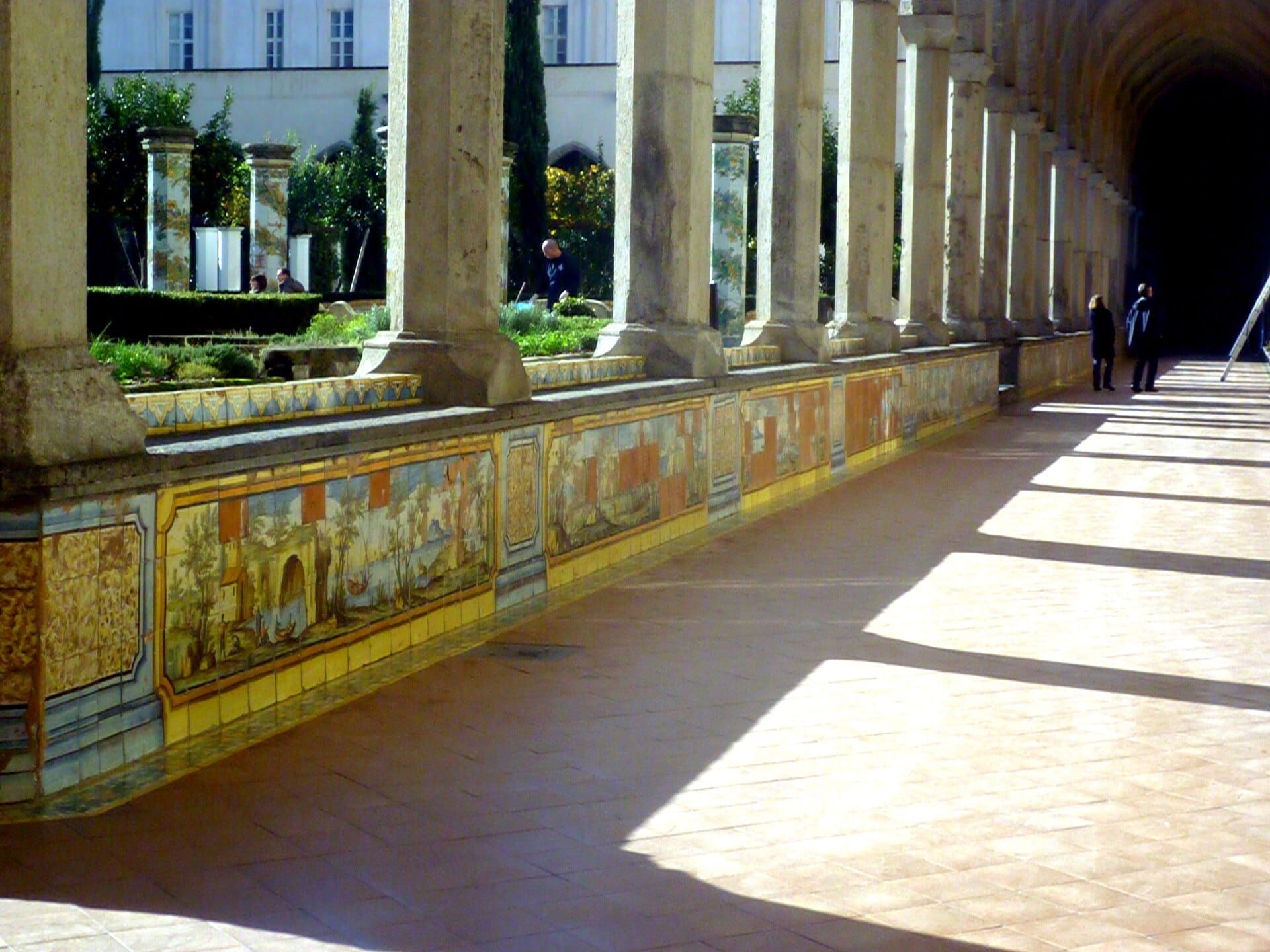
If the basilica rewards patience, the cloister stops people mid-step. The Chiostro delle Clarisse, redesigned in the early 18th century by Domenico Antonio Vaccaro, is decorated entirely with hand-painted majolica tiles depicting pastoral scenes: hunting, fishing, picnicking, musicians, nobles, farmers. The benches and pillars that divide the cloister into quadrants are wrapped in this tilework, running to thousands of individual painted panels.
The colour palette is soft: pale blues, greens, yellows, and whites, all slightly weathered now, which only adds depth. Wisteria and climbing plants thread through the colonnade depending on the season, and the garden at the centre is planted simply, with grass and citrus trees. On a warm morning, with the light falling low across the tiles and almost no one else around, the cloister is extraordinarily still for a place sitting in the middle of one of Europe's densest cities.
Visit early, ideally when the complex first opens, to have the cloister largely to yourself. By midday on any day between April and October, tour groups fill the space and the intimate quality evaporates. Photography is allowed, and the tilework is genuinely photogenic, but flat morning light from the north side gives better results than the harsh midday sun that bleaches colour from the panels.
The Museum: More Than an Afterthought
The attached museum occupies rooms of the former monastery and is better than it gets credit for. Displays include archaeological finds from the Roman-era thermal baths that existed on this site before the church was built, fragments of the medieval frescoes that survived the 1943 bombing, surviving Baroque decorative elements, and a collection of devotional objects, vestments, and liturgical items spanning several centuries.
Allow at least 30 to 40 minutes here if you have any interest in Neapolitan history. The Roman bath remnants alone are worth seeing as a reminder that this city has been continuously inhabited and layered for over two millennia. For anyone already planning to visit the Naples National Archaeological Museum, the museum here provides useful context at a smaller scale.
The Basilica Interior: Austere and Intentional
Entering the basilica after seeing the cloister is an adjustment. The post-war restoration produced an interior that is almost aggressively plain: white walls, pointed Gothic arches, stone floors, and very little ornamentation. Some visitors find this beautiful. Others, expecting the layered richness of a typical Neapolitan church, feel slightly underwhelmed.
What survives of genuine medieval quality includes the royal tombs, particularly the monument to Robert of Anjou behind the main altar, and a handful of Gothic sculptural details. For comparison, the nearby Gesù Nuovo church directly across Via Benedetto Croce offers a completely different register: dense, dark, overwhelmingly Baroque. Visiting both in the same morning makes the contrast instructive.
ℹ️ Good to know
Dress code is enforced. Shoulders and knees must be covered to enter the basilica. Scarves and wraps are not provided at the entrance, so come prepared. The cloister and museum have no specific dress requirement.
Getting There, Getting Around, and Practical Notes
Metro Line 1 to Dante station is the most direct approach, leaving a walk of roughly 450 metres along Via Benedetto Croce into the heart of Spaccanapoli. The street itself is worth the walk: narrow, lined with workshops and small shops, and often smelling of coffee and frying dough from the bars that open early. If you are arriving from the waterfront or Piazza del Plebiscito area, it is a straightforward 15-minute walk north through the historic centre.
The complex is in the UNESCO-listed historic centre of Naples, on streets that are primarily pedestrianised or very narrow. Taxis can drop you at either end of Via Benedetto Croce. There is no on-site parking.
Tickets are sold on-site only. The official website lists current hours and pricing, and it is worth checking before you go since hours can shift between high and low season. Arriving at opening time is the single most effective way to improve your experience, particularly for the cloister.
Accessibility within the complex is limited in certain areas due to the age of the buildings and the uneven stone surfaces. The cloister garden paths are navigable, but some museum rooms and parts of the basilica involve steps. Contact the complex directly for specific accessibility needs.
Is Santa Chiara Worth Your Time?
For most visitors with a genuine interest in history or architecture, yes, clearly. The cloister alone justifies the entrance fee and the detour. If you are building a day around the historic centre, Santa Chiara pairs logically with Cappella Sansevero, the Gesù Nuovo, and San Gregorio Armeno, all within a short walking radius.
If you are short on time and forced to choose between the Complesso Monumentale di Santa Chiara and, say, the Cappella Sansevero, the Sansevero is more immediately dramatic. But Santa Chiara offers something the Sansevero does not: space, quiet, and room to sit and absorb. On a hot afternoon or after a long morning of walking, that counts for a great deal.
Travellers who prefer kinetic, sensory-overload sightseeing over reflective, layered history will find this complex too quiet and its basilica too sparse. The same is true for anyone with very limited time who wants maximum density of spectacle per hour. Santa Chiara rewards slow attention, not speed.
Insider Tips
- The cloister is at its best in the first hour after opening. The quality of light is better, the space is quieter, and you can actually hear the fountain. Plan the rest of the complex for after, not before.
- The museum section on the Roman baths is often skipped by visitors who rush through. Take five minutes to find it. The archaeological continuity of the site adds real depth to the Gothic and Baroque history above it.
- Via Benedetto Croce, directly outside the entrance, has some of the most photogenic shop fronts and street scenes in the historic centre. Budget 15 minutes to walk a block in each direction before or after your visit.
- If you visit in late spring, the wisteria in the cloister colonnade may still be in flower, adding colour that photographs exceptionally well against the blue and white majolica tiles.
- The complex is often quieter on weekday mornings in November, February, and March. These months also have lower ticket prices at many Naples attractions. Weather is unpredictable, but the indoor sections of Santa Chiara are unaffected by rain.
Who Is Complesso Monumentale di Santa Chiara For?
- Architecture and art history enthusiasts who want to understand Gothic and Baroque Naples side by side
- Travellers looking for a genuinely peaceful hour in a city that offers very few of them
- Anyone with an interest in medieval royal history and the Angevin kingdom
- Photographers seeking colour, texture, and composition opportunities beyond the standard Naples postcard
- Visitors combining the complex with a walking route through Spaccanapoli and the surrounding historic streets
Nearby Attractions
Other things to see while in Spaccanapoli:
- Gesù Nuovo Church
The Chiesa del Gesù Nuovo stands at the heart of Spaccanapoli with one of the most deceptive facades in Italian architecture: a rough diamond-point stone exterior that gives no hint of the gilded Baroque spectacle waiting inside. Free to enter and rarely overcrowded, it rewards visitors who look beyond the more-visited Santa Chiara next door.