The Flatiron Building: New York's Most Photographed Triangular Tower
One of New York City's earliest skyscrapers and one of its most recognizable silhouettes, the Flatiron Building rewards visitors with a free, unhurried experience on the streets of the Flatiron District. No tickets, no queues — just one of the world's most compelling pieces of architectural geometry.
Quick Facts
- Location
- 175 Fifth Avenue, at the intersection of Fifth Avenue, Broadway & East 23rd Street, Manhattan
- Getting There
- N/R/W to 23rd St (Broadway); F/M to 23rd St (6th Ave); 6 to 23rd St (Park Ave South)
- Time Needed
- 20–45 minutes for exterior viewing and photography
- Cost
- Free — exterior viewing from public sidewalks and Madison Square Park
- Best for
- Architecture lovers, photographers, first-time visitors, walking tours
- Official website
- www.nyctourism.com/attractions-tours/flatiron-building
What the Flatiron Building Actually Is
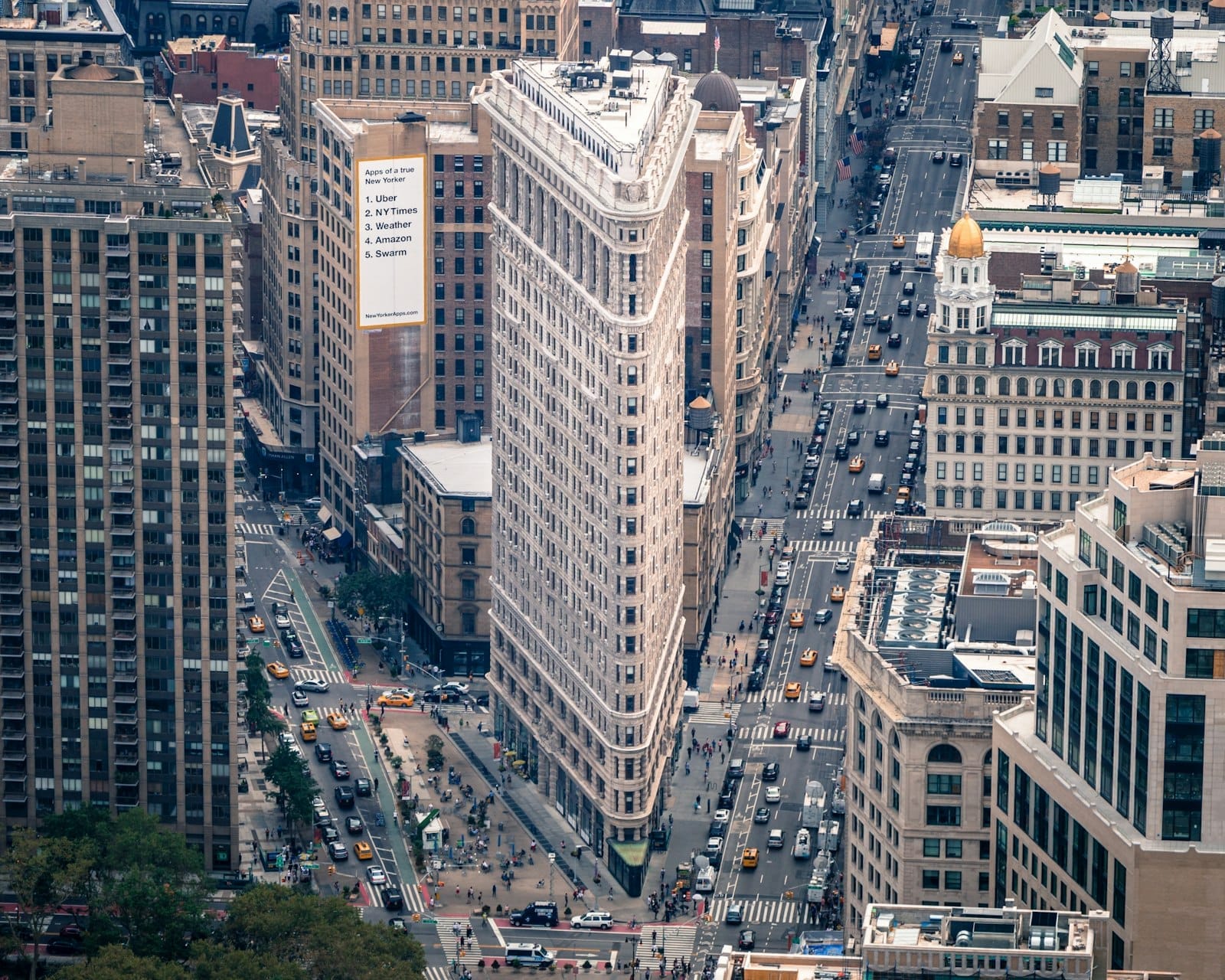
The Flatiron Building stands at the triangular wedge where Fifth Avenue and Broadway collide at 23rd Street, forcing a building into a shape that looks more like a stage prop than a functional office tower. Completed in 1902 and rising 307 feet (93.6 meters) across 22 stories, it was one of New York City's first true skyscrapers — and at its sharpest northern point, the structure narrows to just 6.5 feet (roughly 2 meters) wide. That fact alone tells you something about the audacity of the design.
Originally named the Fuller Building after the construction company that commissioned it, the structure was designed by Chicago architect Daniel H. Burnham, working with Frederick P. Dinkelberg. Burnham clad the steel frame in a French Renaissance-inflected terra cotta skin, with elaborate decorative detailing that softens what is otherwise a supremely angular form. The building was designated a New York City Landmark in 1966 and a U.S. National Historic Landmark in 1989.
There is no public access to the interior. The Flatiron Building is an office property (currently undergoing renovation and not open to the public), and no ticketed tours or public observation floors are offered. The entire visit happens on the streets and in the park to the north. For most visitors, that is more than enough.
ℹ️ Good to know
Entry is completely free. You view the building from public sidewalks, pedestrian islands, and Madison Square Park. No reservations, no tickets, no queues.
The Experience of Being There
The first thing visitors notice is that the building looks different from every approach. Walking south on Fifth Avenue, the tower appears as a flat facade and could almost pass for a conventional building. But as you angle toward Broadway and the northern tip comes into view, the illusion collapses and that knife-edge prow emerges. There is a moment, somewhere around 24th Street looking south, where the geometry clicks into place and the building genuinely looks like a ship bearing down on you.
The intersection itself is chaotic in the best way. Taxis, cyclists, pedestrians, and delivery trucks all navigate the same irregular junction, and the Flatiron presides over it with a kind of indifferent grandeur. Street vendors sometimes work the corners. Tourists photograph from every conceivable angle. Office workers pass through without looking up. The contrast between the building's stillness and the street's constant motion is what makes the spot feel alive.
Madison Square Park, directly to the north, provides the best sustained views. The park has benches and open lawn areas that let you sit and actually study the building rather than just snapping a photo and moving on. On weekday mornings the park fills with office workers on coffee breaks; on weekend afternoons, families take over the grass. The building anchors the southern end of the park's sightline regardless of the season.
Tickets & tours
Hand-picked options from our booking partner. Prices are indicative; availability and final rates are confirmed when you complete your booking.
Tickets to the Empire State Building Observatory at Sunrise
From 126 €Instant confirmationFree cancellationEmpire State Building Guided Tour with Observation Deck Access
From 127 €Instant confirmationFree cancellationTickets to the Empire State Building Observatory
From 0 €Instant confirmationFree cancellationFlatiron District tour with the City Exploration Game
From 10 €Instant confirmationFree cancellation
How the Flatiron Looks at Different Times of Day
Early morning, roughly 7 to 9 a.m., is when the building is at its most photogenic and the surrounding streets are at their most manageable. The eastern facade catches direct sunlight and the terra cotta detailing throws sharp shadows that show off Burnham's ornamental work. Foot traffic is mostly commuters rather than tourists, and the pedestrian islands at the building's base are relatively clear.
Midday light flattens the facade somewhat, but the lunch crowds from nearby offices give the intersection real energy. This is also when Madison Square Park's famous Shake Shack original location sees its longest lines, if that is relevant to your afternoon. Late afternoon, as the sun drops in the west, the building's western side glows a warm ochre and the shadow of the tower stretches across 23rd Street. This is peak photography hour.
After dark, the Flatiron is illuminated and visible from a distance, but the detailed terra cotta work that makes it architecturally interesting largely disappears at night. Evening visits are atmospheric but less rewarding for close study of the building itself.
💡 Local tip
For the best photographs of the northern prow, stand on the pedestrian island on Broadway between 22nd and 23rd Streets and shoot upward with a wide-angle lens. The morning light hits this side first.
Architectural and Historical Context
Understanding why the Flatiron Building matters requires a brief detour into what New York looked like in 1902. The steel-frame skyscraper was a relatively new technology, and buildings of this height were still novel enough to draw crowds of spectators during construction. The triangular site at the junction of two major street grids — the older downtown grid and the uptown grid laid out by the Commissioners' Plan of 1811 — was considered an awkward, nearly unusable parcel. Burnham's solution was to treat the constraint as the concept.
The building's Beaux-Arts detailing, worked in glazed terra cotta, was a deliberate choice to make the tower look established and permanent at a time when many New Yorkers were skeptical that steel-frame construction would last. The three-part vertical organization — base, shaft, and capital — mimics the structure of a classical column, a visual trick to make a 22-story tower feel proportioned rather than oversized.
The Flatiron district that surrounds the building takes its name from the structure, and the neighborhood retains a mix of late-nineteenth-century commercial buildings alongside newer offices and residences. It sits between Flatiron District proper to the north and the older commercial districts to the south, making it a natural stopping point on any downtown walking route.
Getting There and Getting Around the Area
The building is straightforward to reach by subway. The most convenient stop is 23rd Street on the N, R, and W lines (when the W is running), which deposits you directly at the building's corner. The F and M trains also stop at 23rd Street, one block west on Sixth Avenue. The 6 train's 23rd Street stop at Park Avenue South is about two blocks east and is slightly less convenient but still an easy walk.
The area around the Flatiron is extremely walkable and well-suited to combining with other stops. Madison Square Park is immediately to the north. Union Square, with its year-round greenmarket and transit hub, is about ten minutes south on foot down Broadway or Fifth Avenue. The neighborhood has dense restaurant and cafe options along both Broadway and Fifth Avenue.
If you are building a longer itinerary around this area, the Flatiron fits naturally into a walking tour that takes in Union Square Park to the south and works its way up toward the Empire State Building a few blocks north on Fifth Avenue. The NYC architecture guide covers how this stretch of the Flatiron District fits into the city's broader architectural history.
Photography Tips and Practical Notes
The three standard vantage points each produce a different image. From the pedestrian island on Broadway north of 22nd Street, you get the classic prow shot. From Madison Square Park, you get the full building in context with trees in the foreground depending on the season. From the south on Fifth Avenue at around 20th Street, you get the flat facade composition that emphasizes the building's height over its unusual shape.
Overcast days actually work well here because the diffused light reveals the texture of the terra cotta detailing without the harsh shadows that bright sun can create on the deeply carved surfaces. Rain makes the stone surfaces darker and richer in tone. Snow, predictably, produces images that circulate endlessly online.
Accessibility at this location is governed by standard New York City sidewalk conditions. The area around the building has curb cuts and pedestrian signals at all major crossings. Madison Square Park has paved pathways throughout. There are no steps or barriers to approach any of the primary viewing positions.
⚠️ What to skip
The intersection of Fifth Avenue, Broadway, and 23rd Street sees heavy vehicle and pedestrian traffic throughout the day. When photographing from the street or pedestrian islands, remain aware of turning vehicles — the unusual intersection geometry creates blind spots for drivers.
Is It Worth the Time?
The honest answer depends on what you are expecting. As a piece of urban experience, the Flatiron Building delivers: the geometry is genuinely arresting up close, the surrounding streetscape is interesting, and the visit costs nothing and takes very little time. It pairs well with Madison Square Park and the surrounding neighborhood, making it easy to fold into a larger afternoon rather than treating it as a standalone destination.
Visitors who arrive expecting an interactive experience, an observation deck, or interior access will be disappointed. The building is essentially a facade — extraordinarily photogenic, historically significant, and free to see, but fundamentally a walk-past rather than a walk-through.
Travelers primarily interested in New York's skyline experiences should compare the Flatiron with ticketed options such as Summit One Vanderbilt or Top of the Rock, both of which offer elevated perspectives on the city. The Flatiron offers something different: a ground-level encounter with one of the buildings that defined modern urban architecture.
Insider Tips
- The pedestrian island at the very tip of the building on Broadway south of 23rd Street lets you stand almost directly beneath the narrow prow. Most visitors photograph from further away and miss this close-up perspective entirely.
- Madison Square Park has free Wi-Fi and public seating with direct sightlines to the building. It is a better base for extended photography sessions than the crowded sidewalks directly adjacent to the Flatiron.
- The Shake Shack in Madison Square Park is the original location. Lines at peak lunch hours (noon to 2 p.m.) can be long, but the wait shortens considerably after 3 p.m.
- For social-media-style wide-angle shots looking up the building from street level, the morning light on the eastern facade between 7 and 9 a.m. is significantly better than any other time of day. The low angle of winter morning sun in particular creates dramatic raking light across the terra cotta.
- The building's north face and the intersection look different in each season. Autumn foliage in Madison Square Park frames the building in warm tones from late October through early November, while winter strips the trees and makes the full steel structure of the park's iron fence visible.
Who Is Flatiron Building For?
- Architecture and design enthusiasts interested in early American skyscraper history
- Photographers looking for a free, endlessly variable subject with multiple vantage points
- First-time visitors building a classic New York City itinerary
- Travelers combining several Flatiron District and nearby Gramercy landmarks in a single afternoon walk
- Anyone who wants a recognizable New York landmark without paying admission or standing in a queue
Nearby Attractions
Other things to see while in Midtown Manhattan:
- Broadway Theater District
The Broadway Theater District in Midtown Manhattan is the center of American live theater, home to 41 official Broadway houses spanning nearly a century of performance history. Whether you're booking months in advance or hunting same-day discount tickets, this guide covers everything from curtain times to architectural details.
- Bryant Park
Tucked behind the New York Public Library on Sixth Avenue, Bryant Park is an 8-acre public park that holds its own against the surrounding skyscrapers. Free to enter year-round, it shifts character dramatically by season, from a winter ice rink to a summer outdoor cinema — and remains one of the most functional and well-managed public spaces in New York City.
- Carnegie Hall
Carnegie Hall has anchored Midtown Manhattan's cultural life since 1891. With three auditoriums ranging from 268 to 2,790 seats, it hosts everything from orchestral premieres to intimate recitals. This guide covers the halls, the history, and exactly how to make the most of a visit.
- Chrysler Building
Completed in 1930 and briefly the tallest building on earth, the Chrysler Building remains the finest example of Art Deco architecture in New York City. Visitors generally can't go inside beyond the main lobby, but the experience of standing beneath its gleaming stainless steel crown is genuinely unforgettable.