East-West/West-East by Richard Serra: Qatar's Desert Steel Monoliths
Standing in the remote Brouq Nature Reserve near Zekreet, Richard Serra's East-West/West-East is one of the most dramatic large-scale sculptures in the world. Four steel plates, each over 14 metres tall, stretch across more than a kilometre of gypsum desert terrain, creating an experience that is equal parts art, landscape, and silence. Entry is free, but getting there requires planning.
Quick Facts
- Location
- Brouq Nature Reserve, Zekreet Peninsula, western Qatar (approx. 1–1.25 hrs from Doha)
- Getting There
- Private car or 4WD only. Take Dukhan Highway (Route 1) west toward Zekreet, then follow GPS to Ras Abrouq. No public transport reaches the site.
- Time Needed
- 2–4 hours including drive time from Doha; allow 45–60 minutes at the installation itself
- Cost
- Free (no admission fee)
- Best for
- Art enthusiasts, photographers, desert explorers, architecture lovers
- Official website
- qm.org.qa/en/visit/public-art/richard-serra-east-west-west-east
What East-West/West-East Actually Is
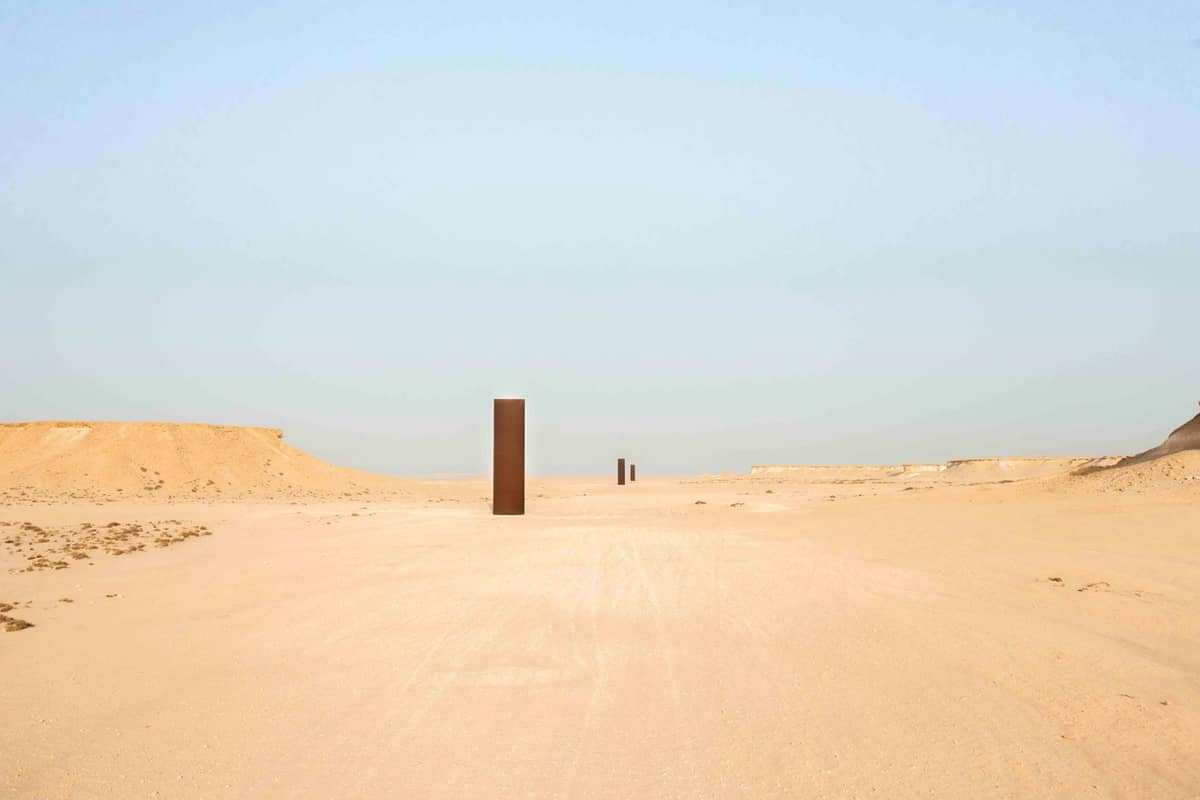
East-West/West-East is a permanent outdoor sculpture by the American artist Richard Serra, commissioned by Qatar Museums and installed in the Brouq Nature Reserve on the Zekreet Peninsula in western Qatar. It consists of four Cor-Ten steel plates, each rising more than 14 metres from the desert floor, positioned along a corridor that runs for more than one kilometre between ancient gypsum rock formations. The work is oriented so that one end faces toward the Gulf and the other looks inland, making the title both a literal and philosophical description of what you experience walking through it.
Serra was known internationally for sculptures that make you acutely aware of your own body in space, and this installation is perhaps his most extreme exercise in that idea. There are no pedestals, no labels, no explanatory plaques visible from a distance. You approach across open desert and four enormous steel walls simply appear, rising from the ground as though they have always been there. The scale only registers fully when a person stands next to one of the plates, at which point the plate dwarfs them completely.
ℹ️ Good to know
The installation is open at all times with no ticketing, but visiting after dark or without GPS coordinates is not advisable. The desert terrain offers no lighting and no landmarks after sunset.
The Drive Out: Part of the Experience
Getting to East-West/West-East is not a minor errand. From central Doha, the drive takes roughly an hour to an hour and a quarter depending on traffic, mostly along the Dukhan Highway heading west. The highway itself is fast and well-maintained. The transition happens gradually: the city thins, the roadside developments disappear, and eventually you are moving through flat, bone-dry terrain with almost nothing on the horizon.
The final approach from the Zekreet area involves unpaved desert tracks. Most visitors reach the site in a standard SUV or high-clearance vehicle, though a proper 4WD is more comfortable on the rougher sections. The Plus Code GV8C+R9W and GPS coordinates work well in Google Maps and Apple Maps, and are the most reliable way to navigate the last few kilometres. Do not rely on road signs alone.
⚠️ What to skip
There are no facilities at the site: no toilets, no shade structures, no water, no food vendors. Bring at least 1.5 litres of water per person, and more in warmer months. A hat and sunscreen are essential between April and October.
If you are combining this trip with other western Qatar destinations, the route pairs logically with Al Zubarah Fort, a UNESCO World Heritage Site about 30 minutes further north, or with a stop at the Sealine Beach area near Mesaieed on the return. Both are worth including if you are making a full day of it.
What You Actually See and Feel
The gypsum plateau landscape of Brouq Nature Reserve is quietly strange before you even reach the sculpture. The formations are pale and layered, wind-eroded into low flat-topped shapes that look almost architectural themselves. The ground between them is sandy and scattered with small stones. Sparse, low desert vegetation appears in patches. It is very quiet in the way that genuinely remote places are quiet, where the absence of human noise becomes its own presence.
The steel plates themselves have weathered to the deep orange-brown of oxidised iron, which means they read against the desert's grey-white tones as something warm and almost organic. Up close, the surface has texture: rust blooms, drips, streaks where rain has run across the metal in the rare occasions it falls here. The plates are not identical in their exact placement or the angles they subtly hold, and Serra designed them to interact with the sightlines created by the gypsum cliffs on either side of the corridor.
Walking the full length of the installation, from one end plate to the other, takes about 15 to 20 minutes at a relaxed pace. As you move between the plates, the framing of the landscape changes: sky, rock, and steel combine differently depending on your position. Stand directly between two plates and the edges of the steel create a narrow frame. Move to either side and the open desert reasserts itself. Serra built this kind of perceptual shift deliberately into all his large outdoor works, and here the distance between plates is long enough that you feel the landscape change significantly as you move through it.
Time of Day: How It Changes
Early morning arrivals, around sunrise, get two things that afternoon visitors do not: cooler temperatures and a quality of light that makes the steel glow copper-red against the pale sky. The low angle of the sun picks up every surface detail on the plates, and shadows stretch long across the desert floor. If photography is part of your goal, sunrise is the clear answer, though it requires leaving Doha in darkness.
Midday visits in summer months are uncomfortable to the point of being inadvisable. Temperatures in the Zekreet area regularly reach 40°C and above between June and September, there is no shade anywhere near the sculpture, and the steel plates absorb and radiate heat. If you visit in summer, make it an early morning trip and be back at your vehicle before 9:00 or 10:00 AM.
Late afternoon light in the cooler months, roughly November through March, creates the richest colour contrast: the deep orange of the steel against the golden-hour desert tones. This is also when the temperature is most forgiving, sitting in the low 20s Celsius at their coolest. The plates cast long shadows to the east as the sun drops toward the Gulf horizon to the west, reinforcing the directional geometry Serra built into the title and orientation of the work.
For more on navigating Doha's art landscape more broadly, the Doha photography guide covers shooting logistics across the city and its surroundings, including light conditions and permissions.
Cultural and Artistic Context
Richard Serra was one of the most significant sculptors of the 20th and early 21st centuries, known for works that reject the traditional pedestal and insist on a direct relationship between steel, site, and human body. Works like Tilted Arc in New York and the Torqued Ellipses series in museum settings established his international reputation. East-West/West-East belongs to a category of his work that operates at landscape scale, where the surrounding environment is not background but material.
Qatar Museums commissioned the piece as part of a broader strategy to position Qatar as a serious destination for contemporary art, alongside institutions like the Museum of Islamic Art and Mathaf: Arab Museum of Modern Art. Placing a Serra installation not in a city park or museum courtyard but in a protected desert reserve was a deliberate decision, one that removed the work from any urban context and forced it into dialogue with deep geological time. The gypsum cliffs around it are ancient formations. The steel plates are industrial. The contrast is not incidental.
If contemporary and modern art interests you, the Mathaf: Arab Museum of Modern Art in Doha holds a significant permanent collection and regularly hosts international exhibitions. The Museum of Islamic Art is also worth building into any art-focused itinerary.
Practical Walkthrough: Visiting Without Surprises
The best months to visit are November through March, when daytime temperatures in the Zekreet area are comfortable for outdoor activity. April and October are manageable with early starts. May through September requires genuine caution and ideally a pre-dawn departure.
There is no formal car park, but vehicles typically stop on flatter ground near the start of the installation. The terrain to and between the plates is uneven desert ground: soft sand in patches, loose stones, and compacted gypsum in others. Closed shoes with grip are recommended. Sandals are a poor choice, particularly when the sand is hot.
Photography-wise, the most rewarding shots are usually from ground level, positioning the plates against the sky. A wide-angle lens captures the full height of the plates and the landscape corridor between them. A person in frame provides scale reference that dramatically changes how the image reads. Because the plates run roughly east-west, the sun is behind you at sunrise if approaching from the east, and behind you at sunset if approaching from the west, making both ends of the day workable depending on which direction you are facing.
💡 Local tip
Download offline maps for the Zekreet area before leaving Doha. Mobile signal is unreliable on the desert tracks near the installation, and GPS navigation based on cached maps works far better than relying on live data.
Visitors with mobility limitations should be aware that there is no paved path, no ramp access, and no formal infrastructure of any kind at the site. The desert terrain is uneven throughout. The installation is not currently accessible for wheelchair users without significant assistance.
For those planning a full day trip out of Doha that incorporates this installation, the day trips from Doha guide has practical itinerary suggestions for western Qatar including timing and route options.
Who Should Skip This
East-West/West-East is not for everyone, and that is worth stating directly. If remote desert driving, no facilities, and an abstract encounter with large steel objects does not sound inherently rewarding, the two-hour round trip is unlikely to change that. The installation does not come with interpretation panels, audio guides, or any contextual support on-site. You either connect with what you are seeing or you do not, and that depends entirely on what you bring to it.
Families with very young children face practical challenges: rough terrain, no toilets, no shade, and a walk of considerable length for small legs in the heat. Travellers with tight itineraries who have not yet visited Doha's city-centre attractions should probably prioritise those before making this drive. And anyone visiting Qatar in summer without a very early morning plan should reconsider entirely.
Insider Tips
- Use the Plus Code GV8C+R9W in Google Maps when you lose clear road signage. Save it offline before leaving Doha.
- Walk the full corridor between all four plates rather than stopping at the first or second. The relationship between the plates changes significantly depending on your position, and the final plate has a different orientation relative to the sky and plateau that makes it worth the full walk.
- Bring a small tarpaulin or car sunshade. The interior of your vehicle will reach extreme temperatures while you are walking. Parking in any available shadow from the plateaus makes the return far more comfortable.
- The installation is less visited on weekday mornings. Friday afternoons attract more locals on leisure drives, and the atmosphere shifts from contemplative to social, which changes the experience.
- If you have a drone and the relevant permits, the full linear alignment of all four plates against the desert is only fully legible from above. At ground level, the plates appear separated by the landscape. From altitude, the intentionality of the alignment becomes clear.
Who Is East-West / West-East (Richard Serra) For?
- Contemporary art and sculpture enthusiasts who know Serra's work and want to see it at desert scale
- Landscape and architecture photographers chasing unusual light and geometry
- Travellers making a day trip that combines western Qatar's natural and cultural sites
- People who find meaning in quiet, remote places and extended contemplation
- Design, architecture, and urbanism professionals interested in how built forms respond to natural landscape
Nearby Attractions
Combine your visit with:
- Al Hazm Mall
Al Hazm Mall is not a typical shopping centre. Built in a classical European-inspired style with colonnaded stone arcades and soaring ceilings, this northern Doha landmark houses luxury boutiques, acclaimed restaurants, and art installations in a setting that feels more like a Milanese galleria than a Gulf mall. Entry is free, the architecture alone justifies the visit, and the restaurant scene is among the strongest in the city.
- Al Safliya Island
A small, uninhabited sand island off the Doha coast, Al Safliya Island draws visitors with clear Gulf waters, a quiet beach, and easy half-day boat access from The Pearl-Qatar or the Corniche. There are no facilities on the island, so what you bring is what you have.
- Al Shahaniya Camel Racetrack
Al Shahaniya Camel Racetrack is Qatar's principal venue for camel racing, a sport central to the country's Bedouin heritage. Located about 40–60 minutes west of central Doha along the Dukhan Highway, the track draws local families, Qatari enthusiasts, and curious visitors during its October-to-April season. Entry to regular race days is free.
- Al Thakira Mangroves
About 64 km north of Doha, the Al Thakira Mangroves protect one of Qatar's largest and most ecologically significant coastal habitats. Whether you paddle through the channels at sunset or simply walk the shoreline at low tide, this protected reserve offers a rare contrast to the capital's urban skyline.