Mathaf: Arab Museum of Modern Art — A Major Collection of Arab Modernism
Mathaf: Arab Museum of Modern Art in Education City houses more than 9,000 works tracing over a century of Arab artistic practice. It is the most comprehensive institution of its kind in the world, and for anyone serious about art, it belongs at the top of any Doha itinerary.
Quick Facts
- Location
- Education City, Doha, Qatar
- Getting There
- Doha Metro Green Line — Education City station
- Time Needed
- 2 to 3 hours for a focused visit; half a day for exhibitions plus the permanent collection
- Cost
- Admission fee — check official site before visiting, as pricing is subject to change
- Best for
- Art lovers, students of Arab history, photographers, and anyone seeking a serious cultural counterweight to Doha's commercial attractions
- Official website
- mathaf.org.qa/en
What Mathaf Actually Is — and Why It Matters
Mathaf: Arab Museum of Modern Art opened in 2010 as part of Qatar Foundation's Education City campus in Doha, and it has no real peer. The museum holds more than 9,000 artworks representing artists from across the Arab world — from the Maghreb to the Gulf — covering the evolution of modern and contemporary practice into the present day. No other institution in the world focuses on this specific tradition at this scale, which makes Mathaf less a regional curiosity and more a genuinely significant global resource.
The collection corrects a persistent gap in the international art-historical record. Works by Egyptian, Iraqi, Lebanese, Syrian, Sudanese, and Gulf artists who were active during the 20th century — many of them trained in Paris, Rome, or Cairo — have rarely been collected systematically by Western institutions. Mathaf provides that context, placing Arab modernism in dialogue with global movements without subordinating it to them.
ℹ️ Good to know
Mathaf is closed on Mondays. Opening hours vary by day: Sunday, Tuesday, Wednesday, and Saturday from 9:00am to 7:00pm; Thursday from 9:00am to 9:00pm; Friday from 1:30pm to 7:00pm. Hours may change — always confirm on the official website before you go.
The Collection: A Century of Arab Artistic Practice
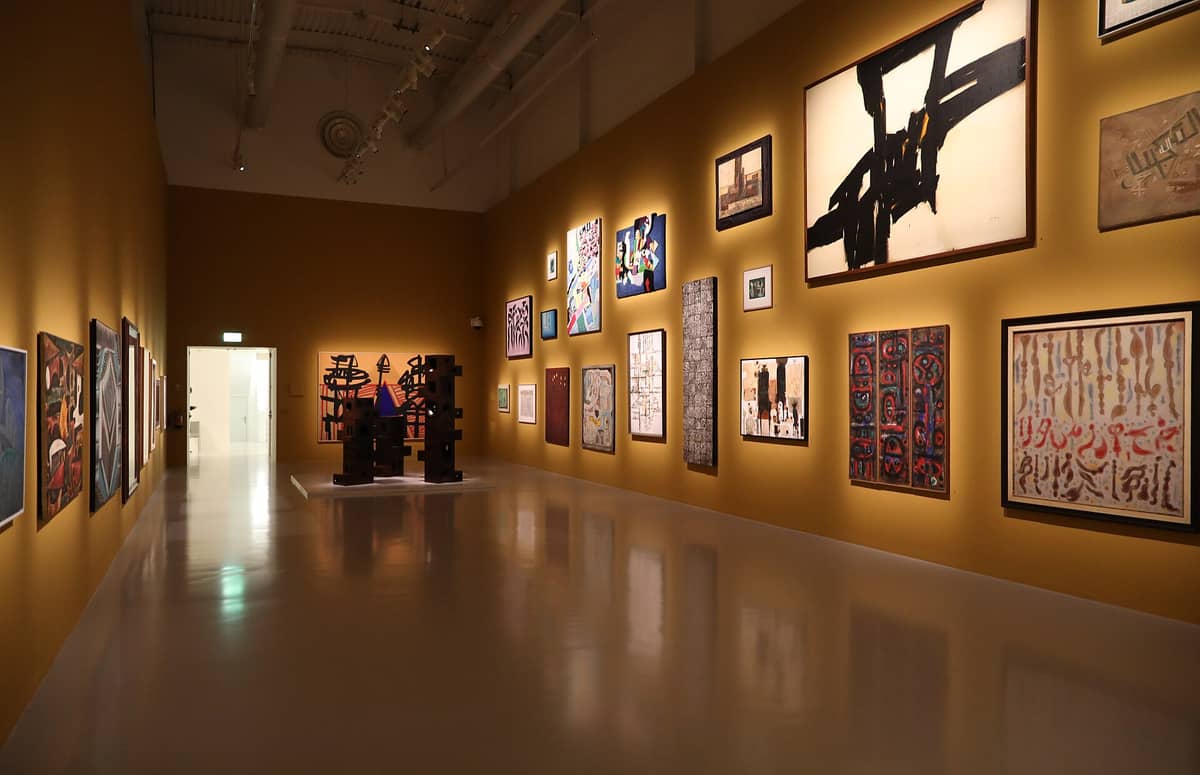
Walking through the permanent galleries, the first thing that strikes you is the sheer range of styles held within one narrative thread. Realist portraiture from early 20th-century Egypt shares wall space with abstract expressionism from mid-century Iraq, geometric abstraction from the Maghreb, and politically charged installations from Lebanese artists who lived through civil war. The curatorial logic is not chronological in a rigid sense; it tends to trace movements, migrations, and counter-movements.
Iraqi artists are particularly well-represented, reflecting a golden era of Baghdad's arts scene during the 1950s and 1960s, when groups like the Baghdad Modern Art Group and the Pioneers sought to synthesise international modernism with Mesopotamian and Islamic visual heritage. Seeing these works in a dedicated Arab institution rather than a side room of a Western encyclopaedic museum feels substantially different. The framing changes the meaning.
The temporary exhibition programme rotates several times a year and has included major surveys of individual artists, thematic group shows, and collaborative projects with international institutions. These exhibitions are usually the reason specialist visitors make specific trips to Mathaf, and they are worth checking well in advance of any visit.
The Building and the Campus Setting
Mathaf occupies a building on the Education City campus, a vast Qatar Foundation development in the western urban fringe of Doha in the Al Rayyan area. The campus itself houses branch campuses of several international universities alongside research centres and cultural institutions. This context matters: the museum sits inside an intellectual infrastructure, not a traditional city-centre tourist precinct.
The scale of Education City means distances between buildings feel larger than expected. Arriving by car is straightforward; the Doha Metro Green Line serves Education City station, but confirm current timetables and connections before relying on it. Taxis and ride-hailing apps work well from central Doha, typically a 15-to-25-minute ride depending on traffic.
The building's exterior is relatively understated compared to the dramatic architecture you find at the Museum of Islamic Art or the National Museum of Qatar closer to the waterfront. Inside, the gallery spaces prioritise the work itself: clean white walls, controlled lighting, high ceilings in certain halls. The effect is focused, even austere, and it suits the collection.
If you are planning a deeper cultural day, Mathaf pairs naturally with a visit to the Museum of Islamic Art and the National Museum of Qatar, though those two are near the Corniche, about 30 minutes from Education City by car. Building in travel time is essential.
When to Visit and What to Expect at Different Times
Mathaf is not a high-footfall tourist attraction in the way that Souq Waqif or the Corniche promenade are. On a weekday morning between 10:00am and noon, the galleries can be near-empty, which is ideal for unhurried looking. The silence in these rooms is rare in Doha's cultural landscape and worth factoring into your plans.
Weekends — Friday afternoon and Saturday — tend to bring more visitors, particularly families and Education City students. Friday is a shorter day, opening at 1:30pm, so arriving early on a Saturday or mid-week gives you the fullest possible experience. Thursday evenings, when the museum stays open until 9:00pm, offer a quieter late visit after the after-work crowd thins out.
💡 Local tip
The best time to visit from a comfort standpoint is November through March, when Doha's outdoor temperature is manageable and you can walk between campus buildings without the extreme heat of summer. During June to September, the air-conditioned interiors are a relief, but external movement on the sprawling campus becomes genuinely uncomfortable.
Photography policies vary by exhibition. In the permanent collection spaces, personal photography without flash is generally permitted, though this should be confirmed with staff on arrival. Temporary exhibitions sometimes include loaned works with restrictions. The gallery lighting is designed to render colours accurately — natural light is minimal, which is good for the works but means your phone camera may need a moment to adjust.
Practical Walkthrough: Getting There and Getting Around
Education City sits roughly 7 to 14 kilometres west-northwest of central Doha. There is no standard street address with a house number to type into maps; searching 'Mathaf Education City Doha' in Google Maps or similar navigation apps reliably locates it. Parking is available on campus. The official mailing address is PO Box 2777, Education City, Doha, Qatar.
Once inside, the museum layout is navigable without a map for most visitors. Staff are present throughout the galleries and can direct you to current exhibitions or the permanent collection. A museum shop carries art books, catalogues, and prints — the catalogue selection here, particularly for Arab modernism, is notably good.
For first-time visitors arriving in Doha without a pre-planned museum circuit, the best museums in Doha guide provides useful context for prioritising Mathaf against the city's other major institutions.
Accessibility: the campus has modern infrastructure consistent with international standards, but specific details on wheelchair access routes, audio guides, or tactile materials were not confirmed in official sources at time of writing. Contact Mathaf directly via the official website before visiting if accessibility requirements are a factor.
Honest Assessment: Who This Is For and Who Might Skip It
Mathaf is a serious museum. It rewards visitors who arrive with some curiosity about Arab art history, modernism, or the broader question of how non-Western art movements develop in relation to and apart from dominant Western canons. If those questions interest you even slightly, the collection will hold your attention for two hours or more.
If you are a first-time visitor to Doha with limited time and primarily interested in the city's atmospheric spaces, the architecture, or Qatari heritage specifically, the Museum of Islamic Art and the National Museum of Qatar will likely feel more immediately rewarding. Mathaf's focus is broader geographically (all Arab countries) and more demanding conceptually. That is a strength, not a flaw, but it is not the right first stop for every traveller.
Families with young children may find the collection harder to engage with than purpose-built family attractions. For a broader education-focused day with children, the wider Education City campus offers green spaces and architecture worth exploring, and the Doha with kids guide outlines better-suited alternatives for that age group.
Visitors who are accustomed to major Western art museums and assume that non-Western institutions are necessarily smaller or less rigorous in scholarship will be corrected here. The research programme, publications, and curatorial depth at Mathaf are operating at a genuinely high international level.
Insider Tips
- Check the temporary exhibition calendar before your visit at mathaf.org.qa. The museum's major shows often run for two to three months and are not widely advertised outside specialist art circles — some have been genuinely landmark surveys of artists who have almost no museum presence elsewhere, and free timed tickets should be reserved in advance.
- Thursday evenings until 9:00pm are the quietest extended-hours window. The campus is largely empty by 7:00pm, giving you the galleries almost to yourself and a different quality of light in the common areas.
- The museum shop's art book selection on Arab modernism is one of the best in the region and includes out-of-print or limited-distribution catalogues. Budget time and luggage space for it.
- If you are combining Mathaf with the Education City Stadium, note that the stadium is on the same campus. The 3-2-1 Qatar Olympic and Sports Museum is also nearby, so a single trip out to this part of Doha can serve multiple interests.
- Dress comfortably but note that Education City is a working academic campus with a generally conservative atmosphere. The same dress standards that apply across Doha's public spaces apply here.
Who Is Mathaf: Arab Museum of Modern Art For?
- Art lovers and museum professionals with a serious interest in 20th-century art history beyond the Western canon
- Students and academics researching Arab cultural modernity, postcolonial aesthetics, or Middle Eastern art movements
- Photographers and creatives who want substantial visual material beyond Doha's more photographed landmarks
- Repeat visitors to Doha who have already covered the Corniche institutions and want deeper engagement
- Travellers spending multiple days in Doha who want to balance heritage sites with contemporary cultural institutions
Nearby Attractions
Other things to see while in Education City:
- Education City Stadium
Education City Stadium is one of the most architecturally distinctive venues from the FIFA World Cup Qatar 2022, its faceted facade designed to evoke a cut diamond catching the Gulf sun. Located within Qatar Foundation's sprawling Education City campus in Al Rayyan, it continues to host regional football tournaments and community events, making it worth a visit well beyond its World Cup legacy.
- Qatar National Library
Designed by Rem Koolhaas and spanning 42,000 square metres, Qatar National Library is one of the most architecturally significant public buildings in the Gulf. Free to enter and open to all, it holds over one million books and houses a rare Heritage Library collection inside Education City’s academic campus.