Qatar National Library: Architecture, Knowledge, and Free Access in Education City
Designed by Rem Koolhaas and spanning 42,000 square metres, Qatar National Library is one of the most architecturally significant public buildings in the Gulf. Free to enter and open to all, it holds over one million books and houses a rare Heritage Library collection inside Education City’s academic campus.
Quick Facts
- Location
- Al Luqta Street, Education City, Doha, Qatar
- Getting There
- Doha Metro Green Line – Education City Station
- Time Needed
- 1.5 to 3 hours (longer for researchers)
- Cost
- Free entry; free membership for Qatar residents
- Best for
- Architecture lovers, families, students, readers, remote workers
- Official website
- www.qnl.qa/en
What Is Qatar National Library?
Qatar National Library opened in 2018 inside Education City, the sprawling academic campus on Doha's western fringe developed by Qatar Foundation. It is not a university library restricted to students. It is a fully public institution, free to enter, and open to anyone who walks through the door. That distinction matters, because very few buildings in Doha of this architectural calibre invite the general public in without a ticket.
The library sits within the broader Education City district alongside branch campuses of international universities including Georgetown, Northwestern, and Carnegie Mellon. The surrounding area has the feel of a quiet academic town transplanted into the desert, with wide roads, manicured grounds, and very little foot traffic compared to central Doha. The library is the cultural anchor of this district, and its design announces that role immediately.
💡 Local tip
Hours shift on Fridays: the library does not open until 4:00 PM. If you are planning a morning visit, go Saturday through Thursday when doors open at 8:00 AM.
The Architecture: Rem Koolhaas and OMA
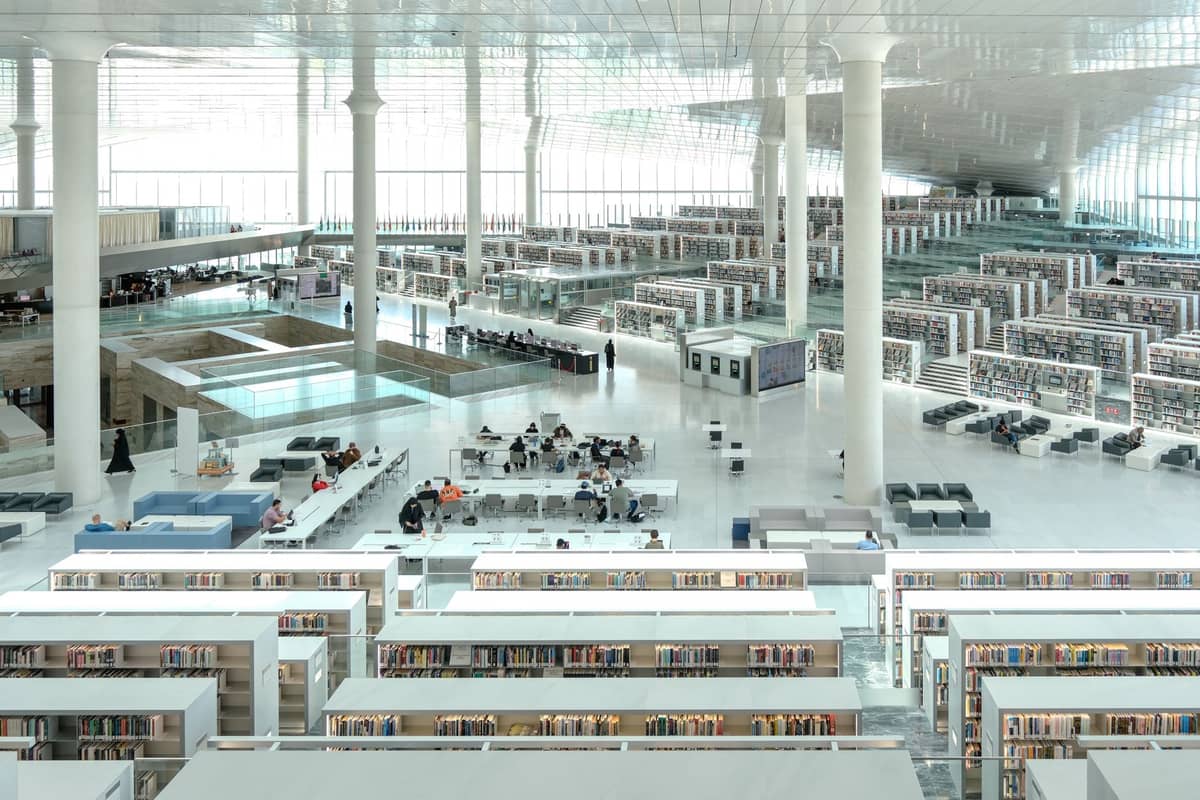
Dutch architect Rem Koolhaas, through his firm OMA, designed the building. The concept is striking in its simplicity: a large rhomboid volume that appears to fold upward at the edges, with the ground plane curving gently to meet the walls. This means the floor and the shelving gradually tilt as you move toward the perimeter, creating a sensation of walking on a landscape rather than a flat surface. It is an architectural idea that photographs poorly and reads powerfully in person.
The exterior cladding is a warm, creamy white that reflects Qatar's midday sun with intensity. Inside, the mood shifts entirely. The ceiling is perforated and diffuses natural light across the open floor plan. There is almost no visual clutter. The shelving system is built directly into the sloping perimeter walls, creating a continuous ramp of books that frames the central reading space like a canyon. The material palette is restrained: pale wood, white surfaces, and polished floors. Sound behaves oddly in the space, which is surprisingly quiet given its scale.
For architecture enthusiasts, this building belongs in the same conversation as the Museum of Islamic Art and the National Museum of Qatar as examples of world-class design commissioned specifically for Doha. Unlike both of those institutions, entry here costs nothing.
If you are building a day around architectural landmarks, consider pairing this with the Museum of Islamic Art or the National Museum of Qatar for a complete picture of Doha's investment in significant public architecture.
The Collections: More Than a Reading Room
The library holds capacity for over one million items across its general, academic, and children's collections. The general collection covers a broad range of subjects in both Arabic and English. The academic collection supports the universities within Education City and is accessible to registered members, though visiting guests can freely browse the open stacks during their visit.
The Heritage Library is the collection that warrants special attention. Housed in a dedicated, climate-controlled section of the building, it holds rare manuscripts, historical maps, and early printed books relating to the Arab world, the Gulf region, and the history of Islamic scholarship. Display cases present selected items from this archive, and the preservation conditions are immediately visible: the lighting is amber-toned and dimmer, the temperature noticeably cooler, and the cases are sealed. If you have any interest in the cartographic or manuscript history of the Arabian Peninsula, this section rewards a slow look.
The Children's Library operates as a genuinely separate space with its own atmosphere. It closes earlier than the main library on weekdays (6:30 PM Sunday through Thursday) and is designed for young readers with age-appropriate furniture, interactive elements, and a dedicated programme of events. Families with children under ten will find it well-equipped and calm on weekday mornings.
What a Visit Actually Feels Like
Arriving by car, you enter Education City through a main gate where security checks vehicles briefly. This is routine and takes only a minute. Once inside, the library building is visible from the road: its white geometric form sits low and wide against the sky. Parking is available nearby.
Walking inside on a weekday morning, the library is quiet, sometimes almost completely silent. Students from the surrounding campuses work at individual desks along the perimeter. The smell is the familiar one of conditioned air and paper, with none of the dust of an older institution. The flooring has a slight give underfoot in some sections where the surface follows the building's curve. The tilt of the shelves is gradual enough that you notice it only when you stand still and look along the line of books.
By afternoon, particularly between 2:00 PM and 5:00 PM on days when universities are in session, the population of the building increases. Study groups occupy the collaborative zones. The coffee area, if available at the time of your visit, draws a quieter crowd. On Fridays, visitors tend to arrive after the 4:00 PM opening and the atmosphere is more relaxed and browsing-oriented rather than work-focused.
ℹ️ Good to know
Late-night study areas are open Friday through Wednesday from 8:00 PM until 6:00 AM, and on Thursdays from 8:00 PM until 9:00 AM Friday morning. These hours are for study spaces only, not the full library.
Getting There and Practical Logistics
The Doha Metro Green Line serves Education City station. From the station, the library is not immediately walkable for most visitors, as distances within Education City are significant and the campus is not designed for pedestrian navigation between buildings. Taxis and ride-hailing apps can drop you directly at the library entrance from the metro station or from anywhere in the city.
If you are staying near the city centre or Souq Waqif, budget approximately 20 to 30 minutes by taxi depending on traffic. Education City is located on the western edge of the urban area, and journeys from the Corniche or West Bay can take longer during peak hours, particularly the late-afternoon commute between 4:00 PM and 7:00 PM.
The building is fully step-free. Elevators access all levels, interior walkways are wide, and the open-plan design means very few physical barriers exist between spaces. Families with pushchairs and visitors with mobility considerations will find the layout genuinely practical rather than notionally accessible.
💡 Local tip
Combine Education City with a visit to the nearby Education City Stadium if you are interested in architecture or World Cup venues. Both are within the same campus area and a single taxi trip can cover both with minimal backtracking.
Photography and Etiquette
The architecture photographs well from the exterior in the early morning when the light is soft and the parking areas are mostly empty. Inside, the perimeter shelving creates a natural compositional depth, and the diffused ceiling light produces an even, flattering exposure without harsh shadows. Wide-angle lenses capture the relationship between floor curve and shelving slope more effectively than standard focal lengths.
Photography of the Heritage Library collections should be approached with discretion. Photography of other visitors, particularly students working quietly, is not appropriate without permission. General photography of the architecture and public spaces appears to be accepted, but confirm with staff on arrival if you are carrying professional equipment.
For broader photography guidance across Doha, the Doha photography guide covers the city's most photogenic locations and practical tips for each.
Honest Assessment: Is It Worth the Trip?
The Qatar National Library is one of Doha's most architecturally significant public spaces, and the combination of free entry, a genuinely interesting building, and a substantial collection makes it more valuable than most visitors expect. However, it requires a dedicated journey to Education City rather than slotting conveniently into a central Doha day.
Visitors who are primarily interested in shopping, beach access, or nightlife will not find this rewarding. Those who enjoy architecture, research, quiet spaces, or want to understand how Qatar is investing in knowledge infrastructure will come away with a clear sense of something real. The Heritage Library alone makes the visit worthwhile for anyone interested in the history of the Arabian Peninsula.
For first-time visitors to Doha trying to prioritise their time, the Doha first-timer guide helps map out which attractions reward the effort of a longer commute from the city centre.
Insider Tips
- Visit the Heritage Library section specifically, not just the main reading floor. The rare maps and manuscripts relating to the Gulf region are displayed in rotating exhibitions that most casual visitors walk past without noticing.
- Weekday mornings between 9:00 AM and 11:00 AM are the quietest period. If you want the architecture to yourself for photography, arrive early on a Sunday or Monday.
- The building's exterior geometry is best understood from a slight distance. Walk to the edge of the adjacent open space before entering to appreciate the full form of the structure rather than seeing it fragmented from a close approach.
- Membership is free for Qatar residents and unlocks borrowing privileges across the full collection. Even if you are a long-term visitor rather than a permanent resident, it is worth asking staff about access options.
- The late-night study hours make this one of very few public cultural spaces in Doha open well past midnight. If you experience insomnia or arrive from a long-haul flight with a disrupted schedule, this is a genuinely useful resource.
Who Is Qatar National Library For?
- Architecture enthusiasts interested in Rem Koolhaas and OMA's built work
- Researchers and academics studying Arab, Islamic, or Gulf history via the Heritage Library
- Families looking for a free, air-conditioned, child-friendly cultural space
- Students and remote workers needing a quiet, well-equipped workspace
- Visitors building a full day around Education City's campus architecture
Nearby Attractions
Other things to see while in Education City:
- Education City Stadium
Education City Stadium is one of the most architecturally distinctive venues from the FIFA World Cup Qatar 2022, its faceted facade designed to evoke a cut diamond catching the Gulf sun. Located within Qatar Foundation's sprawling Education City campus in Al Rayyan, it continues to host regional football tournaments and community events, making it worth a visit well beyond its World Cup legacy.
- Mathaf: Arab Museum of Modern Art
Mathaf: Arab Museum of Modern Art in Education City houses more than 9,000 works tracing over a century of Arab artistic practice. It is the most comprehensive institution of its kind in the world, and for anyone serious about art, it belongs at the top of any Doha itinerary.