National Museum of Qatar: What to Expect, How to Visit, and Why It Matters
Opened in 2019 inside a building shaped like interlocking desert rose crystals, the National Museum of Qatar tells the complete story of the country from its geological origins to the present day. Located at the southern end of the Doha Corniche with its own metro stop, it is one of the most architecturally and intellectually ambitious museums in the Gulf region.
Quick Facts
- Location
- Museum Park Street, off the Corniche, Doha (southern end of Doha Bay waterfront)
- Getting There
- National Museum Station, Gold Line (Doha Metro) — directly adjacent to the building
- Time Needed
- 2.5 to 4 hours for the full collection; 90 minutes minimum for highlights
- Cost
- QAR 50 non-resident adults / QAR 25 non-resident students / Free for Qatar residents and children under 16
- Best for
- History lovers, architecture enthusiasts, families, first-time visitors to Qatar
- Official website
- nmoq.org.qa/en
What the National Museum of Qatar Actually Is
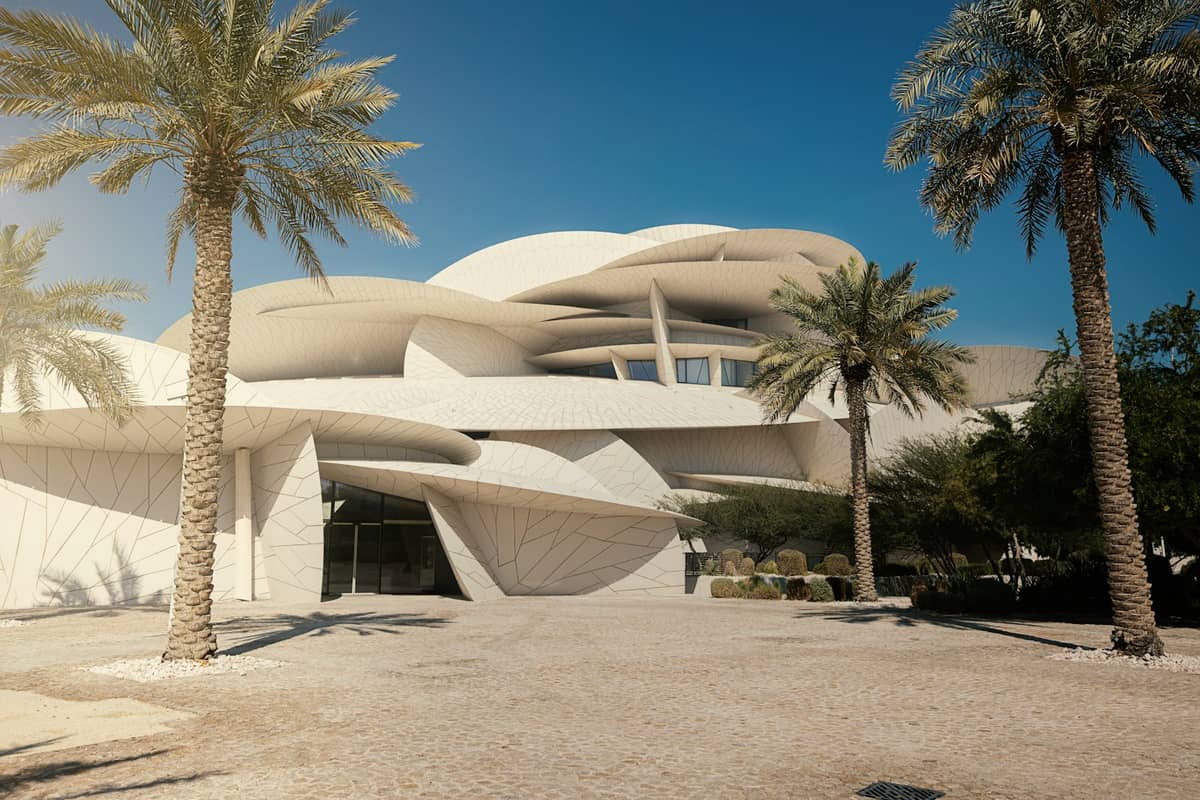
The National Museum of Qatar is not just a building with exhibits inside. It is, before you ever step through the entrance, a sculptural event. French architect Jean Nouvel designed the structure around the desert rose, a naturally occurring crystal formation of gypsum and sand found beneath Qatar's surface. The result is a complex of 539 interlocking disc-shaped panels, some up to 87 metres in diameter, that stack and cantilever at sharp angles against the sky. Photographed from any direction, no two angles look the same.
Inside, 11 galleries spread across a roughly 40,000 square metre building tell the full arc of Qatar's story: from the ancient seabed geology of the peninsula through pearl diving culture, Bedouin life, the founding of the modern state, and Qatar's rapid 21st-century transformation. The museum officially opened on 28 March 2019, making it among the newest major national museums in the world. At its core, preserved and fully restored within the new structure, stands the Old Palace of Sheikh Abdullah bin Jassim Al Thani, a compound from the early 20th century that once served as Qatar's seat of government.
ℹ️ Good to know
The museum is closed every Tuesday. From Sunday to Monday, Wednesday, and Saturday it opens 9:00–19:00; on Thursdays it stays open until 21:00, making it the best evening to visit. On Fridays doors open at 13:30. Last entry is 45 minutes before closing on all days.
The Architecture: Understanding What You Are Looking At
Most visitors encounter the building before they fully understand it, and that is by design. From the Corniche approach road, the overlapping concrete discs appear almost chaotic, like something that collapsed and refused to fall. Up close, the panels reveal a warm beige tone that shifts with light conditions, appearing pale gold at midday and closer to amber in the late afternoon. The surface texture is rough aggregate concrete, and the scale only becomes clear when you spot a human figure walking beneath one of the overhanging cantilevers.
Jean Nouvel, who completed the project after more than a decade of development, has described the building as inseparable from the landscape of Qatar itself. The desert rose crystal forms when mineral-saturated groundwater evaporates in arid conditions, leaving behind rosette-shaped gypsum clusters. As a metaphor for a museum rooted in its own geology, it is unusually precise. Whether or not you find the architecture beautiful, it is not generic.
Photography of the exterior works best in two windows: early morning, when the low sun casts long shadows across the disc edges and the building appears almost three-dimensional in relief, and the hour before sunset, when the warm light eliminates the harshness of noon contrast. At midday in summer the reflective heat from the concrete plazas can be intense, so plan accordingly.
Inside the Galleries: What the Collection Covers
The museum's narrative begins underground and geological, with Qatar's formation as a shallow sea limestone shelf. The early galleries use environmental storytelling: low lighting, immersive sound design, and large-format imagery that places you inside a context rather than in front of a display case. This approach continues throughout. Artifacts are often secondary to atmosphere in the first few rooms, which unsettles some visitors expecting a conventional chronological march through glass cases.
The pearl diving section is the collection's emotional centre. Qatar was, before oil, one of the world's major sources of natural pearls, and the trade shaped every aspect of social life from debt structures to seasonal migration. The objects here are small but significant: diving weights, nose clips, mesh bags, ledger books recording generations of debt between pearl merchants and divers. The scale of what the industry meant to the Gulf is made legible.
Later galleries address Bedouin material culture, including textiles, silver jewellery, camel gear, and the tools of falconry, a tradition that continues actively in Qatar today. The transition galleries that document Qatar's oil era and state formation in the mid-20th century are dense with archival film, photographs, and official documents. The final sections address contemporary Qatar, which requires some tolerance for state narrative, though the curatorial choices are generally more nuanced than comparable national museums elsewhere in the region.
The Old Palace of Sheikh Abdullah bin Jassim Al Thani, preserved at the centre of the complex, is worth your time. The restored courtyard rooms give direct texture to what pre-oil Doha looked and felt like. Visitors interested in how the peninsula developed as a modern city might also find the nearby Msheireb Museums a useful companion — those four townhouse museums tell a more intimate story of the same era from a neighbourhood rather than national perspective.
How the Experience Changes by Time of Day
Thursday evenings stand out. With the extended 21:00 closing time, the crowds thin noticeably after about 18:30, the building's exterior lights activate around dusk, and the temperature drops enough to make the outdoor plazas and the adjacent MIA Park walkable. This is the most comfortable visit for people who want space in the galleries without rushing.
Weekend mornings, particularly Saturday and Sunday from 9:00 to 11:00, attract school groups and family visits. The galleries can fill quickly, especially in the immersive early rooms where projection space is limited. If you are visiting during school term time and want relative quiet, a weekday afternoon is your best option.
During summer months (June through September), when outdoor Doha temperatures reach 40°C or above, the museum offers effective fully air-conditioned space. This makes it a genuinely useful option in the hot season, not just a cultural obligation. That said, the exterior approach from the metro station or car park is exposed and can be uncomfortable for 10 to 15 minutes in peak summer heat. Bring water if you are visiting between June and September.
💡 Local tip
Thursday evenings are the insider choice: cooler temperatures, smaller crowds after 18:30, illuminated exterior worth photographing, and the full 21:00 close time to avoid rushing the later galleries.
Getting There and Practical Logistics
The National Museum Station on the Doha Metro Gold Line sits directly beside the museum, making this one of the most straightforwardly accessible major attractions in the city. From central Doha or West Bay, a Gold Line train typically gets you here in under 15 minutes depending on your starting point. From Hamad International Airport, the Red Line connects to the Gold Line; check the current interchange station when planning your journey, as connections may require a short platform change.
Taxis and ride-hailing apps drop off at the museum's main entrance on Museum Park Street. The museum is at the southern end of the Doha Corniche promenade, which means visitors who are already walking the waterfront can approach on foot from the north, passing the Museum of Islamic Art park along the way. That walk, roughly 1.5 km from the MIA, is pleasant in cooler months.
Tickets can be purchased on-site or via the Qatar Museums online portal. Qatar residents enter free but still need to collect a ticket. Children 16 and under are free. Non-resident students pay QAR 25 with valid ID. Non-resident adults pay QAR 50. Given the scale and quality of the collection, this is reasonable value by international standards.
The museum is wheelchair accessible throughout, with routes evaluated by accessibility specialists. A dedicated accessibility contact is available at nmoqaccessibility@qm.org.qa for advance queries. Staff within the museum are available to assist visitors who need support navigating the space.
Setting Expectations Honestly
The museum has received significant international architectural praise, and that praise is largely justified at the level of the building. The collection itself is uneven. The experiential galleries of the early sections are genuinely immersive and well-resourced. Some of the mid-gallery rooms covering the state formation period are text-heavy and feel less designed, requiring more effort from the visitor. The contemporary Qatar section, as noted, reflects a national self-portrait that is flattering by design.
Visitors who come primarily for contemporary art may be underwhelmed. This is a national history museum, not an art museum. For contemporary and modern art, the Mathaf Arab Museum of Modern Art in Education City serves a different purpose and audience.
Visitors who want maximum cultural context per hour should consider pairing this museum with the Museum of Islamic Art on the same day. The two are a 15-minute walk apart along the Corniche. MIA covers Islamic art and civilisation across 1,400 years of geography; NMoQ covers Qatar specifically. Together they give a complete picture of both the broader regional heritage and the specific local story.
⚠️ What to skip
The museum is closed every Tuesday. If you are in Doha for a short trip and Tuesday falls in your window, plan around this. There is no exception for holidays or special events — check the official website before your visit for any schedule changes.
Photography and What to Bring
Personal photography is permitted throughout the museum, including in the galleries, using available light and without flash. Tripods and selfie sticks are generally not permitted in gallery spaces. The exterior architecture offers the most rewarding shots, particularly from the approach road and from the landscaped park to the south of the building. The building photographs well with a wide-angle lens that can capture the full span of multiple overlapping discs in a single frame.
If photography in Doha is a priority, the NMoQ exterior ranks among the city's best subjects alongside the Corniche skyline and the sculpture at MIA Park. The Doha photography guide covers the best angles and timing for both sites in detail.
Inside, wear comfortable shoes. The galleries involve considerable walking on polished concrete and sloped corridor surfaces that connect the disc-shaped rooms. There is a cafe and a restaurant within the complex. The gift shop stocks a solid selection of Qatar-focused books, prints, and design objects, notably better curated than most national museum shops.
Insider Tips
- Thursday is the only day the museum stays open until 21:00. Arrive at 17:30 to explore in relative quiet, then step outside around dusk when the exterior lighting transforms the building entirely.
- The Old Palace of Sheikh Abdullah bin Jassim Al Thani, preserved inside the complex, is easy to miss if you follow the main gallery flow. Ask staff at the entrance to point out the palace access route and treat it as a separate stop.
- The museum restaurant overlooks the Corniche waterfront. If you visit on a cooler day between November and March, the outdoor seating offers a clear view of Doha Bay that most visitors to the building never see.
- The museum's audio guide is available in multiple languages including Arabic, English, and French. Even if you rarely use audio guides, the architecture sections add genuine context that the wall text alone does not provide.
- Last entry is 45 minutes before closing, but the final galleries take around 30 to 40 minutes to move through at a reasonable pace. Factor this in if you arrive late — cutting off mid-collection is a common visitor frustration.
Who Is National Museum of Qatar For?
- First-time visitors to Qatar who want structured context before exploring the city
- Architecture and design enthusiasts drawn to Jean Nouvel's desert rose concept
- Families with older children (10+) who can engage with the immersive gallery format
- History and anthropology readers interested in Gulf pearl diving culture and Bedouin heritage
- Travellers visiting in summer who need high-quality fully air-conditioned attractions
Nearby Attractions
Other things to see while in Doha Corniche & West Bay:
- Doha Corniche Promenade
The Doha Corniche is the city's defining public space: a sweeping seafront promenade that stretches along Doha Bay, framing the West Bay skyline across the water. Free, open around the clock, and accessible by metro, it rewards visitors differently at dawn, midday, and after dark.
- MIA Park
MIA Park is a free, 24-hour public garden hugging the Museum of Islamic Art on Doha's Corniche. Landscaped lawns, shaded walkways, and an unobstructed view of West Bay's skyline make it one of the most rewarding outdoor spaces in Qatar's capital, whether you arrive at dawn or after dark.
- Museum of Islamic Art (MIA)
The Museum of Islamic Art sits on a purpose-built island off Doha's Corniche, housing one of the world's most comprehensive collections of Islamic art across 1,400 years. Designed by I.M. Pei and reopened in 2022 with a full rehang, it rewards both casual visitors and serious art travelers.
- Stadium 974
Built from 974 shipping containers and designed to be fully dismantled after use, Stadium 974 is one of the most architecturally distinctive structures to emerge from the 2022 FIFA World Cup in Qatar. Positioned along the Ras Abu Aboud waterfront with West Bay's skyline as its backdrop, the stadium is as photogenic as it is conceptually daring.