Stadium 974: Doha's Iconic Container Stadium on the Gulf Shore
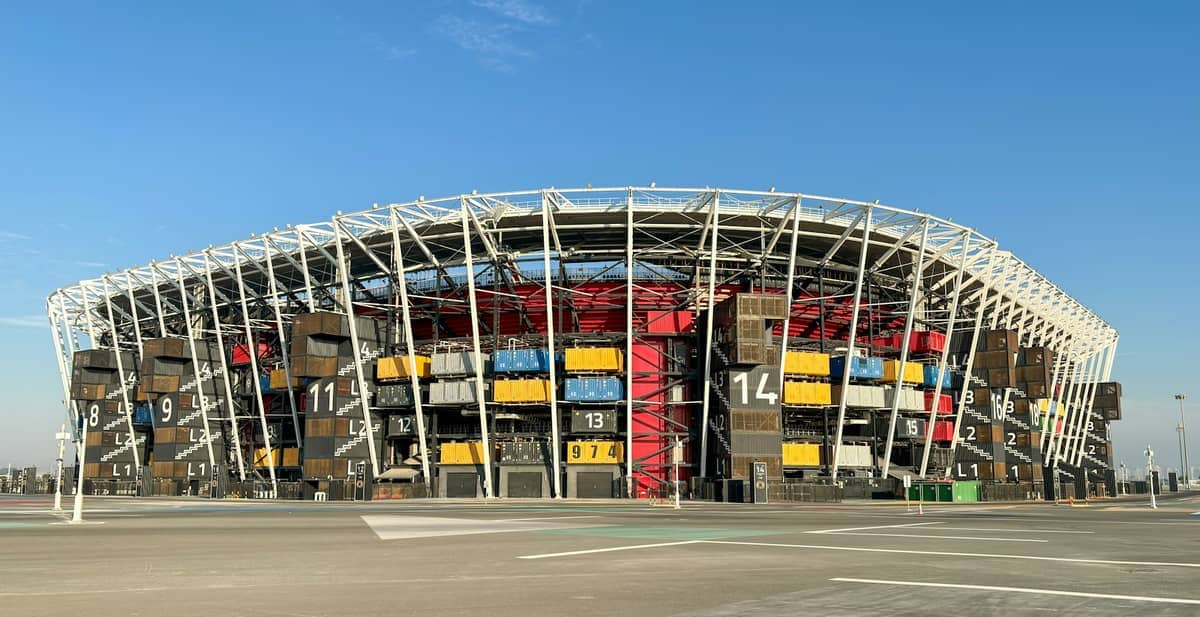
Built from 974 shipping containers and designed to be fully dismantled after use, Stadium 974 is one of the most architecturally distinctive structures to emerge from the 2022 FIFA World Cup in Qatar. Positioned along the Ras Abu Aboud waterfront with West Bay's skyline as its backdrop, the stadium is as photogenic as it is conceptually daring.
Quick Facts
- Location
- Ras Abu Aboud, Doha, Qatar (approx. 10 km east of central Doha, on the Gulf shoreline)
- Getting There
- Ras Bu Abboud station, Gold Line (Doha Metro) — approx. 10–20 min walk to stadium
- Time Needed
- 1–2 hours for exterior exploration; longer during events
- Cost
- No standard walk-in fee; event tickets vary by competition and category (check event organizers for current prices in QAR)
- Best for
- Architecture enthusiasts, football fans, photographers, and World Cup heritage visitors
What Is Stadium 974?
Stadium 974 is a football stadium with a capacity of around 40,000–44,000 in the Ras Abu Aboud district of Doha, Qatar, built for the 2021 FIFA Arab Cup and the 2022 FIFA World Cup. Its name carries a double meaning: 974 is the international dialing code for Qatar, and the stadium was constructed using 974 repurposed shipping containers, stacked and integrated into a modular steel framework. It is the first fully demountable World Cup stadium ever built, designed from the outset to be dismantled after the tournament rather than left as a permanent fixture, although as of the mid‑2020s it has not yet been fully dismantled.
The stadium sits on reclaimed land along the Gulf shoreline, with open water visible through its container-frame structure from certain angles. On the opposite side, West Bay's cluster of towers forms an almost cinematic backdrop, especially in the late afternoon when light hits the glass facades and the sea takes on a deep blue-green colour. It is an unusual combination: heavy industrial materials arranged with enough precision that the result reads as genuinely architectural rather than improvised.
ℹ️ Good to know
Stadium 974 does not operate fixed daily visiting hours. Access is event-based. Before making a trip specifically to enter the stadium, check Visit Qatar or the relevant event organizer for current scheduled events and ticketing.
Architecture and Construction: Why the Containers Matter
The choice to build with shipping containers was not purely aesthetic. The design, developed for the 2022 World Cup by architects working within Qatar's Supreme Committee for Delivery and Legacy framework, addressed one of the most persistent criticisms of major sporting events: the construction of enormous, expensive stadiums that become underused white elephants once the tournament ends. Stadium 974 offered a direct answer. Every element was modular, bolted rather than permanently fixed, and designed for eventual disassembly.
From the outside, the containers are clearly visible in the facade. They are stacked in irregular arrangements, painted in deep navy and red tones, and interspersed with open-air sections that allow Gulf breezes to ventilate the stands. This ventilation was a deliberate engineering decision for a stadium operating in Qatar's climate, where afternoon temperatures regularly exceed 40°C in summer. The open structure means the stadium also lacks the enclosed, echoing atmosphere of a traditional bowl, giving it a more exposed, festival-ground character on match days.
The dimensions are significant: at roughly 40,000–44,000 seats, it was among the smaller of the eight 2022 World Cup venues in Qatar, used for group stage and round‑of‑16 matches. Its location, facing the open sea, meant that certain upper-tier seats offered one of the more unusual viewing angles in international football, with the Gulf visible beyond the pitch on one side.
For a broader look at how Stadium 974 sits within Qatar's World Cup infrastructure, the guide to Doha's World Cup stadiums covers all eight venues with practical visiting details and architectural comparisons.
The Waterfront Setting: Ras Abu Aboud in Context
Ras Abu Aboud is a coastal district roughly 10 kilometres east of Doha's historic centre, connected to the city by the Ras Bu Abboud Expressway. Before the World Cup, the area was largely industrial, with port facilities and warehousing. The stadium's construction, and the infrastructure improvements that surrounded it, shifted its character considerably, though it remains a quieter part of the waterfront compared to the Corniche promenade or Katara.
On a clear winter morning, the approach along the waterfront road offers good views of the stadium's container facade against the pale blue sky. The sea is immediately present here in a way it is not at inland venues like Khalifa International Stadium. Salt air, the distant sound of water, and the industrial geometry of the containers create an atmosphere that is genuinely different from anything else in Doha's architectural landscape.
The stadium is positioned close enough to the Corniche area that a combined visit is feasible. The Doha Corniche promenade and the waterfront walking path can be incorporated into a half-day route that includes the stadium exterior.
Visiting in Practice: What to Expect Outside Event Days
Since the 2022 World Cup, Stadium 974 has not operated as a regular public attraction with set opening hours, and its long‑term future and dismantling schedule remain subject to official decisions. The exterior is publicly visible from the surrounding roads and the waterfront area, and many visitors come specifically to photograph the container facade and the view back toward West Bay. This is a legitimate reason to visit even without an event: the structure is striking from the outside, and the combination of industrial materials, Gulf water, and Doha's skyline provides photography that is difficult to replicate anywhere else in the city.
During active events, gates typically open approximately four hours before kickoff and remain open for around 90 minutes after the final whistle. On those days, the stadium's open-sided design means the experience inside is noticeably airier than a conventional stadium, though this also means reduced acoustics. The crowd atmosphere during matches tends to be more international and mixed than at local league games elsewhere in the Gulf, a legacy of the World Cup's global audience.
💡 Local tip
For exterior photography, the best light falls in the hour before sunset, when the low sun catches the painted containers and the skyline behind glows. Arrive from the seaward side for the most unobstructed angles.
If you are visiting Doha specifically to see World Cup legacy sites, Stadium 974 pairs naturally with the Museum of Islamic Art and the National Museum of Qatar, both accessible within a 20–30 minute taxi or metro journey. Combining these into a single day gives a reasonable overview of what the 2022 tournament added to the city's cultural and architectural landscape.
Those interested in Doha's broader sports infrastructure may also want to see Khalifa International Stadium and the 3-2-1 Qatar Olympic and Sports Museum, both located in Aspire Zone and accessible by metro.
Getting There: Metro, Taxi, and On Foot
The nearest Doha Metro station is Ras Bu Abboud on the Gold Line. From the station, the stadium is approximately a 15 to 30 minute walk along a road that is not particularly pedestrian-friendly, so be prepared for limited shade and an uneven footpath. On event days, this route is likely to be more clearly signposted and better managed. Taxis via Karwa, Uber, or Careem will drop you directly at the stadium perimeter without difficulty; simply entering 'Stadium 974' into any ride-hailing app is sufficient.
Walking from the eastern edge of central Doha is possible in around 30 to 40 minutes, but the route is not scenic until you reach the waterfront. If you are combining the visit with time at Souq Waqif or the Corniche, a taxi between points makes more sense unless the weather is cool and you want a longer walk along the shore.
For visitors still figuring out how Doha's metro and transport network fits together, the guide to getting around Doha covers metro lines, taxi options, and practical fare information.
Best Time to Visit and Weather Considerations
Qatar's climate divides the year sharply. From roughly November through March, temperatures sit in the low-to-mid 20s Celsius during the day, making outdoor exploration comfortable. This is the window when visiting the stadium exterior on foot, or attending an outdoor event here, is genuinely pleasant. The stadium's open-sided design, an asset during the ventilated cool of a winter evening, becomes a liability in summer when there is no shelter from the Gulf humidity and afternoon sun.
The 2022 FIFA World Cup itself was scheduled in November and December partly because of these conditions, and evening matches in that period offered some of the most photogenic conditions the stadium will likely see: clear skies, mild temperatures, and the West Bay skyline lit up after dark. For any future events scheduled here, evening fixtures in the November-to-March window are the optimal combination.
⚠️ What to skip
Between June and September, daytime temperatures in Doha regularly exceed 40°C and humidity is high. The stadium's open design offers no climate control outside of event-day cooling systems. Exterior visits during summer should be kept short and scheduled for early morning only.
For a detailed breakdown of when to plan your trip to Qatar, including festival calendars and climate data, the best time to visit Doha guide provides month-by-month guidance.
Photography Guide: Getting the Most from the Location
Stadium 974 is one of the more photogenic structures in Doha, and its combination of industrial texture and waterfront setting rewards careful framing. The shipping container facade photographs well in direct afternoon light, when the shadows between stacked containers create depth and the painted surfaces saturate. From the seaward approach, you can frame the structure with open water in the foreground and the stadium grid rising behind it, which removes context and emphasises the architectural geometry.
The skyline shot from the Ras Abu Aboud waterfront, with the stadium in the midground and West Bay towers behind, works best just after sunset when both the stadium's exterior lighting and the tower facades are lit simultaneously. Wide-angle lenses suit the full facade; a longer focal length compresses the skyline and the containers together effectively. Drone regulations in Qatar are strict and require permits; ground-level photography is unrestricted in public areas around the stadium perimeter.
For broader photography planning across Doha, including permit requirements, the Doha photography guide covers locations, drone rules, and lighting conditions city-wide.
Honest Assessment: Who This Is For, and Who Should Skip It
For architecture enthusiasts and anyone interested in sustainable or temporary construction, Stadium 974 is worth the journey from central Doha. The concept is genuinely interesting, the execution is well-documented in the structure itself, and the waterfront setting adds context that you cannot fully appreciate in photographs. It is not a conventional tourist attraction in the way that the Museum of Islamic Art or Souq Waqif are: there is no curated interior experience on non-event days, no cafe inside, and no guided tour.
Visitors hoping for a stadium tour, interactive exhibitions, or a lively public space will likely find the non-event-day experience underwhelming. The stadium is striking from the outside, but the surrounding area does not yet have the street-level energy of the Corniche or the Pearl. If your time in Doha is limited to two or three days, prioritising the stadium exterior over established cultural sites requires a specific interest in football heritage or architectural design to justify the trip.
If you are planning a short visit and need to prioritise, the 2 days in Doha itinerary helps structure the most important sites efficiently.
Insider Tips
- The seaward side of the stadium, facing the Gulf, gives the cleanest view of the container facade without road infrastructure in the foreground. Walk past the main entrance and continue toward the waterfront edge for the best unobstructed angles.
- On non-event days, the area is quiet enough that you will often have the exterior almost to yourself — useful for photographers who want clean shots without crowds.
- The Gold Line metro journey from central Doha to Ras Bu Abboud station is straightforward, but the walk from the station to the stadium crosses a busy expressway junction. A taxi or rideshare for the final leg saves time and avoids an uncomfortable road crossing in heat.
- The West Bay skyline is directly across the water from the stadium's main facade. A telephoto lens from the waterfront path can compress the distance and produce a shot where the containers and the towers appear in the same frame.
- Stadium 974's future use beyond 2022 has remained subject to official planning decisions into the mid‑2020s. Check Visit Qatar for the latest on scheduled events before making it the centrepiece of a day trip.
Who Is Stadium 974 For?
- Architecture and design enthusiasts interested in sustainable and modular construction
- Football fans visiting Qatar for World Cup heritage and stadium tourism
- Photographers seeking industrial-waterfront compositions with Doha's skyline
- Travellers on a broader World Cup venues itinerary combining multiple stadiums in a day
- First-time visitors to Doha with a specific interest in how the city transformed for 2022
Nearby Attractions
Other things to see while in Doha Corniche & West Bay:
- Doha Corniche Promenade
The Doha Corniche is the city's defining public space: a sweeping seafront promenade that stretches along Doha Bay, framing the West Bay skyline across the water. Free, open around the clock, and accessible by metro, it rewards visitors differently at dawn, midday, and after dark.
- MIA Park
MIA Park is a free, 24-hour public garden hugging the Museum of Islamic Art on Doha's Corniche. Landscaped lawns, shaded walkways, and an unobstructed view of West Bay's skyline make it one of the most rewarding outdoor spaces in Qatar's capital, whether you arrive at dawn or after dark.
- Museum of Islamic Art (MIA)
The Museum of Islamic Art sits on a purpose-built island off Doha's Corniche, housing one of the world's most comprehensive collections of Islamic art across 1,400 years. Designed by I.M. Pei and reopened in 2022 with a full rehang, it rewards both casual visitors and serious art travelers.
- National Museum of Qatar
Opened in 2019 inside a building shaped like interlocking desert rose crystals, the National Museum of Qatar tells the complete story of the country from its geological origins to the present day. Located at the southern end of the Doha Corniche with its own metro stop, it is one of the most architecturally and intellectually ambitious museums in the Gulf region.