Doha Corniche Promenade: Doha's Waterfront at Every Hour
The Doha Corniche is the city's defining public space: a sweeping seafront promenade that stretches along Doha Bay, framing the West Bay skyline across the water. Free, open around the clock, and accessible by metro, it rewards visitors differently at dawn, midday, and after dark.
Quick Facts
- Location
- Corniche Street (Al Corniche St), Doha, Qatar
- Getting There
- West Bay QIC, Corniche, or Al Bidda stations (Doha Metro)
- Time Needed
- 1 to 3 hours depending on pace; full walk end-to-end takes 1.5–2 hours
- Cost
- Free. No admission fee
- Best for
- Skyline photography, evening strolls, family outings, first-time visitors
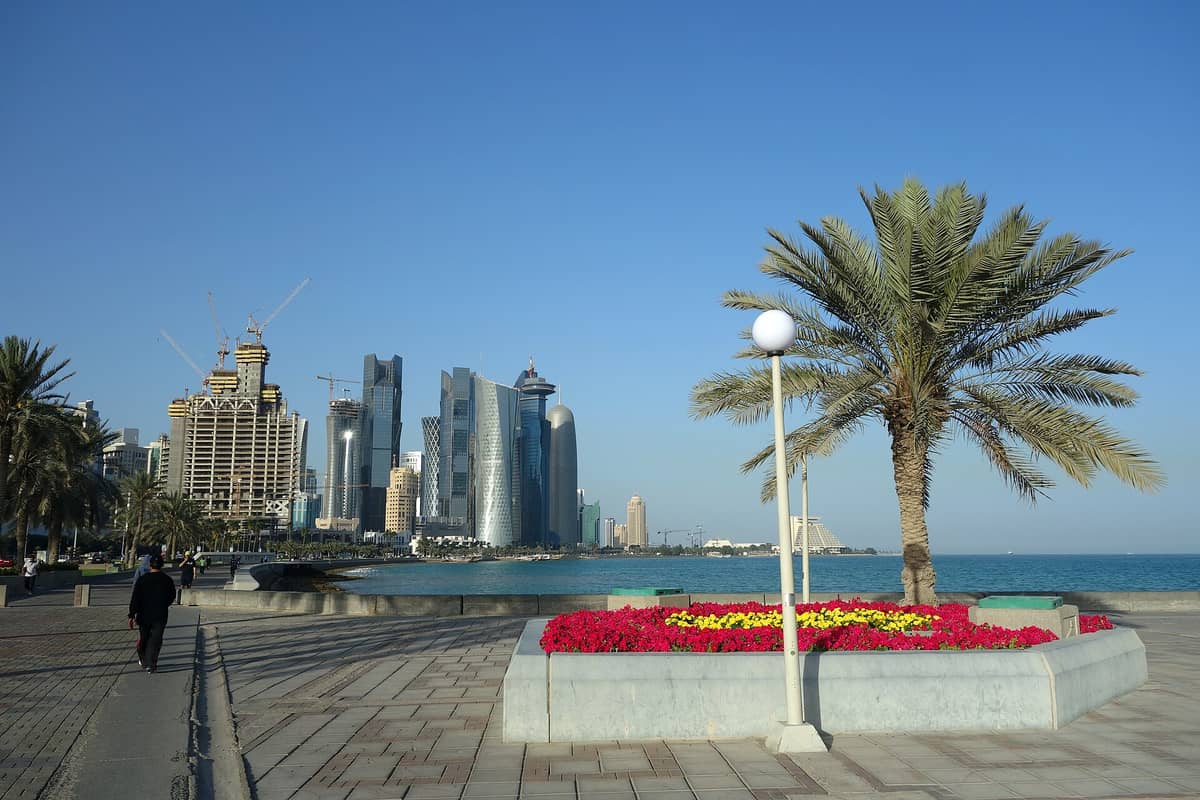
What the Doha Corniche Actually Is
The Doha Corniche is a multi-kilometre waterfront promenade running along the western edge of Doha Bay in Qatar's capital. It curves from roughly the Sheraton Grand Doha Resort at its northern end down toward the National Museum of Qatar near the south, tracing a crescent of open public space between the water and the city's main arterial road. There is no entry fee, no ticket booth, and no fixed opening time. It functions as both a civic gathering place and Doha's most instantly recognisable viewpoint.
From the walkway, the entire West Bay skyline sits directly across the bay: the cluster of towers that defines modern Doha reflects across the Gulf water at golden hour and again under artificial light after dark. The scale of that view is the Corniche's main draw, and it explains why every first-time visitor tends to end up here within the first twenty-four hours.
💡 Local tip
The Corniche is long. If you plan to walk the full stretch in summer (May to September), carry water and start before 8 a.m. or wait until after sunset. At peak midday heat, surface temperatures on the paved path can feel punishing.
How the Experience Changes by Time of Day
Early Morning: 5:30 a.m. to 8 a.m.
This is the Corniche at its least crowded and, depending on the season, its most photogenic. In winter months (November through March), dawn temperatures hover between 15 and 22 degrees Celsius, making it genuinely pleasant for walking. The light in the first thirty minutes after sunrise is soft and low-angled, hitting the West Bay towers across the water and turning the Gulf surface copper-gold. Joggers, dog walkers, and older residents doing slow circuits dominate the path at this hour.
The dhow harbour activity picks up early too. Traditional wooden vessels that anchor near the southern end of the Corniche create foreground interest for photography that you simply don't get from other Doha viewpoints.
Midday: Approaching Realistically
Between May and September, the midday Corniche is almost empty for good reason. Temperatures regularly exceed 38 to 40 degrees Celsius and the exposed pavement offers almost no shade. In winter, midday is actually one of the better times to visit: comfortable temperatures, full-sun clarity for photographs, and a steady flow of visitors without the after-sunset crush.
⚠️ What to skip
Avoid the Corniche between 11 a.m. and 4 p.m. during summer months. The promenade has minimal shade structures, and heat-related discomfort sets in quickly. Even locals avoid outdoor activity during these hours in June, July, and August.
Sunset and Evening: The Prime Window
The hour before and after sunset is when the Corniche functions as a social space. Families spread out on the grassed areas behind the walkway. Food carts and kiosks appear along the path. The West Bay towers catch direct late light and then, as darkness falls, their facades light up in full. The reflection across Doha Bay at this hour is one of the more genuinely impressive urban panoramas in the Gulf region.
After 8 p.m. in cooler months, the promenade reaches something close to its maximum activity. Groups of teenagers, couples, tourist families, and expat residents all share the path at once. The ambient noise shifts from ambient traffic to conversation, children, and occasionally live music from temporary event setups. The path is well-lit along its full length and feels entirely safe after dark.
Historical and Cultural Context
The Corniche as a formal public promenade reflects Doha's transformation from a small pearl-diving and fishing settlement into a modern Gulf capital. Pearl diving was the economic foundation of Doha and the wider Qatar coast for centuries before oil revenues arrived in the mid-twentieth century. The bay the Corniche overlooks was once the working water of that industry: boats departing for the pearl banks, returning to the shoreline that is now landscaped promenade.
That history is not heavily interpreted along the path itself, but the National Museum of Qatar sits at the southern end of the Corniche arc and provides the most thorough account of how Qatar's coastal communities lived and worked before the oil era. Pairing a walk along the waterfront with a visit to the museum makes the geography feel more meaningful.
The towers visible across the bay from the Corniche were largely built in the 2000s and 2010s as Qatar's sovereign wealth and urbanisation accelerated. West Bay's skyline is effectively a record of that economic sprint: glass and steel high-rises developed in rapid succession, many serving as headquarters for international businesses and luxury hotels. The visual contrast between the open water, the low-rise historic areas near Souq Waqif, and those towers is part of what makes the Corniche view readable as a story about a city in fast transition.
The Practical Walkthrough: What You Pass Along the Route
Walking the Corniche south to north (starting near the National Museum of Qatar and heading toward West Bay) gives you the skyline view directly ahead for the bulk of the walk. The path itself is wide, paved, and in good repair. Benches appear at intervals. The adjacent green strips are maintained parkland, and Al Bidda Park opens off the promenade mid-route, offering shade, a children's playground, and restroom facilities.
Al Bidda Park is the most useful rest stop along the Corniche for families with children. It sits roughly in the central portion of the promenade and has covered seating areas that provide genuine relief from the sun. Entry is free.
Closer to the southern end, the waterfront near the Dhow Harbour adds visual texture. Traditional wooden dhows moored along the jetty create a scene that feels removed from the gleaming skyline backdrop. The harbour area also connects to the broader Souq Waqif district, which is worth a detour before or after the walk.
The northern section near West Bay is more formal in character: hotel lobbies open toward the water, and the path here widens further. This section tends to be quieter than the central and southern stretches during evening hours.
Getting There and Getting Around
The Doha Metro provides the most straightforward access. Three stations serve different points along the Corniche: West Bay QIC station for the northern end, Corniche station for the central section, and Al Bidda station for the southern stretch near Al Bidda Park and the adjacent Corniche area. The metro is air-conditioned and inexpensive by international standards, with fares structured by zone and smart card type. Exact current fares should be confirmed via the official Doha Metro channels before travel, as they are subject to update.
Taxis via the official Karwa app or ride-hailing services are straightforward for drop-off at any point along Corniche Street. Parking is available along the road for those arriving by car, though evening weekends can fill adjacent lots quickly.
For first-time visitors plotting an itinerary, the Corniche connects naturally with Souq Waqif to the south and the West Bay hotel district to the north. A half-day that combines a Corniche walk with a couple of hours at Souq Waqif covers Doha's two most recognisable public spaces in a single outing.
Photography Along the Corniche
The primary subject is the West Bay skyline reflected across Doha Bay. For the strongest reflections, the water needs to be calm, which is most common in early morning and in winter. Long-exposure shots after dark require a tripod; the Corniche railing provides a surface for steadying a camera, but a compact tripod gives significantly better control.
If you want to go further into Doha photography locations, the dedicated Doha photography guide covers angles, timing, and locations beyond the Corniche that most visitors miss.
Drone use over the Corniche and Doha Bay is regulated and requires prior authorisation from Qatar's Civil Aviation Authority. Do not fly without confirmed permits; enforcement is active in this area.
Honest Assessment: What the Corniche Is and Isn't
The Corniche is a beautiful urban waterfront, but it is not an attraction with a singular focal point or a story that unfolds as you move through it. It is a backdrop and a path. If your primary interest is cultural immersion, traditional architecture, or interactive experiences, the Corniche will feel like a pleasant walk rather than a destination. It earns its place on almost every Doha itinerary as an orientation point and a skyline viewpoint, not as a deep cultural experience in itself.
Visitors who arrive expecting an active waterfront with restaurants, shops, and activity along the path itself may be surprised by how open and uncluttered it is. The commercial activity is limited compared to waterfronts in more tourism-built cities. That restraint is actually what makes it pleasant to walk, but it is worth knowing in advance.
ℹ️ Good to know
Accessibility: The Corniche promenade is flat and paved, making it wheelchair and stroller accessible along its main length. Some sections adjacent to road crossings may have kerb variations. Event-related closures of sections of the path occur occasionally, particularly during national celebrations and major sporting events.
Insider Tips
- The best unobstructed skyline photographs are taken from the small jetty areas along the water's edge, not from the main promenade path itself. Step down to the lower waterside level wherever access points allow.
- Friday and Saturday evenings (the Gulf weekend) bring significantly larger crowds than weekday evenings. If you prefer a quieter walk with better photo opportunities, a Sunday or Monday evening after 7 p.m. is noticeably calmer.
- The stretch of promenade between Al Bidda Park and the Dhow Harbour is where most of the food carts and informal vendors set up in cooler months. This is the section to walk if you want to eat while strolling.
- The Corniche is one of the few places in Doha where public jogging is genuinely comfortable and socially normal. If you run, the flat paved surface and consistent lighting after dark make it one of the better urban running routes in the city.
- Ramadan changes the rhythm entirely. The Corniche comes alive after Iftar (the breaking of the fast at sunset) and stays active well past midnight. If you are visiting during Ramadan, this is actually one of the most atmospheric times to walk the promenade.
Who Is Doha Corniche Promenade For?
- First-time visitors to Doha who want a quick orientation to the city's scale and skyline
- Photographers targeting the West Bay reflection, particularly at sunrise or after dark
- Families looking for a free, flat, and low-pressure outdoor space that works in cooler months
- Couples after a straightforward evening walk with an impressive backdrop
- Joggers and walkers based in central Doha hotels who want a scenic outdoor route
Nearby Attractions
Other things to see while in Doha Corniche & West Bay:
- MIA Park
MIA Park is a free, 24-hour public garden hugging the Museum of Islamic Art on Doha's Corniche. Landscaped lawns, shaded walkways, and an unobstructed view of West Bay's skyline make it one of the most rewarding outdoor spaces in Qatar's capital, whether you arrive at dawn or after dark.
- Museum of Islamic Art (MIA)
The Museum of Islamic Art sits on a purpose-built island off Doha's Corniche, housing one of the world's most comprehensive collections of Islamic art across 1,400 years. Designed by I.M. Pei and reopened in 2022 with a full rehang, it rewards both casual visitors and serious art travelers.
- National Museum of Qatar
Opened in 2019 inside a building shaped like interlocking desert rose crystals, the National Museum of Qatar tells the complete story of the country from its geological origins to the present day. Located at the southern end of the Doha Corniche with its own metro stop, it is one of the most architecturally and intellectually ambitious museums in the Gulf region.
- Stadium 974
Built from 974 shipping containers and designed to be fully dismantled after use, Stadium 974 is one of the most architecturally distinctive structures to emerge from the 2022 FIFA World Cup in Qatar. Positioned along the Ras Abu Aboud waterfront with West Bay's skyline as its backdrop, the stadium is as photogenic as it is conceptually daring.