Dhow Harbour Doha: Where Traditional Boats Meet a Modern Skyline
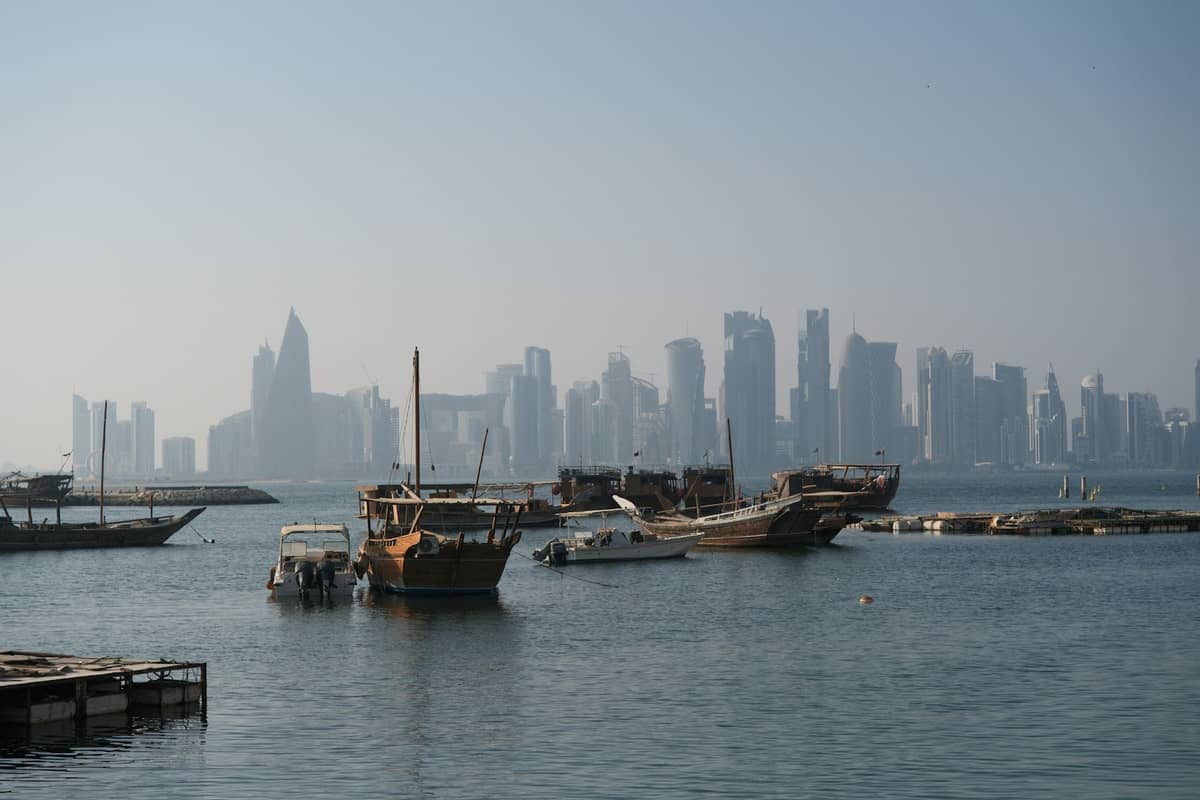
Dhow Harbour sits along the Doha Corniche, where rows of traditional wooden vessels have been moored for generations. Free to walk through at any hour, the harbour offers one of the city's most photogenic contrasts: hand-crafted dhows in the foreground, West Bay's glass towers rising across the bay. Short rides and longer sunset cruises are available for those who want to see the skyline from the water.
Quick Facts
- Location
- Corniche Promenade, near Museum of Islamic Art, Doha, Qatar
- Getting There
- Taxi or ride-hailing to 'Dhow Harbour' or 'Museum of Islamic Art'; Corniche buses stop nearby along the waterfront
- Time Needed
- 30 min to walk and photograph; 1–2 hours for a dhow cruise
- Cost
- Free to visit; shared dhow rides approx. QAR 25–60 per person; longer dinner cruises vary by operator (often around QAR 150 and up)
- Best for
- Sunset photography, cultural context, families, and anyone wanting a waterside break near Souq Waqif
What Dhow Harbour Actually Is
Dhow Harbour is the informal name for the cluster of traditional wooden vessels moored along the southern stretch of the Doha Corniche, near the Museum of Islamic Art. These are working dhows, the same style of boat that Qatar's ancestors used for pearl diving and coastal fishing before oil reshaped the economy in the mid-20th century. Today they serve a different purpose: short sightseeing rides, private charters, and occasional dinner cruises. But their physical presence along the waterfront is itself a form of living heritage display.
The area has no gates, no ticket booth, and the Corniche promenade is open around the clock. The boats are visible at many times of day. What changes is the quality of the experience depending on when you arrive and what you want from it.
ℹ️ Good to know
There is no entry fee to walk the promenade, watch the boats, and take photos. Budget extra only if you plan to board a dhow for a cruise.
The View That Makes This Worth Stopping For
The sight that draws most photographers to this spot is compositional: wooden hulls lacquered in earthy tones, rigging lines casting thin shadows on the water, and directly across Doha Bay, West Bay's cluster of contemporary skyscrapers. The contrast is not subtle. You have one of the Gulf's oldest maritime traditions in the foreground and one of the region's most aggressively modern skylines behind it. On a clear winter morning, with the light coming in from the east, the reflection of the towers on the calm water and the silhouettes of the dhows is genuinely striking.
This is one of the most recognisable vantage points in the city. If you are putting together an itinerary that prioritises photography, pair this with the Doha Corniche Promenade walk and the nearby MIA Park, both of which sit within easy walking distance and offer different angles on the same bay.
Late afternoon, roughly an hour before sunset, is when the light becomes warmest and the scene most photogenic.
How the Experience Changes by Time of Day
In the early morning, Dhow Harbour is quiet and slightly industrial in feel. Crew members move around the boats, ropes get coiled, and the smell of salt water and wood is strongest before the heat of the day takes over. There are few tourists at this hour, which makes it easier to observe the boats up close without the congestion that builds later. The light at sunrise is soft and diffused, though West Bay towers are partly in shadow from the east.
Midday in summer (May through September) is best skipped entirely if you are sensitive to heat. Temperatures routinely exceed 40°C during these months, and the waterfront offers almost no shade. The boats are still visible, but the experience of standing on open pavement in direct sun is punishing. Winter middays, by contrast, are pleasant: temperatures in the low-to-mid 20s Celsius, low humidity, and a cooling breeze off the water.
⚠️ What to skip
Avoid visiting between 11 AM and 4 PM from May through September. The Corniche offers minimal shade, and the heat along the waterfront is intense. The cooler months are when this spot genuinely rewards a visit.
Evenings bring the harbour to life. Families walk the Corniche after dark, dhows depart for sunset and dinner cruises, and the West Bay skyline lights up in full. The air cools noticeably after nightfall even in shoulder months, and the waterfront takes on a social character: couples, groups of friends, and families with young children are all present. On weekends (Friday and Saturday in Qatar), the Corniche is significantly busier from around 5 PM onward.
The History Behind the Boats
Dhows are traditional wooden sailing vessels built across the Arabian Gulf, Indian Ocean, and East African coast for centuries. In Qatar's case, the dhow is inseparable from the pearl diving industry that defined the country's economy from roughly the 17th century until synthetic pearl production in the 1930s effectively ended it. Before oil was discovered in commercial quantities in the 1940s and 1950s, pearling was Qatar's primary source of wealth, and dhows were the vessels that carried divers out to the oyster beds.
The dhows now moored at this stretch of the Corniche are no longer working fishing vessels in the commercial sense. They have been repurposed for tourism, but they retain the traditional construction methods and silhouettes of their predecessors: wooden planks fastened with rope or nails, high prows, and low-slung hulls built for warm, shallow Gulf waters. Some are better maintained than others. Walking along the quayside, you can see the craftsmanship up close, including the carved woodwork along the bow and stern of older vessels.
Taking a Dhow Cruise: What to Know
Short shared rides along the Corniche typically run approximately QAR 25 to QAR 60 per person, depending on duration and how many passengers are aboard. These rides cover a stretch of the bay, offer a close-up view of the skyline from the water, and last anywhere from 20 minutes to an hour. Operators can be approached directly at the quayside; no advance booking is required for the shorter trips, though prices and availability are best confirmed on the day.
Longer dinner cruises with food and live music are available through tour operators, among others. Rates for these vary by operator and package. For context on how dhow cruises fit into a wider water-based itinerary in Doha, the Doha boat rides guide covers operators, routes, and booking advice in more detail.
Boarding involves stepping across gangplanks and navigating short steps down into the vessel. For visitors with significant mobility limitations, this can be challenging. The wooden decks also get slippery when wet. Confirm accessibility requirements directly with the operator before committing to a cruise, as conditions vary between individual vessels.
💡 Local tip
For a sunset cruise, aim to board by 4:30 PM in winter. The light peaks around 30 to 40 minutes before actual sunset, and being on the water at that point gives you the best angle on the skyline and the harbour simultaneously.
Practical Walkthrough: Getting There and What to Bring
The dhow mooring area is located along the Corniche near the Museum of Islamic Art, in central Doha. Taxis and ride-hailing services (including Karwa Taxi) recognise both 'Dhow Harbour' and 'Museum of Islamic Art' as destinations. Corniche buses stop along the waterfront road; from any stop, the dhow area is visible from the promenade and walkable within a few minutes.
The harbour is a natural extension of a walk that combines Souq Waqif and the Corniche promenade. Souq Waqif is roughly 10 to 15 minutes on foot from the dhow area, making it practical to combine both in a single half-day. From the harbour, the Museum of Islamic Art is also within easy walking distance along the Corniche path.
What to bring: comfortable walking shoes, sun protection if visiting during the day (even in winter, midday sun is strong), and a wide-angle lens or smartphone if photography is the goal. Dress modestly, as this is a public waterfront in Qatar's capital: covered shoulders and knees are appropriate. There are food and drink vendors along the Corniche, and the cafes and restaurants of Souq Waqif are a short walk away for a proper meal.
Honest Assessment: What This Is and What It Is Not
Dhow Harbour is not a curated heritage attraction. There is no museum-quality interpretation, no guided tour of the boats, and no guarantee of uniformly pristine vessels. Some dhows look immaculate; others show their age. The quayside can feel loosely organised, with multiple operators approaching visitors informally. If you are expecting a polished cultural experience in the vein of a well-funded heritage site, this is not that.
What it is: an authentic, low-cost, easily accessible waterfront spot that gives a genuine visual connection to Qatar's pre-oil maritime identity, while providing one of the best framing opportunities for Doha's distinctive skyline contrast. For travellers already visiting the Museum of Islamic Art or walking the Corniche, stopping at Dhow Harbour adds almost no extra time and meaningfully enriches the context of both.
Travellers who are not interested in photography, maritime history, or boat rides, and who find the heat or informal vendor approach off-putting, may find this stop unremarkable. It works best as part of a wider Corniche or Souq Waqif circuit, not as a standalone destination requiring a dedicated trip.
Insider Tips
- The best photography angle is from the Corniche promenade looking northwest toward West Bay: position yourself with the dhow hulls in the lower third of the frame and the skyline across the water. A polarising filter dramatically reduces glare from the bay surface.
- If you want a short ride without committing to a formal cruise, approach dhow operators directly at the quayside in the late afternoon. Prices are often negotiable for small groups, and you may pay less than listed rates for a quick run along the Corniche.
- Friday and Saturday evenings bring significantly larger crowds to the Corniche. If you want the harbour quiet and easy to photograph, visit on a weekday morning between 7 and 9 AM, when the light is good and foot traffic is minimal.
- The MIA Park lawn, just a short walk along the Corniche, provides a grassy area with a view of the dhow anchorage from slightly above water level, which is useful for wider establishing shots.
- Operators of dinner cruises often book out during the November to February peak season and around Qatari national holidays. If you want a specific evening cruise, contact operators a few days in advance rather than leaving it to the day.
Who Is Dhow Harbour For?
- Photographers seeking the classic dhows-versus-skyline shot of Doha
- Families wanting a relaxed, free waterfront walk with an optional boat ride
- First-time visitors to Qatar looking for cultural and historical context about the country's pearl-diving past
- Travellers combining a Souq Waqif visit with a Corniche walk
- Couples looking for a scenic evening setting, particularly at sunset
Nearby Attractions
Other things to see while in Souq Waqif Area:
- Al Bidda Park
At roughly 1.7 square kilometres of lawns, walking paths, and play areas in the heart of Doha, Al Bidda Park is one of the city’s largest and most central green spaces. Free to enter, open until midnight, and positioned right along the Corniche, it earns its place on any itinerary that extends beyond air-conditioned malls and museums.
- Al Koot Fort
Al Koot Fort, also known as Doha Fort, is a compact 20th-century structure with Ottoman roots standing just steps from Souq Waqif. Free to visit, historically significant, and easy to pair with a half-day in the old market district, it offers a rare glimpse into pre-oil Doha.
- Camel Pen at Souq Waqif
Tucked a few minutes' walk from the Falcon Souq inside Souq Waqif, Doha's camel pen offers a rare and grounded encounter with one of Arabia's most iconic animals. Free to visit, generally accessible throughout the day, and genuinely surprising in the middle of a historic market, it rewards travelers who wander beyond the spice stalls.
- Falcon Souq
Tucked within the historic lanes of Souq Waqif, the Falcon Souq (Souq Al-Suqoor) is one of the most culturally specific markets in the Gulf. Live birds perch on wooden stands, hooded and patient, while traders discuss bloodlines and breeders negotiate in Arabic. Entry is free, and even a short visit reveals something most Doha itineraries entirely miss.