Souq Waqif: Doha's Historic Market Quarter, Explained
Souq Waqif is Doha's most atmospheric traditional market, extensively restored between 2004 and 2008 to revive its historic mud-plaster architecture. Free to enter and open daily, it draws everyone from spice traders to tourists looking for a genuine sense of old Qatar.
Quick Facts
- Location
- Al Souq district (near Al Jasra), central Doha, close to the Corniche and Museum of Islamic Art
- Getting There
- Doha Metro Gold Line to Souq Waqif station; short walk from the station to the market. Taxis and ride-hailing drop off at multiple points around the perimeter.
- Time Needed
- 1.5 to 3 hours for a thorough visit; longer if you plan to eat or linger over coffee
- Cost
- Free entry. Shops, food, and activities priced individually in Qatari riyals (QAR).
- Best for
- Culture seekers, food lovers, photographers, and first-time Doha visitors
- Official website
- souqwaqif.qa
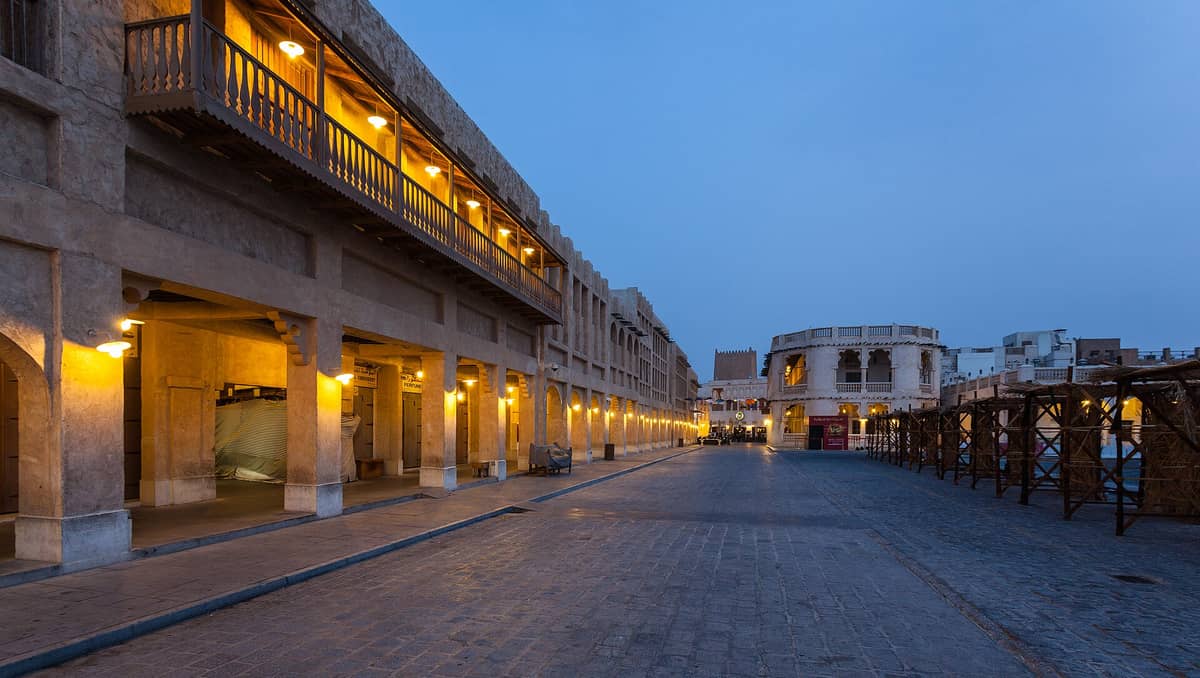
What Souq Waqif Actually Is
Souq Waqif, whose Arabic name translates roughly as the 'standing market', is one of Doha's oldest surviving commercial quarters. The name references a practice now centuries old: merchants who sold their goods while standing in the open, without fixed stalls. The market traces its origins back around 250 years, when it functioned as a trading hub for Bedouin tribes selling wool, animals, and agricultural produce from the surrounding peninsula.
What you see today is not entirely original. By the mid-twentieth century, concrete extensions and corrugated roofing had overwritten much of the traditional architecture. A government-ordered restoration program, carried out primarily between 2004 and 2008, stripped away those additions and rebuilt the souq using mud plaster, gypsum, and exposed wooden beams consistent with historic Qatari construction. The result is a coherent and largely accurate recreation of how the market would have looked in earlier decades, rather than an untouched relic. That distinction matters: visitors expecting a rough, spontaneous bazaar will find something more curated, but no less interesting for it.
ℹ️ Good to know
Entry to Souq Waqif is free of charge. There are no gates, tickets, or timed entry systems. You simply walk in.
The Architecture and Layout
The souq occupies a dense network of narrow lanes fanning out from a central open plaza. Buildings are low-rise, typically one or two storeys, with carved wooden screens (mashrabiya), arched doorways, and colonnaded walkways providing shade over the lanes below. The mud plaster walls shift from pale ochre to a deeper brown depending on the light, and the smell of incense from open doorways tends to arrive before you see the shops themselves.
Orientation is easier than the map suggests. The main commercial artery runs roughly north to south, with the spice and perfume section concentrated toward the southern end. The Falcon Souq occupies a dedicated building on the western edge. Restaurants cluster on upper floors or along wider pedestrian streets toward the northern section, where there is more room for outdoor seating.
The surrounding area connects naturally to other landmarks worth combining in the same visit. The Dhow Harbour sits just to the northeast, where traditional wooden vessels still dock along the waterfront. A ten-minute walk northwest brings you to MIA Park and the Museum of Islamic Art beyond it, making a logical half-day loop possible without needing a taxi.
How the Souq Changes Through the Day
Morning, roughly from eight until noon, is the quietest and in many ways the most rewarding time to visit. Shop owners are setting out their goods, the temperature is manageable during the winter months (November through March), and the lanes have space to walk without navigating crowds. Cafes are open and serving strong Arabic coffee and fresh juices. This is the best window for photography: the light falls cleanly through the narrow alleys, and there are fewer people to navigate around.
Many shops close around 13:00 and reopen in the late afternoon, typically from around 16:00 onward. The midday gap is worth knowing if you have specific shopping in mind. If you arrive at 14:00 hoping to browse the spice stalls, you may find shutters down.
Evening is when the souq comes fully alive. From around sunset until well past 22:00, the lanes fill with Doha residents and visitors alike. Restaurants put out their terrace seating, street food vendors set up, and the scent of grilling meat and shisha smoke mixes with the incense that drifts out of nearby perfume shops. This is the version of Souq Waqif most people see in photographs: lantern-lit archways, crowded tables, and the low hum of Arabic conversation. It is genuinely atmospheric but also genuinely crowded, particularly on Thursday and Friday evenings.
💡 Local tip
For the best combination of atmosphere and manageable crowds, arrive around 17:00 on a weekday. You catch the golden-hour light, shops are fully open, and the dinner rush has not yet peaked.
What to Buy, Eat, and Do
The spice section is the most sensory-dense part of the souq. Sacks of dried chilies, sumac, za'atar, saffron, and blended Gulf spice mixes sit open at counter height, and vendors will let you smell before you commit to buying. Prices for spices here are generally reasonable and the quality is reliable. Packaged spice mixes make practical, lightweight gifts.
The perfume and oud section warrants its own visit. Oud, a resinous wood burned as incense, is central to Qatari social ritual and is sold here in a range of grades and prices. Bottles of Arabian perfume (attar) line the shelves of small, dimly lit shops. Vendors are accustomed to visitors who are unfamiliar with the product and will typically offer a demonstration without pressure to buy.
The Falcon Souq within the market complex is one of the few places in the world where you can observe falconry as a living commercial practice rather than a staged performance. Birds are bought, sold, and assessed here by specialists. Even without buying anything, spending fifteen minutes in this section gives insight into a cultural tradition that has been practiced in the Gulf for over 4,000 years.
For food, the options range from Qatari street snacks (machboos rice, harees porridge in season, fresh-squeezed juices) to Lebanese, Indian, Iranian, and Turkish restaurants, most of which have outdoor seating. Restaurants typically open from around 08:00 and serve until around midnight. Shisha cafes are widespread and legal here, which surprises some visitors unfamiliar with Gulf customs. Non-smoking sections exist in most sit-down restaurants but are not always well-separated.
Practical Walkthrough and Getting There
Souq Waqif is accessible via the Doha Metro Gold Line at Souq Waqif station, which puts you within walking distance of the market. Taxis and ride-hailing services drop off directly at the souq perimeter. If you are arriving from Hamad International Airport, take the Metro Red Line to Msheireb, then change to the Gold Line for one stop to Souq Waqif station, making public transit a straightforward option. Exact current fares for the Metro should be confirmed via the Doha Metro official channels before travel, as they are subject to revision.
Wear comfortable, closed-toe shoes. The lanes are paved but uneven in sections, and some covered passages have low thresholds. Modest dress is appropriate here: shoulders covered and knees covered is the baseline expectation in this part of central Doha, consistent with Qatar's general public dress guidance. During summer months (June through September), midday heat in the open sections of the souq is extreme, with temperatures regularly exceeding 40°C. Plan visits for early morning or evening during this period.
If you are planning a broader day in this part of Doha, the Museum of Islamic Art is walkable from the souq and pairs well with it thematically. For those with more time, the Msheireb Museums in the adjacent Msheireb Downtown Doha district offer context on how Doha's urban history evolved from neighborhoods like this one. A Doha first-timer guide can help you structure these attractions into a coherent itinerary.
Accessibility and Honest Limitations
Mobility is a real consideration here. The traditional street layout means narrow lanes, irregular paving, and occasional steps between sections. Wheelchair users and visitors with limited mobility will find parts of the souq navigable but others difficult. Drop-off points are available nearby, which helps with arrival, but specific information on accessible routes within the market is not clearly documented in public sources. Contacting the souq management or asking at the entrance is the most reliable way to get current information.
The souq can feel overwhelming in its busiest evening hours, particularly for visitors who are sensitive to crowds, noise, and smoke. The combination of shisha, incense, and cooking aromas is part of the character of the place, but it is worth knowing in advance if you have respiratory sensitivities.
Visitors looking for an exclusively authentic, tourist-free experience may find the souq too polished. The 2004 to 2008 restoration was thorough, and while the architecture is genuine in style, the overall feel is managed. Prices in some tourist-facing shops reflect this. The more interesting commercial reality sits in sections where working traders buy and sell among themselves, which is most visible in the early morning.
⚠️ What to skip
During Ramadan, restaurant hours, shop schedules, and the overall rhythm of the souq change significantly. Many establishments do not open until after iftar (sunset). Check current Ramadan timings if your visit falls during this period.
Photography at Souq Waqif
The souq is one of Doha's most photographed locations, and for good reason. The narrow lanes create natural leading lines, the warm tones of the mud plaster walls respond well to morning and evening light, and the covered sections allow for interesting contrast between shadow and bright openings. Early morning provides the cleanest compositions with minimal foot traffic.
When photographing people, standard courtesy applies: ask before photographing individuals at close range, especially in the Falcon Souq where traders may be conducting business. For broader photography strategy across Doha, the Doha photography guide covers timing, permissions, and the best vantage points across the city.
Insider Tips
- The lane running along the back wall of the Falcon Souq building tends to be quieter than the main commercial alleys and gives a better sense of the market's working-day character. Go early on a weekday morning.
- Many restaurants at Souq Waqif add a service charge to the bill automatically. Check before leaving an additional tip, as double-tipping is common among visitors who do not notice this.
- The perfume shops near the southern end often stock a range of Gulf-blended attars that are significantly cheaper than equivalent international perfume brands and are made using regional ingredients including oud and rose water. If you are buying gifts, this is one of the better value propositions in the market.
- Parking around Souq Waqif is constrained in the evenings. If you are self-driving, arriving before 17:00 gives you a much better chance of finding space. Metro or taxi is the more practical option after dark.
- The upper-floor terraces of several restaurants overlook the main plaza and the lane network below. Booking a table for sunset, rather than a ground-floor seat, gives you a different and arguably better view of the souq at its most active hour.
Who Is Souq Waqif For?
- First-time visitors to Doha who want cultural context before exploring the rest of the city
- Food travelers interested in Gulf cuisine, street snacks, and Arabic coffee culture
- Photographers working in the early morning or golden-hour window
- Couples looking for an atmospheric evening destination with dining options
- Anyone curious about falconry, oud, or traditional Qatari craft and trade practices
Nearby Attractions
Other things to see while in Souq Waqif Area:
- Al Bidda Park
At roughly 1.7 square kilometres of lawns, walking paths, and play areas in the heart of Doha, Al Bidda Park is one of the city’s largest and most central green spaces. Free to enter, open until midnight, and positioned right along the Corniche, it earns its place on any itinerary that extends beyond air-conditioned malls and museums.
- Al Koot Fort
Al Koot Fort, also known as Doha Fort, is a compact 20th-century structure with Ottoman roots standing just steps from Souq Waqif. Free to visit, historically significant, and easy to pair with a half-day in the old market district, it offers a rare glimpse into pre-oil Doha.
- Camel Pen at Souq Waqif
Tucked a few minutes' walk from the Falcon Souq inside Souq Waqif, Doha's camel pen offers a rare and grounded encounter with one of Arabia's most iconic animals. Free to visit, generally accessible throughout the day, and genuinely surprising in the middle of a historic market, it rewards travelers who wander beyond the spice stalls.
- Dhow Harbour
Dhow Harbour sits along the Doha Corniche, where rows of traditional wooden vessels have been moored for generations. Free to walk through at any hour, the harbour offers one of the city's most photogenic contrasts: hand-crafted dhows in the foreground, West Bay's glass towers rising across the bay. Short rides and longer sunset cruises are available for those who want to see the skyline from the water.