Falcon Souq Doha: Inside Qatar's Living Falconry Tradition
Tucked within the historic lanes of Souq Waqif, the Falcon Souq (Souq Al-Suqoor) is one of the most culturally specific markets in the Gulf. Live birds perch on wooden stands, hooded and patient, while traders discuss bloodlines and breeders negotiate in Arabic. Entry is free, and even a short visit reveals something most Doha itineraries entirely miss.
Quick Facts
- Location
- Al Souq Street, Souq Waqif, Doha, Qatar
- Getting There
- Taxi or rideshare to Souq Waqif; on foot from Doha Corniche (about 25–30 min walk)
- Time Needed
- 30–60 minutes to browse; longer if visiting the adjacent falcon hospital
- Cost
- Free entry; individual shops charge for purchases
- Best for
- Culture seekers, photographers, and anyone curious about Qatari heritage
- Official website
- visitqatar.com/intl-en/things-to-do/shopping/souqs/falcon
What Is the Falcon Souq?
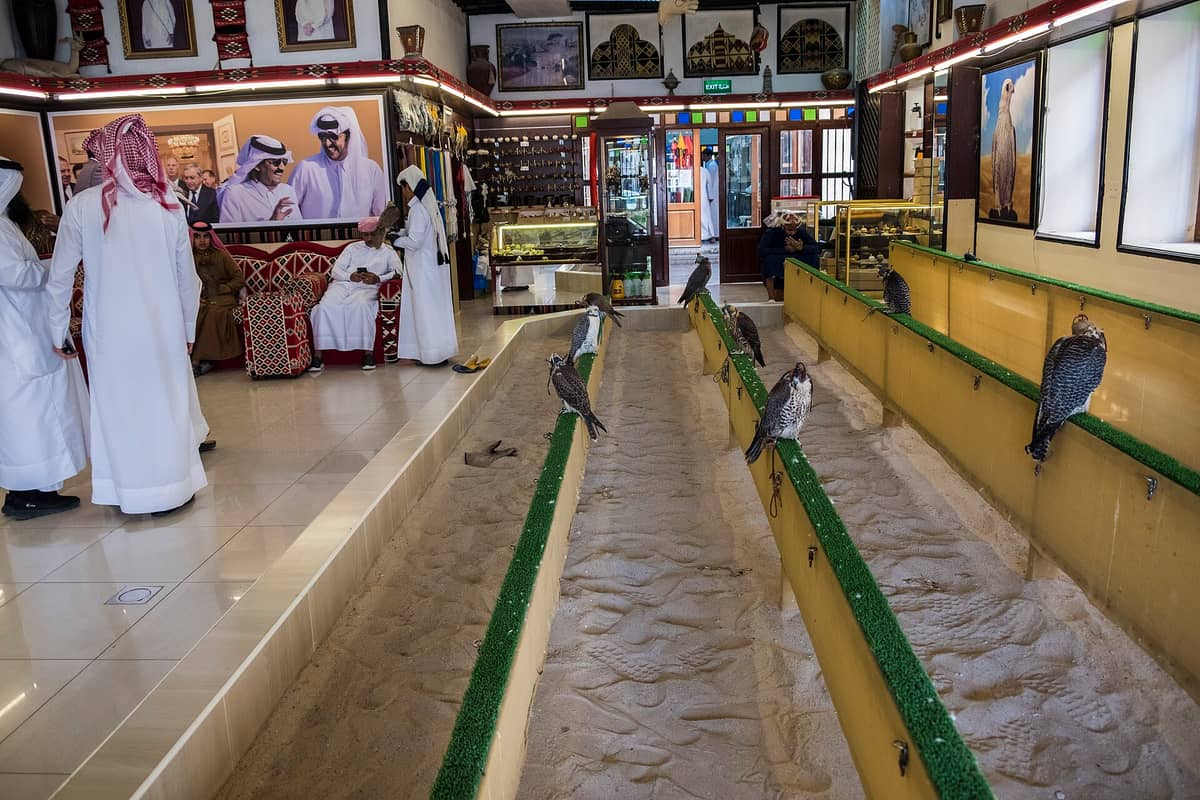
The Falcon Souq, known in Arabic as Souq Al-Suqoor, is a working falconry market inside the Souq Waqif complex in central Doha. It is not a performance, a museum exhibit, or a tourist reconstruction. Falcons are bought, sold, examined, and trained here daily. Serious Qatari falconers come to inspect birds, negotiate prices, and collect custom-fitted hoods or lightweight leather perches. Visitors are welcome to walk through and observe, but this is fundamentally a trade market, not a heritage display.
Falconry holds UNESCO Intangible Cultural Heritage status, and Qatar takes this designation seriously. The practice predates the modern state by centuries, rooted in Bedouin hunting tradition across the Arabian Peninsula. To understand why this small, unpretentious market matters, it helps to read more about falconry culture in Qatar before you visit.
💡 Local tip
Visit in the morning or early evening for the most active trading. Mornings bring good light for photography, while Fridays are generally quieter earlier in the day.
What You Will Actually See
The souq occupies a cluster of shops within Souq Waqif. The architecture matches the wider complex: mud-render walls, timber-latticed facades, and the kind of sand-coloured palette that feels deliberately muted beside the birds themselves.
Inside individual shops, sakers, peregrines, and gyrfalcons stand on padded perches, hooded in embroidered leather caps that muffle their senses and keep them calm. The birds range from the relatively modest (a young saker in training) to the extraordinary (a large, pale gyrfalcon that might represent a six-figure investment). Shop owners will often describe the birds freely, switching between Arabic and serviceable English, and the atmosphere is unhurried rather than aggressively commercial.
Adjacent to the bird shops, you will find dedicated falconry equipment vendors. These stock a specific, practised inventory: tiryals (leather leg straps), mangalahs (portable perches), hoods in various sizes and decorative styles, weighing scales for tracking a bird's hunting weight, and GPS tracking devices now clipped to tail feathers on modern hunts. The equipment shops alone are worth a slow browse even for visitors with no interest in buying.
The Falcon Hospital: Practical Details
The Souq Waqif Falcon Hospital operates directly adjacent to the market and provides checkups and surgical treatment for injured falcons. On a given morning, you might see a Qatari falconer carrying a hooded bird in for a pre-season health check before the hunting season begins.
The hospital is a working clinical facility, not a visitor attraction with a welcome desk. Access for general tourists is typically limited to the reception area, and public access arrangements should be checked with staff on arrival.
ℹ️ Good to know
Falcons sold in this market can travel internationally with their owners, provided they carry CITES documentation and a health certificate. This legal framework for falcon export is one reason the hospital sits directly beside the trading souq.
How the Experience Changes by Time of Day
Mornings, particularly between 8:00 and noon, are the most active window. The heat is manageable, the light is soft and directional through the alleyway gaps, and the highest concentration of traders and buyers is present. You can hear the occasional sharp call of a bird shifting on its perch, the low murmur of price negotiation in Arabic, and the distant sound of the wider Souq Waqif warming up around you.
Midday to mid-afternoon in summer (May through September) brings extreme heat that empties the alleyways and shuts some shops. If you are visiting in summer, plan your visit for early morning or after 17:00 when the temperature drops to a more bearable level and evening trading resumes. In winter months, afternoon visits are generally comfortable, and the souq often stays lively into the evening.
Evenings have a different character. The transactional urgency of morning gives way to something more social. Locals stop by to check on birds in the care of a trusted shop owner, men sit outside on low chairs and talk, and the souq lights shift from natural to warm artificial. It is less ideal for photography but pleasant as a cultural observation.
Photography and Practical Notes
The Falcon Souq is among the most photogenic locations in Doha for anyone interested in portraiture and detail work. The birds themselves are compelling subjects: the texture of a leather hood against grey-blue plumage, the sharpness of a talon gripping a padded perch, the stillness of a hooded falcon beside the movement of hands counting currency. A longer lens (85mm or above) lets you keep a respectful distance from the birds while capturing detail.
Always ask before photographing shop owners, falconers, or the birds closely. Many traders are accustomed to visitors with cameras and will nod approval or wave you forward; some prefer not to be photographed, and that boundary should be respected. For wider context on shooting Doha's markets and street life, the Doha photography guide covers etiquette across the city.
⚠️ What to skip
Do not attempt to touch or handle the falcons without explicit permission from the owner. These are highly trained, high-value animals. A startled or mishandled bird can injure itself or a visitor. Watch, photograph, and ask questions, but keep your hands to yourself unless invited otherwise.
Dress modestly for the Falcon Souq, as you would for all of Souq Waqif. Covered shoulders and knees are appropriate for both men and women, and this holds particularly true if you continue your visit to the nearby mosque areas within the complex. Comfortable, closed footwear is a practical choice given the paved-but-sometimes-uneven alley surfaces.
Placing It in Your Doha Itinerary
The Falcon Souq sits inside Souq Waqif, which means it pairs naturally with a broader half-day in the historic market district. After the falconry shops, the spice traders, the pet animal section (including the notable camel pen), and the broader food and craft lanes are all within walking distance. Allow two to three hours total if you want to cover the full complex without rushing.
The Dhow Harbour is a short walk away along the waterfront, and the Museum of Islamic Art is close enough to combine in a single morning without requiring a taxi between them. This cluster of attractions along the southern Corniche represents some of the most concentrated cultural sightseeing in Doha.
If you are working through a short trip, the 2-day Doha itinerary includes the Falcon Souq alongside other central highlights in an efficient sequence.
Who Should Skip This
Visitors who are uncomfortable around birds of prey, or who have strong objections to live animal markets in general, will not enjoy the Falcon Souq. While the birds appear well-maintained and the trade operates within Qatar's legal framework, this is an active commercial environment where animals are bought and sold, not a sanctuary or a welfare-focused exhibit.
Those looking for a large-scale, air-conditioned retail experience will also be disappointed. The Falcon Souq is compact, outdoor, and ambient-temperature dependent. It rewards curiosity and patience more than browsing efficiency.
Insider Tips
- If you want to have a longer conversation about falconry, find a shop where the owner is not mid-negotiation. When business is slow, many traders are genuinely happy to explain the differences between falcon species, hunting techniques, and what makes a bird valuable.
- The hood designs in the equipment shops are more varied and interesting than they first appear. Some are plain leather for training; others are elaborately embroidered. They are sold in specific sizes calibrated to the circumference of individual birds' heads, and a skilled shopkeeper can explain the sizing system in minutes.
- Morning visits in the cooler months coincide with the traditional falconry hunting season, when interest in the market peaks and the variety of birds on offer is at its highest.
- The Falcon Souq is easy to miss if you enter Souq Waqif from the main food and spice lane entrances. Head toward the southern section of the complex, near the falcon hospital signage, and you will find it. Asking any Souq Waqif shop owner for directions to 'the falcon market' will get you there in under two minutes.
- Falcon prices in this market range from a few thousand Qatari riyals for a young, untested bird to much higher amounts for a champion hunting falcon with a proven record. Do not assume the birds are inexpensive because the souq is not glamorous.
Who Is Falcon Souq For?
- Travelers curious about authentic Gulf and Bedouin cultural traditions
- Photographers looking for detail-rich, non-touristic subjects in central Doha
- First-time visitors to Doha wanting one distinctly Qatari experience
- History and heritage travelers exploring the Souq Waqif complex
- Anyone with a general interest in birds of prey, falconry, or traditional hunting crafts
Nearby Attractions
Other things to see while in Souq Waqif Area:
- Al Bidda Park
At roughly 1.7 square kilometres of lawns, walking paths, and play areas in the heart of Doha, Al Bidda Park is one of the city’s largest and most central green spaces. Free to enter, open until midnight, and positioned right along the Corniche, it earns its place on any itinerary that extends beyond air-conditioned malls and museums.
- Al Koot Fort
Al Koot Fort, also known as Doha Fort, is a compact 20th-century structure with Ottoman roots standing just steps from Souq Waqif. Free to visit, historically significant, and easy to pair with a half-day in the old market district, it offers a rare glimpse into pre-oil Doha.
- Camel Pen at Souq Waqif
Tucked a few minutes' walk from the Falcon Souq inside Souq Waqif, Doha's camel pen offers a rare and grounded encounter with one of Arabia's most iconic animals. Free to visit, generally accessible throughout the day, and genuinely surprising in the middle of a historic market, it rewards travelers who wander beyond the spice stalls.
- Dhow Harbour
Dhow Harbour sits along the Doha Corniche, where rows of traditional wooden vessels have been moored for generations. Free to walk through at any hour, the harbour offers one of the city's most photogenic contrasts: hand-crafted dhows in the foreground, West Bay's glass towers rising across the bay. Short rides and longer sunset cruises are available for those who want to see the skyline from the water.