Camel Pen at Souq Waqif: What to Expect at Doha's Most Unexpected Stop
Tucked a few minutes' walk from the Falcon Souq inside Souq Waqif, Doha's camel pen offers a rare and grounded encounter with one of Arabia's most iconic animals. Free to visit, generally accessible throughout the day, and genuinely surprising in the middle of a historic market, it rewards travelers who wander beyond the spice stalls.
Quick Facts
- Location
- Souq Waqif, Al Jasra, central Doha (Plus Code: 7GQJ+WP5)
- Getting There
- Souq Waqif station, Gold Line (M3) – approx. 290 m walk
- Time Needed
- 15–30 minutes at the pen; pair with Falcon Souq for a 1-hour loop
- Cost
- Free entry
- Best for
- Families, cultural curiosity, photography, first-time visitors to Qatar
- Official website
- souqwaqif.qa
What the Camel Pen Actually Is
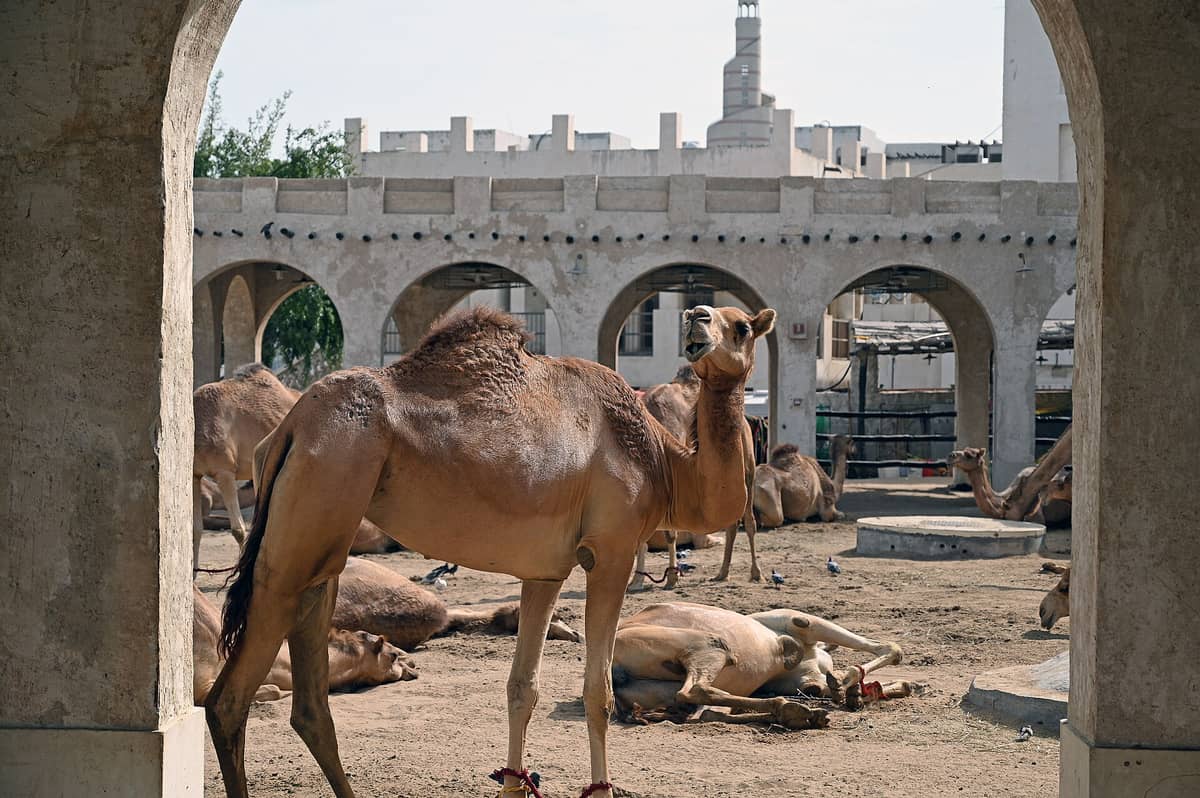
The Camel Pen at Souq Waqif is not a zoo exhibit or a staged tourist set. It is a working enclosure, set within the traditional market district of Souq Waqif in central Doha, where camels are kept as part of Qatar's living cultural practice around these animals. The pen sits close to the Falcon Souq and the Emiri Stables area, making it part of a loose cluster of attractions that reflect how central animals remain to Qatari heritage.
Visitors often stumble onto it while navigating the market's narrow lanes. The scale is modest: you are not looking at rows of camels, but typically a small number in an open outdoor pen, close enough to observe clearly. The smell arrives before the sight. It is earthy, dry, and unmistakably agricultural, a reminder that this is not curated for comfort.
💡 Local tip
The camel pen is listed as open 24 hours daily, but the most rewarding visits happen in the cooler morning hours (before 10:00) or in the early evening, when the market itself picks up and the light for photography is better.
The Sensory Experience: Morning vs. Evening
In the morning, Souq Waqif is quieter and the camel pen area feels unhurried. The camels tend to be more active at this hour, moving around the pen or being tended to. The surrounding lanes are cooler, the light is softer, and you are more likely to have the space to yourself. Shopkeepers in the adjacent stalls are opening up, and the air carries a mix of incense from nearby stores and the raw, hay-like smell of the pen itself.
By late afternoon, particularly after 17:00, Souq Waqif comes alive in a very different way. Foot traffic increases sharply, families fill the lanes, and the market takes on the animated atmosphere it is known for. The camel pen area gets busier too, with visitors stopping for photos. The tradeoff is that the crowd energy is higher, which can make the experience feel more festive but also more cramped around the enclosure.
If you are visiting purely for photography, the golden-hour window before sunset offers warm, directional light that works well for portraits of the camels against the sandy-toned walls of the surrounding market architecture. Avoid midday in summer: temperatures between June and September regularly exceed 40°C in Doha, and the outdoor pen provides no shade for visitors.
⚠️ What to skip
Summer visits (June–September) are genuinely uncomfortable outdoors in Doha. If you are visiting during these months, plan the camel pen for early morning only and move to air-conditioned spaces quickly.
Cultural Context: Why Camels Matter Here
Qatar's relationship with camels runs far deeper than tourism. Historically, camels were essential to survival across the Arabian Peninsula, providing transport, milk, and meat across a landscape with almost no permanent water. In Doha today, camel racing remains a practiced sport with deep social significance, particularly among Qatari families. The Al Shahaniya Camel Racetrack, located outside the city, hosts formal racing events that draw serious local interest.
Souq Waqif itself was restored in the mid-2000s to reflect its traditional architectural character, with mud-rendered facades and exposed timber beams replacing earlier concrete additions. The camel pen fits naturally into this broader effort to maintain Souq Waqif as a place of cultural continuity rather than pure retail. If you want to understand the full context of the market, pair this stop with a visit to the Falcon Souq nearby, where live falcons are traded and assessed, and you start to understand how wildlife and heritage are genuinely intertwined in Qatari public life.
For first-time visitors to Doha, the camel pen is often a more memorable experience than expected, precisely because it is not polished. It sits within a functioning market, not a museum. For broader context on what makes Souq Waqif worth your time, the Souq Waqif attraction guide covers the full market in detail.
Getting There and Navigating the Market
The nearest metro stop is Souq Waqif station on the Gold Line (M3), approximately 290 meters from the market entrance, which works out to about a four-minute walk. Bus routes 538, T602, T606, L538, and T603 also serve the area. Taxis and ride-hailing apps drop off along the perimeter of the market district.
Once inside Souq Waqif, the camel pen requires a few minutes of walking. The market's lanes are mostly pedestrian and can feel labyrinthine on a first visit. Head toward the Falcon Souq section and the Emiri Stables area; the camel pen is nearby. The plus code 7GQJ+WP5 works well in Google Maps if you want a precise pin.
Footwear matters here. The pen area and surrounding lanes involve uneven paving, sand, and outdoor surfaces. Sandals are fine in cooler months but closed shoes offer more comfort if the ground is wet after rare winter rain. Visitors with mobility concerns should note that Souq Waqif is a pedestrian market without dedicated wheelchair infrastructure documented at the camel pen itself; surfaces are uneven and outdoor conditions apply.
Photography and What to Actually Photograph
Camels are visually compelling subjects because of scale and texture: the height of a standing camel relative to a person, the intricate pattern of their coat, and the characteristic indifference of their expression all make for strong images. A medium focal length (50–85mm equivalent) works well for portraits. If you shoot wide, include the market walls and any handlers present to give a sense of place.
For photographers, the camel pen is one stop within a broader photographic route through the area. The Doha photography guide covers the best light windows and locations across the city, including Souq Waqif.
If there are handlers or workers present, ask before photographing people directly. This is common courtesy anywhere, and particularly appreciated in a culturally conservative context like Qatar. Photographing the camels themselves is unproblematic.
Honest Assessment: Is It Worth the Detour?
The camel pen at Souq Waqif is not a destination in isolation. You would not plan a trip across Doha purely to see it. But if you are already spending time in Souq Waqif, which most visitors to Doha do, then walking the few extra minutes to reach the pen costs nothing and delivers something that most markets cannot: the chance to stand next to a camel in an unsanitized, authentic setting, in the middle of a working traditional market.
Travelers who have already visited camel farms in other parts of the Gulf, or who have been to the Al Shahaniya Camel Racetrack where the experience is considerably richer and more immersive, may find the pen a bit slight. But for families with children, first-time visitors to Qatar, and anyone whose Doha itinerary is urban-focused, it is a worthwhile ten minutes.
If you want to build a half-day around the area, combine the camel pen with the Falcon Souq, a walk through the spice and textile lanes of Souq Waqif, and lunch at one of the restaurants along the main promenade. The Doha first-timer guide offers a practical framework for fitting the Souq Waqif area into a broader itinerary.
ℹ️ Good to know
Dress conservatively when visiting Souq Waqif. Qatar's guidelines for public markets advise avoiding sleeveless tops and short shorts. Loose, lightweight clothing covering shoulders and knees is appropriate and more comfortable in the heat regardless.
Insider Tips
- The market midday break means some surrounding stalls close between roughly 12:00 and 16:00, but the camel pen itself is accessible throughout the day. If you visit during the break, the lanes are quieter and navigation is easier.
- The Falcon Souq is a two-minute walk from the camel pen and is one of the few places in the world where you can watch live falcons being traded and assessed. Do not skip it if you have time.
- The plus code 7GQJ+WP5 in Google Maps gives you a precise pin for the pen. The market lanes can be disorienting, so having this loaded before you enter saves time.
- Ramadan significantly changes the rhythm of Souq Waqif. The market becomes most active after Iftar (sunset), sometimes running well past midnight. The camel pen area is worth visiting during this period for the atmosphere, though it can get crowded.
- If you want a more complete camel experience, the Al Shahaniya Camel Racetrack outside Doha holds races during the cooler winter season. It is a genuinely different scale of encounter compared to the pen.
Who Is Camel Pen at Souq Waqif For?
- Families with young children who want an animal encounter without a zoo setting
- First-time visitors to Qatar looking for cultural touchstones beyond the skyline
- Photographers interested in texture, scale, and market-life imagery
- Travelers with limited time who are already visiting Souq Waqif
- Anyone curious about how Arabian cultural traditions persist in a modern Gulf city
Nearby Attractions
Other things to see while in Souq Waqif Area:
- Al Bidda Park
At roughly 1.7 square kilometres of lawns, walking paths, and play areas in the heart of Doha, Al Bidda Park is one of the city’s largest and most central green spaces. Free to enter, open until midnight, and positioned right along the Corniche, it earns its place on any itinerary that extends beyond air-conditioned malls and museums.
- Al Koot Fort
Al Koot Fort, also known as Doha Fort, is a compact 20th-century structure with Ottoman roots standing just steps from Souq Waqif. Free to visit, historically significant, and easy to pair with a half-day in the old market district, it offers a rare glimpse into pre-oil Doha.
- Dhow Harbour
Dhow Harbour sits along the Doha Corniche, where rows of traditional wooden vessels have been moored for generations. Free to walk through at any hour, the harbour offers one of the city's most photogenic contrasts: hand-crafted dhows in the foreground, West Bay's glass towers rising across the bay. Short rides and longer sunset cruises are available for those who want to see the skyline from the water.
- Falcon Souq
Tucked within the historic lanes of Souq Waqif, the Falcon Souq (Souq Al-Suqoor) is one of the most culturally specific markets in the Gulf. Live birds perch on wooden stands, hooded and patient, while traders discuss bloodlines and breeders negotiate in Arabic. Entry is free, and even a short visit reveals something most Doha itineraries entirely miss.