Al Shahaniya Camel Racetrack: Qatar's Living Desert Sport
Al Shahaniya Camel Racetrack is Qatar's principal venue for camel racing, a sport central to the country's Bedouin heritage. Located about 40–60 minutes west of central Doha along the Dukhan Highway, the track draws local families, Qatari enthusiasts, and curious visitors during its October-to-April season. Entry to regular race days is free.
Quick Facts
- Location
- Garafat Al Rayyan, Dukhan Highway, Ash-Shahaniyah, Qatar — approx. 40–60 min west of central Doha
- Getting There
- Private car or pre-booked taxi/ride-hail via Dukhan Highway; public buses reach Ash-Shahaniyah but are not a convenient or reliable option for race-time visits
- Time Needed
- 2–3 hours including drive time; a race morning runs 1–1.5 hours at the track
- Cost
- Free for general spectators on regular race days; guided tours from approx. USD 60–120 per person
- Best for
- Culture seekers, photography, families, sports enthusiasts, first-time visitors to Qatar
- Official website
- hejen.qa
What Al Shahaniya Actually Is
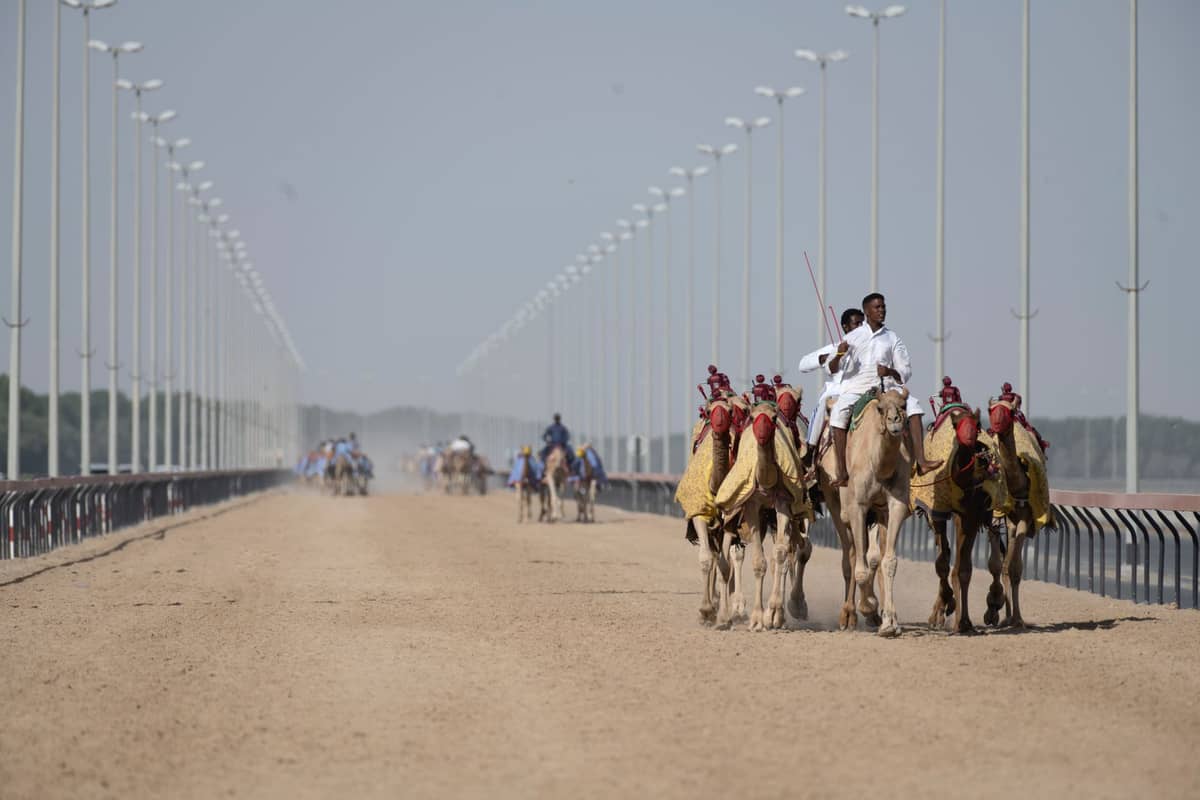
Al Shahaniya Camel Racetrack, also known as the Qatar National Camel Race Track, is the country's most prominent venue for competitive camel racing. It sits along the Dukhan Highway in the Ash-Shahaniyah district, roughly midway between Doha and the western oil town of Dukhan. The surrounding landscape is flat, sandy desert scrubland: precisely the kind of terrain where camel culture evolved over millennia.
The track itself is a long, oval sand circuit bordered by a concrete grandstand and a viewing road that runs parallel to the track's length. On race days, the facility is organized into sections where trainers, owners, and their camels congregate near the starting gates while spectators gather along the rail or watch from vehicles. It is a working sports facility, not a tourist set piece, which is exactly what makes it worth the drive.
ℹ️ Good to know
Camel racing in Qatar is a seasonal sport. The main racing calendar runs from approximately October to April or May, when daytime temperatures drop to comfortable levels. Outside this window, the track is largely quiet. Check current schedules via hejen.qa or local listings before making the trip.
The Racing Season and When to Go
The season typically opens in September or October with local qualifying races and builds toward major tournaments and festivals in the November-to-February window. This aligns with Qatar's most agreeable weather: daytime highs in the mid-20s Celsius, clear skies, and low humidity. The 2026–2027 season, for instance, opened with a local race at Al Shahaniya on 7 September 2026, signaling that the facility can start activity earlier than many visitors expect.
For the best combination of competitive racing and cooler morning conditions, aim for a weekend between late November and late February. Races are typically scheduled in both morning and afternoon sessions, but morning starts are generally the most atmospheric: the light is golden, the air is sharp, and the crowds of Qatari families and handlers are at their most energetic. By mid-morning on a major race day, the grandstand fills with older men in thobes and younger spectators perched on SUVs, all tracking camels that are moving faster than most visitors expect.
💡 Local tip
Exact race times are not fixed and vary by event. The most reliable approach is to call the racetrack directly or check Qatar Living community listings a few days before your planned visit. Arriving too late means missing the main heats.
If timing a trip to Doha around the racing season, the broader best time to visit Doha guide gives a full seasonal breakdown covering weather, events, and crowd levels across the city.
The Robot Jockeys: A Practical Revolution
One of the first things visitors notice is that there are no human jockeys on the camels. Since the mid-2000s, Qatar and other Gulf states transitioned to lightweight robotic jockeys mounted on the camels' saddles. Each robot is equipped with a motorized crop that the camel's trainer activates remotely via a handheld controller. Trainers follow their animals in convoys of pickup trucks and SUVs that race alongside the track at speed, shouting commands into radio units while simultaneously operating the robot.
The result is a spectacle unlike almost anything else in sport. A pack of camels thundering along the back straight is accompanied by a dust cloud of vehicles doing 50–60 km/h in parallel, trainers hanging out of windows or standing in truck beds while managing remote controls. The noise is a mix of engines, shouted Arabic, the low groan of camels at full stride, and the crowd calling out from the rail. It sounds chaotic. In practice, it is highly organized, and the trainers' precision with the remote systems is a genuine skill developed over years.
How the Visit Unfolds
The racetrack is located off Dukhan Highway, and road signs in Ash-Shahaniyah direct drivers to the venue. On-site parking is ample. From the car park, the starting gate and paddock area are often accessible before races begin, which is when the most interesting close-up viewing happens: handlers walk camels in circles, animals are fitted with saddle robots, and the general pre-race bustle gives visitors a ground-level look at how the sport is actually prepared.
Once races start, spectators tend to move along the rail or position their vehicles along the viewing road that runs the length of the track. There is no formal seating requirement. Qatari families often set up folding chairs from their vehicles, share tea from thermoses, and watch multiple heats in succession. Foreigners are welcome and will generally find locals happy to explain what is happening if asked respectfully.
The whole experience has a relaxed, community-event quality during regular season meetings. Major tournaments attract larger crowds and a more formal atmosphere, but even then, the venue does not feel overcrowded in the way that a football stadium can. There is genuine space to move, watch from multiple angles, and photograph freely.
💡 Local tip
Arrive at least 30 minutes before the first heat. The paddock area before racing begins is the best opportunity for close photography of camels and robotic jockey equipment. Once racing starts, attention shifts to the track and paddock access becomes more restricted.
Camel Racing in Qatari Culture
Camel racing is not simply sport in Qatar; it is a living thread connecting contemporary Gulf society to its Bedouin past. Camels were historically central to desert survival: transport, trade, and sustenance across the Arabian Peninsula. Competitive racing developed as a natural extension of that relationship, traditionally held during weddings and festivals. As Qatar modernized rapidly through the latter half of the 20th century, the sport was formalized through organized federations and dedicated facilities, with Al Shahaniya becoming the flagship venue.
Prize-winning racing camels, known in Arabic as hejin, are bred selectively for speed and endurance. A top racing camel can be worth substantial sums, and the social prestige attached to owning a prize-winning animal remains genuine. Watching the body language of owners and trainers during and after a race communicates this clearly: the investment is emotional as much as financial.
Camel culture in Qatar extends beyond the racetrack. The Falcon Souq in central Doha offers another window into traditional Gulf practices, and the two visits together make a compelling half-day into Qatari heritage. For a broader overview of the country's cultural landscape, the Doha falconry guide covers the parallel world of falconry.
Practical Details: Getting There and On the Ground
There is no direct metro connection to Al Shahaniya Camel Racetrack. The Doha Metro does not extend to Ash-Shahaniyah, and while buses serve the area, they are not a practical or reliable way to reach the venue at race time. For most visitors, the options are a private car, a pre-booked taxi, or a guided tour package.
By car, head west from central Doha on Al Rayyan Road, which continues as the Dukhan Highway. The drive is straightforward and road signs guide you into the venue from the highway. Allow 40–60 minutes from central Doha depending on traffic. If taking a taxi or ride-hailing app, arrange a return pickup in advance: the area has limited on-demand transport availability, and being stranded after races finish is a genuine inconvenience.
For those who want the experience without self-driving logistics, organized tours including Al Shahaniya as part of a half-day or full-day itinerary are available from Doha tour operators, starting from roughly USD 60–120 per person depending on group size and inclusions. These typically combine the racetrack with a camel farm visit and transport from the city.
- Dress conservatively: loose, lightweight layers work for cool mornings; the desert sun intensifies by late morning even in winter
- Bring sunscreen and sunglasses: the racetrack has limited shade outside the grandstand structure
- Carry cash: food vendors at the venue may not accept card payments
- Accessibility: the complex has some paved areas and ramps, but visitors with mobility needs should confirm current accessibility features in advance
- Photography: camels and robot equipment can be photographed freely in public areas; ask before photographing individuals closely, particularly women
Honest Assessment: What to Expect and Who to Skip It
Al Shahaniya delivers something authentic that is genuinely rare in modern tourism: a functioning, community-driven event with deep cultural roots that has not been packaged primarily for outside consumption. It is not polished. The facilities are functional rather than luxurious. There are no souvenir stands or food courts on the scale of an international sports venue. If you want organized, predictable sightseeing, this is not that.
Visitors who come with patience, a willingness to observe without a script, and genuine curiosity about Gulf culture will find the morning absorbing. Those who find animal sports uncomfortable on ethical grounds should note this is a competitive sport involving animals, and while the shift to robot jockeys addressed earlier welfare concerns, the sport retains its athletic and breeding pressure dimensions.
The drive out from Doha also requires committing 80–100 minutes of round-trip travel. On a short trip to Qatar, that is a real consideration. For travelers focused on central Doha's cultural institutions, the combination of the Museum of Islamic Art and Souq Waqif may make more sense as a half-day. But for anyone with more than two days and an interest in what Qatar looks like away from its skyline, Al Shahaniya is the most direct answer.
For a broader sense of how to structure time in Qatar's capital, the things to do in Doha guide covers the full range of experiences across the city.
Insider Tips
- The vehicle convoy that follows the camels during races is best viewed from the back straight, not the main grandstand. Walk the length of the viewing road before the first heat to find a position where you can see both the camels and the chase vehicles together — it is the detail that makes the spectacle make sense.
- Races happen in multiple heats over the morning, and heats are separated by category (age and size of camel). If you miss the opening heat, stay: later heats often feature larger, faster animals in the senior categories.
- Major seasonal festivals, particularly around Qatar National Day in December and during Eid periods, draw significantly larger crowds and can include prize ceremonies and cultural displays beyond standard racing. These dates are worth targeting specifically for richer context.
- If you come by car, park along the interior track road rather than the main lot. This positions you closer to the rail and makes it easier to follow the action by driving slowly alongside races — exactly what local spectators do.
- Bring binoculars if you have them. The track is long and the robot jockey details are small; seeing the remote-control operation clearly from a distance adds considerably to understanding what is happening.
Who Is Al Shahaniya Camel Racetrack For?
- First-time visitors to Qatar wanting authentic cultural immersion beyond the city center
- Photography enthusiasts looking for action, light, and genuinely local subjects
- Families with older children curious about animals and Qatari heritage
- Sports and equestrian culture travelers with an interest in traditional Gulf athletics
- Travelers on extended stays who have covered central Doha's main sites
Nearby Attractions
Combine your visit with:
- Al Hazm Mall
Al Hazm Mall is not a typical shopping centre. Built in a classical European-inspired style with colonnaded stone arcades and soaring ceilings, this northern Doha landmark houses luxury boutiques, acclaimed restaurants, and art installations in a setting that feels more like a Milanese galleria than a Gulf mall. Entry is free, the architecture alone justifies the visit, and the restaurant scene is among the strongest in the city.
- Al Safliya Island
A small, uninhabited sand island off the Doha coast, Al Safliya Island draws visitors with clear Gulf waters, a quiet beach, and easy half-day boat access from The Pearl-Qatar or the Corniche. There are no facilities on the island, so what you bring is what you have.
- Al Thakira Mangroves
About 64 km north of Doha, the Al Thakira Mangroves protect one of Qatar's largest and most ecologically significant coastal habitats. Whether you paddle through the channels at sunset or simply walk the shoreline at low tide, this protected reserve offers a rare contrast to the capital's urban skyline.
- Al Thumama Stadium
Al Thumama Stadium is one of Qatar's most architecturally distinctive sports venues, its circular silhouette modeled on the traditional Arab gahfiya cap. Built for the FIFA World Cup 2022 and located about 13 km south of central Doha, it continues to host major football tournaments and serves as a striking example of how Qatar embedded cultural identity into its World Cup infrastructure.