Al Thakira Mangroves: Qatar's Wild Coastal Reserve Worth the Drive
About 64 km north of Doha, the Al Thakira Mangroves protect one of Qatar's largest and most ecologically significant coastal habitats. Whether you paddle through the channels at sunset or simply walk the shoreline at low tide, this protected reserve offers a rare contrast to the capital's urban skyline.
Quick Facts
- Location
- Near Al Thakhira town, ~64 km north of Doha (approx. 17 km northeast of Al Khor city)
- Getting There
- Car is the simplest option — approx. 45–60 min drive from Doha. No direct door-to-door public transport; reaching the site via bus requires transfers and a taxi from Al Khor or Al Thakhira Road, so taxi, rideshare, or organized tour are recommended
- Time Needed
- 2–3 hours on site (longer if joining a guided kayaking session)
- Cost
- Free to enter the reserve. Guided kayaking tours typically range around QAR 180–240 per adult, with some operators offering child rates around QAR 75
- Best for
- Nature lovers, kayakers, birdwatchers, photographers, families seeking outdoor space
What the Al Thakira Mangroves Actually Are
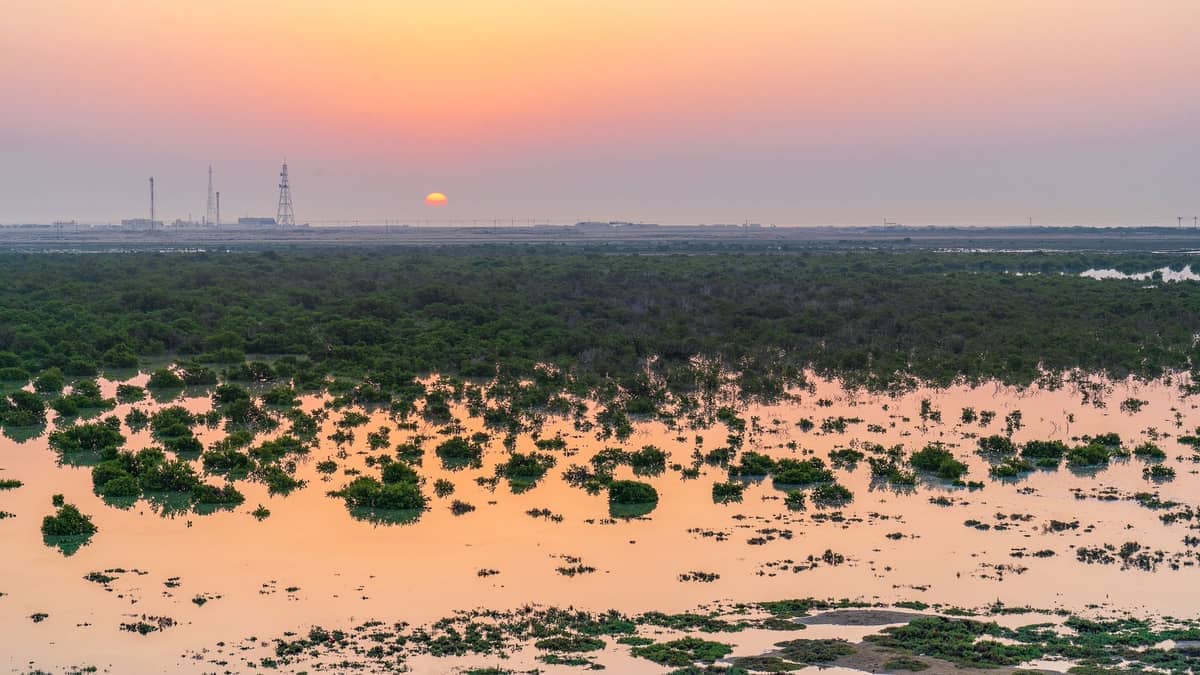
The Al Thakira Mangroves, officially designated as Al Thakhira Reserve, form one of Qatar's largest and most ecologically intact coastal habitats. Declared a protected natural reserve in 2006 by Qatar's Ministry of Environment and Climate Change, the mangrove habitat together with the adjacent Al Khor mangrove belt covers approximately 1,392 hectares, with mangrove forest extending across roughly 14 square kilometres of tidal channels and mud flats along the northeastern Gulf coast.
The dominant species here is Avicennia marina, the grey mangrove, which is the only mangrove species found in Qatar and one of the most heat-tolerant in the world. These are not the towering jungle canopies of Southeast Asia. The trees typically reach 2–4 metres in height, their grey-green foliage dense enough to block the sun inside the channels but low enough that the sky opens up as soon as you emerge onto the flats. The root systems, partially exposed at low tide, create a knotted foreground that makes every photograph compositionally interesting.
The reserve sits near the town of Al Thakhira, roughly 17 kilometres northeast of Al Khor city and about 64 kilometres from central Doha. It is routinely grouped with nearby Purple Island (Jazirat Bin Ghannam) in travel itineraries, and both sites are accessed via the same general coastal road corridor.
ℹ️ Good to know
Al Thakhira Reserve is managed by Qatar's Ministry of Environment and Climate Change (MECC). Access to the shoreline and mangrove reserve is free of charge, and there are currently no tickets or permits required for self-guided visits; most visitors come during daylight hours.
How the Experience Changes by Time of Day
Morning visits, roughly between 7:00 and 9:30, offer the coolest temperatures and the best birdwatching. The channels are quiet except for the sound of water moving through the roots and the calls of wading birds, including herons, egrets, and flamingos that are periodically spotted on the tidal flats. The light is soft and directional, hitting the water at a low angle that photographs well without harsh shadows.
Midday visits in summer (May through September) should be avoided unless you are genuinely heat-adapted. Temperatures regularly exceed 40°C in that window, and the mangrove channels provide minimal shade once the sun is directly overhead. In winter (November through March), midday is perfectly comfortable, with temperatures typically in the low-to-mid 20s Celsius, and the site sees more casual visitors at this time.
The most popular window is the late afternoon into sunset, roughly 15:00–18:00. This is when kayaking operators run most of their guided sessions. The light turns amber and copper around 17:00, the temperature drops to a manageable level even in shoulder seasons, and the water surface picks up colour in a way that makes the channel paddling genuinely memorable rather than just pleasant exercise. Arrive at least 30 minutes before your tour departure to allow time to park, reach the water, and gear up.
💡 Local tip
November through March is the recommended window for visiting. Outside these months, early morning (before 9:00) is the only comfortable time for outdoor activity. In summer, midday temperatures make an unshaded coastal site genuinely dangerous for unacclimatised visitors.
Kayaking the Mangrove Channels
Kayaking is the primary organised activity at Al Thakira and the main reason most visitors make the drive from Doha. Several tour operators run guided sessions through the tidal channels, typically in sit-on-top kayaks that are stable enough for beginners. Guided tours are generally priced around QAR 180–240 per adult, with rates for children around QAR 75, though pricing varies by operator and season and should be confirmed at the time of booking.
The channels that wind through the mangrove forest are calm and shallow. There is no meaningful current to fight, which makes this accessible even for people who have never kayaked before. The narrower passages require light maneuvering, and in some sections the root systems are close enough to touch from your seat. Guides point out ecological features along the route including crab burrows in the mud, exposed pneumatophores (the small breathing roots that project upward from the sediment), and, if conditions are right, the occasional flamingo standing in the shallows at the channel edges.
Most tours run 90 minutes to 2 hours. If you are considering a sunset session, note that the sky becomes remarkable quickly once the sun approaches the horizon across the flat Gulf water, and operators time the return paddle to coincide with peak colour. Book ahead during Qatar's cooler months, particularly from November through February, as these sessions fill up. Weekends are busier than weekdays.
If kayaking is your main goal, check the Doha boat rides and water activities guide for a broader look at what's available on the water across Qatar, including dhow cruises and other coastal excursions worth combining into a day trip.
Walking the Shore and Exploring on Foot
You do not need to kayak to find this site rewarding. The shoreline around the mangrove edge is walkable, and at low tide the exposed flats reveal a busy ecosystem of crabs, molluscs, and shorebirds. The smell here is distinctive: a combination of salt air, organic mud, and the faint brine of the tidal zone, which is characteristic of healthy mangrove systems rather than a sign of pollution. It is earthy and specific to this kind of coastal environment.
The ground near the water's edge is muddy and uneven, with patches of shells and small stones. Closed-toe shoes with grip are essential. Sandals or open footwear will make walking uncomfortable and potentially hazardous on the root-embedded sections. The terrain is not suitable for wheelchairs or pushchairs, and there are no paved paths, boardwalks, or formal visitor facilities at the site.
There are no toilets, cafes, water stations, or shade structures. Bring enough water for your entire visit, more than you think you need if visiting between April and October. There is no waste infrastructure either, so pack out everything you bring in.
⚠️ What to skip
Facilities are minimal. There are no toilets, food vendors, or drinking water available on site. Bring at least 1.5–2 litres of water per person, sun protection, and insect repellent for dusk visits.
Getting There from Doha
The Al Thakira Mangroves are not reachable by a single direct public transport line from Doha to the shoreline. The Doha Metro network does not extend this far north, and while buses run to Al Khor and Al Thakhira Road, you would still need a taxi for the final stretch. The practical options are a rental car, a Karwa taxi, a rideshare, or a pre-booked organised tour that includes transport.
By car, the drive from central Doha takes approximately 45–60 minutes under normal traffic conditions, mostly along well-maintained dual carriageway roads heading north toward Al Khor. From Al Khor city, follow the road northeast toward Al Thakhira. The final approach to the shoreline includes some unpaved stretches, and while a standard sedan can manage the route in dry conditions, a higher-clearance vehicle is more comfortable. After rain, sections can become soft.
Parking is informal and off-road along the shoreline. There is no designated car park, marked bays, or fee. The lot fills up on winter weekend afternoons.
Planning a broader day out north of Doha? The day trips from Doha guide covers how to combine Al Thakira with other sites like Al Khor and the surrounding coastline into a full-day itinerary.
Ecological and Historical Context
Mangroves occupy a critical position in Gulf coastal ecosystems. They serve as nursery habitat for commercially important fish and shrimp species, act as a natural barrier against coastal erosion, and sequester carbon at rates significantly higher than terrestrial forests. In a country where the coastline is under pressure from urban development, the Al Thakhira Reserve represents a deliberate conservation choice.
Qatar's northeastern coast historically supported mangrove stands across multiple bays and inlets. The Al Khor and Al Thakhira corridor contains the largest continuous tract remaining. The 2006 designation as a protected reserve formalised restrictions on development, boat traffic, and extraction within the reserve boundaries. The site is monitored by the Ministry of Environment and Climate Change (MECC), which lists it among Qatar's priority protected areas.
The adjacent Purple Island, visible from the mangrove shoreline, gets its name from the remains of an ancient dye-production industry. The Murex snail, harvested from these waters in antiquity, yielded a purple dye used across the ancient world, and the shell middens that gave the island its character are still visible from the water. The combination of this archaeological layer and the living mangrove ecosystem gives the area a depth that purely recreational coastal sites lack.
For context on how Qatar's natural and cultural heritage sites fit together, the complete guide to things to do in Doha gives a useful overview of the range of experiences available across the country.
Photography Conditions and Tips
The mangrove channels at Al Thakira are genuinely photogenic, but the quality of the light matters enormously. The hour before sunset in winter produces dramatic warm tones reflecting off the still water inside the channels. If you are shooting from a kayak, a wide-angle lens captures the tunnel effect of the overhanging foliage. A telephoto is more useful from the shoreline for birds on the flats.
Drone flight in the vicinity of the protected reserve is subject to Qatar's Civil Aviation Authority regulations and any site-specific restrictions imposed by the MECC. Do not fly a drone without confirming current rules, as protected natural reserves carry additional restrictions beyond general airspace rules.
For a broader look at photographing Qatar's landscapes and urban contrasts, the Doha photography guide covers the best times, locations, and practical tips across the city and its surroundings.
Who Should Skip This Attraction
Al Thakira is not a polished tourist site. If you are expecting manicured paths, visitor centres, interpretive signage, food vendors, or reliable shade, you will be disappointed. The absence of infrastructure is part of what makes it ecologically intact, but it is not an attraction built for passive visitors.
Travellers on a tight schedule or those visiting Doha for only a day or two may find that the 45-60 minute drive each way does not fit their priorities compared to the concentration of world-class museums and cultural sites in central Doha. Anyone with significant mobility limitations will also find the uneven, muddy terrain difficult to navigate. Summer visitors who are not booked on an early-morning or late-afternoon kayaking tour and are not heat-acclimatised should probably skip this one entirely until the cooler months.
Insider Tips
- Book your kayaking tour at least 2–3 days in advance during winter weekends (November–February). Sessions timed 90 minutes before sunset are the most popular and fill up fastest.
- Low tide exposes more of the mudflat and root systems, making the walk along the shore more interesting and revealing more birdlife. Check a tide table for the Al Khor coast before your visit and time your arrival accordingly.
- Combine the trip with a stop at Al Khor Corniche or the nearby traditional fishing harbour on the drive back. The total round-trip from Doha works well as a half-day or full-day outing when paired with lunch in Al Khor town.
- Mosquitoes can be present at dusk near the water's edge, particularly after rain or in humid conditions. Insect repellent is worth packing, especially for sunset kayaking sessions.
- The access track to the shoreline can become soft after rain. If there has been recent precipitation, a higher-clearance vehicle is preferable to a standard sedan for the final section of road.
Who Is Al Thakira Mangroves For?
- Nature and wildlife enthusiasts who want to see Qatar's coastal ecosystem beyond the city
- Kayakers of all experience levels, including beginners, looking for a calm and scenic guided session
- Photographers chasing golden-hour reflections and bird subjects in a non-commercial setting
- Families with older children (7+) who can manage uneven ground and a kayaking session
- Travellers on extended visits to Qatar who have already covered the main Doha cultural sites and want contrast
Nearby Attractions
Combine your visit with:
- Al Hazm Mall
Al Hazm Mall is not a typical shopping centre. Built in a classical European-inspired style with colonnaded stone arcades and soaring ceilings, this northern Doha landmark houses luxury boutiques, acclaimed restaurants, and art installations in a setting that feels more like a Milanese galleria than a Gulf mall. Entry is free, the architecture alone justifies the visit, and the restaurant scene is among the strongest in the city.
- Al Safliya Island
A small, uninhabited sand island off the Doha coast, Al Safliya Island draws visitors with clear Gulf waters, a quiet beach, and easy half-day boat access from The Pearl-Qatar or the Corniche. There are no facilities on the island, so what you bring is what you have.
- Al Shahaniya Camel Racetrack
Al Shahaniya Camel Racetrack is Qatar's principal venue for camel racing, a sport central to the country's Bedouin heritage. Located about 40–60 minutes west of central Doha along the Dukhan Highway, the track draws local families, Qatari enthusiasts, and curious visitors during its October-to-April season. Entry to regular race days is free.
- Al Thumama Stadium
Al Thumama Stadium is one of Qatar's most architecturally distinctive sports venues, its circular silhouette modeled on the traditional Arab gahfiya cap. Built for the FIFA World Cup 2022 and located about 13 km south of central Doha, it continues to host major football tournaments and serves as a striking example of how Qatar embedded cultural identity into its World Cup infrastructure.