Al Zubarah Fort: Qatar's UNESCO World Heritage Site Worth the Drive
Al Zubarah Fort anchors Qatar's only UNESCO World Heritage Site, sitting 100 km northwest of Doha amid the ruins of an 18th- and 19th-century pearling and trading town. Entry is free, the desert landscape is striking, and the archaeological remains offer a rare, unfiltered look at pre-oil Gulf civilization.
Quick Facts
- Location
- Al Zubarah, northwestern Qatar, ~100 km from Doha
- Getting There
- Private car or taxi are the main options; most visitors drive Al Shamal Road to Junction 59, then ~37 km west. Public transport is extremely limited and not practical for most travellers.
- Time Needed
- 2–3 hours on site; budget half a day including the drive from Doha
- Cost
- Free, but entry to the Al Zubarah Archaeological Site is ticketed (QAR 0.00 ticket via Qatar Museums).
- Best for
- History enthusiasts, archaeology lovers, photography, day trips from Doha
- Official website
- qm.org.qa/en/visit/heritage-sites/al-zubarah
What Is Al Zubarah Fort, and Why Does It Matter?
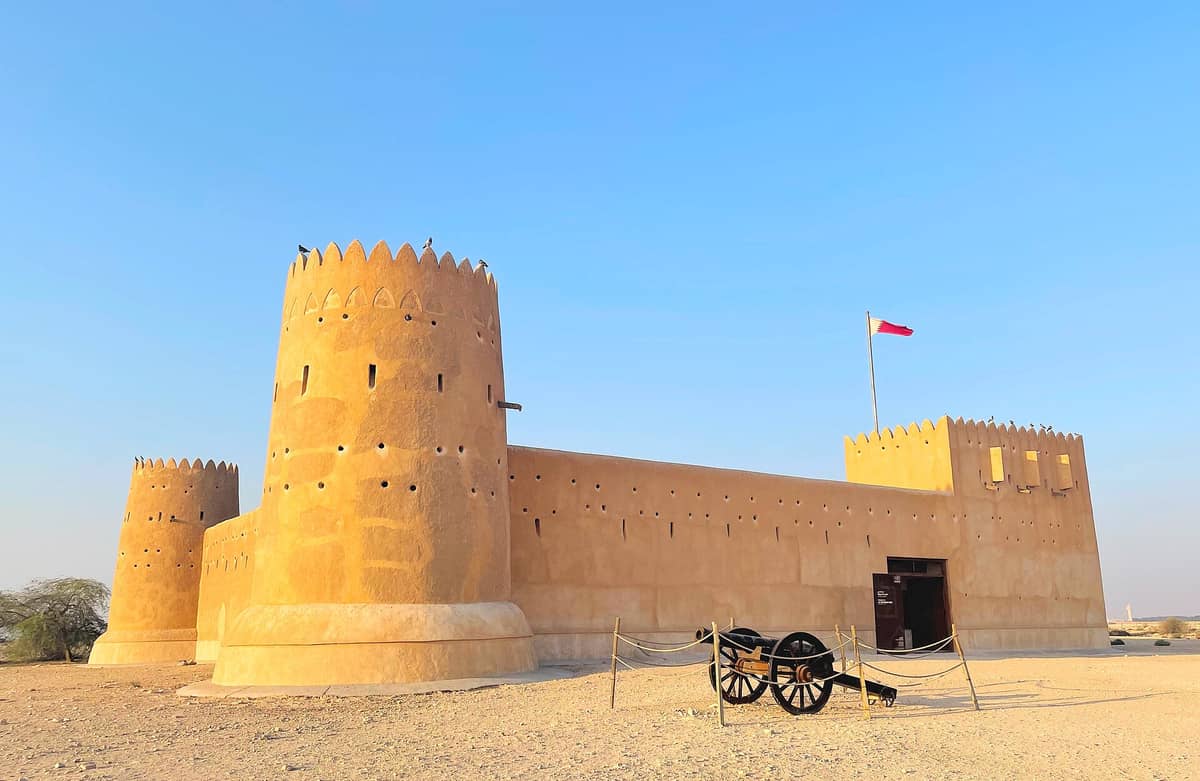
Al Zubarah Fort stands at the western edge of Qatar's northwestern coast as the most visible landmark within the Al Zubarah Archaeological Site, Qatar's only entry on the UNESCO World Heritage List of cultural properties. The fort itself is a 20th-century coastal structure, angular and sun-bleached, with four cylindrical corner towers rising from compacted desert ground. But the fort is really a gateway: behind it and spreading across roughly 60 hectares lies the buried and partially excavated remains of one of the Gulf's most significant 18th- and 19th-century towns.
The site is managed by Qatar Museums and receives far fewer visitors than Doha's urban attractions, which means you can move through it at your own pace without queues or crowds. The combination of free admission, serious archaeological depth, and a landscape that feels genuinely remote makes it one of the most rewarding day trips available from the capital.
ℹ️ Good to know
Booking is required before you arrive for the Al Zubarah Archaeological Site. Reserve your free ticket through Qatar Museums; the site is ticketed and you may be turned away if you arrive without a ticket during busy periods.
The History Behind the Ruins
Al Zubarah's rise as a major town began around 1760, when the Banu Utba tribe migrated from Kuwait and established a settlement on Qatar's northwestern coast. Within decades, the town grew into a major pearling and maritime trading hub, with a population that supported mosques, merchant houses, a souq, and two defensive walls. At its peak, Al Zubarah was one of the largest towns in the Gulf, rivalling the importance of Kuwait and Bahrain as a commercial centre.
That prosperity collapsed in 1811 when the settlement was attacked and largely abandoned. What followed was centuries of gradual burial under wind-blown sand, which paradoxically preserved the urban fabric in remarkable detail. Archaeologists working the site have uncovered street layouts, building foundations, a mosque, wells, and evidence of long-distance trade networks reaching East Africa, India, and the Ottoman Empire. The desert here functioned as an accidental archive.
UNESCO inscribed the Al Zubarah Archaeological Site on the World Heritage List in 2013 at the 37th session, recognising it as an exceptionally well-preserved example of an early Gulf trading town and an important record of Qatari and regional heritage. For Qatar, it carries national significance well beyond its remote location.
Arriving and First Impressions
The drive from Doha takes roughly 90 minutes on a clear run north along Al Shamal Road. As Doha's skyline fades and the highway straightens through open scrubland, the scale of Qatar's undeveloped interior becomes apparent. The air through a cracked window carries dust and a faint mineral dryness. There are no roadside distractions near the site, no souvenir stalls or food trucks. The fort appears suddenly as you turn off the highway: a low, pale building against a flat horizon.
The car park is surfaced and has marked accessible bays. A visitor centre sits adjacent to the fort entrance, where staff check reservations and provide orientation materials, including a site map. The reception area is air-conditioned and offers basic interpretation panels in Arabic and English explaining the UNESCO significance and archaeological timeline. Spend a few minutes here before heading out, especially if visiting with children or people new to archaeological sites.
💡 Local tip
Arrive by 9:30 am on a winter weekday if you want the site to yourself. By late morning on weekends, school and family groups arrive in numbers. Summer heat makes midday visits uncomfortable regardless of crowd levels.
Inside Al Zubarah Fort
The fort interior is compact but well-organised as an interpretive museum. Display cases present ceramics, glass, metalwork, and trade goods recovered from excavations, with contextual panels explaining what each artefact tells us about the town's commercial networks and daily life. The curation is straightforward and readable, aimed at general visitors rather than specialists, though the quality of the objects on display is genuinely striking.
Climb the internal staircase to the roof and the view changes everything. From the top of the fort's walls, the archaeological site unfolds across the flat terrain below: low earthen mounds, excavated foundations, and the faint geometry of former streets visible in the ground. On a clear winter morning, with the Gulf visible as a silver strip to the north, this vantage point provides one of the most unusual panoramas in Qatar. The silence up here is almost complete, broken only by wind.
Photography from the rooftop is excellent, particularly in the hour after opening when the low sun throws long shadows across the ruins. A wide-angle lens captures the spatial scale; a telephoto compresses the mounds into texture. The fort walls themselves, with their rough-textured mud-brick finish, are worth photographing at close range.
Exploring the Archaeological Site
Beyond the fort, a marked trail leads through the open excavation areas. Walking the site takes 45 minutes to an hour at a comfortable pace. The ground is uneven and sandy in places, so closed shoes with grip are practical. The excavated areas reveal the foundations of residential buildings, a mosque with a visible mihrab, and sections of the town's inner and outer defensive walls. Interpretation signs are placed at key points, though the depth of explanation varies.
The scale of what is buried here is difficult to comprehend from ground level alone. The 60-hectare site contains the remains of a complete urban organism, with zoning evidence for residential, commercial, and industrial districts. Active excavation work has been conducted by international archaeological teams, including Danish and Qatari researchers, and findings continue to refine understanding of Gulf trade in the pre-oil era.
⚠️ What to skip
There is almost no shade on the outdoor trail. In spring and autumn, morning temperatures are manageable, but By April, midday heat can exceed 35°C. Bring at least 1.5 litres of water per person, sunscreen, and a hat. There are no refreshment facilities at the site.
The site pairs naturally with a visit to the Sheikh Faisal bin Qassim Museum, located closer to Doha on the same Al Shamal Road corridor, making a logical full-day heritage loop for travellers interested in Qatari material culture.
When to Visit and How to Plan the Day
The best months to visit are November through March, when daytime temperatures in northwestern Qatar range between roughly 18°C and 26°C. The light in December and January is clean and low-angled for most of the morning, which benefits both photography and outdoor exploration. February can bring brief rain, but the site remains accessible and the overcast conditions provide softer photographic light.
Friday is the one day to approach carefully. The site opens later on Fridays, at 12:30 pm rather than 9:00 am, which compresses your available time and pushes the visit into the hotter afternoon hours. Saturday through Thursday morning openings give you the full day.
Because the drive from Doha is around 90 minutes each way, this is a half-day minimum commitment. Most visitors spend 2 to 3 hours on site. Combine it with a stop at the coastal area near Al Shamal on the way back, or factor it into a broader northern Qatar road trip. There are very limited food options in the immediate area, so carry provisions.
If you are planning a wider day out from Doha, the day trips from Doha guide covers Al Zubarah alongside other northern and inland options worth combining into a single itinerary.
Practical Details
Opening Hours
- Saturday to Thursday: 9:00 am to 5:00 pm
- Friday: 12:30 pm to 5:00 pm
- Closed during some public holidays and Ramadan hours may differ; verify with Qatar Museums before visiting
Getting There
There is extremely limited public transport to Al Zubarah, and most visitors use a private car or hired taxi. From Doha, the route is straightforward: north on Al Shamal Road to Junction 59, then west for approximately 37 km to the site. Total driving distance from central Doha is around 100 km. GPS navigation to 'Al Zubarah Fort, Qatar' or the plus code X2GJ+X6P is reliable.
Accessibility
The site is described as wheelchair accessible in the core areas, with designated accessible parking. The fort interior has ramps and the visitor centre is ground-level. The outdoor archaeological trail is on compacted sand and earth; some sections may be challenging for wheelchairs, particularly after rain.
Dress Code
Qatar's standard conservative dress norms apply. Shoulders and knees covered is advisable for both men and women. Practical clothing that breathes and covers skin also reduces sun exposure during the outdoor trail.
Who Should Skip Al Zubarah Fort
If you have only one or two days in Qatar and your priorities are city life, the waterfront, or Doha's museums, Al Zubarah is probably not the best use of your limited time. The 3-hour round trip plus site visit requires a genuine commitment. Travellers without access to a private car or willing to arrange a taxi for the day will also find logistics more complicated than most Doha attractions.
For those short on time, Doha's urban heritage is substantial and concentrated. The Museum of Islamic Art and the Msheireb Museums offer serious historical depth within the city itself, without the long drive.
Children under 10 may find the site less engaging than the fort interior and rooftop; the outdoor trail involves a significant amount of walking over uneven ground with limited visual payoff for younger visitors unless they have a genuine interest in archaeology.
Insider Tips
- Book your free ticket online before leaving Doha. The Qatar Creates booking system can occasionally be slow to load; do it the evening before to avoid frustration at the gate.
- The rooftop of the fort offers the best overview of the site, but the light is optimal before 11:00 am. If photography is a priority, plan to be on the roof within the first 30 minutes of your visit.
- Bring more water than you think you need. There are no vendors, no cafes, and no vending machines at the site. 2 litres per adult on a cool day is a reasonable baseline.
- The drive north along Al Shamal Road passes through Qatar's less-visited interior. If you have time, the small fishing settlement near Al Ruwais, north of the junction, is worth a brief stop for coastal scenery that feels completely different from Doha.
- If you are visiting in the cooler months, arrive at opening time on a weekday. The site can be genuinely empty for the first 45 minutes, giving you the fort rooftop and the trail to yourself in a way that is rare at UNESCO heritage sites anywhere in the world.
Who Is Al Zubarah Fort For?
- History and archaeology enthusiasts who want substance beyond Doha's modern attractions
- Photographers looking for desert light, Islamic fort architecture, and unpeopled landscapes
- Travellers on a longer Qatar itinerary who have a full day to devote to a northern road trip
- Families with older children or teenagers who have an interest in heritage and can handle the outdoor trail
- Visitors researching Gulf trade history or the origins of Qatari national identity
Nearby Attractions
Combine your visit with:
- Al Hazm Mall
Al Hazm Mall is not a typical shopping centre. Built in a classical European-inspired style with colonnaded stone arcades and soaring ceilings, this northern Doha landmark houses luxury boutiques, acclaimed restaurants, and art installations in a setting that feels more like a Milanese galleria than a Gulf mall. Entry is free, the architecture alone justifies the visit, and the restaurant scene is among the strongest in the city.
- Al Safliya Island
A small, uninhabited sand island off the Doha coast, Al Safliya Island draws visitors with clear Gulf waters, a quiet beach, and easy half-day boat access from The Pearl-Qatar or the Corniche. There are no facilities on the island, so what you bring is what you have.
- Al Shahaniya Camel Racetrack
Al Shahaniya Camel Racetrack is Qatar's principal venue for camel racing, a sport central to the country's Bedouin heritage. Located about 40–60 minutes west of central Doha along the Dukhan Highway, the track draws local families, Qatari enthusiasts, and curious visitors during its October-to-April season. Entry to regular race days is free.
- Al Thakira Mangroves
About 64 km north of Doha, the Al Thakira Mangroves protect one of Qatar's largest and most ecologically significant coastal habitats. Whether you paddle through the channels at sunset or simply walk the shoreline at low tide, this protected reserve offers a rare contrast to the capital's urban skyline.