Sheikh Faisal Bin Qassim Al Thani Museum: The Private Collection That Rivals National Museums
Set on Al Samriya Farm along Dukhan Highway, the Sheikh Faisal Bin Qassim Al Thani Museum holds one of the Gulf's most extraordinary private collections. Vintage cars, Islamic art, Qatari heritage objects, and thousands of coins fill a sprawling fort-style complex about 20 km west of Doha. It takes a half-day to do it properly, and it is worth every minute.
Quick Facts
- Location
- Al Samriya Farm, Dukhan Highway, Al Shahaniya — approx. 20 km west of central Doha
- Getting There
- Best reached by car or taxi; no direct metro link. Drive west on Dukhan Highway and follow museum signs up a 1 km tree-lined access road. Ride-hailing apps (Karwa and others) serve the route.
- Time Needed
- 3–4 hours minimum; allow a full half-day for thorough exploration
- Cost
- Adults QAR 50 | Students (13–22): QAR 30 | Children 12 and under: Free. Guided tours and special packages are available at additional cost; check current pricing when booking or on arrival.
- Best for
- History enthusiasts, Islamic art lovers, vintage car fans, families with older children, travellers wanting depth beyond Doha's city-centre museums
- Official website
- www.alsamriyaestate.com/museum
What Is the Sheikh Faisal Bin Qassim Al Thani Museum?
The Sheikh Faisal Bin Qassim Al Thani Museum (also known as the FBQ Museum) is one of the largest and most eclectic private museums in the Arab world. Located on Al Samriya Farm in the Al Shahaniya municipality, roughly 20 km west of Doha along the Dukhan Highway, it sits well outside the city's main tourist corridor. That distance is precisely the point: this is a personal estate turned public institution, and arriving along the tree-lined access road from the highway signals immediately that you are entering something apart from the typical city attraction.
Sheikh Faisal bin Qassim Al Thani spent decades assembling a collection that spans Islamic art and manuscripts, Qatari and Gulf heritage objects, vintage and classic automobiles, handwoven carpets, coins and banknotes from across four continents, and much more. The sheer range is genuinely unusual. Most private collections have a thesis; this one has several, each housed in dedicated galleries within a fortified complex that looks as though it was designed to contain exactly this kind of accumulated wonder.
💡 Local tip
The museum is closed on Sundays. Hours currently are Monday–Thursday 09:00–17:00, Friday 14:00–19:00, Saturday 10:00–18:00. Last entry is 30 minutes before closing. Confirm current hours before travelling, especially during Ramadan or Qatari public holidays.
The Collections: What You Actually See
The museum divides its holdings across several major galleries, and the contrast between them is striking. The Islamic art section contains calligraphy, ceramics, metalwork, and textiles sourced from across the Islamic world, from Andalusia to Central Asia. Pieces range from fine manuscript pages to architectural fragments, and the curation reflects both regional breadth and material diversity. It is not as formally presented as the permanent collection at the Museum of Islamic Art on Doha's waterfront, but it carries the intimacy of a personal obsession rather than an institutional acquisition policy.
The Qatari heritage galleries are among the most informative sections for visitors unfamiliar with Gulf history. Tools, textiles, dhow models, pearl-diving equipment, and traditional domestic objects are displayed alongside contextual explanation. For travellers who have walked through Souq Waqif and want to understand the material culture behind those restored facades, this section adds real depth.
The automobile collection is a crowd-pleaser for good reason. Classic and vintage cars, many in remarkable condition, fill a dedicated hall. The variety reflects a collector's taste rather than a single era or marque: expect American muscle cars alongside European classics and rare regional vehicles. The smell of oil and polished metal is part of the experience. Children who might struggle with manuscript rooms tend to light up here.
The carpet gallery deserves more time than most visitors give it. Rugs and kilims from Persia, Anatolia, the Caucasus, and Central Asia cover the floors and walls in arrangements that allow close inspection of weave structures and pattern traditions. Some pieces are genuinely old and show the kind of use-wear that makes a carpet historically interesting rather than merely decorative.
The Setting: A Fort on a Farm
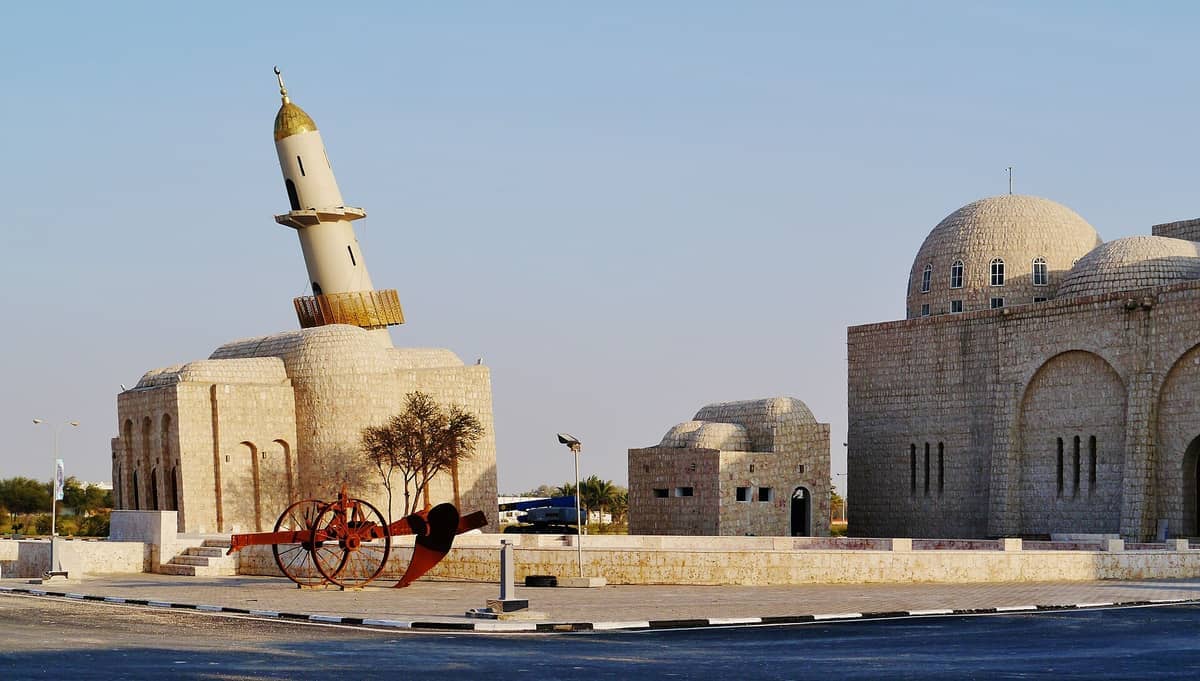
The museum building itself is an attraction. The fort-style complex, built on the Al Samriya Farm estate, uses traditional Gulf architectural vocabulary: thick walls, crenellations, interior courtyards, and warm stone tones that shift colour between midday and late afternoon. From a photography standpoint, the exterior is most rewarding in the two hours before sunset, when the light falls low and the building's texture becomes pronounced.
The surrounding grounds include landscaped areas and the wider farm estate context, which means the air outside carries something different from central Doha: quieter, drier, with the faint smell of desert scrub rather than the sea. On cooler winter mornings, between November and March, the exterior walk around the complex is genuinely pleasant rather than something to rush through to reach air conditioning.
ℹ️ Good to know
The museum is located near the Al Shahaniya camel racetrack. If you are visiting between October and March, check whether races are running that day. Combining both into a single day trip west of Doha is very manageable by car.
When to Visit and How to Plan Your Time
The best months to visit are November through March, when Doha's temperatures sit in the low to mid-20s°C during the day and the drive along Dukhan Highway is comfortable rather than brutal. Summer visits (June to September) are possible, since the museum is air-conditioned, but the car journey and any time outside the building will be oppressive, with temperatures regularly exceeding 40°C.
Morning visits on weekdays tend to be quieter. School groups occasionally visit, and Friday afternoons can draw larger local crowds given the later opening (14:00). Saturday mornings offer a good balance: the museum opens at 10:00, the collection is fully accessible, and visitor numbers are usually moderate. If your wider Doha itinerary is guided by the best time to visit Doha, winter months align well with a half-day trip to FBQ Museum.
Plan for a minimum of three hours. Four hours is more realistic if you read labels, linger in the carpet gallery, and spend time in the car collection. There is no logical way to rush through this much material without leaving with a blurred impression. Come with a half-day commitment or reconsider the visit entirely.
Getting There: Practicalities
The museum sits approximately 20–22 km west of central Doha on Dukhan Highway (the road toward Dukhan on the western coast). There is no direct Doha Metro connection, and the nearest metro stations are in the city centre, making the last stretch impractical by public transport alone. The most practical approach is a hired car, rental car, or ride-hailing app. Karwa taxis are official and metered; international ride-hailing apps also operate in Doha, though availability can vary.
From the highway, the museum is signposted and the final kilometre runs along a shaded access road on the estate grounds. Parking is available at the site. Return journey: if you arrive by taxi or ride-hail, arrange a pick-up time in advance, since hailing a ride from a farm estate 20 km outside the city is not as instant as in central Doha.
Visitors combining this with a desert-facing day out might consider the route toward Al Shahaniya camel racetrack in the same direction, or a longer excursion toward Al Zubarah in the north. The museum works well as the cultural anchor of a day that incorporates more than one stop outside central Doha.
Photography and Practical Notes
Photography policies inside private museum collections in Qatar can vary. Check with staff at the entrance whether personal photography is permitted in each gallery. The exterior and courtyard areas are generally photogenic and more freely accessible for cameras. Wide-angle lenses work well for the fort architecture; macro or standard focal lengths suit the detail work in the carpet and Islamic art sections.
Dress conservatively, as is appropriate throughout Qatar's cultural institutions and consistent with the country's general dress norms for public and cultural spaces. Comfortable walking shoes matter: the galleries cover significant floor area, and moving between sections involves corridor walking across a large complex.
If this museum sparks your interest in Qatar's broader cultural landscape, the Museum of Islamic Art in central Doha offers a complementary experience with a more formally curated permanent collection, and the National Museum of Qatar provides the narrative framing of Qatari history that gives context to much of what you see at FBQ. Together, the three form a coherent introduction to the region's material culture.
⚠️ What to skip
The museum is 20 km from central Doha and not easily reached by public transport. Do not plan to walk or rely on metro access. Arrange transport both ways before you leave your accommodation, especially if visiting on a Friday afternoon when return traffic toward Doha can be busy.
Who Might Not Enjoy This Visit
Travellers with very limited time in Doha should weigh this carefully. The round trip from central Doha, combined with a minimum three-hour visit, commits most of a day. If your itinerary covers only one or two days, the city-centre museums, the Corniche, and Souq Waqif may offer a better return on limited time. The FBQ Museum rewards depth over speed, and visitors who struggle with eclecticism or prefer tightly themed collections may find the breadth here disorienting rather than impressive.
Visitors with very young children should also plan carefully. While children under 12 enter free and the car collection will engage many kids, the manuscript and carpet galleries demand patience. Families looking primarily for child-friendly activities in Doha might find Doha with kids a more targeted starting point before committing to the FBQ Museum.
Insider Tips
- Arrive when the museum opens on a weekday morning: the galleries are at their quietest before 11:00, and you can move through the Islamic art section without groups clustering around display cases.
- Ask staff at the entrance which gallery is currently receiving a new installation or rotating display. The collection is large enough that temporary arrangements change, and staff are often willing to point out highlights that do not appear in generic online guides.
- Combine the visit with a stop at the Al Shahaniya camel racetrack, a short drive away on the same highway corridor. During the October to March racing season, mornings at the track and afternoons at the museum make for a genuinely distinctive day outside the city.
- If you are particularly interested in the carpet collection, allow it to be your last stop rather than your first. The eye adjusts to pattern and colour over the course of the visit, and returning to the carpet gallery with a calibrated eye is more rewarding than starting there cold.
- The exterior of the fort complex photographs best in the late afternoon, when low western light catches the texture of the walls. If you arrive in the morning, take your exterior photos again before you leave.
Who Is Sheikh Faisal Bin Qassim Al Thani Museum For?
- Islamic art and manuscript enthusiasts looking for a collection with personal rather than institutional curation
- Classic car and vintage vehicle fans wanting an unexpected encounter in a Gulf context
- Travellers who want to understand Qatari and Gulf heritage material culture beyond the curated experience of Souq Waqif
- History-focused visitors spending more than three days in Doha and ready for a half-day trip beyond the city centre
- Photographers interested in traditional Gulf fort architecture and its relationship to the desert landscape
Nearby Attractions
Combine your visit with:
- Al Hazm Mall
Al Hazm Mall is not a typical shopping centre. Built in a classical European-inspired style with colonnaded stone arcades and soaring ceilings, this northern Doha landmark houses luxury boutiques, acclaimed restaurants, and art installations in a setting that feels more like a Milanese galleria than a Gulf mall. Entry is free, the architecture alone justifies the visit, and the restaurant scene is among the strongest in the city.
- Al Safliya Island
A small, uninhabited sand island off the Doha coast, Al Safliya Island draws visitors with clear Gulf waters, a quiet beach, and easy half-day boat access from The Pearl-Qatar or the Corniche. There are no facilities on the island, so what you bring is what you have.
- Al Shahaniya Camel Racetrack
Al Shahaniya Camel Racetrack is Qatar's principal venue for camel racing, a sport central to the country's Bedouin heritage. Located about 40–60 minutes west of central Doha along the Dukhan Highway, the track draws local families, Qatari enthusiasts, and curious visitors during its October-to-April season. Entry to regular race days is free.
- Al Thakira Mangroves
About 64 km north of Doha, the Al Thakira Mangroves protect one of Qatar's largest and most ecologically significant coastal habitats. Whether you paddle through the channels at sunset or simply walk the shoreline at low tide, this protected reserve offers a rare contrast to the capital's urban skyline.