Dwejra & Blue Hole: Gozo's Most Iconic Dive Site (And What to Do If You Don't Dive)
Dwejra on Gozo's west coast is the site of the Blue Hole, a natural limestone sinkhole that funnels divers into one of the Mediterranean's most celebrated underwater landscapes. Above water, the Inland Sea, surrounding cliffs, and the rubble of the lost Azure Window make this one of the most geologically dramatic corners of Malta.
Quick Facts
- Location
- Dwejra Bay, west coast of Gozo, Malta
- Getting There
- By car (parking on site) or local Gozo bus to Dwejra; rough limestone path to the water
- Time Needed
- 2–4 hours for surface exploration; half-day with a guided dive
- Cost
- Free to access the site; dive packages vary by operator
- Best for
- Scuba divers, snorkelers, geology enthusiasts, photographers
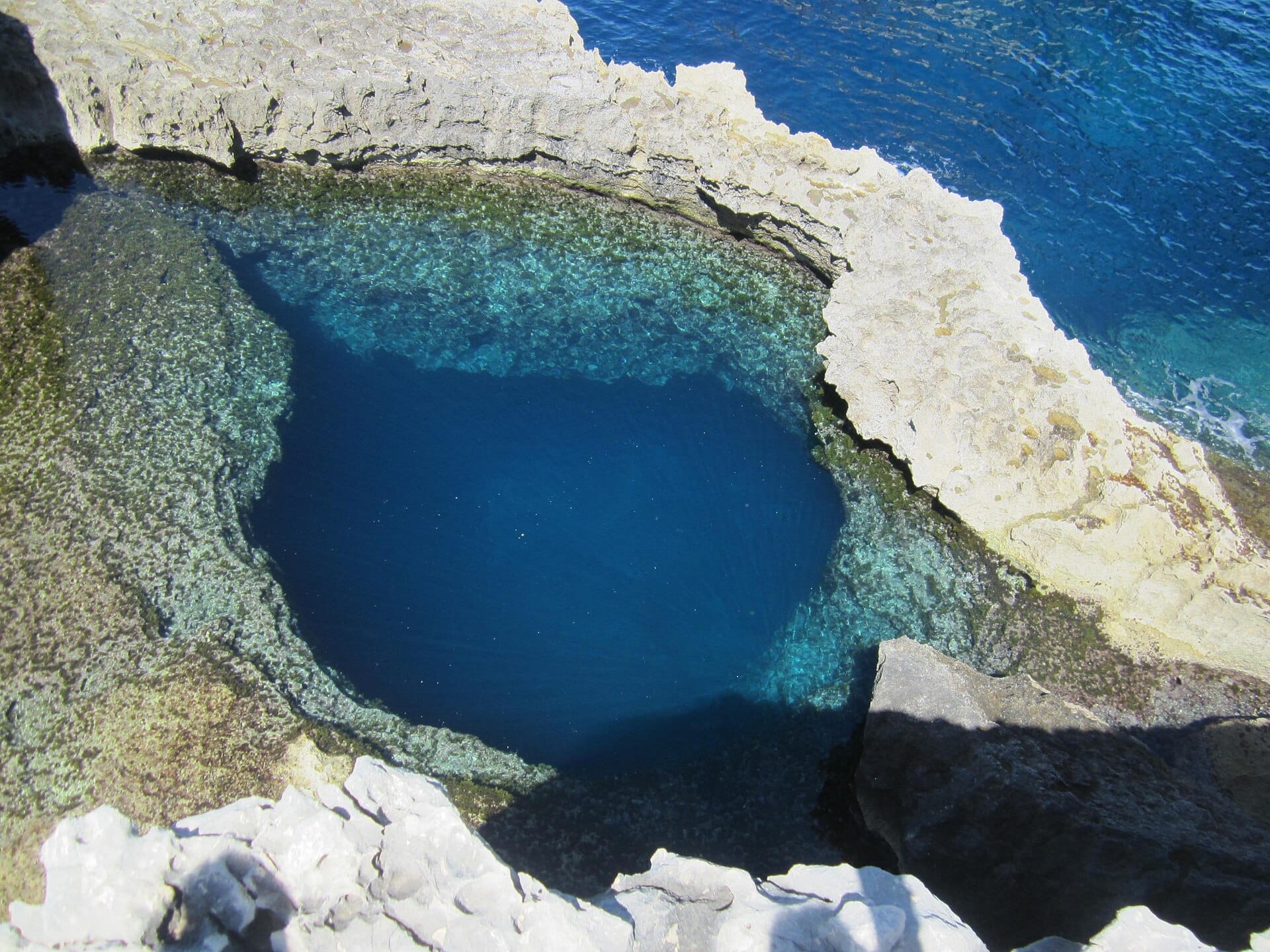
What Dwejra Actually Is
Dwejra is a coastal area on Gozo's western tip that contains several distinct natural features in close proximity: the Blue Hole, the Inland Sea, the collapsed remnants of the Azure Window arch, and the exposed coralline limestone cliffs of Dwejra Point. Together they form one of the most geologically interesting stretches of coastline in the central Mediterranean.
The Blue Hole itself is a natural circular opening in the rock shelf at the sea's edge, roughly 10 metres in diameter at the surface. It drops vertically before opening through an underwater arch into the open sea. For divers, that arch is the gateway to a wall dive and, since March 2017, to the collapsed rubble of the Azure Window, now called the Azure Reef. For snorkelers and freedivers, the hole's upper chamber offers crystal-clear water and dramatic light effects on calm days.
The Inland Sea is a separate feature: a shallow lagoon enclosed by cliff walls, connected to the Mediterranean through a low natural tunnel. Fishermen have used this tunnel for centuries, and small wooden boats still ferry visitors through it for a fee. It is quieter and less physically demanding than the Blue Hole approach, making it a good option for those travelling with children or anyone who prefers to stay dry. See our complete Gozo travel guide for how to structure a day that combines both.
ℹ️ Good to know
The path to the Blue Hole involves walking across uneven coralline limestone with no guard rails. Wear closed, grippy footwear — not sandals. The carved stone steps descending to the water are steep and can be slippery when wet.
The Azure Window: What Was Lost and What Remains
For most of its modern history, Dwejra was defined by the Azure Window, a 28-metre-tall natural limestone arch that stood just offshore at Dwejra Point. It appeared in countless travel photographs and briefly in Game of Thrones. On 8 March 2017, after a storm weakened its already-eroding pillar, the arch collapsed into the sea.
What remains above water is a gap in the skyline where the arch once stood, and a stretch of broken limestone extending into the surf. It is genuinely affecting to stand at the edge and look at that empty space, particularly if you knew the arch from photographs. Some visitors find this absence more powerful than any standing monument. Others are simply disappointed. Both reactions are valid.
Below the surface, the collapsed arch has become the Azure Reef, a dive site in its own right. The massive limestone blocks now form a reef structure colonised by marine life. Diving through and around the debris gives a sense of scale that photographs of the living arch never quite conveyed. The maximum depth around the reef reaches approximately 25 metres, with the average dive conducted at around 15 metres.
Tickets & tours
Hand-picked options from our booking partner. Prices are indicative; availability and final rates are confirmed when you complete your booking.
Roundtrip ferry to Comino Blue Lagoon with Gozo option from Marfa
From 15 €Instant confirmationFree cancellationJet ski safari tour in Northern Island with Blue Lagoon
From 200 €Instant confirmationFree cancellationMalta and Blue Lagoon catamaran day trip with buffet lunch and drinks
From 89 €Instant confirmationFull-day gulet cruise around Malta with Blue Lagoon and lunch
From 65 €Instant confirmationFree cancellation
Diving the Blue Hole: What to Expect
Entry is from the carved stone steps at the Blue Hole's edge. At the surface, the water inside the hole is usually calm and brilliantly clear, sheltered enough from swell that the true conditions only become apparent once you descend toward the arch at the base. That arch sits at around 8 metres and opens onto open water and the outer wall, which drops steeply to depth.
The wall dive outside the hole is the main attraction for certified divers. Gorgonian fans, sponges, and schools of bream and grouper are reliably present. Visibility on a calm summer day can exceed 30 metres. On the bottom near the arch remains, moray eels and octopus are regularly sighted in the crevices.
Open Water certification covers you for the upper portions of this dive. The PADI-listed average depth is 15 metres, with a maximum of 25 metres at the deeper sections of the reef. An Advanced certification is recommended if you intend to explore the full extent of the Azure Reef or push toward greater depth on the outer wall. Several dive operators based in and around Dwejra offer guided dives, equipment rental, and courses if you want to complete an upgrade while on Gozo.
⚠️ What to skip
Do not dive the Blue Hole alone. The arch at depth and the outer wall can disorient less-experienced divers, and surge through the arch can be significant after bad weather. Always dive with a guide or an experienced buddy who knows the site.
Snorkeling the Blue Hole's upper chamber is possible and genuinely worthwhile on a flat, sunny day. The light filtering down through the circular opening creates an otherworldly column of blue-green water. You won't reach the arch, but the visual experience is memorable. For other excellent snorkeling around Gozo, Wied il-Ghasri offers a very different but equally striking setting.
When to Go and How the Site Changes by Time of Day
Dwejra faces west, which has two practical consequences. Mornings are calm and relatively crowd-free, with soft light falling on the cliffs without direct sun in your eyes. This is the best time to photograph the site and to dive, since most tour groups from Malta's main island tend to arrive mid-morning after the ferry crossing.
Late afternoons, roughly two hours before sunset, are when the light turns golden and the cliffs glow amber. The crowds thin again after about 4pm, and the western exposure means the full sunset is visible from the clifftop. Staying for the light show requires no hiking — you are already at the edge of the island. In winter, the cliffs can be lashed by westerly weather that makes the whole site feel theatrical and raw, though diving is generally inadvisable in those conditions.
May, June, and September offer the best balance: warm water, good visibility, comfortable air temperatures, and significantly thinner crowds than July and August. The site never fully empties in summer, but an early morning arrival in June can feel almost solitary. Winter is genuinely quiet, but the dive conditions are inconsistent and some local operators reduce their schedules.
💡 Local tip
Arrive before 9am in summer to claim the carved steps without a queue and to find parking easily. By 10:30am the area around the Blue Hole is noticeably busier, and dive groups can create congestion at the entry point.
Getting There and Moving Around Dwejra
Dwejra sits on the western tip of Gozo, roughly a 20-minute drive from Victoria (Rabat), Gozo's main town. There is a car park near the Inland Sea with toilets and a small number of cafes and snack stalls. Driving is by far the most convenient option and gives you flexibility on timing, which matters if you are trying to avoid the midday crowds or stay for sunset.
Local Gozo buses serve the Dwejra area, though frequency is limited and schedules may require you to plan carefully around connections. If you are based on the main island of Malta, the day will involve the Gozo ferry from Cirkewwa to Mgarr, a drive or bus across Gozo, and a return crossing. That is a full day by public transport. Renting a car specifically for the Gozo leg is worth considering. Our guide to getting around Malta covers the ferry and Gozo transport options in detail.
From the car park, the Inland Sea is a short, flat walk. The Blue Hole requires a longer walk across the rocky limestone shelf toward Dwejra Point, followed by the carved steps down to water level. The path is uneven rather than dangerous, but it is not suitable for wheelchairs or for anyone with significant mobility difficulties. The Inland Sea is far more accessible by comparison.
Beyond Diving: The Rest of Dwejra
The clifftop above Dwejra Point offers one of the most striking coastal walks on Gozo, with views of the offshore Fungus Rock (Il-Ħaġra tal-Ġeneral), a flat-topped islet that the Knights of St John reportedly closed to public access to protect a rare plant believed to have medicinal properties. The rock is still off-limits, which lends it an air of mystery that the surrounding scenery doesn't really need.
The Inland Sea, a few minutes' walk from the Blue Hole approach, is worth at least half an hour on its own terms. The enclosed lagoon is calm, sheltered, and ringed by low cliffs that catch the afternoon light. Fishing boats return through the tunnel from the open sea throughout the day, an image that feels unchanged from photographs taken fifty years ago. If Gozo's quieter character appeals to you, Xlendi Bay and the salt pans near Marsalforn are worth combining into the same day.
Photography at Dwejra does not require a dive. The circular opening of the Blue Hole from above is a compelling subject, particularly in morning light when the water colour shifts from turquoise near the edges to deep indigo at the centre. The empty skyline where the Azure Window once stood has its own kind of photographic power. Wide-angle lenses make the most of the cliff geometry; a polarising filter is useful for cutting reflections off the water.
Non-divers who find the Blue Hole physically demanding or uninteresting will still leave Dwejra with something. The geology alone, a mix of coralline limestone and globigerina formations sculpted by centuries of wave action, is unusual enough to reward simply walking the clifftop for an hour. That said, if you have no interest in diving, geology, or dramatic coastal scenery, the site will feel like a lot of effort for a view of some rocks and a collapsed arch. Manage expectations accordingly.
Practical Details
- No admission charge for the site itself. Dive packages are priced by local operators and vary; contact operators directly for current rates.
- No official opening hours — the outdoor site is accessible at any time, though dive operators work during daylight.
- Toilets and basic refreshments are available near the Inland Sea car park.
- Coordinates: 36°03.180' N 014°11.322' E.
- Minimum dive certification: Open Water Diver (up to 18m); Advanced recommended for full reef exploration.
- Average dive depth: 15m. Maximum: approximately 25m.
- Water temperature: 23–27°C in summer, dropping to around 15°C in winter.
Insider Tips
- The boat trips through the Inland Sea tunnel are run by local fishermen and take about 20 minutes. Prices are negotiated directly with the boatman. It is a worthwhile add-on if you arrive early and the sea is calm enough for the tunnel passage.
- If you are an Open Water diver and want to see the Azure Reef properly, book a guided dive rather than doing a self-guided entry. The site's layout beneath the surface is not immediately obvious from above, and a guide who knows where the collapsed arch sections lie will dramatically improve what you see.
- The clifftop path north of the Blue Hole toward the headland is almost always empty, even when the main site is busy. It takes about 15 minutes to walk and gives elevated views back over Dwejra Bay that most visitors never see.
- In July and August, dive operators at the Blue Hole can queue at peak times. Pre-booking a morning slot with a Gozo-based dive centre rather than showing up independently saves significant waiting time.
- Bring more water than you think you need. The site has no reliable shade between the car park and the Blue Hole, and the limestone reflects heat intensely in summer. Sun protection for the back of the neck is easily forgotten and easily regretted.
Who Is Dwejra & Blue Hole For?
- Certified scuba divers wanting one of the Mediterranean's most referenced wall and reef dives
- Snorkelers and freedivers looking for clear, calm, and visually dramatic water
- Photography-focused travellers chasing coastal geology and unusual light conditions
- Geology and natural history enthusiasts interested in limestone formations and marine ecology
- Day-trippers from Malta's main island building a full Gozo itinerary around a standout location
Nearby Attractions
Other things to see while in Gozo:
- Citadella (Victoria)
Rising from a rocky promontory above Victoria, the Citadella is Gozo's most significant historical site. Inside its 17th-century bastions you'll find a cathedral with a famous trompe-l'oeil ceiling, small but thoughtful museums, and panoramic views stretching across the entire island. It rewards a half-day of exploration.
- Ġgantija Temples
Standing on the Xagħra plateau in Gozo, the Ġgantija Temples are among the oldest freestanding structures on Earth, predating both Stonehenge and the Egyptian pyramids. This UNESCO World Heritage Site offers a rare encounter with Neolithic craftsmanship on a scale that continues to baffle archaeologists and awe visitors.
- Ramla Bay
Ramla Bay (Ir-Ramla l-Ħamra, meaning 'the red sands') is Gozo's largest and most distinctive beach, stretching 360 metres across the island's north-east coast. Its warm-toned sand, clear Blue Flag water, and surrounding dunes of endemic flora make it unlike anything on the main Malta island.
- Xwejni Salt Pans
Carved into the rocky northern coast of Gozo near Marsalforn, the Xwejni Salt Pans are one of the Mediterranean's last working traditional salt harvests. Free to visit year-round, the roughly 300 hand-cut limestone pans have been producing sea salt for centuries, and one family has tended them for over five generations.