Wied il-Għasri: Inside Gozo's Most Dramatic Coastal Gorge
Wied il-Għasri, also known as Għasri Valley, is a narrow limestone gorge on Gozo's north coast that opens into a sheltered sea inlet. Free to access and rarely crowded, it rewards those willing to descend steep steps with one of the island's most striking natural settings.
Quick Facts
- Location
- North coast of Gozo, near Żebbuġ village, near Xwejni Bay salt flats
- Getting There
- By car or taxi from Victoria (Rabat, Gozo); park at the junction on Triq Is-Sagħtrija. No direct bus service to the gorge.
- Time Needed
- 1.5 to 3 hours, depending on whether you swim or hike
- Cost
- Free. No admission fee.
- Best for
- Swimmers, divers, photographers, and anyone wanting solitude on Gozo
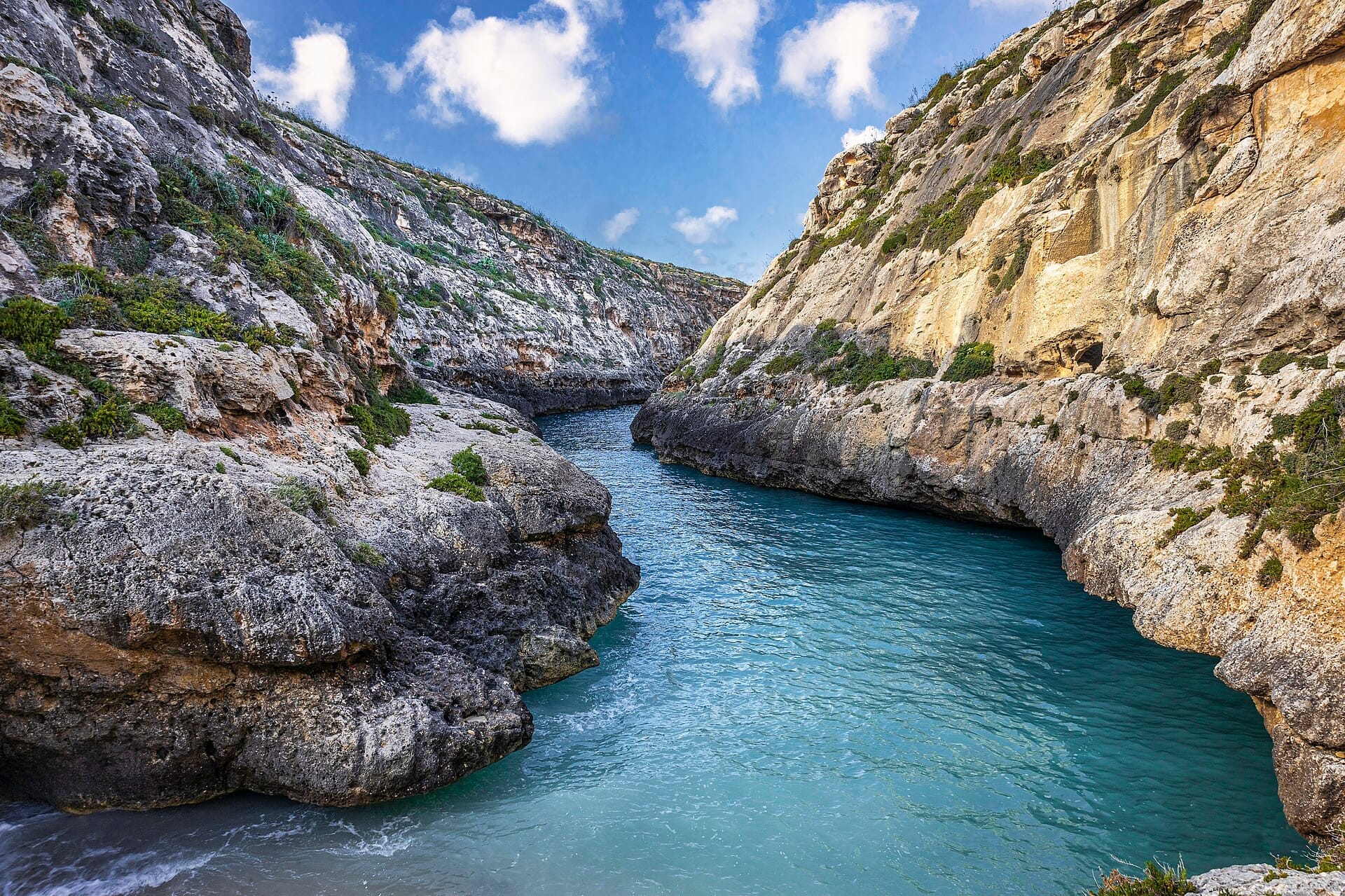
What Wied il-Għasri Actually Is
Wied il-Għasri is a narrow coastal valley carved deep into Gozo's limestone plateau, finishing at a slim, sheltered sea inlet hemmed in by vertical cliffs. The Maltese word wied means valley, and Għasri refers to the nearby village of the same name. The full English translation, Għasri Valley, appears on some maps, though most visitors and locals use the Maltese name.
Unlike Gozo's broader bays, this gorge is barely wide enough in places to stand with arms outstretched. The cliffs on either side rise sharply, and the water at the far end is a dense, concentrated blue that photographs underexpose every time. The sound is different too: the sea doesn't lap here, it resonates, bouncing off limestone walls in a low, continuous hum.
💡 Local tip
The gorge is accessible year-round, but late April to early June is the best window: wildflowers are in bloom, the sea is warming up for swimming, and visitor numbers remain low. Windy winter days produce impressive wave crashes against the cliffs if you're here for photography rather than swimming.
The Descent: What to Expect on the Way Down
You park at the junction on Triq Is-Sagħtrija, near the gorge edge, and from there a set of steep stone steps leads down through the valley floor toward the sea. The path is not long, but it is uneven. The limestone steps are worn smooth in sections and can be slippery when damp. Proper footwear matters here: sandals with grip are acceptable in dry summer conditions, but flip-flops are a genuine hazard.
As you descend, the walls narrow and rise. The path passes between dry stone walls that support terraced agricultural land on either side, remnants of centuries of small-scale farming on Gozo's thin soils. Prickly pear cactus lines the route, along with wild capers growing from crevices in the limestone. In late spring, red poppies appear across the valley floor in numbers that feel disproportionate to the rocky terrain.
The final section opens onto a pebbly beach at the inlet's mouth. The transition from the shaded gorge to the open sea light is abrupt and striking. There are no facilities here: no toilets, no cafe, no shade structures. Whatever you need, you carry down with you.
⚠️ What to skip
The return journey is entirely uphill on those same steep steps. Factor this into your visit, especially in summer heat. Bring water. The descent takes around 15 minutes; the ascent is closer to 25 for most people.
Tickets & tours
Hand-picked options from our booking partner. Prices are indicative; availability and final rates are confirmed when you complete your booking.
City Sightseeing hop-on hop-off bus tour of Gozo
From 20 €Instant confirmationFree cancellationThe Malta Experience Audio-Visual Show and La Sacra Infermeria Tour
From 20 €Instant confirmationFree cancellationLuggage Storage in Malta
From 6 €Instant confirmationFree cancellation6-day heritage and attractions pass in Malta
From 80 €Instant confirmationFree cancellation
The Geology Beneath Your Feet
The valley has been carved through two distinct limestone formations: Lower Coralline Limestone at the base, which is harder and more resistant, and Globigerina Limestone above it. The difference is visible in the cliff faces: the lower sections are darker, more fractured, and pitted with marine erosion, while the upper walls show the soft honey-colored tones that define so much of Gozo's built environment.
Marine erosion has formed sea caves and small arches along the cliff bases, some accessible by water. This is the process that created Cathedral Cave nearby, one of the dive sites associated with this inlet. The rock surfaces above the waterline are sharp and barnacled in the splash zone, which makes entering and exiting the water something that requires attention and ideally water shoes.
Swimming and Diving at Wied il-Għasri
The water at the inlet is clear and relatively sheltered compared to Gozo's exposed north coast. On calm days, the swimming conditions are excellent, with visibility extending several meters down through the limestone-filtered blue. The entry point is from the pebble beach, and the water deepens quickly. In peak summer, a handful of swimmers make the trip down, but the limited space naturally limits numbers.
Wied il-Għasri is also a recognized dive site, primarily because of Cathedral Cave, an underwater cave accessible from the inlet. The cave is documented in Gozo's diving community and sits within a broader network of dive sites along this stretch of coastline. If you're planning dives around Gozo, the Malta diving guide covers the main sites and what to expect in terms of visibility and conditions by season.
Strong swimmers can explore along the cliff bases, but the rock edges are unforgiving. This is not a beginner swimming spot. The inlet is exposed to swell from the north, and conditions can shift quickly outside the summer months. If the sea is rough when you arrive at the top of the gorge, the swim is best skipped.
How the Light and Mood Shift Through the Day
Morning visits offer the best light for photography: the sun enters the gorge from the east at a low angle in the early hours, creating contrast between the shadowed walls and the illuminated water. By mid-morning in summer, the gorge receives more even light, which is better for swimming but flatter for images.
Midday in July and August is genuinely hot. The gorge provides some shade on the descent, but the beach at the bottom offers none. The stone surfaces reflect heat, and the valley amplifies it. If you are visiting in summer, an early morning arrival before 9:00 am is the single most useful practical decision you can make.
Late afternoon in spring and autumn produces a warm, directional light on the west-facing cliff faces that turns the Globigerina Limestone a deep amber. These are the conditions that make for photographs worth keeping. The sea itself is calmer in the mornings, which also affects water color and entry conditions.
Getting There from Victoria and the Rest of Gozo
Wied il-Għasri sits on Gozo's north coast near the village of Żebbuġ, roughly 2 kilometers west of the Xwejni Bay salt flats. There is no direct bus service to the gorge itself. The practical options are a rental car, a taxi from Victoria (Gozo's capital, also known as Rabat), or a bicycle if you are comfortable with Gozo's hilly roads. For a broader orientation to Gozo and how to plan your time there, the Gozo travel guide covers transport logistics, accommodation, and which areas to base yourself in.
Parking is available at the road junction on Triq Is-Sagħtrija, near the gorge edge. The space is limited, which is another reason early morning arrival works best in summer. The road to the parking area is narrow and requires some confidence if you are driving an unfamiliar vehicle on Gozo's rural lanes.
ℹ️ Good to know
If you are visiting the north of Gozo, Wied il-Għasri combines naturally with the Xwejni Bay salt pans to the east and Marsalforn. The salt pans are carved directly into the shoreline rock and are active in summer, producing sea salt the traditional way. The whole coastal stretch makes for a half-day drive or cycle.
For those on a wider Gozo loop, the Dwejra and the Blue Hole dive site is on the island's west coast, and the Citadella in Victoria makes a natural bookend to a day that starts at the gorge and moves inland.
Honest Assessment: Is Wied il-Għasri Worth the Detour?
For travelers who are happy walking uneven terrain and spending time at a place with no infrastructure, yes, unambiguously. The gorge has a quality that is hard to find elsewhere in the Maltese islands: genuine solitude combined with dramatic landscape. It does not have the turquoise spectacle of the Blue Lagoon, and it does not pretend to. What it offers is more austere.
If you are traveling with young children, the steep and uneven stairs present real challenges, and the lack of facilities makes it logistically difficult. Families with children will likely find better-suited options listed in the Malta with kids guide. Travelers who need flat, accessible terrain should also note that the path has no adaptations for mobility aids.
The site is also genuinely affected by weather. On a gray, windy day in November, the crashing waves and salt air give the gorge a completely different character: raw, dramatic, worth experiencing for different reasons. But if you came for a swim, you will be disappointed. Check conditions before making the drive.
Insider Tips
- Arrive before 8:30 am in July and August. The parking is minimal, the descent takes 15 minutes, and the beach at the bottom is barely large enough for a dozen people. You will have it to yourself at dawn.
- Bring water shoes. The pebble beach entry into the water sits alongside barnacled rock shelves, and the limestone underfoot is sharper than it looks from above.
- The late April to late May window brings red poppies across the valley floor. This is the best single visual spectacle the gorge offers on land, and it coincides with comfortable walking temperatures.
- If you are a diver, Cathedral Cave is accessible from the inlet and is worth researching with a local dive operator before your visit. Surface entry from the beach is possible for experienced divers.
- Combine the visit with the Xwejni salt pans, which are a short drive east along the coast road. The salt pans are photographically striking in morning light and add almost no time to the trip.
Who Is Wied il-Għasri For?
- Divers and snorkelers looking for a less-trafficked entry point to Gozo's underwater caves
- Photographers, particularly in spring when wildflowers fill the valley floor
- Travelers who want swimming conditions without the crowds of major beaches
- Walkers and cyclists exploring Gozo's north coast on a half-day route
- Anyone seeking a landscape with a genuinely different character from Malta's main island
Nearby Attractions
Other things to see while in Gozo:
- Citadella (Victoria)
Rising from a rocky promontory above Victoria, the Citadella is Gozo's most significant historical site. Inside its 17th-century bastions you'll find a cathedral with a famous trompe-l'oeil ceiling, small but thoughtful museums, and panoramic views stretching across the entire island. It rewards a half-day of exploration.
- Dwejra & Blue Hole
Dwejra on Gozo's west coast is the site of the Blue Hole, a natural limestone sinkhole that funnels divers into one of the Mediterranean's most celebrated underwater landscapes. Above water, the Inland Sea, surrounding cliffs, and the rubble of the lost Azure Window make this one of the most geologically dramatic corners of Malta.
- Ġgantija Temples
Standing on the Xagħra plateau in Gozo, the Ġgantija Temples are among the oldest freestanding structures on Earth, predating both Stonehenge and the Egyptian pyramids. This UNESCO World Heritage Site offers a rare encounter with Neolithic craftsmanship on a scale that continues to baffle archaeologists and awe visitors.
- Ramla Bay
Ramla Bay (Ir-Ramla l-Ħamra, meaning 'the red sands') is Gozo's largest and most distinctive beach, stretching 360 metres across the island's north-east coast. Its warm-toned sand, clear Blue Flag water, and surrounding dunes of endemic flora make it unlike anything on the main Malta island.