Ġgantija Temples: Gozo's Ancient Wonder Older Than the Pyramids
Standing on the Xagħra plateau in Gozo, the Ġgantija Temples are among the oldest freestanding structures on Earth, predating both Stonehenge and the Egyptian pyramids. This UNESCO World Heritage Site offers a rare encounter with Neolithic craftsmanship on a scale that continues to baffle archaeologists and awe visitors.
Quick Facts
- Location
- Ġgantija Archaeological Park, Xagħra, Gozo, Malta
- Getting There
- By bus or car from the Gozo ferry terminal; on-site parking available
- Time Needed
- 1.5 to 2.5 hours including the Interpretation Centre
- Cost
- Ticketed entry via Heritage Malta; check official site for current prices
- Best for
- History enthusiasts, archaeology lovers, families with older children
- Official website
- heritagemalta.mt/explore/ggantija-archaeological-park
What You're Actually Looking At
The Ġgantija Temples are not ruins in the conventional sense. They are two largely intact Neolithic megalithic temples enclosed within a shared boundary wall, built between approximately 3600 and 2500 BC on a southeast-facing plateau above the village of Xagħra. That places their construction roughly 1,000 years before Stonehenge and over 1,000 years before the Great Pyramid of Giza. In 1980, they were inscribed as a UNESCO World Heritage Site as part of the Megalithic Temples of Malta, a designation later expanded in 1992.
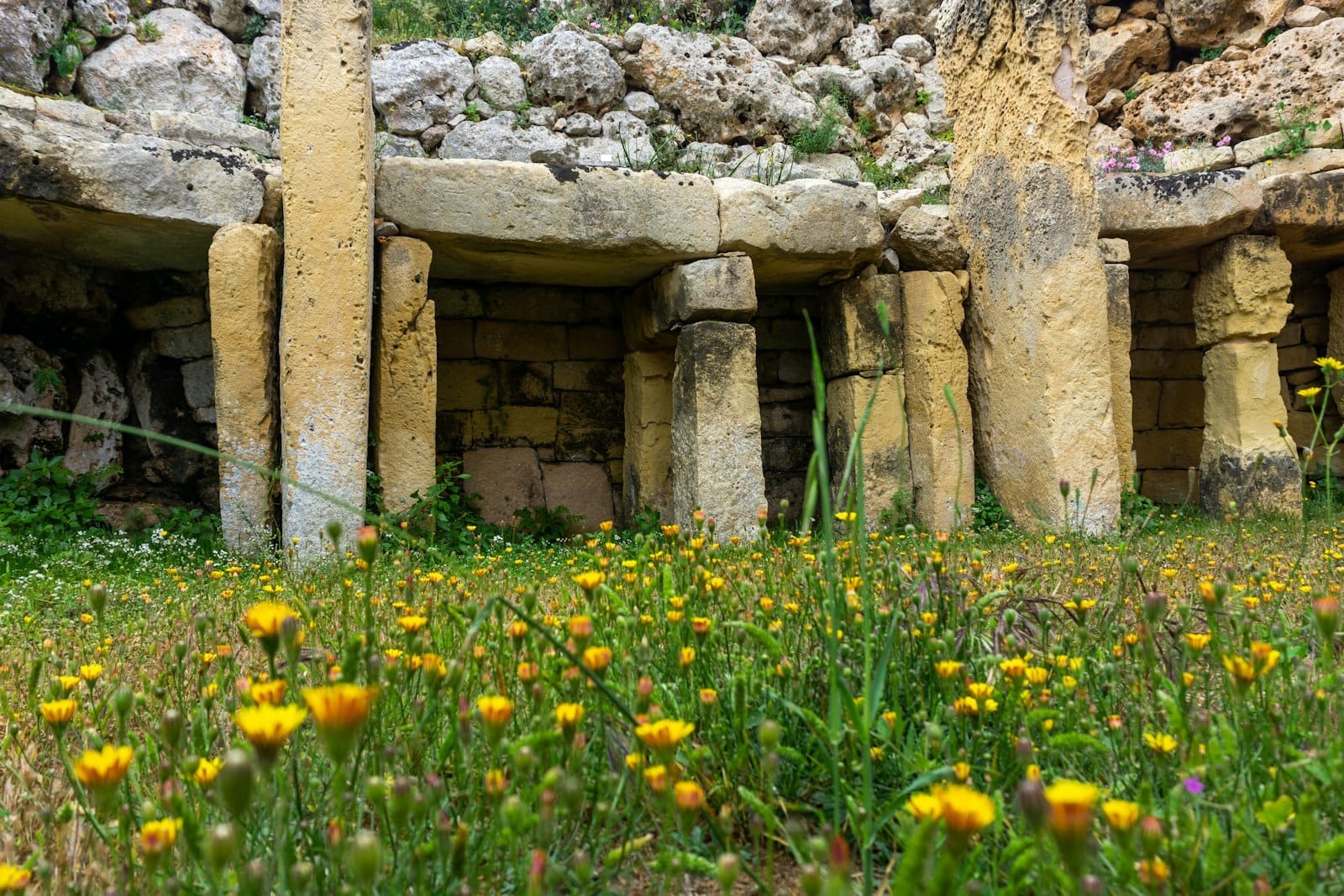
The name Ġgantija comes from the Maltese word for 'giantess', a reflection of local folklore that once explained the impossibility of the construction: these stones were too large for ordinary humans to have moved, so giants must have done it. The megaliths reach up to 5 metres in length and exceed 50 tonnes in weight. The southern temple's outer wall still stands close to 6 metres high, making it among the best-preserved prehistoric structures anywhere in the Mediterranean.
ℹ️ Good to know
Ġgantija is older than Stonehenge by roughly 1,000 years and older than the Great Pyramid of Giza by over 500 years, making it one of the oldest freestanding architectural complexes on the planet.
The Stones Themselves: What You See Up Close
Approaching the temples from the Interpretation Centre, the boundary wall rises unexpectedly fast. What photographs tend to flatten into something manageable is, in person, genuinely imposing: massive upright slabs of Coralline limestone stacked with a precision that seems implausible given the tools available at the time. The texture of the stone is rough and deeply pitted, weathered by over five millennia of Mediterranean sun, salt air, and rain. Running a hand along the outer wall, you feel the irregularity of each block, the slight cant of one slab against another.
The two temples are built to a distinctive trefoil plan: a corridor leading through a threshold into a series of semicircular apses. The southern temple, the larger and older of the two, contains evidence of ritual use including altar slabs, libation holes in the stone, and traces of animal sacrifice. The inner walls were originally plastered and, in places, painted. Some surfaces still show faint tool marks. The interiors feel unexpectedly sheltered, almost intimate, despite the scale of the surrounding stones.
The exterior uses hard Coralline limestone precisely because it weathers well. The interiors, by contrast, were built with softer Globigerina limestone, which is easier to carve and permitted the more detailed ritual features. This distinction was deliberate and architectural, not accidental. An incomplete third temple is also visible within the enclosure, though far less prominent.
Tickets & tours
Hand-picked options from our booking partner. Prices are indicative; availability and final rates are confirmed when you complete your booking.
Gozo full-fay tour including Ggantija Temples
From 80 €Instant confirmationFree cancellationCity Sightseeing hop-on hop-off bus tour of Gozo
From 20 €Instant confirmationFree cancellationThe Malta Experience Audio-Visual Show and La Sacra Infermeria Tour
From 20 €Instant confirmationFree cancellationLuggage Storage in Malta
From 6 €Instant confirmationFree cancellation
The Interpretation Centre: Essential Context, Not Optional
Entry to the temples is through the Interpretation Centre, and this is not a formality to rush past. The centre houses a focused collection of Neolithic artifacts recovered from the site and the surrounding Xagħra area, including figurines, pottery fragments, and ritual objects. For most visitors, this is where the scale of what they are about to see begins to register properly.
The exhibition explains the Temple Period culture, the people who built Ġgantija and Malta's other megalithic temples, and what is known, and not known, about their social organisation, beliefs, and eventual disappearance. The displays are well-labelled in English, and the tone is appropriately cautious: archaeology here involves as much informed speculation as established fact, and the centre reflects that honestly.
💡 Local tip
Spend at least 20 to 30 minutes in the Interpretation Centre before walking to the temples. The context significantly changes how you read the stone structures, particularly the apse layouts and the ritual features.
If Ġgantija sparks a broader interest in Malta's prehistoric culture, the Hal Saflieni Hypogeum in Paola is the most remarkable companion site, though it requires advance booking months ahead. On Malta's main island, Hagar Qim and Mnajdra offer comparable architectural drama in a clifftop setting.
How the Experience Changes Through the Day
Morning visits, particularly in the first hour after opening, offer the site at its quietest. The Xagħra plateau faces southeast, which means the temples catch direct morning light at an angle that sharpens the texture of the stone and creates clear shadows in the crevices between megaliths. Photographs taken in this window tend to be substantially better than those taken at midday, when the light flattens and the limestone washes out in brightness.
By mid-morning, particularly in summer between June and August, coach groups begin arriving, and the path through the temples can become congested around the most photogenic sections of the southern temple. The site is compact, so even moderate crowd numbers change the atmosphere noticeably. If you are visiting in peak season, arriving at opening time is the clearest practical advice.
In spring (April to early June) and autumn (September to October), the light is similarly good in the morning but the crowds are smaller throughout the day. Summer temperatures on the exposed plateau can exceed 30°C with little shade inside the temple enclosure itself. Bring water, wear light clothing, and consider a hat. There is seating and a refreshments area within the facility, but the temple grounds themselves offer no shelter.
⚠️ What to skip
The terrain within the temple enclosure is uneven prehistoric stone. Wear closed, flat shoes. Sandals or heels will make the walk uncomfortable and increase the risk of a stumble on the irregular ground.
Getting There and Fitting It Into Your Gozo Day
Ġgantija sits in Xagħra, a village on Gozo's central plateau. On-site parking is available, and for visitors arriving by car from the Gozo ferry terminal in Mġarr, the drive takes around 20 minutes. Bus connections from Victoria (Gozo's main town) are available but less frequent than on Malta's main island, so check schedules in advance. For a broader picture of getting around the island, the getting around Malta guide covers ferry and bus logistics in useful detail.
Xagħra itself is worth a short stroll before or after the temples. The village square and parish church have a quieter, less tourist-facing character than Victoria. Gozo as a whole rewards slower exploration, and Ġgantija pairs well with a visit to the Citadella in Victoria earlier in the day, or with the dramatic coastal scenery at Dwejra on the island's western edge. For a complete picture of what the island offers, the Gozo travel guide is a useful planning resource.
Photography beyond the standard visitor-path views is limited by the physical layout: the temples are set within a fenced enclosure and there are no elevated vantage points from which to see the full extent of the outer wall in one frame. Drone use is not permitted. Work with the morning light and focus on details: the threshold stones, the tool marks on the Globigerina apses, the way individual megaliths lean against each other with calculated imprecision.
Honest Assessment: What This Site Is and Is Not
Ġgantija is not a spectacle in the sense that, say, a dramatic coastal formation or a cathedral interior is a spectacle. It asks something of you. The scale is impressive, but it becomes meaningful only when you understand what you are looking at and what its age implies about human capacity. Visitors who arrive without context and spend fifteen minutes walking through often leave underwhelmed. Visitors who have spent time in the Interpretation Centre and who slow down to examine the construction details tend to leave genuinely moved.
The site is also small. The entire walkable area within the temple enclosure can be covered in under thirty minutes. The full visit, with the Interpretation Centre done properly, fits comfortably in ninety minutes to two hours. It is not a half-day destination on its own unless you are deeply engaged with the subject matter.
Visitors looking primarily for visual drama or a physically active experience are likely better served by other parts of Gozo. Those for whom prehistoric archaeology is a genuine interest will find this among the most significant sites in the Mediterranean. It belongs on any serious tour of Malta's ancient temples without question.
Insider Tips
- The southern temple is the older and more complete of the two: it is also the one with the more legible ritual features, including libation holes and altar slabs. Spend more time here than in the northern temple.
- Visit on a weekday rather than a weekend if possible. Gozo day-trippers from Malta tend to cluster visits on Saturdays, and the site can feel crowded despite its modest size.
- The village of Xagħra has a good local bar on the main square. A coffee there before opening time is a more pleasant start than waiting in the car park.
- The Xagħra Stone Circle, a Neolithic burial hypogeum near the village, was excavated in the 1990s and yielded remarkable finds now in the Interpretation Centre. Knowing about it before you visit makes the figurine collection significantly more interesting.
- If you are visiting Malta's prehistoric sites broadly, do not leave the Ġgantija visit until late afternoon. Mental fatigue is real at these sites, and the temples reward attention rather than a tired quick walk-through.
Who Is Ġgantija Temples For?
- Archaeology and prehistory enthusiasts seeking one of the Mediterranean's most significant Neolithic sites
- History-focused travellers building an itinerary around Malta's UNESCO World Heritage Sites
- Families with older children (10+) who can engage with the context provided in the Interpretation Centre
- Photographers interested in ancient stone architecture and early-morning texture light
- Travellers already visiting Gozo who want more than coastal scenery from the island
Nearby Attractions
Other things to see while in Gozo:
- Citadella (Victoria)
Rising from a rocky promontory above Victoria, the Citadella is Gozo's most significant historical site. Inside its 17th-century bastions you'll find a cathedral with a famous trompe-l'oeil ceiling, small but thoughtful museums, and panoramic views stretching across the entire island. It rewards a half-day of exploration.
- Dwejra & Blue Hole
Dwejra on Gozo's west coast is the site of the Blue Hole, a natural limestone sinkhole that funnels divers into one of the Mediterranean's most celebrated underwater landscapes. Above water, the Inland Sea, surrounding cliffs, and the rubble of the lost Azure Window make this one of the most geologically dramatic corners of Malta.
- Ramla Bay
Ramla Bay (Ir-Ramla l-Ħamra, meaning 'the red sands') is Gozo's largest and most distinctive beach, stretching 360 metres across the island's north-east coast. Its warm-toned sand, clear Blue Flag water, and surrounding dunes of endemic flora make it unlike anything on the main Malta island.
- Xwejni Salt Pans
Carved into the rocky northern coast of Gozo near Marsalforn, the Xwejni Salt Pans are one of the Mediterranean's last working traditional salt harvests. Free to visit year-round, the roughly 300 hand-cut limestone pans have been producing sea salt for centuries, and one family has tended them for over five generations.