Ramla Bay: Gozo's Red Sand Beach Worth the Detour
Ramla Bay (Ir-Ramla l-Ħamra, meaning 'the red sands') is Gozo's largest and most distinctive beach, stretching 360 metres across the island's north-east coast. Its warm-toned sand, clear Blue Flag water, and surrounding dunes of endemic flora make it unlike anything on the main Malta island.
Quick Facts
- Location
- North-east Gozo, near Xagħra village (between Marsalforn and San Blas bays)
- Getting There
- Drive or taxi from Xagħra (5 min); no direct public bus route to the beach itself
- Time Needed
- 2–4 hours for the beach; half a day if combining with Calypso Cave and Xagħra
- Cost
- Free public access year-round
- Best for
- Swimming, photography, sand walks, couples, and families with older children
What Makes Ramla Bay Different
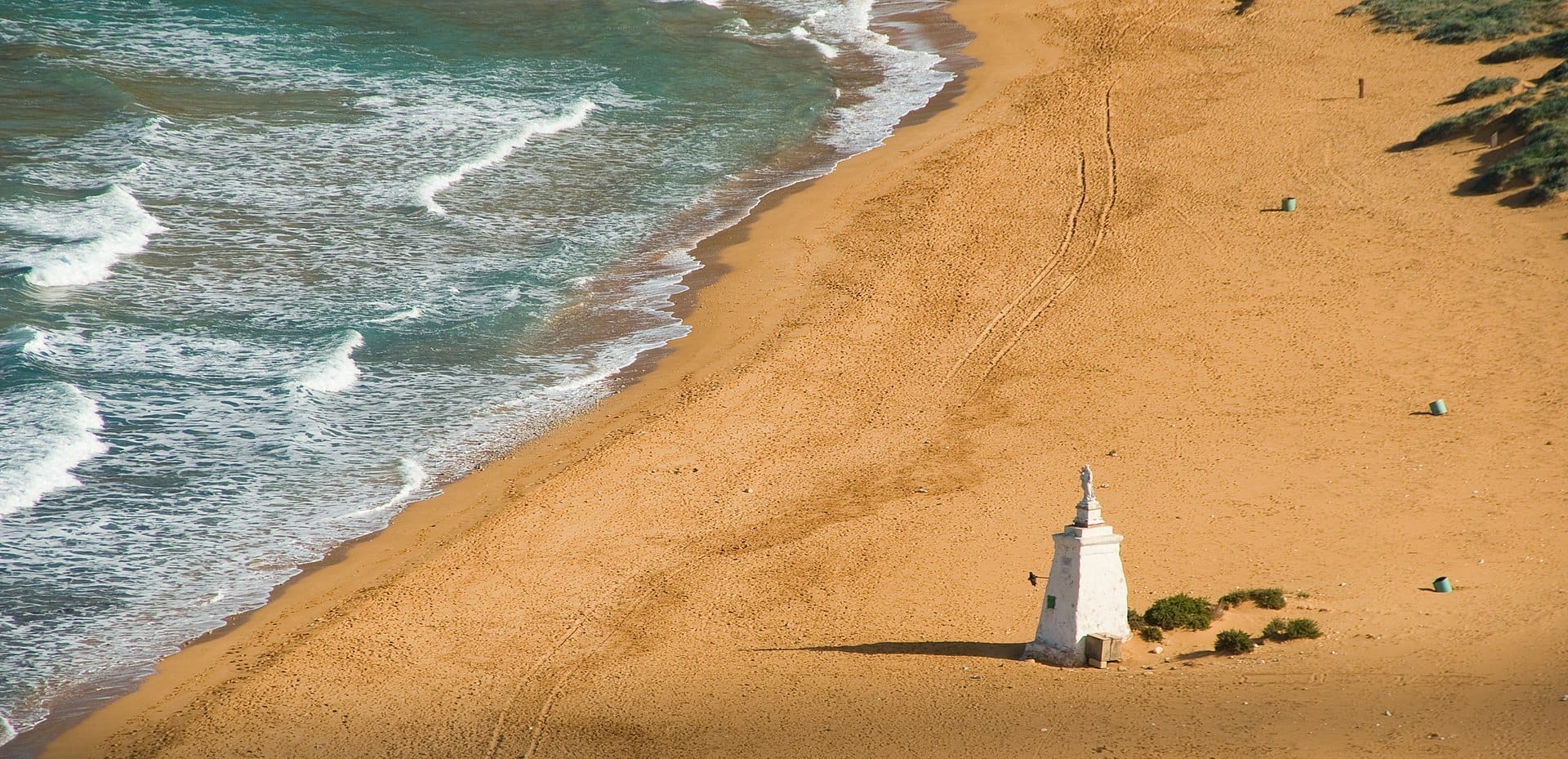
Ramla Bay stands out from every other beach in the Maltese archipelago for one unmistakable reason: the sand is red. Not terracotta-red exactly, but a warm orange-amber that shifts in tone depending on the light and moisture. Early morning, when the sand is still damp, it reads almost copper. By midday under direct sun it fades to a burnt orange. That colour comes from the iron-rich composition of the eroded clay slopes flanking the valley, and it gives Ramla a visual character that photographs rarely capture fully.
At 360 metres wide and roughly 65 metres deep, this is also Gozo's largest beach by a significant margin. The bay curves gently between low headlands, sheltered enough that the sea remains swimmable for a longer season than more exposed beaches on the main island. The water is clear, Blue Flag certified, and shades from pale turquoise at the shore to deeper blue further out, a contrast that works particularly well against the red foreground in photographs taken from the slopes above.
💡 Local tip
The best elevated view of the full bay comes from the footpath leading up toward Calypso Cave, about a 10-minute walk from the beach. The panorama from there is the shot most photographers are looking for.
The Experience: Morning, Midday, and Late Afternoon
Arrive before 9am in summer and Ramla Bay belongs almost entirely to you. The light is low and golden, the red sand glows warmly, and the valley behind the beach is still in partial shadow. A few locals may be walking or swimming, but the seasonal beach infrastructure (sun loungers, a small kiosk, and the water sports operation run from the Ramla Bay Resort) has not yet opened for the day. This is when the beach feels closest to the unspoiled coastal scene that made Gozo a quieter alternative to the main island.
By 10:30am from June through August, the beach fills steadily. The peak crowd arrives between 11am and 2pm, when day-trippers from Valletta and Sliema, having taken the Gozo ferry and driven or taxied across, stake out space on the sand. It is genuinely busy at these times, though never as compressed as the beaches in Sliema or St. Julian's. The scale of the bay absorbs numbers that would overwhelm a smaller cove.
Late afternoon, from around 4pm onward, is arguably the most pleasant window. The direct sun is less punishing, the day-tripper crowds begin to thin, and the light on the sand shifts back toward that warmer amber tone. The sea surface tends to be calmer at this hour too. Families with young children often linger at this time, making use of the shallows.
Tickets & tours
Hand-picked options from our booking partner. Prices are indicative; availability and final rates are confirmed when you complete your booking.
City Sightseeing hop-on hop-off bus tour of Gozo
From 20 €Instant confirmationFree cancellationRoundtrip ferry to Comino Blue Lagoon with Gozo option from Marfa
From 15 €Instant confirmationFree cancellationMalta two islands cruise to Comino and Gozo
From 30 €Instant confirmationFree cancellationRoundtrip ferry to Comino Blue Lagoon with Gozo option from Cirkewwa
From 15 €Instant confirmationFree cancellation
The Sand Dunes, Flora, and Valley Behind the Beach
The appeal of Ramla extends beyond the waterfront. Behind the beach, a shallow valley runs inland through agricultural terraces and wild vegetation. Sand dunes at the back of the bay support endemic plant species that are rare across the rest of the archipelago, and this ecological value is part of why the area has been a subject of conservation debate. The dunes are modest in height but worth walking through rather than around; the texture underfoot changes noticeably from the compacted wet sand near the water to the softer, looser material closer to the vegetation line.
The slopes on either side of the bay are covered in low scrub and wild fennel, and in spring (March to May) the surrounding hillsides carry patches of colour from seasonal wildflowers. If you visit outside peak summer, the landscape framing the beach becomes as interesting as the beach itself.
ℹ️ Good to know
In 2007, planning authority MEPA approved construction of 23 villas near Calypso Cave above the bay, a decision that drew significant environmental objections. The area remains sensitive, and the debate illustrates broader tensions in Gozo between development and conservation.
Calypso Cave: The Mythological Connection Above the Bay
Above the bay's eastern headland sits Calypso Cave, a shallow limestone cave on the cliff top. According to one strand of classical scholarship, this is the cave where Homer's Odysseus was held by the nymph Calypso for seven years in the Odyssey. The identification is contested and the cave itself is modest, but the setting is genuinely striking: a narrow opening in pale limestone above the red sand and blue sea, with views across the north coast of Gozo toward the horizon.
The cave is accessed via the road that winds up from the beach car park toward Xagħra. It takes about 10 to 15 minutes on foot. There is no charge to visit. The interior is small and not particularly dramatic, but the views from the platform outside the cave entrance justify the walk on their own terms. This is also where you get the best wide-angle view of the full bay below.
Combining Ramla Bay with a visit to the Ggantija Temples in nearby Xagħra makes for a logical half-day itinerary. The temples are among the oldest freestanding structures on earth and are a short drive from the beach.
Swimming, Water Sports, and What to Know Before You Go
The swimming at Ramla is generally good: a sandy entry, no sharp rocks near the shore, and water that warms to comfortable temperatures from June onward. The bay is Blue Flag certified, which means water quality is monitored regularly and meets European environmental and safety standards. That said, wave conditions can build with northerly winds, and on those days the sea at Ramla can carry a noticeable chop that makes it tiring for inexperienced swimmers. Parents with toddlers should watch for the sandy shelves where water depth increases unevenly, and shin-level rocks appear at the outer edges of the bay.
Water sports including scuba diving are available through the Ramla Bay Resort, which operates from the beach area during the April to October season. The resort also has basic facilities on-site. Outside this season, the beach has no services, so come prepared with everything you need.
⚠️ What to skip
There is no shaded area on the beach itself. Bring a beach umbrella, sunscreen with high SPF, and more water than you think you need. The reflective quality of the red sand and the surrounding limestone slopes intensifies the heat noticeably during summer midday hours.
Getting There and Practical Logistics
Ramla Bay sits on the north-east coast of Gozo, roughly accessible from Xagħra village, which is about 5 minutes by car. From Victoria (the main town on Gozo, also known as Rabat), the drive takes around 15 to 20 minutes depending on the route. There is a car park at the beach, though it fills quickly on summer weekends and during July and August midday hours.
There is no direct public bus route that deposits passengers at the beach itself. Travellers without a car can take a bus to Xagħra and walk down to the bay, which takes approximately 20 to 25 minutes on foot along a descending road. Alternatively, taxis and ride-hailing apps including Bolt operate on Gozo, and pre-booking a pickup for the return journey is advisable if you do not have a car, since signal in the valley can be unreliable.
Reaching Gozo from Malta requires the Gozo ferry from Cirkewwa to Mġarr. For a full overview of logistics, including ferry timings and getting around the island, the Gozo travel guide covers the practicalities in detail.
If you are planning a full day on the island, Ramla Bay pairs well with a morning at the Gozo salt pans or an afternoon drive along the west coast toward Dwejra. For ideas on combining multiple stops, the day trips from Malta guide outlines the most efficient Gozo circuits.
Honest Assessment: Is It Worth Your Time?
For anyone visiting Gozo, Ramla Bay is worth at least a few hours. The combination of the distinctive red sand, Blue Flag water quality, surrounding landscape, and the Calypso Cave viewpoint above makes it more than a standard beach stop. It is genuinely one of the more photogenic beaches in the entire Maltese archipelago, and the valley backdrop gives it a character that purely urban beaches cannot replicate.
That said, if you are comparing it against the dramatic coastal scenery of the Dwejra area or the crystalline water of the Blue Lagoon, Ramla Bay is a different kind of experience. It is a beach, first and foremost: sand, sea, and sun, framed by an attractive setting. Travellers who prioritise snorkelling or sea caves might find other Gozo spots more rewarding. And visitors arriving in peak August on a weekend should set realistic expectations about crowds, particularly between 11am and 3pm.
Travellers interested in Gozo's broader coastal offer might also consider Xlendi Bay on the island's south-west coast, which has a very different atmosphere and is better suited to snorkelling along rocky edges.
Insider Tips
- Visit on a Tuesday or Wednesday in summer rather than a weekend. Gozo day-trippers from Malta cluster heavily on weekends and the beach can feel much busier than its size suggests.
- The walk up to Calypso Cave is best done at the start of your visit, before the midday heat builds. The views down over the red sand with the sea behind it are significantly better with the morning light angled from the east.
- If you park at the main car park and walk toward the eastern edge of the bay, you will find slightly fewer people and a better angle for photography of the full sweep of sand.
- The kiosk at the beach sells snacks and drinks but closes early in the afternoon on quieter days. Bring your own supplies, particularly water, and do not rely on facilities being open outside July and August.
- In May and early June, before the summer crowds arrive and while the valley vegetation is still green, Ramla Bay is at its most photogenic and least congested. Water temperatures are cooler but still swimmable for most.
Who Is Ramla Bay For?
- Travellers doing a day trip to Gozo who want a scenic sandy beach with good swimming
- Photography enthusiasts drawn by the unusual red-orange sand and elevated viewpoints
- Couples looking for a less urban beach experience than Sliema or St. Julian's
- Families with children who are confident swimmers and can manage sandy, wave-prone water
- Visitors combining beach time with Gozo's archaeological sites, particularly Ggantija Temples a few minutes away
Nearby Attractions
Other things to see while in Gozo:
- Citadella (Victoria)
Rising from a rocky promontory above Victoria, the Citadella is Gozo's most significant historical site. Inside its 17th-century bastions you'll find a cathedral with a famous trompe-l'oeil ceiling, small but thoughtful museums, and panoramic views stretching across the entire island. It rewards a half-day of exploration.
- Dwejra & Blue Hole
Dwejra on Gozo's west coast is the site of the Blue Hole, a natural limestone sinkhole that funnels divers into one of the Mediterranean's most celebrated underwater landscapes. Above water, the Inland Sea, surrounding cliffs, and the rubble of the lost Azure Window make this one of the most geologically dramatic corners of Malta.
- Ġgantija Temples
Standing on the Xagħra plateau in Gozo, the Ġgantija Temples are among the oldest freestanding structures on Earth, predating both Stonehenge and the Egyptian pyramids. This UNESCO World Heritage Site offers a rare encounter with Neolithic craftsmanship on a scale that continues to baffle archaeologists and awe visitors.
- Xwejni Salt Pans
Carved into the rocky northern coast of Gozo near Marsalforn, the Xwejni Salt Pans are one of the Mediterranean's last working traditional salt harvests. Free to visit year-round, the roughly 300 hand-cut limestone pans have been producing sea salt for centuries, and one family has tended them for over five generations.