Xwejni Salt Pans: Gozo's Ancient Sea Salt Tradition Still Working
Carved into the rocky northern coast of Gozo near Marsalforn, the Xwejni Salt Pans are one of the Mediterranean's last working traditional salt harvests. Free to visit year-round, the roughly 300 hand-cut limestone pans have been producing sea salt for centuries, and one family has tended them for over five generations.
Quick Facts
- Location
- Xwejni Bay, Żebbuġ, northern Gozo (near Marsalforn)
- Getting There
- Walkable (~20 min) from Marsalforn village; accessible by quad or jeep tour from Victoria; boat trips from Mġarr Harbour
- Time Needed
- 45 minutes to 1.5 hours
- Cost
- Free entry; salt available to purchase from the family shop
- Best for
- Coastal walks, photography, cultural history, slow travel
- Official website
- xwejnisaltpans.com
What You're Actually Looking At
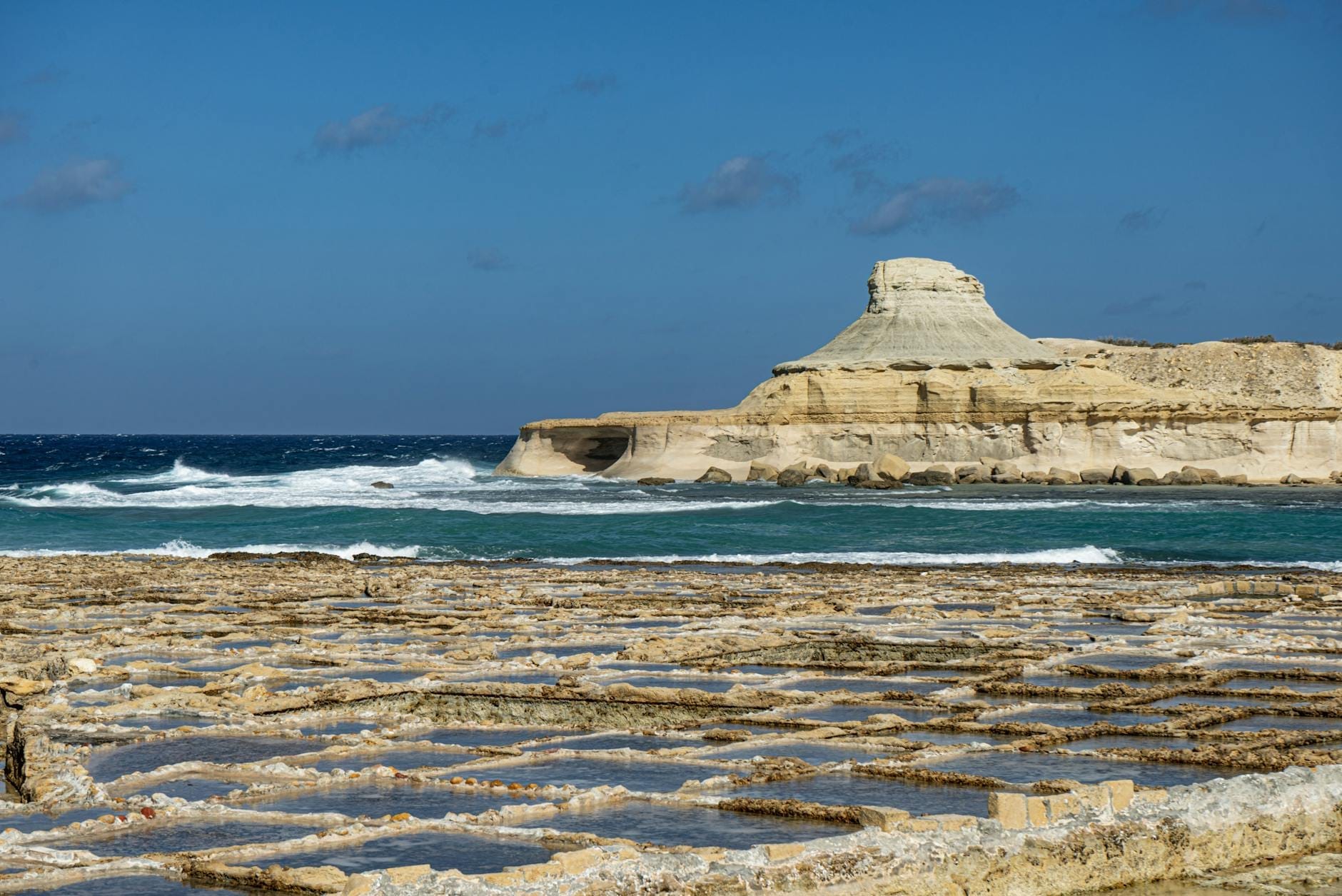
The Xwejni Salt Pans sit along a roughly 3km stretch of Gozo's northern coastline, cut directly into the flat limestone shelves that meet the sea. From a distance, the effect is almost abstract: hundreds of shallow rectangular pools arranged in a chequerboard grid, reflecting sky and cloud, gleaming white with dried salt crust or rippling with trapped seawater depending on the season. Up close, the scale becomes personal. The pans are small, precisely edged, and clearly hand-made, worn smooth by generations of use.
There are approximately 300 individual pans in operation here, each one carved from the natural rock by hand. Historians trace salt production on this coastline back to Roman times, though the exact age of the current pans is difficult to pin down. What is documented is that the Cini-Xuereb family, known locally by the affectionate nickname Leli tal-Melh (roughly: Leli of the Salt), has worked this site since the 19th century, passing the practice down across at least five generations. That continuity is rare anywhere in Europe, let alone in a place this small.
ℹ️ Good to know
Salt harvesting runs from mid-May to early September, weather permitting. You can visit the site year-round, but you'll only see active harvesting during hot, dry summer days. Rain disrupts the evaporation process and can stop work entirely.
The Salt-Making Process: How It Actually Works
The technique is straightforward and almost entirely unchanged from how it has been done for generations. Seawater is pumped into the upper pans and left to evaporate under the summer sun, a process that takes roughly seven days under good conditions. As the water reduces, salt crystals form and accumulate on the pan floors. Workers then sweep the salt into piles using wooden tools and collect it into buckets by hand.
No industrial processes, no additives, no shortcuts. The resulting product is unrefined sea salt with a mineral character shaped by the specific chemistry of the water off Gozo's northern coast. Bags of this salt are sold directly from the family's small shop near the pans, and buying a packet is one of the most genuinely useful souvenirs you can take home from Gozo. It costs very little and carries more of the island's character than anything sold in Valletta's souvenir shops.
Tickets & tours
Hand-picked options from our booking partner. Prices are indicative; availability and final rates are confirmed when you complete your booking.
City Sightseeing hop-on hop-off bus tour of Gozo
From 20 €Instant confirmationFree cancellationRoundtrip ferry to Comino Blue Lagoon with Gozo option from Marfa
From 15 €Instant confirmationFree cancellationMalta two islands cruise to Comino and Gozo
From 30 €Instant confirmationFree cancellationRoundtrip ferry to Comino Blue Lagoon with Gozo option from Cirkewwa
From 15 €Instant confirmationFree cancellation
How the Experience Changes Through the Day
Early morning is the most photogenic time to visit. The low sun angles across the limestone and catches the crystalline salt surfaces, producing sharp contrasts between white deposits, pale rock, and the dark blue of the sea beyond. The air smells of salt and brine, clean rather than heavy. At this hour, the pans are often still and quiet, with only the sound of water moving in the lower pools and occasional seabirds.
By late morning in summer, you may find a family member working the pans, sweeping or collecting salt. This is when the site shifts from scenic to genuinely interesting. Watching the harvesting process takes only a few minutes to understand but leaves a strong impression precisely because it is so unhurried and manual. There is no performance for visitors. The work continues whether anyone is watching or not.
Midday in July and August brings direct heat off both the rock and the water. The limestone absorbs and radiates heat intensely, so if you plan a summer visit, morning or late afternoon is significantly more comfortable. Bring water. The coastline here offers no shade.
In winter, the pans are empty and dry, the salt washed away by autumn storms. The landscape becomes starker: bare limestone, green-grey sea, occasionally dramatic wave action against the rock shelf. Fewer tourists visit in the off-season, and the site feels genuinely remote. It is worth the walk even then.
Getting There and Getting Around
The most practical approach is to base yourself in Marsalforn, Gozo's main northern resort village, and walk the coastal path west along Xwejni Bay. The walk takes around 20 minutes at an easy pace and follows the shoreline closely, with the pans coming into view gradually as you round the bay. Marsalforn itself is easily reached from Victoria (Rabat), Gozo's main town, by local bus or taxi. If you are coming from Malta, you will need to take the ferry from Cirkewwa to Mġarr Harbour and travel from there. For more detail on ferry logistics and bus connections, the Gozo travel guide covers the full journey.
Quad bike and jeep tours from Victoria frequently include the salt pans as a stop, which works well if you want to cover more of northern Gozo in a single outing. Boat excursions from Mġarr Harbour sometimes pass Xwejni Bay, though they rarely stop long enough for a proper visit on foot.
⚠️ What to skip
The terrain along the salt pans is uneven rock with no formal paths between the individual pans. Wheelchair access is not possible. Visitors with limited mobility can observe the pans from the road-side edge, but moving closer requires navigating rough limestone steps and ledges.
Photography: What Works Here
The Xwejni Salt Pans are one of the most photographed landscapes in Gozo, and it is easy to see why. The geometry of the pans, the reflections of sky in the water-filled sections, and the contrast between white salt and dark rock create naturally strong compositions without much effort. That said, most visitor photos look the same because most people shoot at the same angle from the road.
For something different, get low and shoot across the pan surfaces toward the sea. During harvest season, include the salt piles in the foreground with the open water beyond. Early morning light produces the cleanest results. Polarising filters are very effective here, cutting glare off the water surfaces and deepening the blue of the sky.
Drone photography is subject to Maltese Civil Aviation Authority regulations and may require a permit depending on your equipment and the zone category. Check before flying.
Cultural and Ecological Significance
The Xwejni pans are recognised by MedWet (the Mediterranean Wetlands Initiative) as an example of traditional Mediterranean salinas, a category of landscape that has declined sharply across Southern Europe as industrial salt production replaced artisanal methods. That this site remains active and family-operated makes it unusual rather than simply old. The salt pans also form a small but distinct coastal habitat, attracting wading birds and invertebrates adapted to hypersaline conditions. Gozo's coastline holds several such micro-environments, and the Dwejra coastline to the west offers a contrasting perspective on how dramatically the island's geology shifts within a short distance.
The broader cultural context matters here too. Salt was historically one of Malta's most significant exports, and the islands' salt pans once numbered in the thousands across both Malta and Gozo. Most were abandoned during the twentieth century. Xwejni's survival is partly economic, partly stubborn, and the family's continued operation keeps a practice alive that would otherwise exist only in photographs. If you want to understand more of the layered history these islands carry, the history of the Knights of Malta gives essential context for the period during which salt trade was most economically significant.
Honest Assessment: Who Will Love This and Who Won't
The Xwejni Salt Pans reward curiosity and patience. If you find slow, handmade processes interesting, if you respond to industrial archaeology or traditional landscapes, or if you simply enjoy walking a coastline that has not been developed for tourism, this site will feel genuinely worthwhile. The combination of striking scenery, active cultural practice, and free access makes it one of the most satisfying stops on Gozo.
Visitors looking for a dramatic experience, a beach, or an attraction with facilities should manage expectations. There are no toilets, no cafe, and no information panels on site. The pans are not a spectacle in the conventional sense. They are quiet, functional, and best appreciated by those willing to look closely. Travelers who want beaches close by should note that Ramla Bay, Gozo's finest sandy beach, is a short drive away and makes a natural pairing for a half-day itinerary on the northern coast.
Children generally respond well to the tactile aspect if they visit during harvesting season and can see the salt up close, but there is little to engage them beyond that. Families with very young children should know the rocky shoreline requires constant supervision near the water's edge.
Insider Tips
- Visit on a weekday morning in July or August if you want to see active salt harvesting. Weekend mornings can get busy with day-trippers from Malta, and the working pace of the site is better appreciated with fewer people around.
- Buy salt directly from the family shop near the pans. The unrefined sea salt is sold at fair prices and comes with occasional conversation from whoever is staffing the stall. It is a different product from commercial sea salt and genuinely good for cooking.
- The coastal path continues west past the pans toward Qbajjar and connects with the broader northern coastal walk. If your legs are willing, extending the walk adds context and keeps you away from road traffic.
- Bring a polarising filter if you shoot with an interchangeable-lens camera. The glare off wet limestone and shallow water is intense from mid-morning onward, and a polariser transforms what would be washed-out images into sharp, colour-rich shots.
- Come back at sunset if you visited in the morning. The light on the pans at golden hour is completely different and often more dramatic, especially in late summer when the salt has accumulated to its maximum depth.
Who Is Xwejni Salt Pans For?
- Photography enthusiasts drawn to geometric landscapes and natural textures
- Travellers interested in traditional crafts, food production, and living cultural heritage
- Walkers exploring Gozo's northern coastline on foot
- Slow travellers who prefer authentic, uncommercialized experiences over organised attractions
- Anyone building a half-day itinerary around Marsalforn and the northern coast
Nearby Attractions
Other things to see while in Gozo:
- Citadella (Victoria)
Rising from a rocky promontory above Victoria, the Citadella is Gozo's most significant historical site. Inside its 17th-century bastions you'll find a cathedral with a famous trompe-l'oeil ceiling, small but thoughtful museums, and panoramic views stretching across the entire island. It rewards a half-day of exploration.
- Dwejra & Blue Hole
Dwejra on Gozo's west coast is the site of the Blue Hole, a natural limestone sinkhole that funnels divers into one of the Mediterranean's most celebrated underwater landscapes. Above water, the Inland Sea, surrounding cliffs, and the rubble of the lost Azure Window make this one of the most geologically dramatic corners of Malta.
- Ġgantija Temples
Standing on the Xagħra plateau in Gozo, the Ġgantija Temples are among the oldest freestanding structures on Earth, predating both Stonehenge and the Egyptian pyramids. This UNESCO World Heritage Site offers a rare encounter with Neolithic craftsmanship on a scale that continues to baffle archaeologists and awe visitors.
- Ramla Bay
Ramla Bay (Ir-Ramla l-Ħamra, meaning 'the red sands') is Gozo's largest and most distinctive beach, stretching 360 metres across the island's north-east coast. Its warm-toned sand, clear Blue Flag water, and surrounding dunes of endemic flora make it unlike anything on the main Malta island.