City Hall Square (Rådhuspladsen): Copenhagen's Civic Heart
Rådhuspladsen is the great open plaza at the centre of Copenhagen — free, open at all hours, and framed by one of Scandinavia's most photogenic town halls. Whether you arrive at rush hour or midnight, the square reads the mood of the city back to you.
Quick Facts
- Location
- Rådhuspladsen 1, 1599 København V, Indre By, Copenhagen
- Getting There
- Metro: Rådhuspladsen station; multiple bus lines nearby
- Time Needed
- 15–45 minutes to pass through; longer during events
- Cost
- Free — the square is a public space with no admission fee
- Best for
- First-time visitors, architecture, people-watching, orientation
What Is Rådhuspladsen?
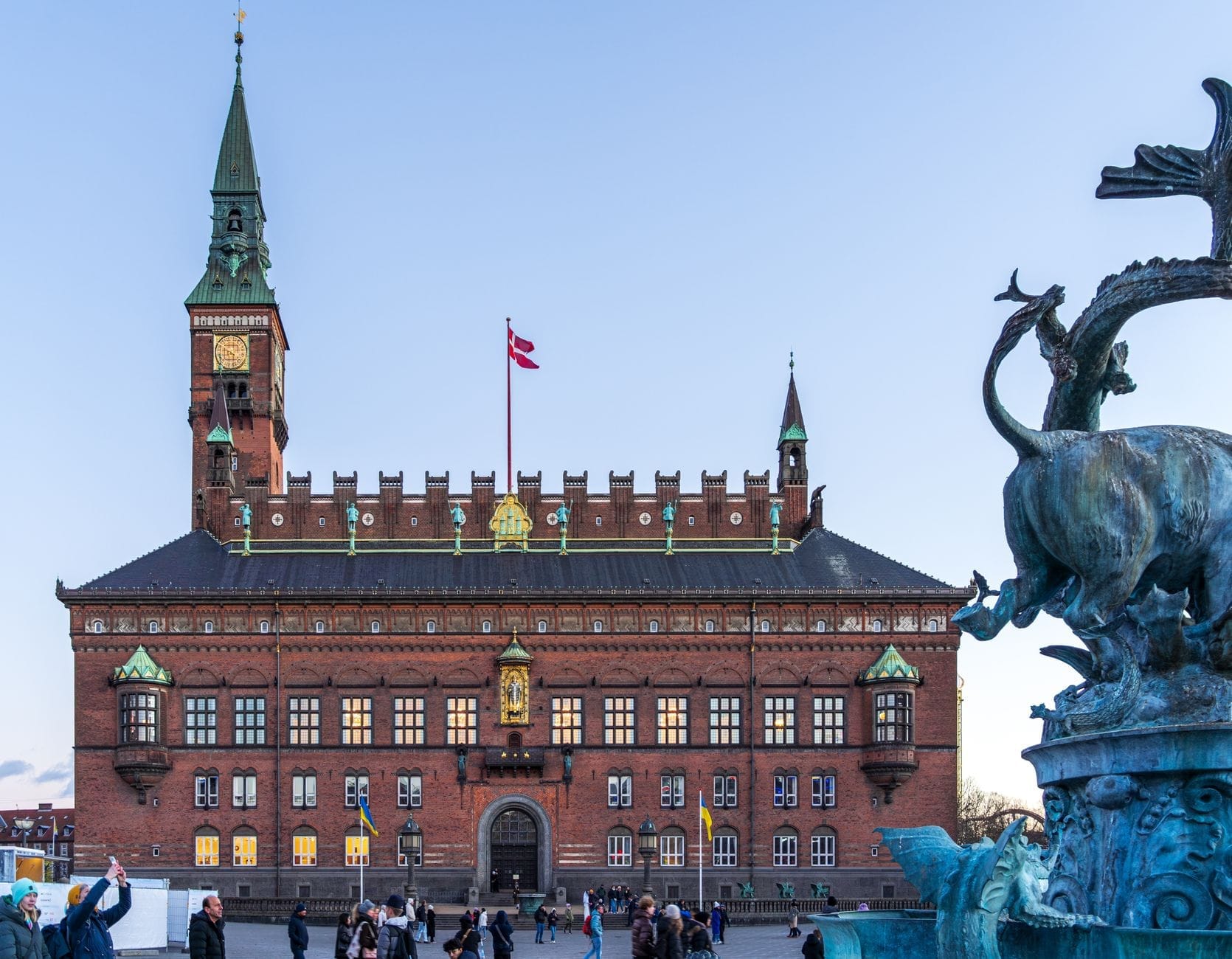
City Hall Square, known in Danish as Rådhuspladsen, is the civic centre of Copenhagen. Covering roughly 9,800 square metres, it is a large, open urban plaza framed on its eastern side by the red-brick Copenhagen City Hall, and anchored to the rest of the city by the southwestern entrance to Strøget, Denmark's famous pedestrianised shopping street. Covering roughly 9,800 square metres, it is a large, open urban plaza framed on its eastern side by the red-brick Copenhagen City Hall, and anchored to the rest of the city by the southwestern entrance to Strøget, Denmark's famous pedestrianised shopping street. It is not a park, not a museum, not a ticketed attraction — it is simply a great public square that the city flows through and gathers around.
Visitors using the Strøget shopping street will pass through here naturally, as will anyone arriving on the Metro or transferring between bus lines. That makes Rådhuspladsen less a destination in its own right and more the square you will return to again and again during any stay in central Copenhagen.
ℹ️ Good to know
City Hall Square is open 24 hours a day, 7 days a week. There is no admission charge. The Metro station directly beneath the square makes it one of the easiest points in Copenhagen to reach by public transport.
The Architecture: Copenhagen City Hall
The building that dominates the square is Copenhagen City Hall (Københavns Rådhus), completed in 1905 and designed by architect Martin Nyrop in the National Romantic style. Nyrop drew inspiration from the medieval town halls of northern Italy and Scandinavian vernacular brick-building traditions, producing a building that is at once grand and grounded. The facade is dark red brick with elaborate terracotta detailing, and the tall clock tower rises to approximately 105.6 metres, making it one of the tallest points in the city centre.
The gilded statue above the main entrance is of Bishop Absalon, the 12th-century founder of Copenhagen, and along the facade you will find a decorative programme that rewards close looking: carved figures, ornate ironwork, and stonework that shifts tone depending on the light and season. In winter, the brick absorbs the flat grey sky and looks almost severe. In summer afternoon light, it turns a warm amber that makes the building photograph beautifully from the square's open centre.
The City Hall itself has guided tours and a tower climb available on selected days — worth considering if you want an elevated view of the city that differs from the Round Tower experience. Check the City Hall's own schedule before visiting, as tour availability varies.
Tickets & tours
Hand-picked options from our booking partner. Prices are indicative; availability and final rates are confirmed when you complete your booking.
Escape Tour self-guided, interactive city challenge in Copenhagen
From 30 €Instant confirmationEscape Tour self-guided, interactive city challenge in Copenhagen
From 30 €Instant confirmationEnter the city hall and discover the old town
From 37 €Instant confirmationFree cancellation1-hour boat harbour tour in Copenhagen
From 26 €Instant confirmationFree cancellation
How the Square Changes Through the Day
Early morning, before 8am, Rådhuspladsen belongs mostly to commuters and delivery vehicles. The bus stop infrastructure on the square's northern edge becomes a hive of transit activity, and coffee cups appear in the hands of people moving briskly toward offices. The square itself feels disproportionately large at this hour — all that open stone and sky with only a fraction of the crowds it will hold by midday.
By late morning, tourists have arrived. Guided walking tour groups congregate near the City Hall steps. Street vendors and flower sellers set up near the square's edges. The noise level rises with the number of languages being spoken, and the wide central expanse fills with people pausing to photograph the City Hall, consult maps, or work out which direction Tivoli lies (To the south, across H.C. Andersens Boulevard, lies Tivoli Gardens, with its main entrance on Vesterbrogade.).
Evenings bring a different quality altogether. In summer, the long Scandinavian dusk keeps the sky light until nearly 10pm, and the square becomes a staging point for people heading out to eat or drink in the neighbourhoods beyond. In winter, strings of lights and occasional market stalls transform it into something considerably warmer in atmosphere than the bare stone might suggest. The City Hall's illuminated tower is visible from a wide arc of the surrounding streets, and it reads clearly against a dark sky.
💡 Local tip
For the best photographs of the City Hall, come between 4pm and 7pm on a clear day in late spring or summer. The low-angle afternoon light hits the brick facade directly and removes the flat, washed-out quality you get at midday.
History of the Square
The site now occupied by Rådhuspladsen was for centuries a hay market on the western edge of Copenhagen's medieval city. As the city expanded through the 18th and 19th centuries, the area was gradually formalised, and the square we see today has taken its current broad shape through multiple redesigns. The most recent significant reconfiguration was completed in 1995–1996, which produced the current open, largely uncluttered layout with its distinctive stone paving.
Throughout the 20th century, the square became Copenhagen's default venue for major civic events: celebrations at the end of World War II, New Year gatherings, football championship celebrations, political demonstrations, and public concerts. That role continues. On significant national occasions, tens of thousands of people fill a space that on an ordinary Tuesday holds a few hundred. Knowing that history makes the square read differently — the openness is not accidental; it is designed for assembly.
The Surrounding Area and What to Do Nearby
Rådhuspladsen sits at the intersection of several of Copenhagen's most important pedestrian and tourist routes. To the east, Strøget begins immediately at the square's edge — stretching roughly 1.1 kilometres to Kongens Nytorv and passing through the Indre By shopping district the entire way. To the south, across H.C. Andersens Boulevard, lies the main entrance to Tivoli Gardens.
A short walk north brings you to the Ny Carlsberg Glyptotek, one of Copenhagen's finest art museums, housed in a building that is architecturally impressive in its own right. The museum's winter garden and Impressionist collection are consistently among the most rewarding museum hours you can spend in the city.
If you are exploring on foot and want to understand how Rådhuspladsen connects to the city's broader historic centre, the Copenhagen walking tour guide maps the most logical route from the square outward — including the lake system, the Latin Quarter, and the canal district.
Practical Notes for Visitors
The square is fully accessible as a flat, open stone plaza. There are no kerbs or barriers in the central area, and the Metro station beneath provides step-assisted transit access. The bus stop infrastructure on the northern side is served by numerous lines, making this one of the most connected points in Copenhagen for onward travel to any part of the city.
Weather has a real effect on the experience here. Rådhuspladsen is completely exposed — no shade trees, no shelter from wind. In midsummer heat it can feel relentlessly bright and dry. In a February northerly, crossing it without a proper coat is a mistake. The most comfortable seasons for lingering are May, June, and early September, when temperatures sit in a range that makes open plazas pleasant rather than punishing.
The square is included as part of most standard city overview routes. If you are working with the Copenhagen Card, note that transit to and from Rådhuspladsen is covered, and several nearby paid attractions can be accessed with the card. The Copenhagen Card guide covers which attractions are worth the pass and which are not.
⚠️ What to skip
During major events — national sports celebrations, New Year's Eve, summer concerts — the square can become extremely crowded and difficult to navigate. If you are not there for the event, avoid the area entirely and use parallel streets to move between districts.
Insider Tips
- The Jens Olsen World Clock inside Copenhagen City Hall displays astronomical cycles across 14 dials. It is viewable for a small fee. Most visitors never know it exists because the entrance is understated — ask at the City Hall reception.
- The square's northern bus stops are the most central in Copenhagen's surface network. If you are trying to reach a neighbourhood not directly served by Metro, starting here gives you more route options than almost any other point in the city.
- Tivoli Gardens is literally across the road from the square's southern edge, but the main entrance is set back slightly on Vesterbrogade. First-time visitors sometimes walk past it. Look for the wooden tower visible above the tree line.
- For a less-photographed angle of the City Hall, walk around to its side and rear on Vester Voldgade. The scale of the building becomes clearer from there, and you avoid the tour group congestion at the front steps.
- If you are visiting in late November or December, the square hosts one of Copenhagen's Christmas market setups. It is smaller and more commercial than the Tivoli equivalent, but free to enter and centrally located.
Who Is City Hall Square (Rådhuspladsen) For?
- First-time visitors using it as an orientation point before exploring the city
- Architecture enthusiasts interested in National Romantic Scandinavian civic buildings
- Travellers passing between Tivoli, Strøget, and the museum quarter on foot
- People-watchers who want a central vantage point without paying for a café seat
- Visitors during major civic events or national celebrations
Nearby Attractions
Other things to see while in Indre By (Old Town):
- Amalienborg Palace
Amalienborg is the official home of the Danish royal family and one of Copenhagen's most architecturally coherent ensembles. Four near-identical Rococo palaces frame a grand octagonal square, with the Amalienborg Museum open to visitors inside Christian VIII's Palace. The daily changing of the guard at noon is a punctual, unhurried ceremony worth timing your visit around.
- The Black Diamond
The Black Diamond is the modern extension of the Royal Danish Library, clad in polished black granite and angled toward the harbour on Slotsholmen. Entry is free, the atrium is genuinely impressive, and the building rewards visitors who take time to understand what they are looking at.
- Botanical Garden of the University of Copenhagen
Tucked behind Nørreport Station in the heart of the city, the Copenhagen University Botanical Garden is a 10-hectare green sanctuary with a Victorian glasshouse complex, a tranquil lake, and around 8,000 plant species. Entry to the grounds is free, making it one of the most rewarding stops in central Copenhagen for any pace of traveler.
- Christiansborg Palace
Christiansborg Palace sits on the Slotsholmen islet in central Copenhagen, serving simultaneously as the home of the Danish Parliament, the Supreme Court, the Prime Minister's Office, and the Royal Reception Rooms. It is widely described as uniquely housing all three branches of Denmark’s national government under one roof, and its 106-metre tower offers one of the best free panoramic views in the city.