The Round Tower (Rundetårn): Copenhagen's 17th-Century Observatory with the Best View in the Old City
Built for King Christian IV between 1637 and 1642, the Round Tower (Rundetårn) is often described as Europe's oldest functioning observatory building. Its defining feature is a wide spiral ramp rather than stairs, designed originally for horse-drawn carts. From the open rooftop platform, the view over Copenhagen's historic core is wide, unhurried, and genuinely worth the 60 DKK admission.
Quick Facts
- Location
- Købmagergade 52A, Indre By, Copenhagen
- Getting There
- Nørreport Station (Metro/S-train, approx. 5-min walk); buses 5C, 14, 66 nearby
- Time Needed
- 45–75 minutes
- Cost
- Adults 60 DKK; Students 40 DKK; Children 0–17 free
- Best for
- Rooftop views, 17th-century history, families, architecture lovers
- Official website
- www.rundetaarn.dk/en/front-page
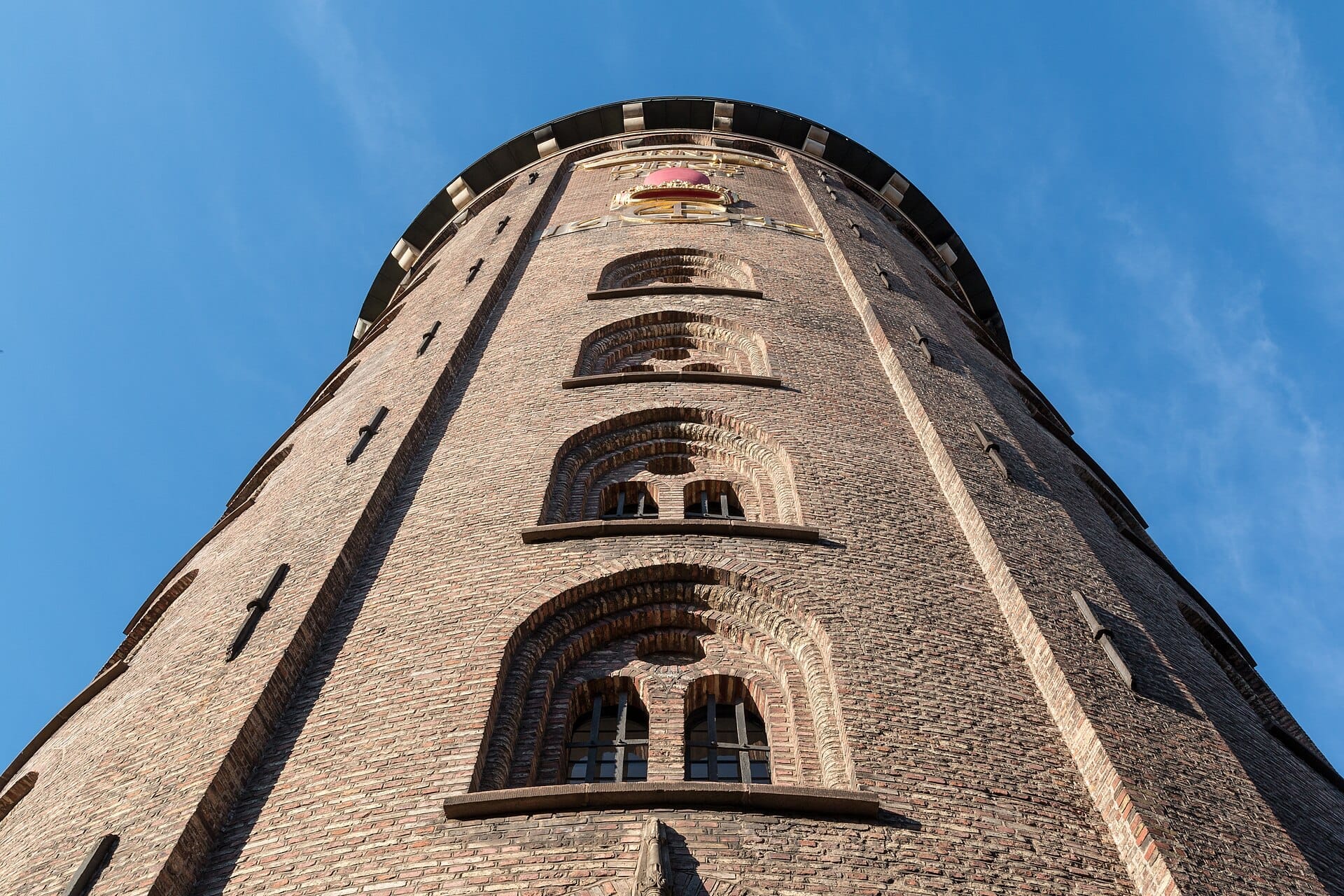
What the Round Tower Actually Is
The Round Tower (Rundetårn) is a 17th-century cylindrical tower standing at Købmagergade 52A in Indre By, Copenhagen's historic city centre. It was built as part of the Trinitatis Complex, a project commissioned by King Christian IV that combined a church, a university library, and a rooftop observatory into a single urban complex. Construction ran from 1637 to 1642, and the tower has been in near-continuous use ever since. It is often described as Europe's oldest functioning observatory building.
What sets the Round Tower apart from other historic towers in northern Europe is not just its age but its internal structure. Instead of a staircase, the tower is ascended via a continuous spiral ramp, 7.5 turns of a wide brick-paved helical passage that rises gradually from ground level to the viewing platform. The ramp was designed to allow horse-drawn carts to haul heavy astronomical equipment to the observatory at the top. Whether or not horses ever actually made the full trip is debated, but the architectural ambition behind the design is not.
ℹ️ Good to know
Opening hours vary by season. April 1 to September 30: daily 10:00–20:00. October 1 to March 31: daily 10:00–18:00. Closed 24–25 December and 31 December from 15:00; always confirm on the official website before visiting.
The Ascent: What to Expect on the Ramp
The ramp is the experience. From the moment you step inside, the tower reveals its scale in a way that photographs don't prepare you for. The passage is wide enough that two people can walk side by side comfortably, and the brick underfoot has the worn, uneven texture of centuries of use. Light filters in through narrow windows as you rise, and the walls have a cool, slightly damp stone smell even in summer.
The gradient is gentle, but the total distance is longer than most visitors expect. Families with young children find the ramp a positive feature: no steep steps to worry about. Older visitors and those with moderate mobility limitations can usually manage it, but there is no elevator, and the descent on the same ramp can feel harder on the knees than the ascent. People who use wheelchairs or have significant mobility restrictions should note that the tower's official sources do not indicate accessible alternatives to the ramp.
Partway up, a glass floor panel in the centre of the ramp allows you to look straight down approximately 25 meters to the ground floor below. It stops most people mid-stride. Children tend to love it; some adults step around it quickly. Either way, it breaks up the climb and gives a useful sense of how high you've already come.
💡 Local tip
Wear comfortable, flat shoes. The brick ramp surface is uneven in places and can be slippery when the tower is busy and the air is humid. Avoid hard-soled dress shoes.
Tickets & tours
Hand-picked options from our booking partner. Prices are indicative; availability and final rates are confirmed when you complete your booking.
Full-day tour to Forest Tower and Forgotten Giants from Copenhagen
From 110 €Instant confirmationFree cancellationFull-day trip around Copenhagen
From 108 €Instant confirmationFree cancellationFull-day tour to Mons Klint and The Forest tower from Copenhagen
From 187 €Instant confirmationFree cancellation1-hour boat harbour tour in Copenhagen
From 26 €Instant confirmationFree cancellation
The View from the Top
The rooftop platform is open-air and circular, ringed by a low metal railing. The view is not Copenhagen's highest, but it is arguably the most contextually rewarding: you are looking out from inside the old city rather than from a modern tower on its edge. On a clear day you can trace the copper-green spire of the Church of Our Saviour across the water in Christianshavn, spot the Frederiks Church dome in the Frederiksstaden quarter, and see the roofline of Rosenborg Castle a few blocks north.
Morning visits, roughly 10:00 to 11:30, offer the clearest light for photography, especially in summer when the sun rises early and comes from the east at a low angle that catches the city's older rooftops cleanly. Late afternoon in summer produces warmer tones, but the platform is also at its busiest then, typically 14:00 to 17:00. If you visit on a Tuesday or Wednesday evening in the October to March period, the extended 21:00 closing allows for a night view of the city, which is a different experience entirely: the canal streets below glow from streetlights, and the density of the old quarter is more apparent in the dark.
The rooftop is exposed to Copenhagen's maritime weather. Wind on the platform is consistent and often stronger than it feels at street level. A light jacket is advisable even on warm summer days, and in autumn and early spring the wind can be genuinely cold. For context on how weather affects outdoor experiences across the city, the best time to visit Copenhagen guide covers seasonal conditions in detail.
Historical and Cultural Context
Christian IV is one of the most architecturally ambitious monarchs in Danish history, and the Round Tower is among his most distinctive commissions. The king intended the Trinitatis Complex to serve the University of Copenhagen, giving students access to a library and professors access to an observatory, all anchored by a church. The tower's observatory functioned as a working scientific instrument for astronomers into the 19th century, when modern observatories eventually superseded it.
The observatory is expected to reopen after restoration in 2026, with certain evenings offering public stargazing sessions that are separately scheduled and announced on the official website. If you have any interest in the history of astronomy in northern Europe, the tower qualifies as a genuinely significant site; it is included in UNESCO’s Astronomy and World Heritage programme, though it is not itself a World Heritage Site.
The tower sits at the northern end of Strøget, Copenhagen's main pedestrian shopping corridor, and is surrounded by the dense street grid of Indre By. Exploring the surrounding blocks after your visit is straightforward, and Strøget connects the area directly to City Hall Square to the south and Kongens Nytorv to the east. The neighbourhood has been a centre of Copenhagen life since the medieval period.
Practical Walkthrough: Getting There and Making the Most of It
The most convenient transit option is Nørreport Station, served by both the Metro and S-train lines. From there, Rundetårn is a five-minute walk south along Fiolstræde or Landemærket. Bus lines 5C and 14 also stop in the immediate area. Walking from Nyhavn takes roughly 12 to 15 minutes through Indre By's compact streets.
Admission at the door is 60 DKK for adults, 40 DKK for students, and free for children under 18. The Round Tower is not included on the Copenhagen Card (as of April 2024). Tickets are purchased at the entrance; the process is quick and there is rarely a long queue to buy tickets, though the ramp itself can feel congested when a large group is ahead of you.
Budget 45 to 75 minutes total: the ramp takes 10 to 15 minutes at a relaxed pace, the rooftop visit typically runs 15 to 25 minutes depending on weather and how long you want to stay, and the descent is faster than the ascent. If you stop to read the interpretive panels about the tower's history on the way up, add another 10 minutes.
💡 Local tip
Arrive within the first hour of opening (around 10:00–11:00) to have the rooftop largely to yourself. By midday, school groups and tour parties can make the ramp feel narrow and the platform crowded.
Who This Attraction Suits, and Who It Doesn't
The Round Tower works particularly well for visitors who want a historically grounded viewpoint rather than a purely scenic one. The climb itself is the narrative: you are walking the same ramp that astronomers, students, and kings used for centuries, and that context makes the view more interesting than it would be from a generic observation deck.
Families with children generally have a positive experience here. The ramp removes the danger and anxiety of steep stairs, the glass floor panel is a guaranteed talking point, and the 45-minute total time keeps young attention spans engaged. The Copenhagen with kids guide lists the Round Tower as one of the more child-friendly historic attractions in the city centre.
The tower is less suited to visitors whose primary goal is the highest possible vantage point over Copenhagen. For that purpose, other options may offer more elevation. The Round Tower's platform sits well above street level but is not a skyscraper observation deck, and the view, while genuinely good, is partly framed by surrounding buildings. Similarly, visitors with significant mobility restrictions should check accessibility details directly with the tower before visiting, as the ramp without an elevator alternative may not be manageable for everyone.
If you are combining the Round Tower with a broader walk through Indre By, the Rosenborg Castle and its surrounding gardens are a 10-minute walk north and pair well as a half-day itinerary in the historic centre.
Insider Tips
- If special evening openings are scheduled in winter, they can be a less crowded time to visit, with thinner crowds after regular daytime hours and a beautifully illuminated city view from the platform—check the official website for current late-opening days.
- Look up at the ceiling of the ramp as you ascend: the brickwork changes character at different levels, and the acoustic quality of the space shifts noticeably as you gain height. Most visitors walk with their eyes forward.
- The glass floor panel in the centre of the ramp is the natural photography stop, but a better and less photographed shot is from the ramp looking up through the open central shaft toward the observatory room above.
- If stargazing sessions are scheduled during your visit dates, check the official website well in advance. These are separate ticketed events and fill up. They are held in the observatory room above the main ramp terminus.
- Torvehallerne market is a 3-minute walk from Nørreport Station. Combining a morning visit to the Round Tower with a meal at Torvehallerne makes an efficient and enjoyable half-day without backtracking.
Who Is The Round Tower (Rundetårn) For?
- Travellers who want a historically grounded panoramic view rather than a purely modern observation deck
- Families with children, thanks to the ramp access and the glass floor feature
- Architecture and design enthusiasts interested in 17th-century Danish royal construction
- Astronomy history buffs, given the tower's UNESCO recognition and working observatory
- First-time visitors to Copenhagen wanting a single landmark that efficiently combines history, architecture, and a city overview
Nearby Attractions
Other things to see while in Indre By (Old Town):
- Amalienborg Palace
Amalienborg is the official home of the Danish royal family and one of Copenhagen's most architecturally coherent ensembles. Four near-identical Rococo palaces frame a grand octagonal square, with the Amalienborg Museum open to visitors inside Christian VIII's Palace. The daily changing of the guard at noon is a punctual, unhurried ceremony worth timing your visit around.
- The Black Diamond
The Black Diamond is the modern extension of the Royal Danish Library, clad in polished black granite and angled toward the harbour on Slotsholmen. Entry is free, the atrium is genuinely impressive, and the building rewards visitors who take time to understand what they are looking at.
- Botanical Garden of the University of Copenhagen
Tucked behind Nørreport Station in the heart of the city, the Copenhagen University Botanical Garden is a 10-hectare green sanctuary with a Victorian glasshouse complex, a tranquil lake, and around 8,000 plant species. Entry to the grounds is free, making it one of the most rewarding stops in central Copenhagen for any pace of traveler.
- Christiansborg Palace
Christiansborg Palace sits on the Slotsholmen islet in central Copenhagen, serving simultaneously as the home of the Danish Parliament, the Supreme Court, the Prime Minister's Office, and the Royal Reception Rooms. It is widely described as uniquely housing all three branches of Denmark’s national government under one roof, and its 106-metre tower offers one of the best free panoramic views in the city.